Page Rank Algorithm in Data Mining and Web Application.pdf
1.
Page Rank Algorithm
•Page rank is a “vote”, by all the other pages on the web, about how important a page is.
• A link to a page counts as a vote of support.
• The original page rank algorithm was designed by Lawrence Page and Sergey Brin.
• The original page rank formula with summation:
PR(A) = (1-d) + d (
𝑃𝑅(𝑇1)
𝐶(𝑇1)
+
𝑃𝑅(𝑇2)
𝐶(𝑇2)
+ … … … … . . +
𝑃𝑅(𝑇𝑛)
𝐶(𝑇𝑛)
)
PR(A) - page rank of page A
PR(T1) - page rank of pages T1 which link to page A
C(T1) – number of outbounds link on a given T1 page
d – damping factor in the range 0 and 1
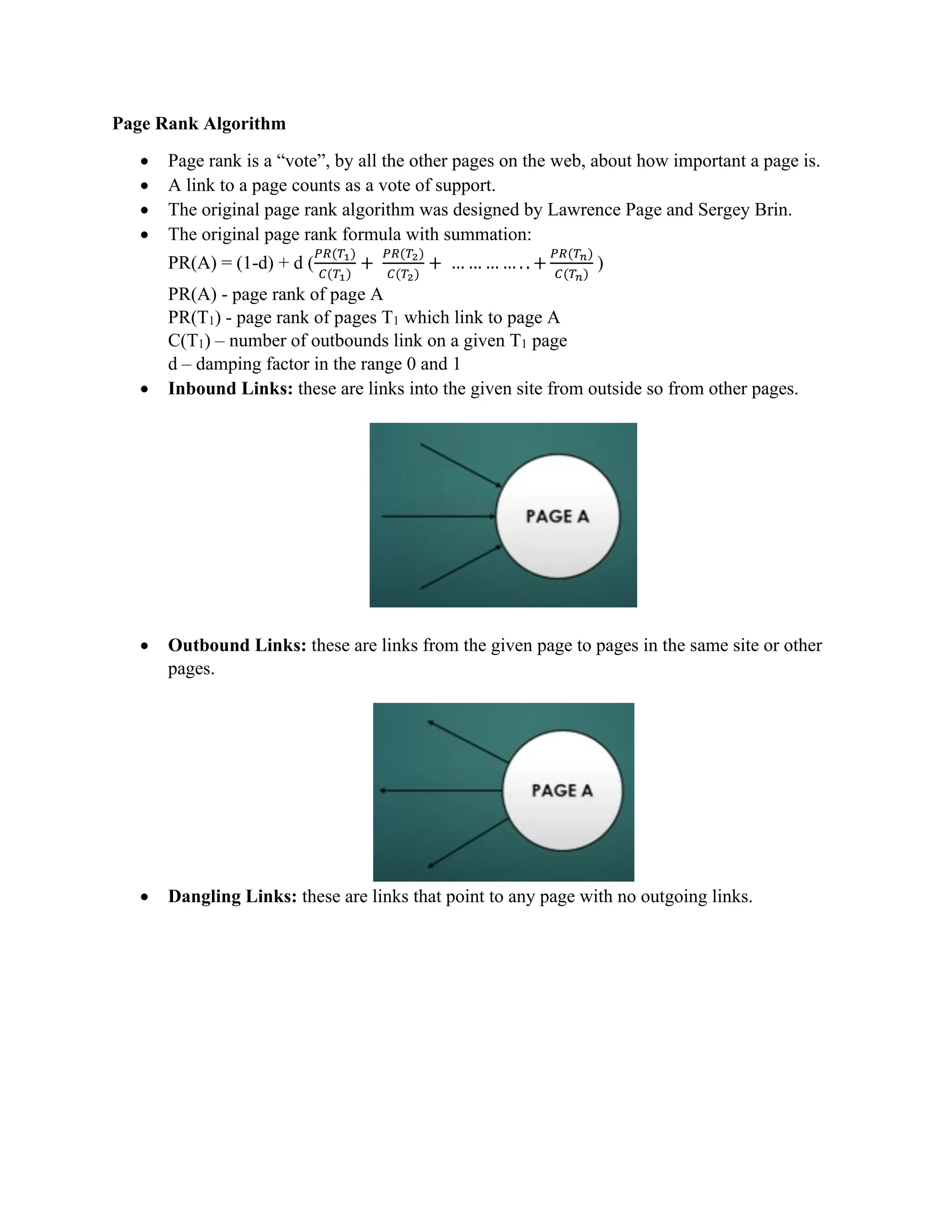
• Inbound Links: these are links into the given site from outside so from other pages.
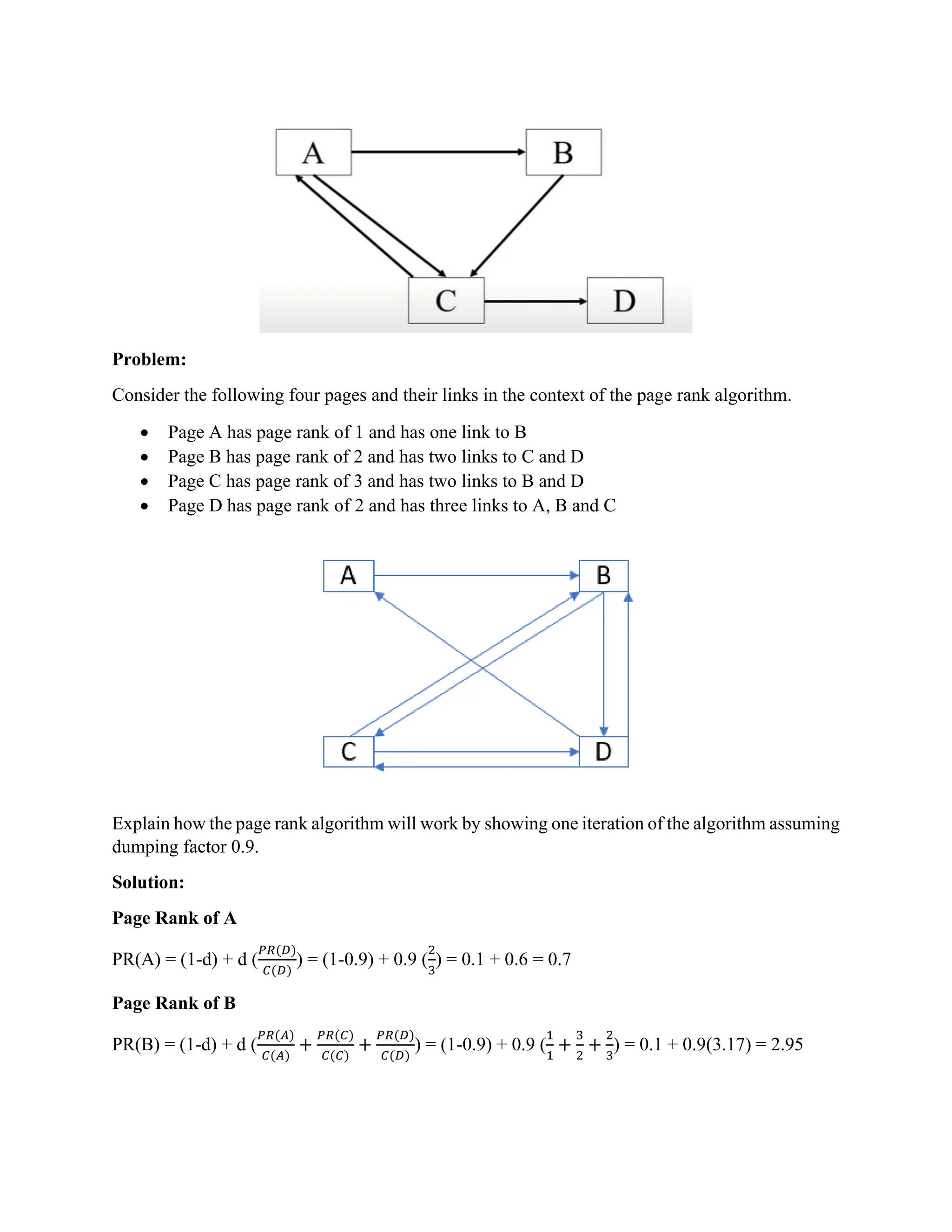
• Outbound Links: these are links from the given page to pages in the same site or other
pages.
• Dangling Links: these are links that point to any page with no outgoing links.
2.
Problem:
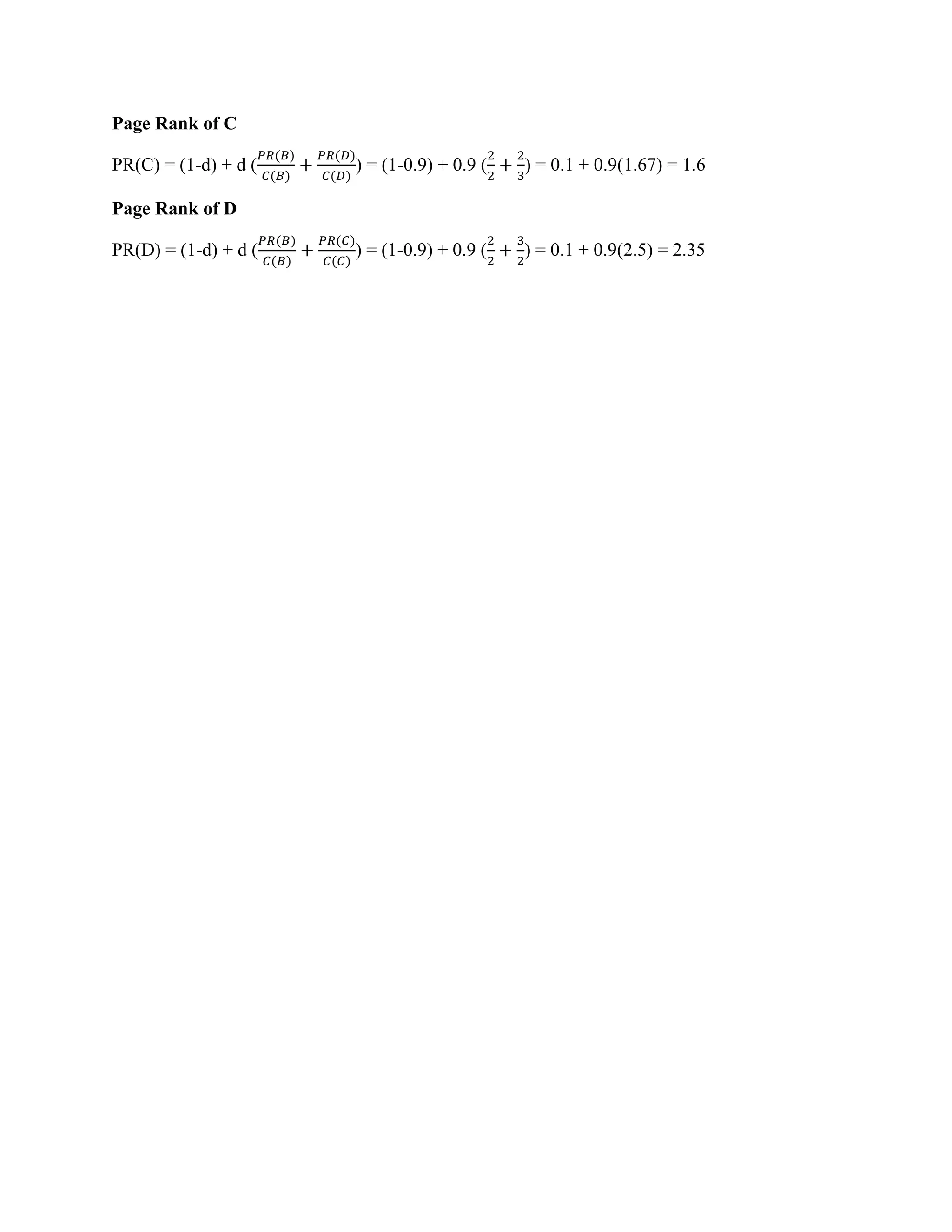
Consider the followingfour pages and their links in the context of the page rank algorithm.
• Page A has page rank of 1 and has one link to B
• Page B has page rank of 2 and has two links to C and D
• Page C has page rank of 3 and has two links to B and D
• Page D has page rank of 2 and has three links to A, B and C
Explain how the page rank algorithm will work by showing one iteration of the algorithm assuming
dumping factor 0.9.
Solution:
Page Rank of A
PR(A) = (1-d) + d (
𝑃𝑅(𝐷)
𝐶(𝐷)
) = (1-0.9) + 0.9 (
2
3
) = 0.1 + 0.6 = 0.7
Page Rank of B
PR(B) = (1-d) + d (
𝑃𝑅(𝐴)
𝐶(𝐴)
+
𝑃𝑅(𝐶)
𝐶(𝐶)
+
𝑃𝑅(𝐷)
𝐶(𝐷)
) = (1-0.9) + 0.9 (
1
1
+
3
2
+
2
3
) = 0.1 + 0.9(3.17) = 2.95