ANALYSIS OF CLOCKED SEQUENTIAL
CIRCUITS
D.R.V.L.B Thambawita
October 29, 2017
D.R.V.L.B Thambawita ANALYSIS OF CLOCKED SEQUENTIAL CIRCUITS
https://sites.google.com/view/vajira-thambawita/leaning-materials/slides
Introduction
Analysis describes what a given circuit will do under certain
operating conditions. The behavior of a clocked sequential
circuit is determined from the inputs, the outputs, and the
state of its flip-flops.
State Equation
The behavior of a clocked sequential circuit can be described
algebraically by means of state equations. A state equation(also
called a transition equation) specifies the next state as a function
of the present state and inputs.
D.R.V.L.B Thambawita ANALYSIS OF CLOCKED SEQUENTIAL CIRCUITS
Example
D.R.V.L.B Thambawita ANALYSIS OF CLOCKED SEQUENTIAL CIRCUITS
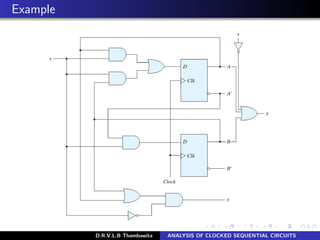
Example: State equations
A(t + 1) = A(t)x(t) + B(t)x(t) (1)
B(t + 1) = A (t)x(t) (2)
Boolean expressions are a function of the present state, we can
omit the designation (t) after each variable for convenience and
can express the state equations in the more compact form:
A(t + 1) = Ax + Bx (3)
B(t + 1) = A x (4)
Similarly, the present-state value of the output can be expressed
algebraically as:
y(t) = [A(t) + B(t)]x (t) (5)
By removing the symbol(t)
y = (A + B)x (6)
D.R.V.L.B Thambawita ANALYSIS OF CLOCKED SEQUENTIAL CIRCUITS
State Table
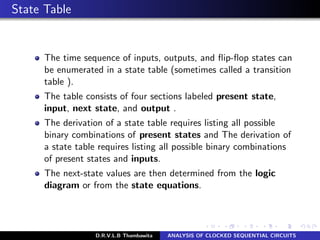
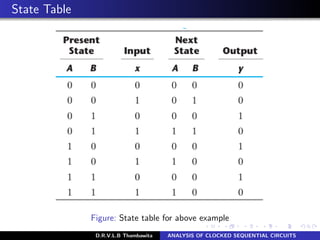
The time sequence of inputs, outputs, and flip-flop states can
be enumerated in a state table (sometimes called a transition
table ).
The table consists of four sections labeled present state,
input, next state, and output .
The derivation of a state table requires listing all possible
binary combinations of present states and The derivation of
a state table requires listing all possible binary combinations
of present states and inputs.
The next-state values are then determined from the logic
diagram or from the state equations.
D.R.V.L.B Thambawita ANALYSIS OF CLOCKED SEQUENTIAL CIRCUITS
State Table
Figure: State table for above example
D.R.V.L.B Thambawita ANALYSIS OF CLOCKED SEQUENTIAL CIRCUITS
State Table
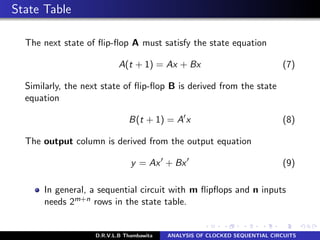
The next state of flip-flop A must satisfy the state equation
A(t + 1) = Ax + Bx (7)
Similarly, the next state of flip-flop B is derived from the state
equation
B(t + 1) = A x (8)
The output column is derived from the output equation
y = Ax + Bx (9)
In general, a sequential circuit with m flipflops and n inputs
needs 2m+n rows in the state table.
D.R.V.L.B Thambawita ANALYSIS OF CLOCKED SEQUENTIAL CIRCUITS
State Table
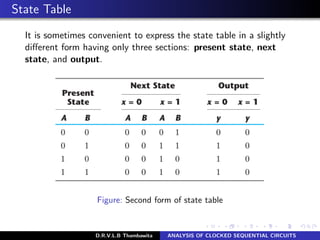
It is sometimes convenient to express the state table in a slightly
different form having only three sections: present state, next
state, and output.
Figure: Second form of state table
D.R.V.L.B Thambawita ANALYSIS OF CLOCKED SEQUENTIAL CIRCUITS
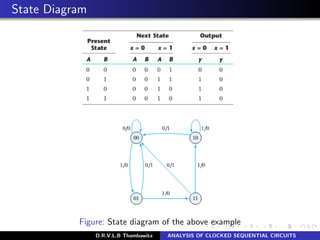
State Diagram
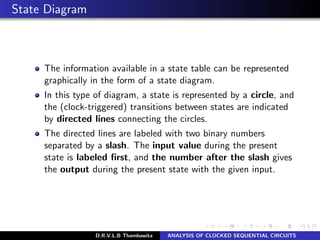
The information available in a state table can be represented
graphically in the form of a state diagram.
In this type of diagram, a state is represented by a circle, and
the (clock-triggered) transitions between states are indicated
by directed lines connecting the circles.
The directed lines are labeled with two binary numbers
separated by a slash. The input value during the present
state is labeled first, and the number after the slash gives
the output during the present state with the given input.
D.R.V.L.B Thambawita ANALYSIS OF CLOCKED SEQUENTIAL CIRCUITS
State Diagram
Figure: State diagram of the above example
D.R.V.L.B Thambawita ANALYSIS OF CLOCKED SEQUENTIAL CIRCUITS
Up to now!
Circuit diagram ⇒ Equations - State table ⇒ State diagram.
This sequence of steps begins with a structural representation
of the circuit and proceeds to an abstract representation of its
behavior.
D.R.V.L.B Thambawita ANALYSIS OF CLOCKED SEQUENTIAL CIRCUITS
Flip-Flop Input Equations
The logic diagram of a sequential circuit consists of flip-flops
and gates.
The knowledge of the type of flip-flops and a list of the
Boolean expressions of the combinational circuit provide the
information needed to draw the logic diagram of the
sequential circuit.
The part of the combinational circuit that generates external
outputs is described algebraically by a set of Boolean
functions called output equations .
The part of the circuit that generates the inputs to flip-flops is
described algebraically by a set of Boolean functions called
flip-flop input equations (or, sometimes, excitation
equations ).
D.R.V.L.B Thambawita ANALYSIS OF CLOCKED SEQUENTIAL CIRCUITS
Flip-Flop Input Equations
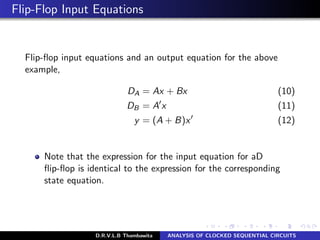
Flip-flop input equations and an output equation for the above
example,
DA = Ax + Bx (10)
DB = A x (11)
y = (A + B)x (12)
Note that the expression for the input equation for aD
flip-flop is identical to the expression for the corresponding
state equation.
D.R.V.L.B Thambawita ANALYSIS OF CLOCKED SEQUENTIAL CIRCUITS
Analysis with D Flip-Flops
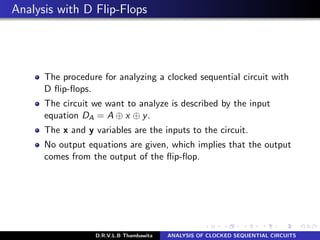
The procedure for analyzing a clocked sequential circuit with
D flip-flops.
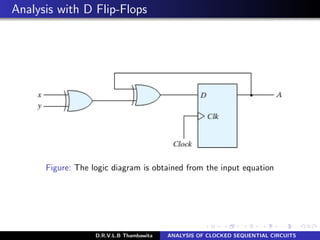
The circuit we want to analyze is described by the input
equation DA = A ⊕ x ⊕ y.
The x and y variables are the inputs to the circuit.
No output equations are given, which implies that the output
comes from the output of the flip-flop.
D.R.V.L.B Thambawita ANALYSIS OF CLOCKED SEQUENTIAL CIRCUITS
Analysis with D Flip-Flops
Figure: The logic diagram is obtained from the input equation
D.R.V.L.B Thambawita ANALYSIS OF CLOCKED SEQUENTIAL CIRCUITS
Analysis with D Flip-Flops
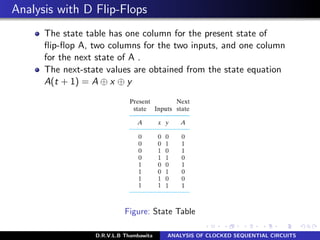
The state table has one column for the present state of
flip-flop A, two columns for the two inputs, and one column
for the next state of A .
The next-state values are obtained from the state equation
A(t + 1) = A ⊕ x ⊕ y
Figure: State Table
D.R.V.L.B Thambawita ANALYSIS OF CLOCKED SEQUENTIAL CIRCUITS
Analysis with D Flip-Flops
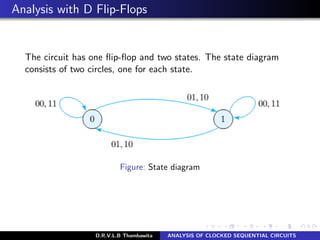
The circuit has one flip-flop and two states. The state diagram
consists of two circles, one for each state.
Figure: State diagram
D.R.V.L.B Thambawita ANALYSIS OF CLOCKED SEQUENTIAL CIRCUITS
Analysis with JK Flip-Flops
The next-state values are evaluated from the state equations.
For a D-type flip-flop, the state equation is the same as the
input equation.
When a flip-flop other than the D type is used, such as JK or
T, it is necessary to refer to the corresponding characteristic
table or characteristic equation to obtain the nextstate
values.
D.R.V.L.B Thambawita ANALYSIS OF CLOCKED SEQUENTIAL CIRCUITS
Analysis with JK Flip-Flops
The next-state values of a sequential circuit that uses JK or T type
flip-flops can be derived as follows:
1 Determine the flip-flop input equations in terms of the present
state and input variables.
2 List the binary values of each input equation.
3 Use the corresponding flip-flop characteristic table to
determine the next-state values in the state table.
D.R.V.L.B Thambawita ANALYSIS OF CLOCKED SEQUENTIAL CIRCUITS
Analysis with JK Flip-Flops: Example
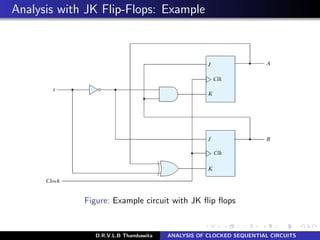
Figure: Example circuit with JK flip flops
D.R.V.L.B Thambawita ANALYSIS OF CLOCKED SEQUENTIAL CIRCUITS
Analysis with JK Flip-Flops: Example
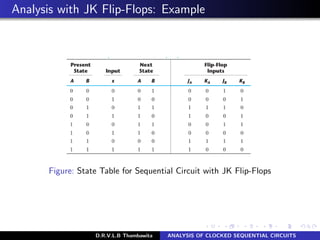
The circuit can be specified by the flip-flop input equations.
JA = B
KA = Bx
JB = x
KB = A ⊕ x = A x + Ax
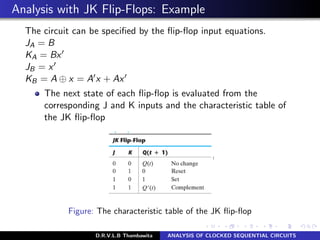
The next state of each flip-flop is evaluated from the
corresponding J and K inputs and the characteristic table of
the JK flip-flop
Figure: The characteristic table of the JK flip-flop
D.R.V.L.B Thambawita ANALYSIS OF CLOCKED SEQUENTIAL CIRCUITS
Analysis with JK Flip-Flops: Example
Figure: State Table for Sequential Circuit with JK Flip-Flops
D.R.V.L.B Thambawita ANALYSIS OF CLOCKED SEQUENTIAL CIRCUITS
Analysis with JK Flip-Flops: Example
The next-state values can also be obtained by evaluating the state
equations from the characteristic equation.
1 Determine the flip-flop input equations in terms of the present
state and input variables.
2 Substitute the input equations into the flip-flop characteristic
equation to obtain the state equations.
3 Use the corresponding state equations to determine the
next-state values in the state table.
D.R.V.L.B Thambawita ANALYSIS OF CLOCKED SEQUENTIAL CIRCUITS
Analysis with JK Flip-Flops: Example
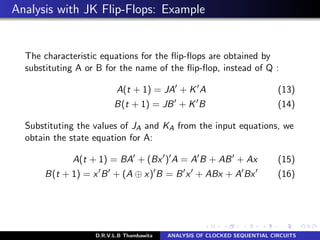
The characteristic equations for the flip-flops are obtained by
substituting A or B for the name of the flip-flop, instead of Q :
A(t + 1) = JA + K A (13)
B(t + 1) = JB + K B (14)
Substituting the values of JA and KA from the input equations, we
obtain the state equation for A:
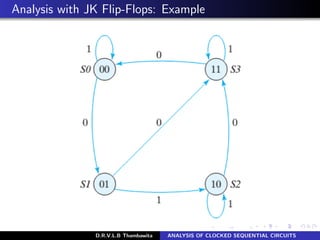
A(t + 1) = BA + (Bx ) A = A B + AB + Ax (15)
B(t + 1) = x B + (A ⊕ x) B = B x + ABx + A Bx (16)
D.R.V.L.B Thambawita ANALYSIS OF CLOCKED SEQUENTIAL CIRCUITS
Analysis with JK Flip-Flops: Example
D.R.V.L.B Thambawita ANALYSIS OF CLOCKED SEQUENTIAL CIRCUITS
Analysis with T Flip-Flops
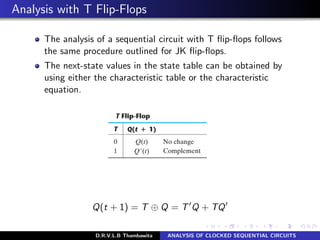
The analysis of a sequential circuit with T flip-flops follows
the same procedure outlined for JK flip-flops.
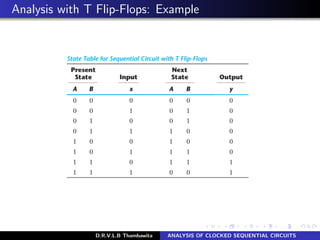
The next-state values in the state table can be obtained by
using either the characteristic table or the characteristic
equation.
Q(t + 1) = T ⊕ Q = T Q + TQ
D.R.V.L.B Thambawita ANALYSIS OF CLOCKED SEQUENTIAL CIRCUITS
Analysis with T Flip-Flops: Example
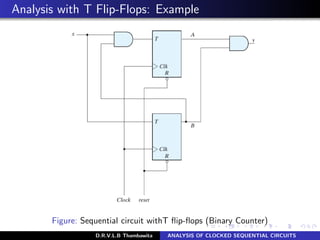
Figure: Sequential circuit withT flip-flops (Binary Counter)
D.R.V.L.B Thambawita ANALYSIS OF CLOCKED SEQUENTIAL CIRCUITS
Analysis with T Flip-Flops: Example
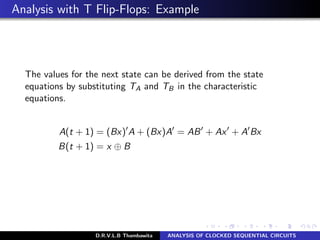
The values for the next state can be derived from the state
equations by substituting TA and TB in the characteristic
equations.
A(t + 1) = (Bx) A + (Bx)A = AB + Ax + A Bx
B(t + 1) = x ⊕ B
D.R.V.L.B Thambawita ANALYSIS OF CLOCKED SEQUENTIAL CIRCUITS
Analysis with T Flip-Flops: Example
D.R.V.L.B Thambawita ANALYSIS OF CLOCKED SEQUENTIAL CIRCUITS
Analysis with T Flip-Flops: Example
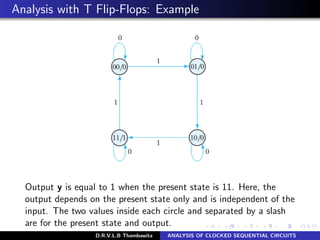
Output y is equal to 1 when the present state is 11. Here, the
output depends on the present state only and is independent of the
input. The two values inside each circle and separated by a slash
are for the present state and output.
D.R.V.L.B Thambawita ANALYSIS OF CLOCKED SEQUENTIAL CIRCUITS
Mealy and Moore Models of Finite State Machines
There are two models of sequential circuits: the Mealy
model and the Moore model.
They differ only in the way the output is generated.
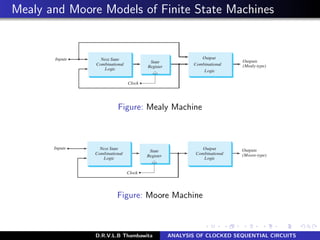
In the Mealy model, the output is a function of both the
present state and the input.
In the Moore model, the output is a function of only the
present state.
The two models of a sequential circuit are commonly referred
to as a finite state machine, abbreviated FSM.
The Mealy model of a sequential circuit is referred to as a
Mealy FSM or Mealy machine.
The Moore model is referred to as a Moore FSM or Moore
machine.
D.R.V.L.B Thambawita ANALYSIS OF CLOCKED SEQUENTIAL CIRCUITS
Mealy and Moore Models of Finite State Machines
Figure: Mealy Machine
Figure: Moore Machine
D.R.V.L.B Thambawita ANALYSIS OF CLOCKED SEQUENTIAL CIRCUITS
Mealy and Moore Models of Finite State Machines
The first example is an example for a Mealy machine
Output y is a function of both input x and the present state of
A and B.
The corresponding state diagram shows both the input and
output values, separated by a slash along the directed lines
between the states.
The last example is an example for a Moore machine
The output depends only on flip-flop values, and that makes it
a function of the present state only.
The input value in the state diagram is labeled along the
directed line, but the output value is indicated inside the
circle together with the present state.
D.R.V.L.B Thambawita ANALYSIS OF CLOCKED SEQUENTIAL CIRCUITS
State Reduction and Assignment
The design (synthesis) of a sequential circuit starts from a set
of specifications and culminates in a logic diagram.
Two sequential circuits may exhibit the same inputoutput
behavior, but have a different number of internal states in
their state diagram.
The current section discusses certain properties of sequential
circuits that may simplify a design by reducing the number of
gates and flip-flops it uses.
Reducing the number of flip-flops reduces the cost of a circuit.
D.R.V.L.B Thambawita ANALYSIS OF CLOCKED SEQUENTIAL CIRCUITS
State Reduction
The reduction in the number of flip-flops in a sequential
circuit is referred to as the state-reduction problem.
State-reduction algorithms are concerned with procedures for
reducing the number of states in a state table, while keeping
the external inputoutput requirements unchanged.
Since m flip-flops produce 2m states, a reduction in the
number of states may (or may not) result in a reduction in the
number of flip-flops.
D.R.V.L.B Thambawita ANALYSIS OF CLOCKED SEQUENTIAL CIRCUITS
State Reduction: Example
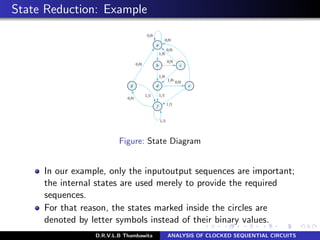
Figure: State Diagram
In our example, only the inputoutput sequences are important;
the internal states are used merely to provide the required
sequences.
For that reason, the states marked inside the circles are
denoted by letter symbols instead of their binary values.
D.R.V.L.B Thambawita ANALYSIS OF CLOCKED SEQUENTIAL CIRCUITS
State Reduction: Example
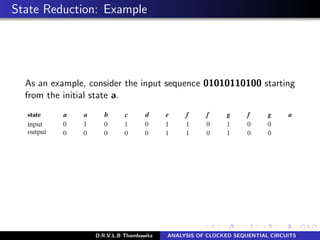
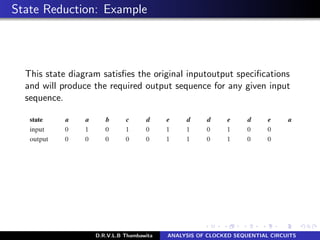
As an example, consider the input sequence 01010110100 starting
from the initial state a.
D.R.V.L.B Thambawita ANALYSIS OF CLOCKED SEQUENTIAL CIRCUITS
State Reduction: Example
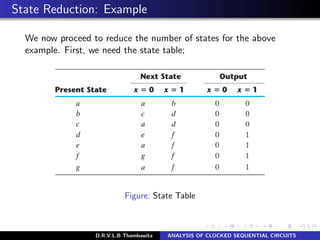
We now proceed to reduce the number of states for the above
example. First, we need the state table;
Figure: State Table
D.R.V.L.B Thambawita ANALYSIS OF CLOCKED SEQUENTIAL CIRCUITS
State Reduction: Example
Steps:
Two states are said to be equivalent if, for each member of
the set of inputs, they give exactly the same output and send
the circuit either to the same state or to an equivalent state.
When two states are equivalent, one of them can be removed
without altering the inputoutput relationships.
D.R.V.L.B Thambawita ANALYSIS OF CLOCKED SEQUENTIAL CIRCUITS
State Reduction: Example
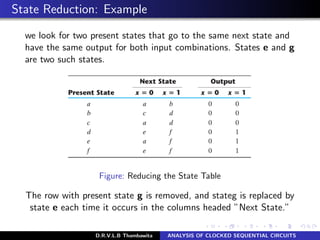
we look for two present states that go to the same next state and
have the same output for both input combinations. States e and g
are two such states.
Figure: Reducing the State Table
The row with present state g is removed, and stateg is replaced by
state e each time it occurs in the columns headed ”Next State.”
D.R.V.L.B Thambawita ANALYSIS OF CLOCKED SEQUENTIAL CIRCUITS
State Reduction: Example
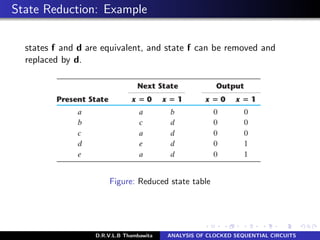
states f and d are equivalent, and state f can be removed and
replaced by d.
Figure: Reduced state table
D.R.V.L.B Thambawita ANALYSIS OF CLOCKED SEQUENTIAL CIRCUITS
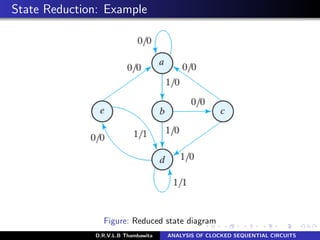
State Reduction: Example
Figure: Reduced state diagram
D.R.V.L.B Thambawita ANALYSIS OF CLOCKED SEQUENTIAL CIRCUITS
State Reduction: Example
This state diagram satisfies the original inputoutput specifications
and will produce the required output sequence for any given input
sequence.
D.R.V.L.B Thambawita ANALYSIS OF CLOCKED SEQUENTIAL CIRCUITS
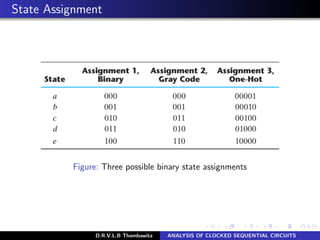
State Assignment
Figure: Three possible binary state assignments
D.R.V.L.B Thambawita ANALYSIS OF CLOCKED SEQUENTIAL CIRCUITS
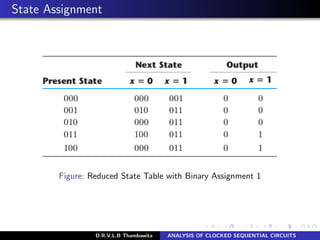
State Assignment
Figure: Reduced State Table with Binary Assignment 1
D.R.V.L.B Thambawita ANALYSIS OF CLOCKED SEQUENTIAL CIRCUITS

Lec 07 - ANALYSIS OF CLOCKED SEQUENTIAL CIRCUITS

  • 1.
    ANALYSIS OF CLOCKEDSEQUENTIAL CIRCUITS D.R.V.L.B Thambawita October 29, 2017 D.R.V.L.B Thambawita ANALYSIS OF CLOCKED SEQUENTIAL CIRCUITS https://sites.google.com/view/vajira-thambawita/leaning-materials/slides
  • 2.
    Introduction Analysis describes whata given circuit will do under certain operating conditions. The behavior of a clocked sequential circuit is determined from the inputs, the outputs, and the state of its flip-flops. State Equation The behavior of a clocked sequential circuit can be described algebraically by means of state equations. A state equation(also called a transition equation) specifies the next state as a function of the present state and inputs. D.R.V.L.B Thambawita ANALYSIS OF CLOCKED SEQUENTIAL CIRCUITS
  • 3.
    Example D.R.V.L.B Thambawita ANALYSISOF CLOCKED SEQUENTIAL CIRCUITS
  • 4.
    Example: State equations A(t+ 1) = A(t)x(t) + B(t)x(t) (1) B(t + 1) = A (t)x(t) (2) Boolean expressions are a function of the present state, we can omit the designation (t) after each variable for convenience and can express the state equations in the more compact form: A(t + 1) = Ax + Bx (3) B(t + 1) = A x (4) Similarly, the present-state value of the output can be expressed algebraically as: y(t) = [A(t) + B(t)]x (t) (5) By removing the symbol(t) y = (A + B)x (6) D.R.V.L.B Thambawita ANALYSIS OF CLOCKED SEQUENTIAL CIRCUITS
  • 5.
    State Table The timesequence of inputs, outputs, and flip-flop states can be enumerated in a state table (sometimes called a transition table ). The table consists of four sections labeled present state, input, next state, and output . The derivation of a state table requires listing all possible binary combinations of present states and The derivation of a state table requires listing all possible binary combinations of present states and inputs. The next-state values are then determined from the logic diagram or from the state equations. D.R.V.L.B Thambawita ANALYSIS OF CLOCKED SEQUENTIAL CIRCUITS
  • 6.
    State Table Figure: Statetable for above example D.R.V.L.B Thambawita ANALYSIS OF CLOCKED SEQUENTIAL CIRCUITS
  • 7.
    State Table The nextstate of flip-flop A must satisfy the state equation A(t + 1) = Ax + Bx (7) Similarly, the next state of flip-flop B is derived from the state equation B(t + 1) = A x (8) The output column is derived from the output equation y = Ax + Bx (9) In general, a sequential circuit with m flipflops and n inputs needs 2m+n rows in the state table. D.R.V.L.B Thambawita ANALYSIS OF CLOCKED SEQUENTIAL CIRCUITS
  • 8.
    State Table It issometimes convenient to express the state table in a slightly different form having only three sections: present state, next state, and output. Figure: Second form of state table D.R.V.L.B Thambawita ANALYSIS OF CLOCKED SEQUENTIAL CIRCUITS
  • 9.
    State Diagram The informationavailable in a state table can be represented graphically in the form of a state diagram. In this type of diagram, a state is represented by a circle, and the (clock-triggered) transitions between states are indicated by directed lines connecting the circles. The directed lines are labeled with two binary numbers separated by a slash. The input value during the present state is labeled first, and the number after the slash gives the output during the present state with the given input. D.R.V.L.B Thambawita ANALYSIS OF CLOCKED SEQUENTIAL CIRCUITS
  • 10.
    State Diagram Figure: Statediagram of the above example D.R.V.L.B Thambawita ANALYSIS OF CLOCKED SEQUENTIAL CIRCUITS
  • 11.
    Up to now! Circuitdiagram ⇒ Equations - State table ⇒ State diagram. This sequence of steps begins with a structural representation of the circuit and proceeds to an abstract representation of its behavior. D.R.V.L.B Thambawita ANALYSIS OF CLOCKED SEQUENTIAL CIRCUITS
  • 12.
    Flip-Flop Input Equations Thelogic diagram of a sequential circuit consists of flip-flops and gates. The knowledge of the type of flip-flops and a list of the Boolean expressions of the combinational circuit provide the information needed to draw the logic diagram of the sequential circuit. The part of the combinational circuit that generates external outputs is described algebraically by a set of Boolean functions called output equations . The part of the circuit that generates the inputs to flip-flops is described algebraically by a set of Boolean functions called flip-flop input equations (or, sometimes, excitation equations ). D.R.V.L.B Thambawita ANALYSIS OF CLOCKED SEQUENTIAL CIRCUITS
  • 13.
    Flip-Flop Input Equations Flip-flopinput equations and an output equation for the above example, DA = Ax + Bx (10) DB = A x (11) y = (A + B)x (12) Note that the expression for the input equation for aD flip-flop is identical to the expression for the corresponding state equation. D.R.V.L.B Thambawita ANALYSIS OF CLOCKED SEQUENTIAL CIRCUITS
  • 14.
    Analysis with DFlip-Flops The procedure for analyzing a clocked sequential circuit with D flip-flops. The circuit we want to analyze is described by the input equation DA = A ⊕ x ⊕ y. The x and y variables are the inputs to the circuit. No output equations are given, which implies that the output comes from the output of the flip-flop. D.R.V.L.B Thambawita ANALYSIS OF CLOCKED SEQUENTIAL CIRCUITS
  • 15.
    Analysis with DFlip-Flops Figure: The logic diagram is obtained from the input equation D.R.V.L.B Thambawita ANALYSIS OF CLOCKED SEQUENTIAL CIRCUITS
  • 16.
    Analysis with DFlip-Flops The state table has one column for the present state of flip-flop A, two columns for the two inputs, and one column for the next state of A . The next-state values are obtained from the state equation A(t + 1) = A ⊕ x ⊕ y Figure: State Table D.R.V.L.B Thambawita ANALYSIS OF CLOCKED SEQUENTIAL CIRCUITS
  • 17.
    Analysis with DFlip-Flops The circuit has one flip-flop and two states. The state diagram consists of two circles, one for each state. Figure: State diagram D.R.V.L.B Thambawita ANALYSIS OF CLOCKED SEQUENTIAL CIRCUITS
  • 18.
    Analysis with JKFlip-Flops The next-state values are evaluated from the state equations. For a D-type flip-flop, the state equation is the same as the input equation. When a flip-flop other than the D type is used, such as JK or T, it is necessary to refer to the corresponding characteristic table or characteristic equation to obtain the nextstate values. D.R.V.L.B Thambawita ANALYSIS OF CLOCKED SEQUENTIAL CIRCUITS
  • 19.
    Analysis with JKFlip-Flops The next-state values of a sequential circuit that uses JK or T type flip-flops can be derived as follows: 1 Determine the flip-flop input equations in terms of the present state and input variables. 2 List the binary values of each input equation. 3 Use the corresponding flip-flop characteristic table to determine the next-state values in the state table. D.R.V.L.B Thambawita ANALYSIS OF CLOCKED SEQUENTIAL CIRCUITS
  • 20.
    Analysis with JKFlip-Flops: Example Figure: Example circuit with JK flip flops D.R.V.L.B Thambawita ANALYSIS OF CLOCKED SEQUENTIAL CIRCUITS
  • 21.
    Analysis with JKFlip-Flops: Example The circuit can be specified by the flip-flop input equations. JA = B KA = Bx JB = x KB = A ⊕ x = A x + Ax The next state of each flip-flop is evaluated from the corresponding J and K inputs and the characteristic table of the JK flip-flop Figure: The characteristic table of the JK flip-flop D.R.V.L.B Thambawita ANALYSIS OF CLOCKED SEQUENTIAL CIRCUITS
  • 22.
    Analysis with JKFlip-Flops: Example Figure: State Table for Sequential Circuit with JK Flip-Flops D.R.V.L.B Thambawita ANALYSIS OF CLOCKED SEQUENTIAL CIRCUITS
  • 23.
    Analysis with JKFlip-Flops: Example The next-state values can also be obtained by evaluating the state equations from the characteristic equation. 1 Determine the flip-flop input equations in terms of the present state and input variables. 2 Substitute the input equations into the flip-flop characteristic equation to obtain the state equations. 3 Use the corresponding state equations to determine the next-state values in the state table. D.R.V.L.B Thambawita ANALYSIS OF CLOCKED SEQUENTIAL CIRCUITS
  • 24.
    Analysis with JKFlip-Flops: Example The characteristic equations for the flip-flops are obtained by substituting A or B for the name of the flip-flop, instead of Q : A(t + 1) = JA + K A (13) B(t + 1) = JB + K B (14) Substituting the values of JA and KA from the input equations, we obtain the state equation for A: A(t + 1) = BA + (Bx ) A = A B + AB + Ax (15) B(t + 1) = x B + (A ⊕ x) B = B x + ABx + A Bx (16) D.R.V.L.B Thambawita ANALYSIS OF CLOCKED SEQUENTIAL CIRCUITS
  • 25.
    Analysis with JKFlip-Flops: Example D.R.V.L.B Thambawita ANALYSIS OF CLOCKED SEQUENTIAL CIRCUITS
  • 26.
    Analysis with TFlip-Flops The analysis of a sequential circuit with T flip-flops follows the same procedure outlined for JK flip-flops. The next-state values in the state table can be obtained by using either the characteristic table or the characteristic equation. Q(t + 1) = T ⊕ Q = T Q + TQ D.R.V.L.B Thambawita ANALYSIS OF CLOCKED SEQUENTIAL CIRCUITS
  • 27.
    Analysis with TFlip-Flops: Example Figure: Sequential circuit withT flip-flops (Binary Counter) D.R.V.L.B Thambawita ANALYSIS OF CLOCKED SEQUENTIAL CIRCUITS
  • 28.
    Analysis with TFlip-Flops: Example The values for the next state can be derived from the state equations by substituting TA and TB in the characteristic equations. A(t + 1) = (Bx) A + (Bx)A = AB + Ax + A Bx B(t + 1) = x ⊕ B D.R.V.L.B Thambawita ANALYSIS OF CLOCKED SEQUENTIAL CIRCUITS
  • 29.
    Analysis with TFlip-Flops: Example D.R.V.L.B Thambawita ANALYSIS OF CLOCKED SEQUENTIAL CIRCUITS
  • 30.
    Analysis with TFlip-Flops: Example Output y is equal to 1 when the present state is 11. Here, the output depends on the present state only and is independent of the input. The two values inside each circle and separated by a slash are for the present state and output. D.R.V.L.B Thambawita ANALYSIS OF CLOCKED SEQUENTIAL CIRCUITS
  • 31.
    Mealy and MooreModels of Finite State Machines There are two models of sequential circuits: the Mealy model and the Moore model. They differ only in the way the output is generated. In the Mealy model, the output is a function of both the present state and the input. In the Moore model, the output is a function of only the present state. The two models of a sequential circuit are commonly referred to as a finite state machine, abbreviated FSM. The Mealy model of a sequential circuit is referred to as a Mealy FSM or Mealy machine. The Moore model is referred to as a Moore FSM or Moore machine. D.R.V.L.B Thambawita ANALYSIS OF CLOCKED SEQUENTIAL CIRCUITS
  • 32.
    Mealy and MooreModels of Finite State Machines Figure: Mealy Machine Figure: Moore Machine D.R.V.L.B Thambawita ANALYSIS OF CLOCKED SEQUENTIAL CIRCUITS
  • 33.
    Mealy and MooreModels of Finite State Machines The first example is an example for a Mealy machine Output y is a function of both input x and the present state of A and B. The corresponding state diagram shows both the input and output values, separated by a slash along the directed lines between the states. The last example is an example for a Moore machine The output depends only on flip-flop values, and that makes it a function of the present state only. The input value in the state diagram is labeled along the directed line, but the output value is indicated inside the circle together with the present state. D.R.V.L.B Thambawita ANALYSIS OF CLOCKED SEQUENTIAL CIRCUITS
  • 34.
    State Reduction andAssignment The design (synthesis) of a sequential circuit starts from a set of specifications and culminates in a logic diagram. Two sequential circuits may exhibit the same inputoutput behavior, but have a different number of internal states in their state diagram. The current section discusses certain properties of sequential circuits that may simplify a design by reducing the number of gates and flip-flops it uses. Reducing the number of flip-flops reduces the cost of a circuit. D.R.V.L.B Thambawita ANALYSIS OF CLOCKED SEQUENTIAL CIRCUITS
  • 35.
    State Reduction The reductionin the number of flip-flops in a sequential circuit is referred to as the state-reduction problem. State-reduction algorithms are concerned with procedures for reducing the number of states in a state table, while keeping the external inputoutput requirements unchanged. Since m flip-flops produce 2m states, a reduction in the number of states may (or may not) result in a reduction in the number of flip-flops. D.R.V.L.B Thambawita ANALYSIS OF CLOCKED SEQUENTIAL CIRCUITS
  • 36.
    State Reduction: Example Figure:State Diagram In our example, only the inputoutput sequences are important; the internal states are used merely to provide the required sequences. For that reason, the states marked inside the circles are denoted by letter symbols instead of their binary values. D.R.V.L.B Thambawita ANALYSIS OF CLOCKED SEQUENTIAL CIRCUITS
  • 37.
    State Reduction: Example Asan example, consider the input sequence 01010110100 starting from the initial state a. D.R.V.L.B Thambawita ANALYSIS OF CLOCKED SEQUENTIAL CIRCUITS
  • 38.
    State Reduction: Example Wenow proceed to reduce the number of states for the above example. First, we need the state table; Figure: State Table D.R.V.L.B Thambawita ANALYSIS OF CLOCKED SEQUENTIAL CIRCUITS
  • 39.
    State Reduction: Example Steps: Twostates are said to be equivalent if, for each member of the set of inputs, they give exactly the same output and send the circuit either to the same state or to an equivalent state. When two states are equivalent, one of them can be removed without altering the inputoutput relationships. D.R.V.L.B Thambawita ANALYSIS OF CLOCKED SEQUENTIAL CIRCUITS
  • 40.
    State Reduction: Example welook for two present states that go to the same next state and have the same output for both input combinations. States e and g are two such states. Figure: Reducing the State Table The row with present state g is removed, and stateg is replaced by state e each time it occurs in the columns headed ”Next State.” D.R.V.L.B Thambawita ANALYSIS OF CLOCKED SEQUENTIAL CIRCUITS
  • 41.
    State Reduction: Example statesf and d are equivalent, and state f can be removed and replaced by d. Figure: Reduced state table D.R.V.L.B Thambawita ANALYSIS OF CLOCKED SEQUENTIAL CIRCUITS
  • 42.
    State Reduction: Example Figure:Reduced state diagram D.R.V.L.B Thambawita ANALYSIS OF CLOCKED SEQUENTIAL CIRCUITS
  • 43.
    State Reduction: Example Thisstate diagram satisfies the original inputoutput specifications and will produce the required output sequence for any given input sequence. D.R.V.L.B Thambawita ANALYSIS OF CLOCKED SEQUENTIAL CIRCUITS
  • 44.
    State Assignment Figure: Threepossible binary state assignments D.R.V.L.B Thambawita ANALYSIS OF CLOCKED SEQUENTIAL CIRCUITS
  • 45.
    State Assignment Figure: ReducedState Table with Binary Assignment 1 D.R.V.L.B Thambawita ANALYSIS OF CLOCKED SEQUENTIAL CIRCUITS