DESIGN PROCEDURE
D.R.V.L.B Thambawita
October 29, 2017
D.R.V.L.B Thambawita DESIGN PROCEDURE
https://sites.google.com/view/vajira-thambawita/leaning-materials/slides
DESIGN PROCEDURE
Design procedures or methodologies specify hardware that will
implement a desired behavior.
The design effort for small circuits may be manual, but
industry relies on automated synthesis tools for designing
massive integrated circuits.
The design of a clocked sequential circuit starts from a set of
specifications and culminates in a logic diagram or a list
of Boolean functions from which the logic diagram can be
obtained.
In contrast to a combinational circuit, which is fully specified
by a truth table, a sequential circuit requires a state table for
its specification.
The first step in the design of sequential circuits is to obtain a
state table or an equivalent representation, such as a state
diagram.
D.R.V.L.B Thambawita DESIGN PROCEDURE
DESIGN PROCEDURE
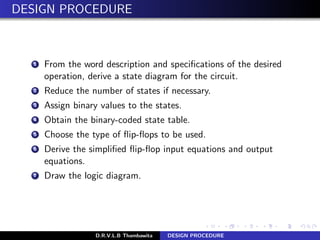
1 From the word description and specifications of the desired
operation, derive a state diagram for the circuit.
2 Reduce the number of states if necessary.
3 Assign binary values to the states.
4 Obtain the binary-coded state table.
5 Choose the type of flip-flops to be used.
6 Derive the simplified flip-flop input equations and output
equations.
7 Draw the logic diagram.
D.R.V.L.B Thambawita DESIGN PROCEDURE
DESIGN PROCEDURE: Example
Suppose we wish to design a circuit that detects a sequence of
three or more consecutive 1’s in a string of bits coming through an
input line (the input is a serial bit stream).
D.R.V.L.B Thambawita DESIGN PROCEDURE
DESIGN PROCEDURE: Example
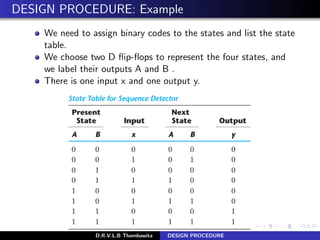
We need to assign binary codes to the states and list the state
table.
We choose two D flip-flops to represent the four states, and
we label their outputs A and B .
There is one input x and one output y.
D.R.V.L.B Thambawita DESIGN PROCEDURE
DESIGN PROCEDURE: Example
The characteristic equation of the D flip-flop is Q(t +1) = DQ
Which means that the next-state values in the state table
specify the D input condition for the flip-flop.
The flip-flop input equations can be obtained directly from
the next-state columns of A and B and expressed in
sum-of-minterms form as
A(t + 1) = DA(A, B, x) = (3, 5, 7)
B(t + 1) = DB(A, B, x) = (1, 5, 7)
y(A, B, x) = (6, 7)
D.R.V.L.B Thambawita DESIGN PROCEDURE
DESIGN PROCEDURE: Example
The Boolean equations are simplified by means of the maps
plotted in the following figure.
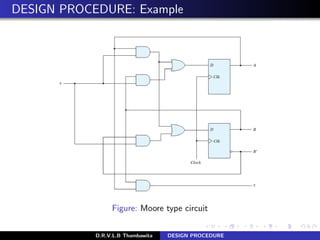
DA = Ax + Bx
DB = Ax + B x
y = AB
The advantage of designing withD flip-flops is that the Boolean
equations describing the inputs to the flip-flops can be obtained
directly from the state table.
D.R.V.L.B Thambawita DESIGN PROCEDURE
DESIGN PROCEDURE: Example
Figure: Moore type circuit
D.R.V.L.B Thambawita DESIGN PROCEDURE
Excitation Tables
When D -type flip-flops are employed, the input equations are
obtained directly from the next state.
This is not the case for the JK and T types of flip-flops.
It is necessary to derive a functional relationship between the
state table and the input equations.
The flip-flop characteristic tables are useful for analyzing
sequential circuits and for defining the operation of the
flip-flops.
During the design process, we usually know the transition
from the present state to the next state.
Wish to find the flip-flop input conditions that will cause the
required transition.
we need a table that lists the required inputs for a given
change of state. Such a table is called an excitation table .
D.R.V.L.B Thambawita DESIGN PROCEDURE
Excitation Tables
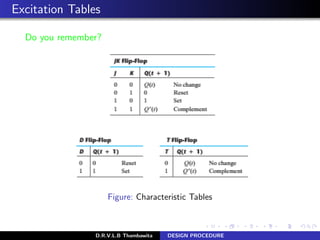
Do you remember?
Figure: Characteristic Tables
D.R.V.L.B Thambawita DESIGN PROCEDURE
Excitation Tables
Figure: Flip-Flop Excitation Tables
D.R.V.L.B Thambawita DESIGN PROCEDURE
Synthesis Using JK Flip-Flops
Example:
Figure: State Table and JK Flip-Flop Inputs
D.R.V.L.B Thambawita DESIGN PROCEDURE
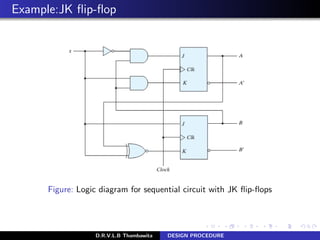
Example:JK flip-flop
Figure: Maps for J and K input equations
D.R.V.L.B Thambawita DESIGN PROCEDURE
Example:JK flip-flop
Figure: Logic diagram for sequential circuit with JK flip-flops
D.R.V.L.B Thambawita DESIGN PROCEDURE
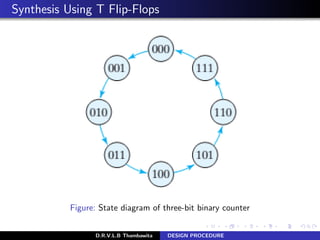
Synthesis Using T Flip-Flops
Figure: State diagram of three-bit binary counter
D.R.V.L.B Thambawita DESIGN PROCEDURE
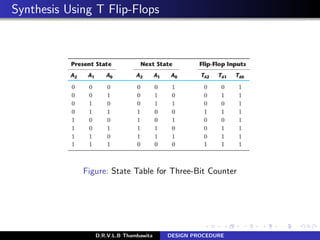
Synthesis Using T Flip-Flops
Figure: State Table for Three-Bit Counter
D.R.V.L.B Thambawita DESIGN PROCEDURE
Synthesis Using T Flip-Flops
Figure: Maps for three-bit binary counter
D.R.V.L.B Thambawita DESIGN PROCEDURE
Synthesis Using T Flip-Flops
Figure: Logic diagram of three-bit binary counter
D.R.V.L.B Thambawita DESIGN PROCEDURE

Lec 08 - DESIGN PROCEDURE

  • 1.
    DESIGN PROCEDURE D.R.V.L.B Thambawita October29, 2017 D.R.V.L.B Thambawita DESIGN PROCEDURE https://sites.google.com/view/vajira-thambawita/leaning-materials/slides
  • 2.
    DESIGN PROCEDURE Design proceduresor methodologies specify hardware that will implement a desired behavior. The design effort for small circuits may be manual, but industry relies on automated synthesis tools for designing massive integrated circuits. The design of a clocked sequential circuit starts from a set of specifications and culminates in a logic diagram or a list of Boolean functions from which the logic diagram can be obtained. In contrast to a combinational circuit, which is fully specified by a truth table, a sequential circuit requires a state table for its specification. The first step in the design of sequential circuits is to obtain a state table or an equivalent representation, such as a state diagram. D.R.V.L.B Thambawita DESIGN PROCEDURE
  • 3.
    DESIGN PROCEDURE 1 Fromthe word description and specifications of the desired operation, derive a state diagram for the circuit. 2 Reduce the number of states if necessary. 3 Assign binary values to the states. 4 Obtain the binary-coded state table. 5 Choose the type of flip-flops to be used. 6 Derive the simplified flip-flop input equations and output equations. 7 Draw the logic diagram. D.R.V.L.B Thambawita DESIGN PROCEDURE
  • 4.
    DESIGN PROCEDURE: Example Supposewe wish to design a circuit that detects a sequence of three or more consecutive 1’s in a string of bits coming through an input line (the input is a serial bit stream). D.R.V.L.B Thambawita DESIGN PROCEDURE
  • 5.
    DESIGN PROCEDURE: Example Weneed to assign binary codes to the states and list the state table. We choose two D flip-flops to represent the four states, and we label their outputs A and B . There is one input x and one output y. D.R.V.L.B Thambawita DESIGN PROCEDURE
  • 6.
    DESIGN PROCEDURE: Example Thecharacteristic equation of the D flip-flop is Q(t +1) = DQ Which means that the next-state values in the state table specify the D input condition for the flip-flop. The flip-flop input equations can be obtained directly from the next-state columns of A and B and expressed in sum-of-minterms form as A(t + 1) = DA(A, B, x) = (3, 5, 7) B(t + 1) = DB(A, B, x) = (1, 5, 7) y(A, B, x) = (6, 7) D.R.V.L.B Thambawita DESIGN PROCEDURE
  • 7.
    DESIGN PROCEDURE: Example TheBoolean equations are simplified by means of the maps plotted in the following figure. DA = Ax + Bx DB = Ax + B x y = AB The advantage of designing withD flip-flops is that the Boolean equations describing the inputs to the flip-flops can be obtained directly from the state table. D.R.V.L.B Thambawita DESIGN PROCEDURE
  • 8.
    DESIGN PROCEDURE: Example Figure:Moore type circuit D.R.V.L.B Thambawita DESIGN PROCEDURE
  • 9.
    Excitation Tables When D-type flip-flops are employed, the input equations are obtained directly from the next state. This is not the case for the JK and T types of flip-flops. It is necessary to derive a functional relationship between the state table and the input equations. The flip-flop characteristic tables are useful for analyzing sequential circuits and for defining the operation of the flip-flops. During the design process, we usually know the transition from the present state to the next state. Wish to find the flip-flop input conditions that will cause the required transition. we need a table that lists the required inputs for a given change of state. Such a table is called an excitation table . D.R.V.L.B Thambawita DESIGN PROCEDURE
  • 10.
    Excitation Tables Do youremember? Figure: Characteristic Tables D.R.V.L.B Thambawita DESIGN PROCEDURE
  • 11.
    Excitation Tables Figure: Flip-FlopExcitation Tables D.R.V.L.B Thambawita DESIGN PROCEDURE
  • 12.
    Synthesis Using JKFlip-Flops Example: Figure: State Table and JK Flip-Flop Inputs D.R.V.L.B Thambawita DESIGN PROCEDURE
  • 13.
    Example:JK flip-flop Figure: Mapsfor J and K input equations D.R.V.L.B Thambawita DESIGN PROCEDURE
  • 14.
    Example:JK flip-flop Figure: Logicdiagram for sequential circuit with JK flip-flops D.R.V.L.B Thambawita DESIGN PROCEDURE
  • 15.
    Synthesis Using TFlip-Flops Figure: State diagram of three-bit binary counter D.R.V.L.B Thambawita DESIGN PROCEDURE
  • 16.
    Synthesis Using TFlip-Flops Figure: State Table for Three-Bit Counter D.R.V.L.B Thambawita DESIGN PROCEDURE
  • 17.
    Synthesis Using TFlip-Flops Figure: Maps for three-bit binary counter D.R.V.L.B Thambawita DESIGN PROCEDURE
  • 18.
    Synthesis Using TFlip-Flops Figure: Logic diagram of three-bit binary counter D.R.V.L.B Thambawita DESIGN PROCEDURE