Control
On-Off Control
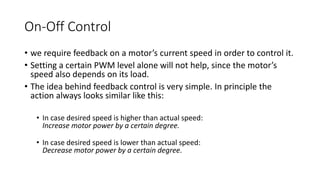
• we require feedback on a motor’s current speed in order to control it.
• Setting a certain PWM level alone will not help, since the motor’s
speed also depends on its load.
• The idea behind feedback control is very simple. In principle the
action always looks similar like this:
• In case desired speed is higher than actual speed:
Increase motor power by a certain degree.
• In case desired speed is lower than actual speed:
Decrease motor power by a certain degree.
On-Off Control
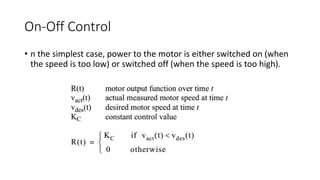
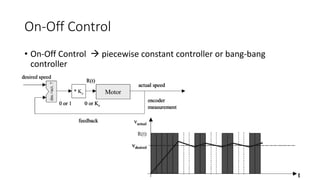
• n the simplest case, power to the motor is either switched on (when
the speed is too low) or switched off (when the speed is too high).
On-Off Control
• On-Off Control  piecewise constant controller or bang-bang
controller
On-Off Control
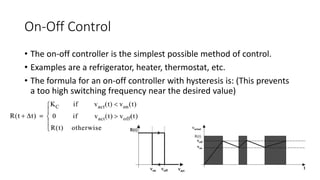
• The on-off controller is the simplest possible method of control.
• Examples are a refrigerator, heater, thermostat, etc.
• The formula for an on-off controller with hysteresis is: (This prevents
a too high switching frequency near the desired value)
•
PID Control
• A more advanced controller and almost industry standard is the PID
controller.
• It comprises a proportional, an integral, and a derivative control part.
• Proportional Controller
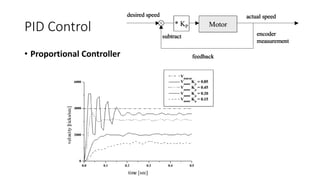
• The abrupt change between a fixed motor control value and zero does not
result in a smooth control behavior.
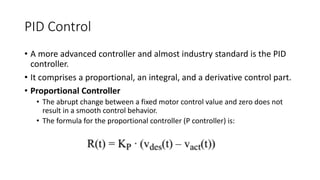
• The formula for the proportional controller (P controller) is:
PID Control
• Proportional Controller
PID Control
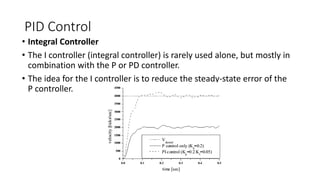
• Integral Controller
• The I controller (integral controller) is rarely used alone, but mostly in
combination with the P or PD controller.
• The idea for the I controller is to reduce the steady-state error of the
P controller.
PID Control
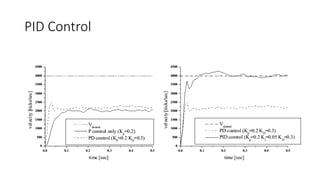
• Derivative Controller
• Similar to the I controller, the D controller (derivative controller) is
rarely used by itself, but mostly in combination with the P or PI
controller.
• The idea for adding a derivative term is to speed up the P controller’s
response to a change of input.
PID Control
Summary

Lecture 09 control

  • 1.
  • 2.
    On-Off Control • werequire feedback on a motor’s current speed in order to control it. • Setting a certain PWM level alone will not help, since the motor’s speed also depends on its load. • The idea behind feedback control is very simple. In principle the action always looks similar like this: • In case desired speed is higher than actual speed: Increase motor power by a certain degree. • In case desired speed is lower than actual speed: Decrease motor power by a certain degree.
  • 3.
    On-Off Control • nthe simplest case, power to the motor is either switched on (when the speed is too low) or switched off (when the speed is too high).
  • 4.
    On-Off Control • On-OffControl  piecewise constant controller or bang-bang controller
  • 5.
    On-Off Control • Theon-off controller is the simplest possible method of control. • Examples are a refrigerator, heater, thermostat, etc. • The formula for an on-off controller with hysteresis is: (This prevents a too high switching frequency near the desired value) •
  • 6.
    PID Control • Amore advanced controller and almost industry standard is the PID controller. • It comprises a proportional, an integral, and a derivative control part. • Proportional Controller • The abrupt change between a fixed motor control value and zero does not result in a smooth control behavior. • The formula for the proportional controller (P controller) is:
  • 7.
  • 8.
    PID Control • IntegralController • The I controller (integral controller) is rarely used alone, but mostly in combination with the P or PD controller. • The idea for the I controller is to reduce the steady-state error of the P controller.
  • 9.
    PID Control • DerivativeController • Similar to the I controller, the D controller (derivative controller) is rarely used by itself, but mostly in combination with the P or PI controller. • The idea for adding a derivative term is to speed up the P controller’s response to a change of input.
  • 10.
  • 11.