DIGITAL LOGIC
DESIGN (DLD)
EE-208412
CHAPTER:05
Synchronous Sequential Logic
DIRECT INPUTS
 Some flip flops have asynchronous inputs
that are used to force the flip flop to a
particular state independent of the clock
 The input that sets the flip flop to 1 is called
preset or direct set
 The input that clears the flip flop to 0 is called
clear or direct reset
 The direct inputs are useful for bringing all
flip flops in a system to a known starting
state
FLIP-FLOPS WITH DIRECT
INPUTS
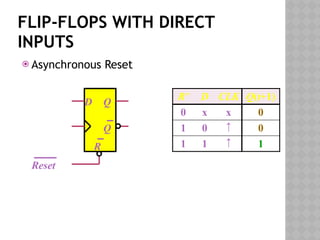
 Asynchronous Reset
D Q
Q
R
Reset
R’ D CLK Q(t+1)
0 x x 0
FLIP-FLOPS WITH DIRECT
INPUTS
 Asynchronous Reset
D Q
Q
R
Reset
R’ D CLK Q(t+1)
0 x x 0
1 0 ↑ 0
1 1 ↑ 1
ANALYSIS OF CLOCKED SEQUENTIAL
CIRCUITS
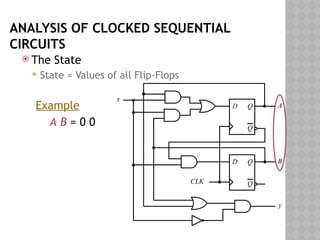
 The State
 State = Values of all Flip-Flops
Example
A B = 0 0
D Q
Q
CLK
D Q
Q
A
B
y
x
ANALYSIS OF CLOCKED SEQUENTIAL
CIRCUITS
 State Equations
D Q
Q
CLK
D Q
Q
A
B
y
x
A(t+1) = DA
= A(t) x(t)+B(t) x(t)
= A x + B x
B(t+1) = DB
= A’(t) x(t)
= A’ x
y(t) = [A(t)+ B(t)] x’(t)
= (A + B) x’
ANALYSIS OF CLOCKED SEQUENTIAL
CIRCUITS
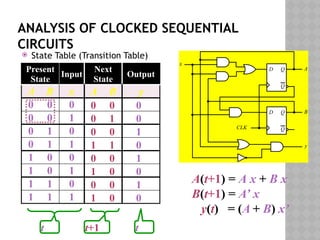
 State Table (Transition Table)
D Q
Q
CLK
D Q
Q
A
B
y
x
A(t+1) = A x + B x
B(t+1) = A’ x
y(t) = (A + B) x’
Present
State
Input
Next
State
Output
A B x A B y
0 0 0
0 0 1
0 1 0
0 1 1
1 0 0
1 0 1
1 1 0
1 1 1
t+1 t
t
0 0 0
0 1 0
0 0 1
1 1 0
0 0 1
1 0 0
0 0 1
1 0 0
ANALYSIS OF CLOCKED SEQUENTIAL
CIRCUITS
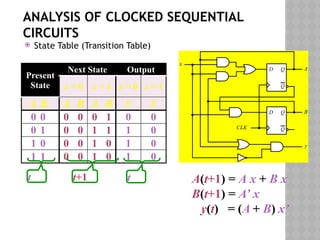
 State Table (Transition Table)
D Q
Q
CLK
D Q
Q
A
B
y
x
A(t+1) = A x + B x
B(t+1) = A’ x
y(t) = (A + B) x’
Present
State
Next State Output
x = 0 x = 1 x = 0 x = 1
A B A B A B y y
0 0 0 0 0 1 0 0
0 1 0 0 1 1 1 0
1 0 0 0 1 0 1 0
1 1 0 0 1 0 1 0
t+1 t
t
ANALYSIS OF CLOCKED SEQUENTIAL
CIRCUITS
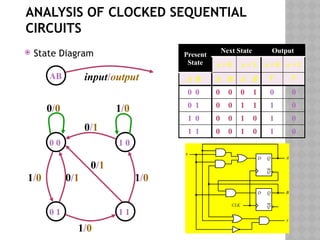
 State Diagram Present
State
Next State Output
x = 0 x = 1 x = 0 x = 1
A B A B A B y y
0 0 0 0 0 1 0 0
0 1 0 0 1 1 1 0
1 0 0 0 1 0 1 0
1 1 0 0 1 0 1 0
D Q
Q
CLK
D Q
Q
A
B
y
x
0 0 1 0
0 1 1 1
0/0
0/1
1/0
1/0
1/0
1/0 0/1
0/1
AB input/output
ANALYSIS OF CLOCKED SEQUENTIAL
CIRCUITS
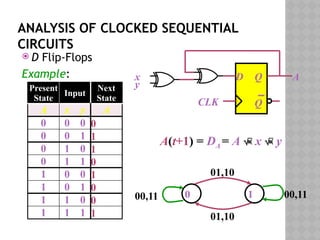
 D Flip-Flops
Example: D Q
Q
x
CLK
y
A
Present
State
Input
Next
State
A x y A
0 0 0
0 0 1
0 1 0
0 1 1
1 0 0
1 0 1
1 1 0
1 1 1
0
1
1
0
1
0
0
1
0 1
00,11 00,11
01,10
01,10
A(t+1) = DA = A  x  y

Digital Logic Design Synchronous logic circuits

  • 1.
  • 2.
  • 3.
    DIRECT INPUTS  Someflip flops have asynchronous inputs that are used to force the flip flop to a particular state independent of the clock  The input that sets the flip flop to 1 is called preset or direct set  The input that clears the flip flop to 0 is called clear or direct reset  The direct inputs are useful for bringing all flip flops in a system to a known starting state
  • 4.
    FLIP-FLOPS WITH DIRECT INPUTS Asynchronous Reset D Q Q R Reset R’ D CLK Q(t+1) 0 x x 0
  • 5.
    FLIP-FLOPS WITH DIRECT INPUTS Asynchronous Reset D Q Q R Reset R’ D CLK Q(t+1) 0 x x 0 1 0 ↑ 0 1 1 ↑ 1
  • 6.
    ANALYSIS OF CLOCKEDSEQUENTIAL CIRCUITS  The State  State = Values of all Flip-Flops Example A B = 0 0 D Q Q CLK D Q Q A B y x
  • 7.
    ANALYSIS OF CLOCKEDSEQUENTIAL CIRCUITS  State Equations D Q Q CLK D Q Q A B y x A(t+1) = DA = A(t) x(t)+B(t) x(t) = A x + B x B(t+1) = DB = A’(t) x(t) = A’ x y(t) = [A(t)+ B(t)] x’(t) = (A + B) x’
  • 8.
    ANALYSIS OF CLOCKEDSEQUENTIAL CIRCUITS  State Table (Transition Table) D Q Q CLK D Q Q A B y x A(t+1) = A x + B x B(t+1) = A’ x y(t) = (A + B) x’ Present State Input Next State Output A B x A B y 0 0 0 0 0 1 0 1 0 0 1 1 1 0 0 1 0 1 1 1 0 1 1 1 t+1 t t 0 0 0 0 1 0 0 0 1 1 1 0 0 0 1 1 0 0 0 0 1 1 0 0
  • 9.
    ANALYSIS OF CLOCKEDSEQUENTIAL CIRCUITS  State Table (Transition Table) D Q Q CLK D Q Q A B y x A(t+1) = A x + B x B(t+1) = A’ x y(t) = (A + B) x’ Present State Next State Output x = 0 x = 1 x = 0 x = 1 A B A B A B y y 0 0 0 0 0 1 0 0 0 1 0 0 1 1 1 0 1 0 0 0 1 0 1 0 1 1 0 0 1 0 1 0 t+1 t t
  • 10.
    ANALYSIS OF CLOCKEDSEQUENTIAL CIRCUITS  State Diagram Present State Next State Output x = 0 x = 1 x = 0 x = 1 A B A B A B y y 0 0 0 0 0 1 0 0 0 1 0 0 1 1 1 0 1 0 0 0 1 0 1 0 1 1 0 0 1 0 1 0 D Q Q CLK D Q Q A B y x 0 0 1 0 0 1 1 1 0/0 0/1 1/0 1/0 1/0 1/0 0/1 0/1 AB input/output
  • 11.
    ANALYSIS OF CLOCKEDSEQUENTIAL CIRCUITS  D Flip-Flops Example: D Q Q x CLK y A Present State Input Next State A x y A 0 0 0 0 0 1 0 1 0 0 1 1 1 0 0 1 0 1 1 1 0 1 1 1 0 1 1 0 1 0 0 1 0 1 00,11 00,11 01,10 01,10 A(t+1) = DA = A  x  y