Government Engineering
college,Bhavnagar
semester: 3
Branch: Computer (2015)
Name:- Paresh Parmar
subject: Digital Electronics
Enrollment No: 140210107040
Topic: Sequential Circuits
Combinational Logic
 Combinational Logic:
 Output depends only on current input
 Has no memory
2016/11/8 22
Sequential Logic
 Sequential Logic:
 Output depends not only on current input but also on
past input values, e.g., design a counter
 Need some type of memory to remember the past input
values
2016/11/8 33
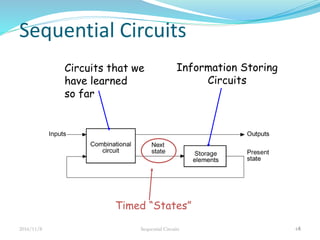
Sequential Circuits
2016/11/8 Sequential Circuits 44
Circuits that we
have learned
so far
Information Storing
Circuits
Timed “States”
Sequential Logic: Concept
 Sequential Logic circuits remember past inputs and
past circuit state.
 Outputs from the system are
“fed back” as new inputs
 With gate delay and wire delay
 The storage elements are circuits that are capable of
storing binary information: memory.
2016/11/8 55
Synchronous vs. Asynchronous
There are two types of sequential circuits:
 Synchronous sequential circuit: circuit output
changes only at some discrete instants of time.
This type of circuits achieves synchronization by
using a timing signal called the clock.
 Asynchronous sequential circuit: circuit output
can change at any time (clockless).
2016/11/8 66
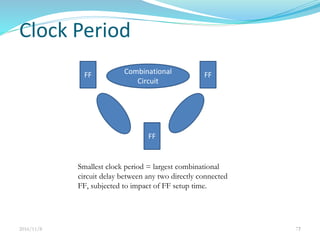
Clock Period
2016/11/8 77
FF FFCombinational
Circuit
Smallest clock period = largest combinational
circuit delay between any two directly connected
FF, subjected to impact of FF setup time.
FF
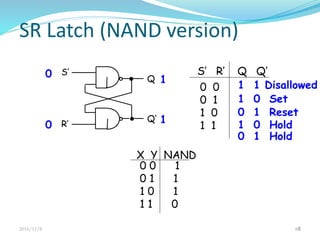
SR Latch (NAND version)
2016/11/8 88
S’
R’
Q
Q’
0 0
0 1
1 0
1 1
S’ R’ Q Q’0
0
1
1
0 0 1
0 1 1
1 0 1
1 1 0
X Y NAND
0 1 Hold
1 0 Set
0 1 Reset
1 0 Hold
1 1 Disallowed
2016/11/8 99
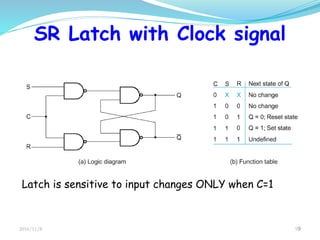
SR Latch with Clock signal
Latch is sensitive to input changes ONLY when C=1
2016/11/8 1010
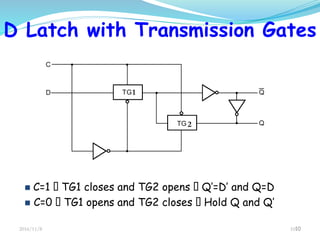
D Latch with Transmission Gates
 C=1 TG1 closes and TG2 opens Q’=D’ and Q=D
 C=0 TG1 opens and TG2 closes Hold Q and Q’
2
1
Flip-Flops
 Latches are “transparent” (= any change on the inputs
is seen at the outputs immediately when C=1).
 This causes synchronization problems.
 Solution: use latches to create flip-flops that can
respond (update) only on specific times (instead of
any time).
 Types: RS flip-flop and D flip-flop
2016/11/8 1111
2016/11/8 1212
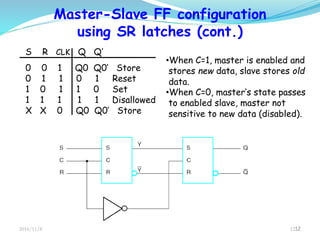
S R CLK Q Q’
0 0 1 Q0 Q0’ Store
0 1 1 0 1 Reset
1 0 1 1 0 Set
1 1 1 1 1 Disallowed
X X 0 Q0 Q0’ Store
Master-Slave FF configuration
using SR latches (cont.)
•When C=1, master is enabled and
stores new data, slave stores old
data.
•When C=0, master’s state passes
to enabled slave, master not
sensitive to new data (disabled).
Characteristic Tables
 Defines the logical properties of a flip-flop (such as a
truth table does for a logic gate).
 Q(t) – present state at time t
 Q(t+1) – next state at time t+1
2016/11/8 1313
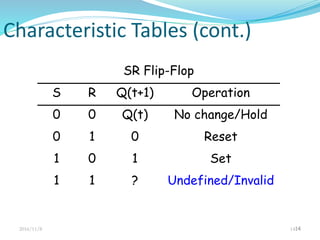
Characteristic Tables (cont.)
SR Flip-Flop
S R Q(t+1) Operation
0 0 Q(t) No change/Hold
0 1 0 Reset
1 0 1 Set
1 1 ? Undefined/Invalid
2016/11/8 1414
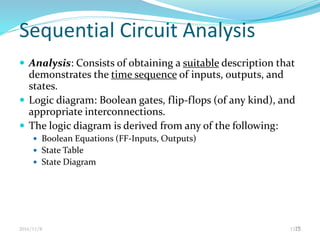
Sequential Circuit Analysis
 Analysis: Consists of obtaining a suitable description that
demonstrates the time sequence of inputs, outputs, and
states.
 Logic diagram: Boolean gates, flip-flops (of any kind), and
appropriate interconnections.
 The logic diagram is derived from any of the following:
 Boolean Equations (FF-Inputs, Outputs)
 State Table
 State Diagram
2016/11/8 1515
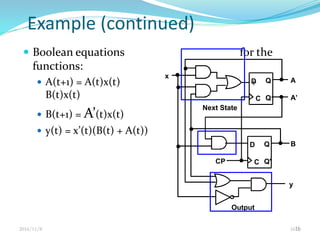
Example (continued)
 Boolean equations for the
functions:
 A(t+1) = A(t)x(t) +
B(t)x(t)
 B(t+1) = A’(t)x(t)
 y(t) = x’(t)(B(t) + A(t))
2016/11/8 1616
C
D Q
Q
C
D Q
Q'
y
x
A
A’
B
CP
Next State
Output
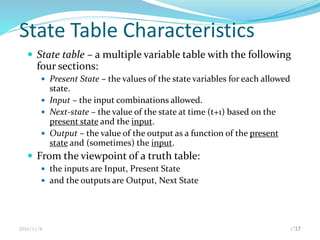
State Table Characteristics
 State table – a multiple variable table with the following
four sections:
 Present State – the values of the state variables for each allowed
state.
 Input – the input combinations allowed.
 Next-state – the value of the state at time (t+1) based on the
present state and the input.
 Output – the value of the output as a function of the present
state and (sometimes) the input.
 From the viewpoint of a truth table:
 the inputs are Input, Present State
 and the outputs are Output, Next State
2016/11/8 1717
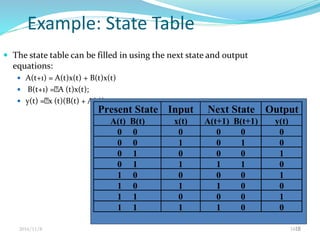
Example: State Table
 The state table can be filled in using the next state and output
equations:
 A(t+1) = A(t)x(t) + B(t)x(t)
 B(t+1) = A (t)x(t);
 y(t) = x (t)(B(t) + A(t))
2016/11/8 1818
Present State Input Next State Output
A(t) B(t) x(t) A(t+1) B(t+1) y(t)
0 0 0 0 0 0
0 0 1 0 1 0
0 1 0 0 0 1
0 1 1 1 1 0
1 0 0 0 0 1
1 0 1 1 0 0
1 1 0 0 0 1
1 1 1 1 0 0
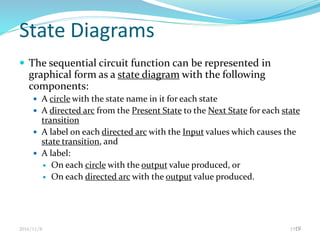
State Diagrams
 The sequential circuit function can be represented in
graphical form as a state diagram with the following
components:
 A circle with the state name in it for each state
 A directed arc from the Present State to the Next State for each state
transition
 A label on each directed arc with the Input values which causes the
state transition, and
 A label:
 On each circle with the output value produced, or
 On each directed arc with the output value produced.
2016/11/8 1919
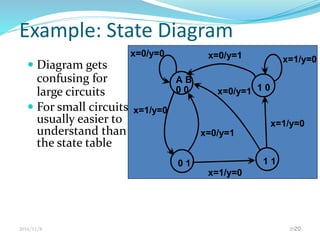
Example: State Diagram
 Diagram gets
confusing for
large circuits
 For small circuits,
usually easier to
understand than
the state table
2016/11/8 2020
A B
0 0
0 1 1 1
1 0
x=0/y=1 x=1/y=0
x=1/y=0
x=1/y=0
x=0/y=1
x=0/y=1
x=1/y=0
x=0/y=0
Summary
 Sequential circuit timing analysis
 Flip-Flop
 Transmission gate based flip-flop design
 Setup time
2016/11/8 2121
Thank you.......(°_°)

Sequential circuits

  • 1.
    Government Engineering college,Bhavnagar semester: 3 Branch:Computer (2015) Name:- Paresh Parmar subject: Digital Electronics Enrollment No: 140210107040 Topic: Sequential Circuits
  • 2.
    Combinational Logic  CombinationalLogic:  Output depends only on current input  Has no memory 2016/11/8 22
  • 3.
    Sequential Logic  SequentialLogic:  Output depends not only on current input but also on past input values, e.g., design a counter  Need some type of memory to remember the past input values 2016/11/8 33
  • 4.
    Sequential Circuits 2016/11/8 SequentialCircuits 44 Circuits that we have learned so far Information Storing Circuits Timed “States”
  • 5.
    Sequential Logic: Concept Sequential Logic circuits remember past inputs and past circuit state.  Outputs from the system are “fed back” as new inputs  With gate delay and wire delay  The storage elements are circuits that are capable of storing binary information: memory. 2016/11/8 55
  • 6.
    Synchronous vs. Asynchronous Thereare two types of sequential circuits:  Synchronous sequential circuit: circuit output changes only at some discrete instants of time. This type of circuits achieves synchronization by using a timing signal called the clock.  Asynchronous sequential circuit: circuit output can change at any time (clockless). 2016/11/8 66
  • 7.
    Clock Period 2016/11/8 77 FFFFCombinational Circuit Smallest clock period = largest combinational circuit delay between any two directly connected FF, subjected to impact of FF setup time. FF
  • 8.
    SR Latch (NANDversion) 2016/11/8 88 S’ R’ Q Q’ 0 0 0 1 1 0 1 1 S’ R’ Q Q’0 0 1 1 0 0 1 0 1 1 1 0 1 1 1 0 X Y NAND 0 1 Hold 1 0 Set 0 1 Reset 1 0 Hold 1 1 Disallowed
  • 9.
    2016/11/8 99 SR Latchwith Clock signal Latch is sensitive to input changes ONLY when C=1
  • 10.
    2016/11/8 1010 D Latchwith Transmission Gates  C=1 TG1 closes and TG2 opens Q’=D’ and Q=D  C=0 TG1 opens and TG2 closes Hold Q and Q’ 2 1
  • 11.
    Flip-Flops  Latches are“transparent” (= any change on the inputs is seen at the outputs immediately when C=1).  This causes synchronization problems.  Solution: use latches to create flip-flops that can respond (update) only on specific times (instead of any time).  Types: RS flip-flop and D flip-flop 2016/11/8 1111
  • 12.
    2016/11/8 1212 S RCLK Q Q’ 0 0 1 Q0 Q0’ Store 0 1 1 0 1 Reset 1 0 1 1 0 Set 1 1 1 1 1 Disallowed X X 0 Q0 Q0’ Store Master-Slave FF configuration using SR latches (cont.) •When C=1, master is enabled and stores new data, slave stores old data. •When C=0, master’s state passes to enabled slave, master not sensitive to new data (disabled).
  • 13.
    Characteristic Tables  Definesthe logical properties of a flip-flop (such as a truth table does for a logic gate).  Q(t) – present state at time t  Q(t+1) – next state at time t+1 2016/11/8 1313
  • 14.
    Characteristic Tables (cont.) SRFlip-Flop S R Q(t+1) Operation 0 0 Q(t) No change/Hold 0 1 0 Reset 1 0 1 Set 1 1 ? Undefined/Invalid 2016/11/8 1414
  • 15.
    Sequential Circuit Analysis Analysis: Consists of obtaining a suitable description that demonstrates the time sequence of inputs, outputs, and states.  Logic diagram: Boolean gates, flip-flops (of any kind), and appropriate interconnections.  The logic diagram is derived from any of the following:  Boolean Equations (FF-Inputs, Outputs)  State Table  State Diagram 2016/11/8 1515
  • 16.
    Example (continued)  Booleanequations for the functions:  A(t+1) = A(t)x(t) + B(t)x(t)  B(t+1) = A’(t)x(t)  y(t) = x’(t)(B(t) + A(t)) 2016/11/8 1616 C D Q Q C D Q Q' y x A A’ B CP Next State Output
  • 17.
    State Table Characteristics State table – a multiple variable table with the following four sections:  Present State – the values of the state variables for each allowed state.  Input – the input combinations allowed.  Next-state – the value of the state at time (t+1) based on the present state and the input.  Output – the value of the output as a function of the present state and (sometimes) the input.  From the viewpoint of a truth table:  the inputs are Input, Present State  and the outputs are Output, Next State 2016/11/8 1717
  • 18.
    Example: State Table The state table can be filled in using the next state and output equations:  A(t+1) = A(t)x(t) + B(t)x(t)  B(t+1) = A (t)x(t);  y(t) = x (t)(B(t) + A(t)) 2016/11/8 1818 Present State Input Next State Output A(t) B(t) x(t) A(t+1) B(t+1) y(t) 0 0 0 0 0 0 0 0 1 0 1 0 0 1 0 0 0 1 0 1 1 1 1 0 1 0 0 0 0 1 1 0 1 1 0 0 1 1 0 0 0 1 1 1 1 1 0 0
  • 19.
    State Diagrams  Thesequential circuit function can be represented in graphical form as a state diagram with the following components:  A circle with the state name in it for each state  A directed arc from the Present State to the Next State for each state transition  A label on each directed arc with the Input values which causes the state transition, and  A label:  On each circle with the output value produced, or  On each directed arc with the output value produced. 2016/11/8 1919
  • 20.
    Example: State Diagram Diagram gets confusing for large circuits  For small circuits, usually easier to understand than the state table 2016/11/8 2020 A B 0 0 0 1 1 1 1 0 x=0/y=1 x=1/y=0 x=1/y=0 x=1/y=0 x=0/y=1 x=0/y=1 x=1/y=0 x=0/y=0
  • 21.
    Summary  Sequential circuittiming analysis  Flip-Flop  Transmission gate based flip-flop design  Setup time 2016/11/8 2121
  • 22.