Mobile Robot Design
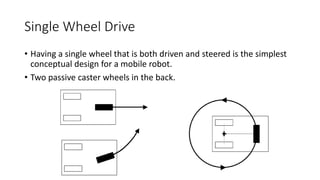
Single Wheel Drive
• Having a single wheel that is both driven and steered is the simplest
conceptual design for a mobile robot.
• Two passive caster wheels in the back.
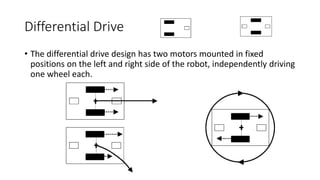
Differential Drive
• The differential drive design has two motors mounted in fixed
positions on the left and right side of the robot, independently driving
one wheel each.
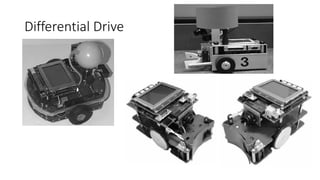
Differential Drive
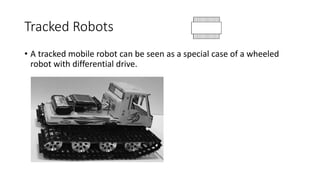
Tracked Robots
• A tracked mobile robot can be seen as a special case of a wheeled
robot with differential drive.
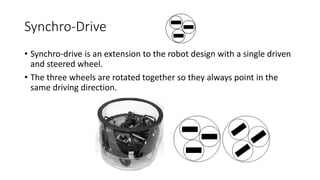
Synchro-Drive
• Synchro-drive is an extension to the robot design with a single driven
and steered wheel.
• The three wheels are rotated together so they always point in the
same driving direction.
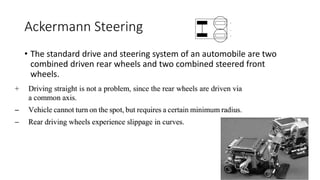
Ackermann Steering
• The standard drive and steering system of an automobile are two
combined driven rear wheels and two combined steered front
wheels.
Omni-directional robot
• Above robots cannot drive in all possible directions.
• For this reason, these robots are called “non-holonomic”.
• In contrast, a “holonomic” or omni-directional robot is capable of
driving in any direction.
• They are capable of driving in any direction in a 2D plane.
Mecanum Wheels
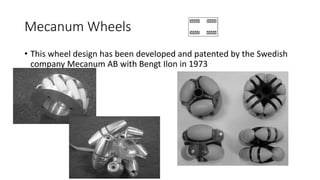
• This wheel design has been developed and patented by the Swedish
company Mecanum AB with Bengt Ilon in 1973
Omni-Directional Drive
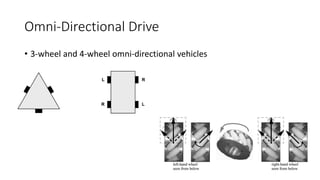
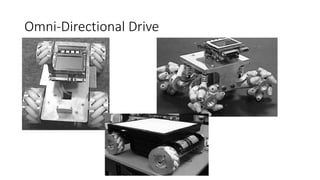
• 3-wheel and 4-wheel omni-directional vehicles
Omni-Directional Drive
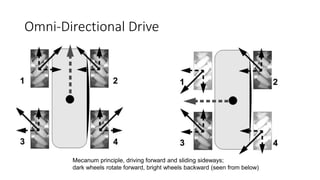
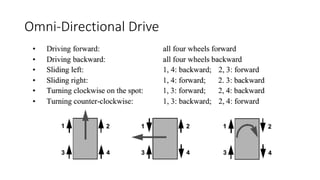
Mecanum principle, driving forward and sliding sideways;
dark wheels rotate forward, bright wheels backward (seen from below)
Omni-Directional Drive
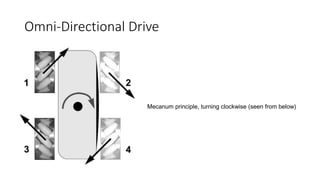
Mecanum principle, turning clockwise (seen from below)
Omni-Directional Drive

Lecture 10 mobile robot design