Sensors and Actuators
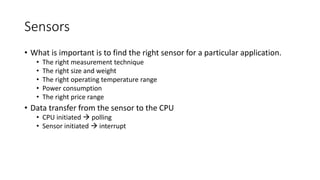
Sensors
• What is important is to find the right sensor for a particular application.
• The right measurement technique
• The right size and weight
• The right operating temperature range
• Power consumption
• The right price range
• Data transfer from the sensor to the CPU
• CPU initiated  polling
• Sensor initiated  interrupt
Sensor output
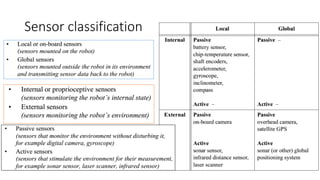
Sensor classification
Analog versus Digital Sensors
• More sensors produce analog signals rather than digital signals.
• Need A/D converter
• Ex:
• Microphone
• Analog infrared distance sensor
• Analog compass
• Barometer sensor
• Digital sensors
• More accurate and more complex
• Analog sensor packed with A/D converter
• Output  parallel interface, serial interface or synchronous serial
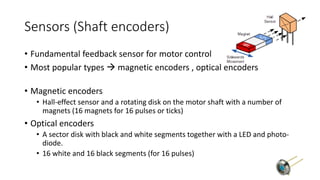
Sensors (Shaft encoders)
• Fundamental feedback sensor for motor control
• Most popular types  magnetic encoders , optical encoders
• Magnetic encoders
• Hall-effect sensor and a rotating disk on the motor shaft with a number of
magnets (16 magnets for 16 pulses or ticks)
• Optical encoders
• A sector disk with black and white segments together with a LED and photo-
diode.
• 16 white and 16 black segments (for 16 pulses)
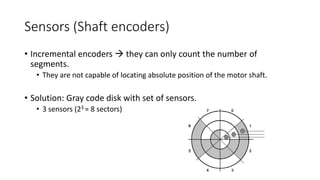
Sensors (Shaft encoders)
• Incremental encoders  they can only count the number of
segments.
• They are not capable of locating absolute position of the motor shaft.
• Solution: Gray code disk with set of sensors.
• 3 sensors (23 = 8 sectors)
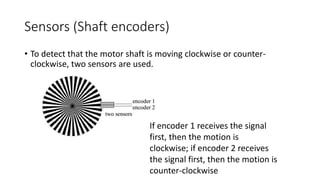
Sensors (Shaft encoders)
• To detect that the motor shaft is moving clockwise or counter-
clockwise, two sensors are used.
If encoder 1 receives the signal
first, then the motion is
clockwise; if encoder 2 receives
the signal first, then the motion is
counter-clockwise
A/D Convertor
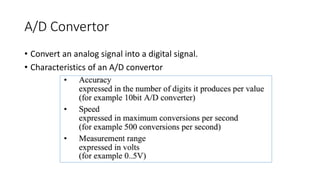
• Convert an analog signal into a digital signal.
• Characteristics of an A/D convertor
A/D Convertor
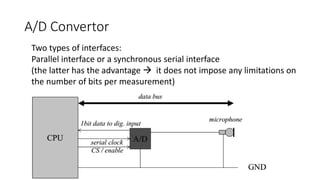
Two types of interfaces:
Parallel interface or a synchronous serial interface
(the latter has the advantage  it does not impose any limitations on
the number of bits per measurement)
Position Sensitive Device
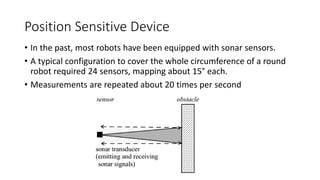
• In the past, most robots have been equipped with sonar sensors.
• A typical configuration to cover the whole circumference of a round
robot required 24 sensors, mapping about 15° each.
• Measurements are repeated about 20 times per second
Position Sensitive Device
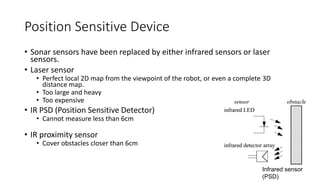
• Sonar sensors have been replaced by either infrared sensors or laser
sensors.
• Laser sensor
• Perfect local 2D map from the viewpoint of the robot, or even a complete 3D
distance map.
• Too large and heavy
• Too expensive
• IR PSD (Position Sensitive Detector)
• Cannot measure less than 6cm
• IR proximity sensor
• Cover obstacles closer than 6cm
Infrared sensor
(PSD)
Compass
• How to track the robot’s position and orientation.
• Standard method:
• “dead reckoning” using shaft encoders
• Error will grow lager and lager over time (ex: wheel slippage)
• Global positioning system (GPS)
• The simplest modules are analog compasses that can only distinguish
eight directions, which are represented by different voltage levels.
• Digital compasses are considerably more complex, but also provide a
much higher directional resolution.
Gyroscope, Accelerometer, Inclinometer
• Accelerometer
Measuring the acceleration along one axis.
• Gyroscope
Measuring the rotational change of orientation about one axis.
• Inclinometer
Measuring the absolute orientation angle about one axis
Digital Camera
• Digital cameras are the most complex sensors used in robotics.
• For mobile robot applications, we are interested in a high frame rate,
because our robot is moving and we want updated sensor data as fast
as possible.
• Since there is always a trade-off between high frame rate and high
resolution, we are not so much concerned with camera resolution.
Actuators
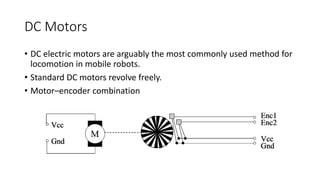
DC Motors
• DC electric motors are arguably the most commonly used method for
locomotion in mobile robots.
• Standard DC motors revolve freely.
• Motor–encoder combination
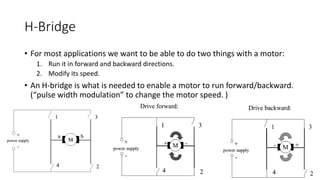
H-Bridge
• For most applications we want to be able to do two things with a motor:
1. Run it in forward and backward directions.
2. Modify its speed.
• An H-bridge is what is needed to enable a motor to run forward/backward.
(“pulse width modulation” to change the motor speed. )
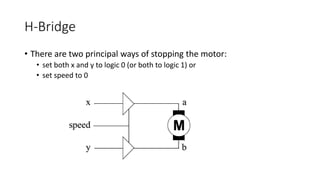
H-Bridge
• There are two principal ways of stopping the motor:
• set both x and y to logic 0 (or both to logic 1) or
• set speed to 0
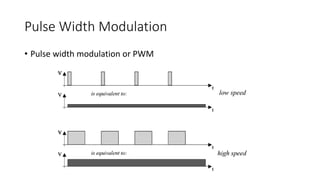
Pulse Width Modulation
• Pulse width modulation or PWM
Stepper Motors
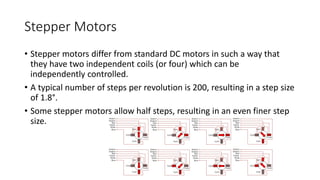
• Stepper motors differ from standard DC motors in such a way that
they have two independent coils (or four) which can be
independently controlled.
• A typical number of steps per revolution is 200, resulting in a step size
of 1.8°.
• Some stepper motors allow half steps, resulting in an even finer step
size.
Servos
• A servo has three wires: VCC, ground, and the PW input control
signal.
• Unlike PWM for DC motors, the input pulse signal for servos is not
transformed into a velocity.
• It is an analog control input to specify the desired position of the
servo’s rotating disk head.
• Internally, a servo combines a DC motor with a simple feedback
circuit, often using a potentiometer sensing the servo head’s current
position.
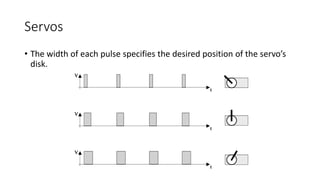
Servos
• The width of each pulse specifies the desired position of the servo’s
disk.
Summary

Lecture 08 robots and controllers

  • 1.
  • 2.
    Sensors • What isimportant is to find the right sensor for a particular application. • The right measurement technique • The right size and weight • The right operating temperature range • Power consumption • The right price range • Data transfer from the sensor to the CPU • CPU initiated  polling • Sensor initiated  interrupt
  • 3.
  • 4.
  • 5.
    Analog versus DigitalSensors • More sensors produce analog signals rather than digital signals. • Need A/D converter • Ex: • Microphone • Analog infrared distance sensor • Analog compass • Barometer sensor • Digital sensors • More accurate and more complex • Analog sensor packed with A/D converter • Output  parallel interface, serial interface or synchronous serial
  • 6.
    Sensors (Shaft encoders) •Fundamental feedback sensor for motor control • Most popular types  magnetic encoders , optical encoders • Magnetic encoders • Hall-effect sensor and a rotating disk on the motor shaft with a number of magnets (16 magnets for 16 pulses or ticks) • Optical encoders • A sector disk with black and white segments together with a LED and photo- diode. • 16 white and 16 black segments (for 16 pulses)
  • 7.
    Sensors (Shaft encoders) •Incremental encoders  they can only count the number of segments. • They are not capable of locating absolute position of the motor shaft. • Solution: Gray code disk with set of sensors. • 3 sensors (23 = 8 sectors)
  • 8.
    Sensors (Shaft encoders) •To detect that the motor shaft is moving clockwise or counter- clockwise, two sensors are used. If encoder 1 receives the signal first, then the motion is clockwise; if encoder 2 receives the signal first, then the motion is counter-clockwise
  • 9.
    A/D Convertor • Convertan analog signal into a digital signal. • Characteristics of an A/D convertor
  • 10.
    A/D Convertor Two typesof interfaces: Parallel interface or a synchronous serial interface (the latter has the advantage  it does not impose any limitations on the number of bits per measurement)
  • 11.
    Position Sensitive Device •In the past, most robots have been equipped with sonar sensors. • A typical configuration to cover the whole circumference of a round robot required 24 sensors, mapping about 15° each. • Measurements are repeated about 20 times per second
  • 12.
    Position Sensitive Device •Sonar sensors have been replaced by either infrared sensors or laser sensors. • Laser sensor • Perfect local 2D map from the viewpoint of the robot, or even a complete 3D distance map. • Too large and heavy • Too expensive • IR PSD (Position Sensitive Detector) • Cannot measure less than 6cm • IR proximity sensor • Cover obstacles closer than 6cm Infrared sensor (PSD)
  • 13.
    Compass • How totrack the robot’s position and orientation. • Standard method: • “dead reckoning” using shaft encoders • Error will grow lager and lager over time (ex: wheel slippage) • Global positioning system (GPS) • The simplest modules are analog compasses that can only distinguish eight directions, which are represented by different voltage levels. • Digital compasses are considerably more complex, but also provide a much higher directional resolution.
  • 14.
    Gyroscope, Accelerometer, Inclinometer •Accelerometer Measuring the acceleration along one axis. • Gyroscope Measuring the rotational change of orientation about one axis. • Inclinometer Measuring the absolute orientation angle about one axis
  • 15.
    Digital Camera • Digitalcameras are the most complex sensors used in robotics. • For mobile robot applications, we are interested in a high frame rate, because our robot is moving and we want updated sensor data as fast as possible. • Since there is always a trade-off between high frame rate and high resolution, we are not so much concerned with camera resolution.
  • 16.
  • 17.
    DC Motors • DCelectric motors are arguably the most commonly used method for locomotion in mobile robots. • Standard DC motors revolve freely. • Motor–encoder combination
  • 18.
    H-Bridge • For mostapplications we want to be able to do two things with a motor: 1. Run it in forward and backward directions. 2. Modify its speed. • An H-bridge is what is needed to enable a motor to run forward/backward. (“pulse width modulation” to change the motor speed. )
  • 19.
    H-Bridge • There aretwo principal ways of stopping the motor: • set both x and y to logic 0 (or both to logic 1) or • set speed to 0
  • 20.
    Pulse Width Modulation •Pulse width modulation or PWM
  • 21.
    Stepper Motors • Steppermotors differ from standard DC motors in such a way that they have two independent coils (or four) which can be independently controlled. • A typical number of steps per revolution is 200, resulting in a step size of 1.8°. • Some stepper motors allow half steps, resulting in an even finer step size.
  • 22.
    Servos • A servohas three wires: VCC, ground, and the PW input control signal. • Unlike PWM for DC motors, the input pulse signal for servos is not transformed into a velocity. • It is an analog control input to specify the desired position of the servo’s rotating disk head. • Internally, a servo combines a DC motor with a simple feedback circuit, often using a potentiometer sensing the servo head’s current position.
  • 23.
    Servos • The widthof each pulse specifies the desired position of the servo’s disk.
  • 24.