Learning presented by Rustam
Lecture Outline
• What is Learning
• Classical Conditioning
• Operant Conditioning
• Classical and Operant Conditioning
• Observational Learning
• Changes By Learning
What is Learning
• Learning is relative change in behavior or
knowledge that is due to experience.
Behaviourism
• Learning is the process of acquiring new
understanding, knowledge, behaviors, skills,
values, attitudes, and preferences. The ability to
learn is possessed by humans, animals, and some
machines; there is also evidence for some kind of
learning in certain plants
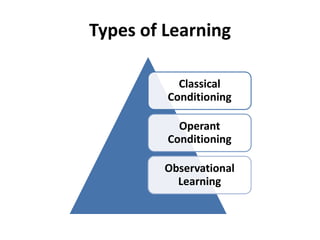
Types of Learning
Classical
Conditioning
Operant
Conditioning
Observational
Learning
Classical Conditioning
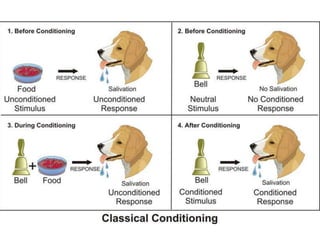
• Discovered by Pavlov Russian Psychologist
• Two stimulus Linked together to produce a
new learned response in a person or animal
• A biologically strong stimulus is paired with a
previously neutral stimulus
Operant Conditioning
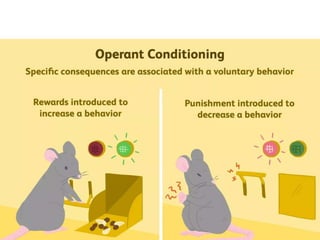
• Discovered by B.F Skinner
• Operant conditioning, or instrumental
conditioning, is a method of learning that
focuses on rewards and punishments for
behavior.
• Through operant conditioning, an association
is made between a behavior and a
consequence (whether negative or positive)
for that behavior.
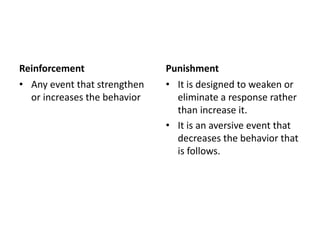
Reinforcement
• Any event that strengthen
or increases the behavior
Punishment
• It is designed to weaken or
eliminate a response rather
than increase it.
• It is an aversive event that
decreases the behavior that
is follows.
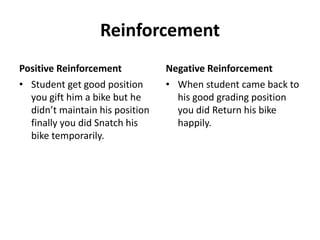
Reinforcement
Positive Reinforcement
• Student get good position
you gift him a bike but he
didn’t maintain his position
finally you did Snatch his
bike temporarily.
Negative Reinforcement
• When student came back to
his good grading position
you did Return his bike
happily.
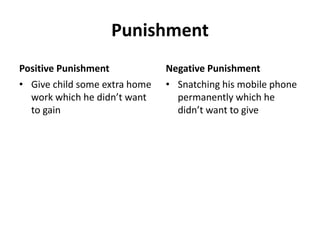
Punishment
Positive Punishment
• Give child some extra home
work which he didn’t want
to gain
Negative Punishment
• Snatching his mobile phone
permanently which he
didn’t want to give
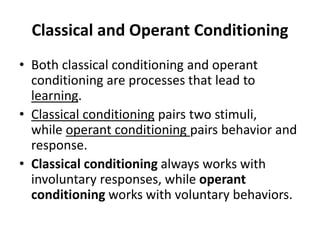
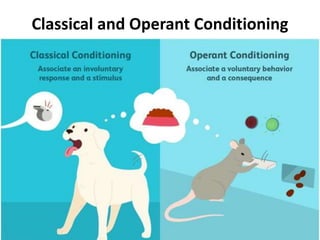
Classical and Operant Conditioning
• Both classical conditioning and operant
conditioning are processes that lead to
learning.
• Classical conditioning pairs two stimuli,
while operant conditioning pairs behavior and
response.
• Classical conditioning always works with
involuntary responses, while operant
conditioning works with voluntary behaviors.
Classical and Operant Conditioning
Observational Learning
• Albert Bandura-Social Learning Theory
• Observational learning is the process of
learning by watching the behaviors of others.
• The targeted behavior is watched, memorized,
and then mimicked.
• Also known as shaping and modeling,
observational learning is most common in
children as they imitate behaviors of adults.
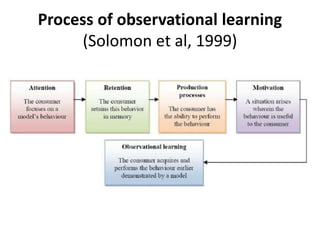
Process of observational learning
(Solomon et al, 1999)
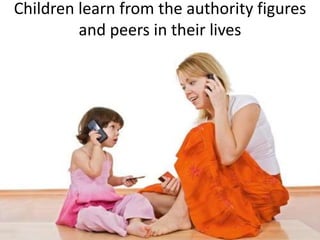
Children learn from the authority figures
and peers in their lives
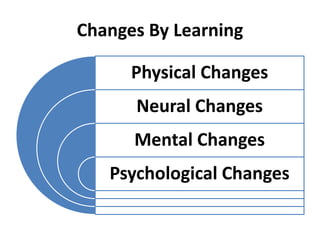
Changes By Learning
Physical Changes
Neural Changes
Mental Changes
Psychological Changes
Thanks

Learning presented by rustam

  • 1.
  • 2.
    Lecture Outline • Whatis Learning • Classical Conditioning • Operant Conditioning • Classical and Operant Conditioning • Observational Learning • Changes By Learning
  • 3.
    What is Learning •Learning is relative change in behavior or knowledge that is due to experience. Behaviourism • Learning is the process of acquiring new understanding, knowledge, behaviors, skills, values, attitudes, and preferences. The ability to learn is possessed by humans, animals, and some machines; there is also evidence for some kind of learning in certain plants
  • 4.
  • 5.
    Classical Conditioning • Discoveredby Pavlov Russian Psychologist • Two stimulus Linked together to produce a new learned response in a person or animal • A biologically strong stimulus is paired with a previously neutral stimulus
  • 7.
    Operant Conditioning • Discoveredby B.F Skinner • Operant conditioning, or instrumental conditioning, is a method of learning that focuses on rewards and punishments for behavior. • Through operant conditioning, an association is made between a behavior and a consequence (whether negative or positive) for that behavior.
  • 9.
    Reinforcement • Any eventthat strengthen or increases the behavior Punishment • It is designed to weaken or eliminate a response rather than increase it. • It is an aversive event that decreases the behavior that is follows.
  • 10.
    Reinforcement Positive Reinforcement • Studentget good position you gift him a bike but he didn’t maintain his position finally you did Snatch his bike temporarily. Negative Reinforcement • When student came back to his good grading position you did Return his bike happily.
  • 11.
    Punishment Positive Punishment • Givechild some extra home work which he didn’t want to gain Negative Punishment • Snatching his mobile phone permanently which he didn’t want to give
  • 12.
    Classical and OperantConditioning • Both classical conditioning and operant conditioning are processes that lead to learning. • Classical conditioning pairs two stimuli, while operant conditioning pairs behavior and response. • Classical conditioning always works with involuntary responses, while operant conditioning works with voluntary behaviors.
  • 13.
  • 14.
    Observational Learning • AlbertBandura-Social Learning Theory • Observational learning is the process of learning by watching the behaviors of others. • The targeted behavior is watched, memorized, and then mimicked. • Also known as shaping and modeling, observational learning is most common in children as they imitate behaviors of adults.
  • 15.
    Process of observationallearning (Solomon et al, 1999)
  • 16.
    Children learn fromthe authority figures and peers in their lives
  • 17.
    Changes By Learning PhysicalChanges Neural Changes Mental Changes Psychological Changes
  • 18.