Definition
Learning is a relatively permanent change in an
organism’s behavior due to experience.
Learning is more flexible in comparison to the
genetically-programmed behaviors
How Do We Learn?
We learn by association. Our minds
naturally connect events that occur in
sequence.
2000 years ago, Aristotle suggested this law
of association.
Behaviorists
• Behavioral perspective - theories that
thoughts, or cognition played NO role in
behavior.
–They disagreed with Freud's theories on the
unconscious mind.
–Only observable behavior had meaning to
them.
• John Locke:
–Environmental determinism - theory which
states our environment shapes every aspect
of who we were, are, and will be.
Classical Conditioning
● Classical Conditioning: a type of learning that
links a neutral stimulus - one that evokes no
special response except to call attention to it - to
another stimulus that elicits a natural or involuntary
response in a given circumstance.
● The association between the two stimuli is one
form of associative learning - a learning in which
ideas and experiences are mentally linked and
thereby reinforce each other.
Associative Learning:
Classical Conditioning
Learning to associate one stimulus
with another.
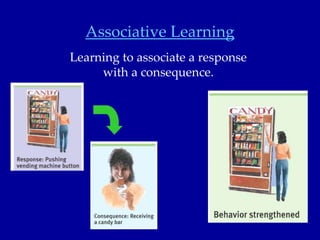
Associative Learning
Learning to associate a response
with a consequence.
Ideas of classical conditioning originate from old
philosophical theories. However, it was the
Russian physiologist Ivan Pavlov who
elucidated classical conditioning. His work
provided a basis for later behaviorists like John
Watson.
Classical Conditioning
Ivan Pavlov (1849-1936)
Sovfoto
Pavlov’s Experiments
Before conditioning, food (Unconditioned
Stimulus, US) produces salivation
(Unconditioned Response, UR). However, the
tone (neutral stimulus) does not.
Pavlov’s Experiments
During conditioning, the neutral stimulus (tone)
and the US (food) are paired, resulting in
salivation (UR). After conditioning, the neutral
stimulus (now Conditioned Stimulus, CS) elicits
salivation (now Conditioned Response, CR)
Acquisition
Acquisition is the initial learning stage in
classical conditioning in which an association
between a neutral stimulus and an
unconditioned stimulus takes place.
1. In most cases, for conditioning to occur, the
neutral stimulus needs to come before the
unconditioned stimulus.
2. The time in between the two stimuli should
be about half a second.
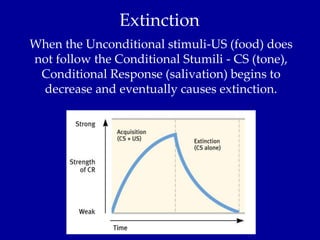
Extinction
When the Unconditional stimuli-US (food) does
not follow the Conditional Stumili - CS (tone),
Conditional Response (salivation) begins to
decrease and eventually causes extinction.
Spontaneous Recovery
After a rest period, an extinguished - Conditional
Response CR (salivation) spontaneously recovers, but if
the Conditional Stumili CS (tone) persists alone, the CR
becomes extinct again.
Stimulus Discrimination
Discrimination is the learned ability to distinguish
between a conditioned stimulus and other stimuli that
do not signal an unconditioned stimulus.
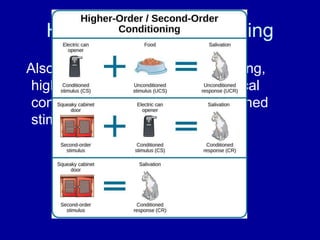
Higher Order Conditioning
Also called second order conditioning,
higher order conditioning is classical
conditioning with an extra conditioned
stimulus.
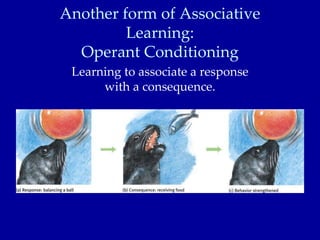
Another form of Associative
Learning:
Operant Conditioning
Learning to associate a response
with a consequence.
Operant & Classical Conditioning
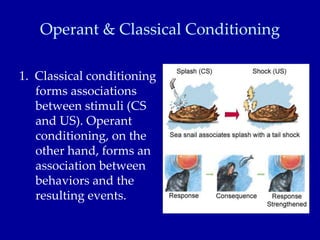
1. Classical conditioning
forms associations
between stimuli (CS
and US). Operant
conditioning, on the
other hand, forms an
association between
behaviors and the
resulting events.
Operant & Classical Conditioning
2. Classical conditioning involves respondent
behavior that occurs as an automatic
response to a certain stimulus. Operant
conditioning involves operant behavior, a
behavior that operates on the environment,
producing rewarding or punishing stimuli
(consequences). Operant conditioning can
also be known as instrumental conditioning
Types of Reinforcers
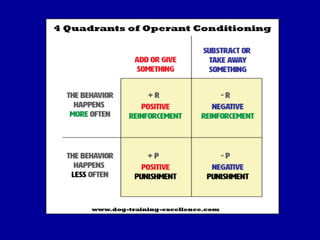
Reinforcement: Any event that strengthens the
behavior it follows. A heat lamp positively
reinforces a meerkat’s behavior in the cold.
Reuters/
Corbis
Punishment
An aversive event that decreases the behavior it
follows.
Punishment
1. Results in unwanted fears.
2. Conveys no information to the organism.
3. Justifies pain to others.
4. Causes unwanted behaviors to reappear in its
absence.
5. Causes aggression towards the agent.
6. Causes one unwanted behavior to appear in
place of another.
Although there may be some justification for
occasional punishment (it usually leads to negative
effects.
Intrinsic Motivation
Intrinsic Motivation:
The desire to perform a
behavior for its own
sake.
Extrinsic Motivation:
The desire to perform a
behavior due to
promised rewards or
threats of punishments.
Applications of Operant
Conditioning
At Home
In children, reinforcing good behavior increases
the occurrence of these behaviors. Ignoring
unwanted behavior decreases their occurrence.
Operant vs. Classical Conditioning
Learning by Observation
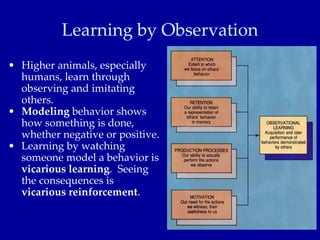
• Higher animals, especially
humans, learn through
observing and imitating
others.
• Modeling behavior shows
how something is done,
whether negative or positive.
• Learning by watching
someone model a behavior is
vicarious learning. Seeing
the consequences is
vicarious reinforcement.
Modeling Violence
Research shows that viewing media violence
leads to an increased expression of aggression.
Children modeling after pro wrestlers
Bob
Daemmrich/
The
Image
Works
Glassman/
The
Image
Works

learning theories.pptx

  • 2.
    Definition Learning is arelatively permanent change in an organism’s behavior due to experience. Learning is more flexible in comparison to the genetically-programmed behaviors
  • 3.
    How Do WeLearn? We learn by association. Our minds naturally connect events that occur in sequence. 2000 years ago, Aristotle suggested this law of association.
  • 4.
    Behaviorists • Behavioral perspective- theories that thoughts, or cognition played NO role in behavior. –They disagreed with Freud's theories on the unconscious mind. –Only observable behavior had meaning to them. • John Locke: –Environmental determinism - theory which states our environment shapes every aspect of who we were, are, and will be.
  • 5.
    Classical Conditioning ● ClassicalConditioning: a type of learning that links a neutral stimulus - one that evokes no special response except to call attention to it - to another stimulus that elicits a natural or involuntary response in a given circumstance. ● The association between the two stimuli is one form of associative learning - a learning in which ideas and experiences are mentally linked and thereby reinforce each other.
  • 6.
    Associative Learning: Classical Conditioning Learningto associate one stimulus with another.
  • 7.
    Associative Learning Learning toassociate a response with a consequence.
  • 8.
    Ideas of classicalconditioning originate from old philosophical theories. However, it was the Russian physiologist Ivan Pavlov who elucidated classical conditioning. His work provided a basis for later behaviorists like John Watson. Classical Conditioning Ivan Pavlov (1849-1936) Sovfoto
  • 9.
    Pavlov’s Experiments Before conditioning,food (Unconditioned Stimulus, US) produces salivation (Unconditioned Response, UR). However, the tone (neutral stimulus) does not.
  • 10.
    Pavlov’s Experiments During conditioning,the neutral stimulus (tone) and the US (food) are paired, resulting in salivation (UR). After conditioning, the neutral stimulus (now Conditioned Stimulus, CS) elicits salivation (now Conditioned Response, CR)
  • 11.
    Acquisition Acquisition is theinitial learning stage in classical conditioning in which an association between a neutral stimulus and an unconditioned stimulus takes place. 1. In most cases, for conditioning to occur, the neutral stimulus needs to come before the unconditioned stimulus. 2. The time in between the two stimuli should be about half a second.
  • 12.
    Extinction When the Unconditionalstimuli-US (food) does not follow the Conditional Stumili - CS (tone), Conditional Response (salivation) begins to decrease and eventually causes extinction.
  • 13.
    Spontaneous Recovery After arest period, an extinguished - Conditional Response CR (salivation) spontaneously recovers, but if the Conditional Stumili CS (tone) persists alone, the CR becomes extinct again.
  • 14.
    Stimulus Discrimination Discrimination isthe learned ability to distinguish between a conditioned stimulus and other stimuli that do not signal an unconditioned stimulus.
  • 15.
    Higher Order Conditioning Alsocalled second order conditioning, higher order conditioning is classical conditioning with an extra conditioned stimulus.
  • 16.
    Another form ofAssociative Learning: Operant Conditioning Learning to associate a response with a consequence.
  • 17.
    Operant & ClassicalConditioning 1. Classical conditioning forms associations between stimuli (CS and US). Operant conditioning, on the other hand, forms an association between behaviors and the resulting events.
  • 18.
    Operant & ClassicalConditioning 2. Classical conditioning involves respondent behavior that occurs as an automatic response to a certain stimulus. Operant conditioning involves operant behavior, a behavior that operates on the environment, producing rewarding or punishing stimuli (consequences). Operant conditioning can also be known as instrumental conditioning
  • 19.
    Types of Reinforcers Reinforcement:Any event that strengthens the behavior it follows. A heat lamp positively reinforces a meerkat’s behavior in the cold. Reuters/ Corbis
  • 20.
    Punishment An aversive eventthat decreases the behavior it follows.
  • 21.
    Punishment 1. Results inunwanted fears. 2. Conveys no information to the organism. 3. Justifies pain to others. 4. Causes unwanted behaviors to reappear in its absence. 5. Causes aggression towards the agent. 6. Causes one unwanted behavior to appear in place of another. Although there may be some justification for occasional punishment (it usually leads to negative effects.
  • 23.
    Intrinsic Motivation Intrinsic Motivation: Thedesire to perform a behavior for its own sake. Extrinsic Motivation: The desire to perform a behavior due to promised rewards or threats of punishments.
  • 24.
    Applications of Operant Conditioning AtHome In children, reinforcing good behavior increases the occurrence of these behaviors. Ignoring unwanted behavior decreases their occurrence.
  • 25.
  • 26.
    Learning by Observation •Higher animals, especially humans, learn through observing and imitating others. • Modeling behavior shows how something is done, whether negative or positive. • Learning by watching someone model a behavior is vicarious learning. Seeing the consequences is vicarious reinforcement.
  • 27.
    Modeling Violence Research showsthat viewing media violence leads to an increased expression of aggression. Children modeling after pro wrestlers Bob Daemmrich/ The Image Works Glassman/ The Image Works