Behaviorism

   Review of Behaviorism and its
  applications to student behavior
A. Classical Behaviorism
1.   Behaviorists believe that we should examine
     only what can be directly observed and
     measured (Santrock, 2004).
2.   Traditional behaviorist view: child is passive
     being whom adults can model by carefully
     controlling stimulus-response associations:
     development is continuous
     process, consisting of gradual increase with
     age in number and strength of associations
A. Classical Behaviorism
1.   Watson: concluded that environment is
     supreme force in development
2.   Skinner (1904-1990): rejected Hull‟s idea;
     child's desirable behavior can be increased
     by following it with a wide variety of
     reinforcers; can be decreased through
     punishment.
A. Classical Behaviorism
3.   Two versions of the behavioral
     approach that are prominent today re
     the view of B.F. Skinner and social
     learning theory.
4.   Skinner (1904-1990): behaviorism
     emphasizes the scientific study of
     observable responses and their
     environmental determinants (Santrock, 2004).
A. Classical Behaviorism
As a result of Skinner‟s work, operant
   conditioning became a broadly applied
   learning principle in child psychology.
* Brainstorm examples of classical
   behaviorism in your classroom and
   school today.
Four Techniques in Behaviorism
   Negative reinforcement
   Positive reinforcement
   Response cost (reinforcement removal)
   Punishment
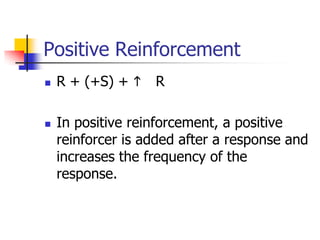
Positive Reinforcement
   Positive Reinforcement--the term
    reinforcement always indicates a
    process that strengthens a behavior;
    the word positive has two cues
    associated with it. First, a positive or
    pleasant stimulus is used in the
    process, and second, the reinforcer is
    added (i.e., "positive" as in + sign for
    addition).
Positive Reinforcement
   R + (+S) + h R

   In positive reinforcement, a positive
    reinforcer is added after a response and
    increases the frequency of the
    response.
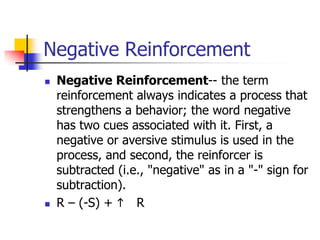
Negative Reinforcement
   Negative Reinforcement-- the term
    reinforcement always indicates a process that
    strengthens a behavior; the word negative
    has two cues associated with it. First, a
    negative or aversive stimulus is used in the
    process, and second, the reinforcer is
    subtracted (i.e., "negative" as in a "-" sign for
    subtraction).
   R – (-S) + h R
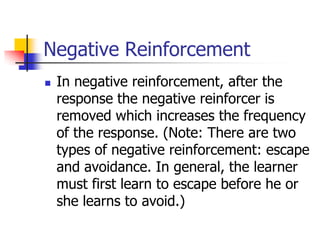
Negative Reinforcement
   In negative reinforcement, after the
    response the negative reinforcer is
    removed which increases the frequency
    of the response. (Note: There are two
    types of negative reinforcement: escape
    and avoidance. In general, the learner
    must first learn to escape before he or
    she learns to avoid.)
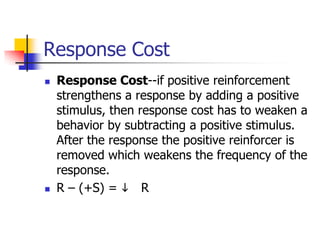
Response Cost
   Response Cost--if positive reinforcement
    strengthens a response by adding a positive
    stimulus, then response cost has to weaken a
    behavior by subtracting a positive stimulus.
    After the response the positive reinforcer is
    removed which weakens the frequency of the
    response.
   R – (+S) = i R
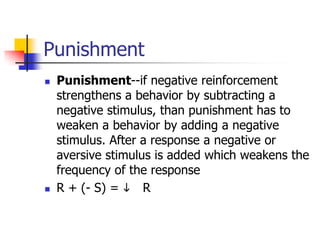
Punishment
   Punishment--if negative reinforcement
    strengthens a behavior by subtracting a
    negative stimulus, than punishment has to
    weaken a behavior by adding a negative
    stimulus. After a response a negative or
    aversive stimulus is added which weakens the
    frequency of the response
   R + (- S) = i R
B. Social Learning Theory
   Built on the principles of conditioning
    and reinforcement offering expanded
    views of how children and adults
    acquire new responses.
   1950‟s: social learning theory became a
    major force in child development
    research
B. Social Learning Theory
   Bandura demonstrated that modeling,
    otherwise known as imitation or
    observational learning is basis for wide
    variety of children‟s behaviors; children
    acquire many favorable and unfavorable
    responses by watching and listening to
    people around them.
B. Social Learning Theory
   Most recent revision of Bandura‟s
    theory places so much emphasis on
    how children think about themselves
    and other people that he calls it social-
    cognitive theory, rather than social
    learning theory.
C. Contributions of
behaviorism
   “applied behavior analysis” refers to
    procedures that combine conditioning
    and modeling to eliminate undesirable
    behaviors that increase socially
    acceptable responses.
   (aggression, language difficulties and
    extreme fears)
D. Criticisms of behaviorism
   Behaviorism and social learning theory
    have been criticized for underestimating
    children‟s role in their own
    development.
E. Applications of behaviorism
1.   Language
2.   Foundations of morality
3.   Aggression
4.   Role of punishment
5.   Gender development
E. Applications of Behaviorism
   1. Language
       Acquired through operant conditioning
       Imitation explains how children rapidly
        acquire complex utterances
E. Applications of Behaviorism
2. Foundations of Morality
     Operant conditioning is regarded as important
      way in which children pick up new responses
     OC is not enough
     Social learning: children largely learn to act
      morally through modeling
     Once moral response is acquired, reinforcement
      in form of praise increases its frequency
E. Applications of Behaviorism
3. Aggression
     Studies of aggression and its relationship
      to viewing violence
E. Applications of Behaviorism
4. Role of punishment: promotes only
    momentary compliance, not lasting
    changed in child‟s behavior
  If used, can increase effectiveness by:
    1.   Consistency
    2.   Warm adult-child relationship
    3.   explanations
E. Applications of Behaviorism
5. Gender development
  1.   Both social learning theory (modeling and
       reinforcement) and cognitive-
       development theory (children as active
       thinkers) offer approaches to explaining
       children‟ gender typing
  2.   Emergence of gender schema theory
Behaviorism
   Grading student work and behavior
       What products do you grade?
       What work habits do you look for?
       What is problem solving behavior?
Social learning theory
   In 1997 work, Bandura outlines
    important aspects of developing self-
    efficacy in children & adolescents.
       Self-efficacy: the expectation that one can
        master a situation and produce positive
        outcomes
Acquiring Self - Efficacy
   Bandura (1982, 1997) suggested four
    principal sources by which people gain
    information to influence their self-
    efficacy beliefs.
Enactive Mastery

   “a learner‟s own previous success at a
    task.”


   Driscoll, M. P. (2007) Psychology of learning for instruction (3rd
    ed). Boston: Allyn & Bacon. p. 318
Vicarious Experiences

   “the learner‟s observation of a role
    model attaining success at a task.”

   Driscoll, M. P. (2007) Psychology of learning for instruction (3rd
    ed). Boston: Allyn & Bacon. p. 318
Verbal persuasion

   “others persuading a learner that he or
    she is capable of succeeding at a
    particular task.”

   Driscoll, M. P. (2007) Psychology of learning for instruction (3rd
    ed). Boston: Allyn & Bacon. p. 318
Physiological States

   “their „gut feeling‟ convinces them of
    probably success for failure”

   Driscoll, M. P. (2007) Psychology of learning for instruction (3rd
    ed). Boston: Allyn & Bacon. p. 318
Infants
   Infants need a stimulating environment
    that encourages them to sense that
    their actions produce outcomes.
Self efficacy in young children
   Young children are developing self-
    efficacy
   Young children‟s requirements for
    extensive monitoring by competent
    adults
Parental role in self-efficacy
   Over-protective parents constrain
    children‟s master capabilities.
   Secure parents are more likely to
    encourage children‟s exploratory efforts
    and give them an opportunity to
    experience a feeling of mastery.
The school‟s role in developing
self-efficacy
   A basic goal of education is to equip
    children with the self-control that
    enables children to educate themselves;
    as children master cognitive skills they
    develop a growing sense of intellectual
    self-efficacy
Self-efficacy in adolescence
   As children move into adolescence, they
    have to assume increasing responsibility
    for their behavior.
   The way in which adolescents develop
    and exercise their self-efficacy can be
    critical in setting the courses that their
    life paths take.
Self-efficacy, in summary
   When children have high self-
    efficacy, they are more likely to do well
    in school and be more competent in a
    number of areas of life than when they
    have low self-efficacy
    (Bandura, 1997, 1998)
References
   Berk, L. (1999). Infants, and children: Infancy
    through middle childhood. Boston: Allyn & Bacon
   Kail, R. (1998). Children and their development.
    Upper Saddle River, NJ: Prentice Hall.
   Santrock, J. (2000). Children (6th ed.). McGraw Hill.

Behaviorism

  • 1.
    Behaviorism Review of Behaviorism and its applications to student behavior
  • 2.
    A. Classical Behaviorism 1. Behaviorists believe that we should examine only what can be directly observed and measured (Santrock, 2004). 2. Traditional behaviorist view: child is passive being whom adults can model by carefully controlling stimulus-response associations: development is continuous process, consisting of gradual increase with age in number and strength of associations
  • 3.
    A. Classical Behaviorism 1. Watson: concluded that environment is supreme force in development 2. Skinner (1904-1990): rejected Hull‟s idea; child's desirable behavior can be increased by following it with a wide variety of reinforcers; can be decreased through punishment.
  • 4.
    A. Classical Behaviorism 3. Two versions of the behavioral approach that are prominent today re the view of B.F. Skinner and social learning theory. 4. Skinner (1904-1990): behaviorism emphasizes the scientific study of observable responses and their environmental determinants (Santrock, 2004).
  • 5.
    A. Classical Behaviorism Asa result of Skinner‟s work, operant conditioning became a broadly applied learning principle in child psychology. * Brainstorm examples of classical behaviorism in your classroom and school today.
  • 6.
    Four Techniques inBehaviorism  Negative reinforcement  Positive reinforcement  Response cost (reinforcement removal)  Punishment
  • 7.
    Positive Reinforcement  Positive Reinforcement--the term reinforcement always indicates a process that strengthens a behavior; the word positive has two cues associated with it. First, a positive or pleasant stimulus is used in the process, and second, the reinforcer is added (i.e., "positive" as in + sign for addition).
  • 8.
    Positive Reinforcement  R + (+S) + h R  In positive reinforcement, a positive reinforcer is added after a response and increases the frequency of the response.
  • 9.
    Negative Reinforcement  Negative Reinforcement-- the term reinforcement always indicates a process that strengthens a behavior; the word negative has two cues associated with it. First, a negative or aversive stimulus is used in the process, and second, the reinforcer is subtracted (i.e., "negative" as in a "-" sign for subtraction).  R – (-S) + h R
  • 10.
    Negative Reinforcement  In negative reinforcement, after the response the negative reinforcer is removed which increases the frequency of the response. (Note: There are two types of negative reinforcement: escape and avoidance. In general, the learner must first learn to escape before he or she learns to avoid.)
  • 11.
    Response Cost  Response Cost--if positive reinforcement strengthens a response by adding a positive stimulus, then response cost has to weaken a behavior by subtracting a positive stimulus. After the response the positive reinforcer is removed which weakens the frequency of the response.  R – (+S) = i R
  • 12.
    Punishment  Punishment--if negative reinforcement strengthens a behavior by subtracting a negative stimulus, than punishment has to weaken a behavior by adding a negative stimulus. After a response a negative or aversive stimulus is added which weakens the frequency of the response  R + (- S) = i R
  • 13.
    B. Social LearningTheory  Built on the principles of conditioning and reinforcement offering expanded views of how children and adults acquire new responses.  1950‟s: social learning theory became a major force in child development research
  • 14.
    B. Social LearningTheory  Bandura demonstrated that modeling, otherwise known as imitation or observational learning is basis for wide variety of children‟s behaviors; children acquire many favorable and unfavorable responses by watching and listening to people around them.
  • 15.
    B. Social LearningTheory  Most recent revision of Bandura‟s theory places so much emphasis on how children think about themselves and other people that he calls it social- cognitive theory, rather than social learning theory.
  • 16.
    C. Contributions of behaviorism  “applied behavior analysis” refers to procedures that combine conditioning and modeling to eliminate undesirable behaviors that increase socially acceptable responses.  (aggression, language difficulties and extreme fears)
  • 17.
    D. Criticisms ofbehaviorism  Behaviorism and social learning theory have been criticized for underestimating children‟s role in their own development.
  • 18.
    E. Applications ofbehaviorism 1. Language 2. Foundations of morality 3. Aggression 4. Role of punishment 5. Gender development
  • 19.
    E. Applications ofBehaviorism  1. Language  Acquired through operant conditioning  Imitation explains how children rapidly acquire complex utterances
  • 20.
    E. Applications ofBehaviorism 2. Foundations of Morality  Operant conditioning is regarded as important way in which children pick up new responses  OC is not enough  Social learning: children largely learn to act morally through modeling  Once moral response is acquired, reinforcement in form of praise increases its frequency
  • 21.
    E. Applications ofBehaviorism 3. Aggression  Studies of aggression and its relationship to viewing violence
  • 22.
    E. Applications ofBehaviorism 4. Role of punishment: promotes only momentary compliance, not lasting changed in child‟s behavior If used, can increase effectiveness by: 1. Consistency 2. Warm adult-child relationship 3. explanations
  • 23.
    E. Applications ofBehaviorism 5. Gender development 1. Both social learning theory (modeling and reinforcement) and cognitive- development theory (children as active thinkers) offer approaches to explaining children‟ gender typing 2. Emergence of gender schema theory
  • 24.
    Behaviorism  Grading student work and behavior  What products do you grade?  What work habits do you look for?  What is problem solving behavior?
  • 25.
    Social learning theory  In 1997 work, Bandura outlines important aspects of developing self- efficacy in children & adolescents.  Self-efficacy: the expectation that one can master a situation and produce positive outcomes
  • 26.
    Acquiring Self -Efficacy  Bandura (1982, 1997) suggested four principal sources by which people gain information to influence their self- efficacy beliefs.
  • 27.
    Enactive Mastery  “a learner‟s own previous success at a task.”  Driscoll, M. P. (2007) Psychology of learning for instruction (3rd ed). Boston: Allyn & Bacon. p. 318
  • 28.
    Vicarious Experiences  “the learner‟s observation of a role model attaining success at a task.”  Driscoll, M. P. (2007) Psychology of learning for instruction (3rd ed). Boston: Allyn & Bacon. p. 318
  • 29.
    Verbal persuasion  “others persuading a learner that he or she is capable of succeeding at a particular task.”  Driscoll, M. P. (2007) Psychology of learning for instruction (3rd ed). Boston: Allyn & Bacon. p. 318
  • 30.
    Physiological States  “their „gut feeling‟ convinces them of probably success for failure”  Driscoll, M. P. (2007) Psychology of learning for instruction (3rd ed). Boston: Allyn & Bacon. p. 318
  • 31.
    Infants  Infants need a stimulating environment that encourages them to sense that their actions produce outcomes.
  • 32.
    Self efficacy inyoung children  Young children are developing self- efficacy  Young children‟s requirements for extensive monitoring by competent adults
  • 33.
    Parental role inself-efficacy  Over-protective parents constrain children‟s master capabilities.  Secure parents are more likely to encourage children‟s exploratory efforts and give them an opportunity to experience a feeling of mastery.
  • 34.
    The school‟s rolein developing self-efficacy  A basic goal of education is to equip children with the self-control that enables children to educate themselves;  as children master cognitive skills they develop a growing sense of intellectual self-efficacy
  • 35.
    Self-efficacy in adolescence  As children move into adolescence, they have to assume increasing responsibility for their behavior.  The way in which adolescents develop and exercise their self-efficacy can be critical in setting the courses that their life paths take.
  • 36.
    Self-efficacy, in summary  When children have high self- efficacy, they are more likely to do well in school and be more competent in a number of areas of life than when they have low self-efficacy (Bandura, 1997, 1998)
  • 37.
    References  Berk, L. (1999). Infants, and children: Infancy through middle childhood. Boston: Allyn & Bacon  Kail, R. (1998). Children and their development. Upper Saddle River, NJ: Prentice Hall.  Santrock, J. (2000). Children (6th ed.). McGraw Hill.