Dr.R.Venkatesan PhD(IITM)
Professor –NICMAR Hyderabad
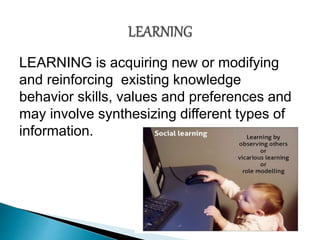
LEARNING is acquiring new or modifying
and reinforcing existing knowledge
behavior skills, values and preferences and
may involve synthesizing different types of
information.
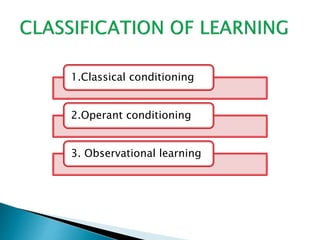
1.Classical conditioning
2.Operant conditioning
3. Observational learning
CLASSICAL CONDITIONING
THEORY
Classical conditioning
was the first type of learning to be
discovered and studied within the
behaviorist tradition. Conditioning is a
kind of response build up through
repeated exposure.The major theorist in the development of
classical conditioning is Ivan Pavlov, a
Russian scientist trained in biology and
medicine .
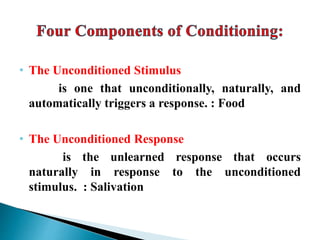
• The Unconditioned Stimulus
is one that unconditionally, naturally, and
automatically triggers a response. : Food
• The Unconditioned Response
is the unlearned response that occurs
naturally in response to the unconditioned
stimulus. : Salivation
• The Conditioned Stimulus
is previously neutral stimulus that, after
becoming associated with the unconditioned
stimulus, eventually comes to trigger a conditioned
response. : Ring + food
• The Conditioned Response
is the learned response to the previously
neutral stimulus. : Ringing + Salivation
Classical conditioning
was the first type of learning to be discovered
and studied within the behaviorist tradition.
Conditioning is a kind of response build up
through repeated exposure.
The major theorist in the development
of classical conditioning is Ivan Pavlov, a
Russian scientist trained in biology and
medicine .
During Conditioning
Food- US( Unconditioned Stimulus)
Bell – NS ( Neutral stimulus)
After conditioning
Bell - Conditioned stimulus
Dog - Conditioned response
 One of the famous example of classical
conditioning was John B. Watson's experiment
in which a fear response was conditioned in a
young boy known as “Little Albert”. The child
initially showed no fear of a white rat, but
after the presentation of the rat was paired
repeatedly with loud, scary sounds, the child
would cry when the rat was present. The
child's fear also generalized to other fuzzy
white objects.
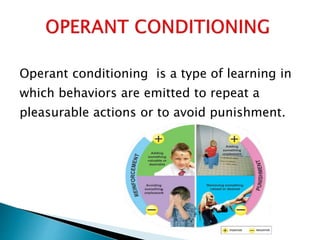
Operant conditioning is a type of learning in
which behaviors are emitted to repeat a
pleasurable actions or to avoid punishment.
REINFORCEMENT is something that happens
after a behavior or event that strengthens or
increases behavior likely to occur again.
+ VE REINFORCRMRNT -VE REINFORCEMENT
 Positive reinforcements
are favorable events or
outcomes that are
presented after the
behavior. A behavior
is strengthened by the
addition of something.
Negative reinforcement
In these situations, a
response is
strengthened by the
removal of something
considered unpleasant.
(e.g. headache–by taking
aspirin headache gone)
 PUNISHMENT is the presentation of an
adverse event or outcome that causes a
decrease in the behavior it follows.
 Classical
Conditioning
Here, the person
learns an association
between two stimuli.
 It usually deals with
reflexive or
involuntary
responses such as
physiological or
emotional responses.
 Operant conditioning
Here, the person
learn an association
between the behavior
and its
consequences.
 it usually deals with
voluntary behaviors
such as active
behaviors that
operate on the
environment.
 Operant conditioning is the basic learning
process that involves changing the
probability that a response will be repeated
by manipulating the consequences that
response.
a. Reinforcement
1. Followed by desirable event
2. Ends an undesirable event
b. Punishment
1. Followed by an undesirable event
2. Ends a desirable event
 Learning by
observing others.
Also called SOCIAL
LEARNING.
 Do we learn by
observing others?
 What do we learn by
observing others?
 Attention — Observing the behavior.
 Retention — Remembering what you paid
attention to
 Reproduction — Being able to reproduce the
image, Including physical capabilities.
 Motivation — Includes having a good reason
to imitate.
 Action — Behaving and practicing .
The ability to store information is an
important part of the learning process
REMEMBERING & RECALLING
Once you have paid attention to the model and
retained the information, it is time to actually
perform the behavior you observed.
IMITATING
ACTION
attention retention processing
motivationaction
- Is a theory of
learning based upon the idea that all
behavior are acquired through conditioning.
Conditioning occurs through interaction
with the environment.
 learning

learning

  • 1.
  • 2.
    LEARNING is acquiringnew or modifying and reinforcing existing knowledge behavior skills, values and preferences and may involve synthesizing different types of information.
  • 3.
  • 4.
    CLASSICAL CONDITIONING THEORY Classical conditioning wasthe first type of learning to be discovered and studied within the behaviorist tradition. Conditioning is a kind of response build up through repeated exposure.The major theorist in the development of classical conditioning is Ivan Pavlov, a Russian scientist trained in biology and medicine .
  • 6.
    • The UnconditionedStimulus is one that unconditionally, naturally, and automatically triggers a response. : Food • The Unconditioned Response is the unlearned response that occurs naturally in response to the unconditioned stimulus. : Salivation
  • 7.
    • The ConditionedStimulus is previously neutral stimulus that, after becoming associated with the unconditioned stimulus, eventually comes to trigger a conditioned response. : Ring + food • The Conditioned Response is the learned response to the previously neutral stimulus. : Ringing + Salivation
  • 8.
    Classical conditioning was thefirst type of learning to be discovered and studied within the behaviorist tradition. Conditioning is a kind of response build up through repeated exposure. The major theorist in the development of classical conditioning is Ivan Pavlov, a Russian scientist trained in biology and medicine .
  • 10.
    During Conditioning Food- US(Unconditioned Stimulus) Bell – NS ( Neutral stimulus)
  • 11.
    After conditioning Bell -Conditioned stimulus Dog - Conditioned response
  • 13.
     One ofthe famous example of classical conditioning was John B. Watson's experiment in which a fear response was conditioned in a young boy known as “Little Albert”. The child initially showed no fear of a white rat, but after the presentation of the rat was paired repeatedly with loud, scary sounds, the child would cry when the rat was present. The child's fear also generalized to other fuzzy white objects.
  • 15.
    Operant conditioning isa type of learning in which behaviors are emitted to repeat a pleasurable actions or to avoid punishment.
  • 17.
    REINFORCEMENT is somethingthat happens after a behavior or event that strengthens or increases behavior likely to occur again.
  • 18.
    + VE REINFORCRMRNT-VE REINFORCEMENT  Positive reinforcements are favorable events or outcomes that are presented after the behavior. A behavior is strengthened by the addition of something. Negative reinforcement In these situations, a response is strengthened by the removal of something considered unpleasant. (e.g. headache–by taking aspirin headache gone)
  • 19.
     PUNISHMENT isthe presentation of an adverse event or outcome that causes a decrease in the behavior it follows.
  • 20.
     Classical Conditioning Here, theperson learns an association between two stimuli.  It usually deals with reflexive or involuntary responses such as physiological or emotional responses.  Operant conditioning Here, the person learn an association between the behavior and its consequences.  it usually deals with voluntary behaviors such as active behaviors that operate on the environment.
  • 21.
     Operant conditioningis the basic learning process that involves changing the probability that a response will be repeated by manipulating the consequences that response. a. Reinforcement 1. Followed by desirable event 2. Ends an undesirable event b. Punishment 1. Followed by an undesirable event 2. Ends a desirable event
  • 24.
     Learning by observingothers. Also called SOCIAL LEARNING.  Do we learn by observing others?  What do we learn by observing others?
  • 25.
     Attention —Observing the behavior.  Retention — Remembering what you paid attention to  Reproduction — Being able to reproduce the image, Including physical capabilities.  Motivation — Includes having a good reason to imitate.  Action — Behaving and practicing .
  • 27.
    The ability tostore information is an important part of the learning process REMEMBERING & RECALLING
  • 28.
    Once you havepaid attention to the model and retained the information, it is time to actually perform the behavior you observed. IMITATING
  • 30.
  • 31.
  • 32.
    - Is atheory of learning based upon the idea that all behavior are acquired through conditioning. Conditioning occurs through interaction with the environment.