Sheena E. Bernal April 22, 2014
3rd Year / BEEd-SpEd Dr. Fely S. Colansi
Assignment:
1. Define the following terms:
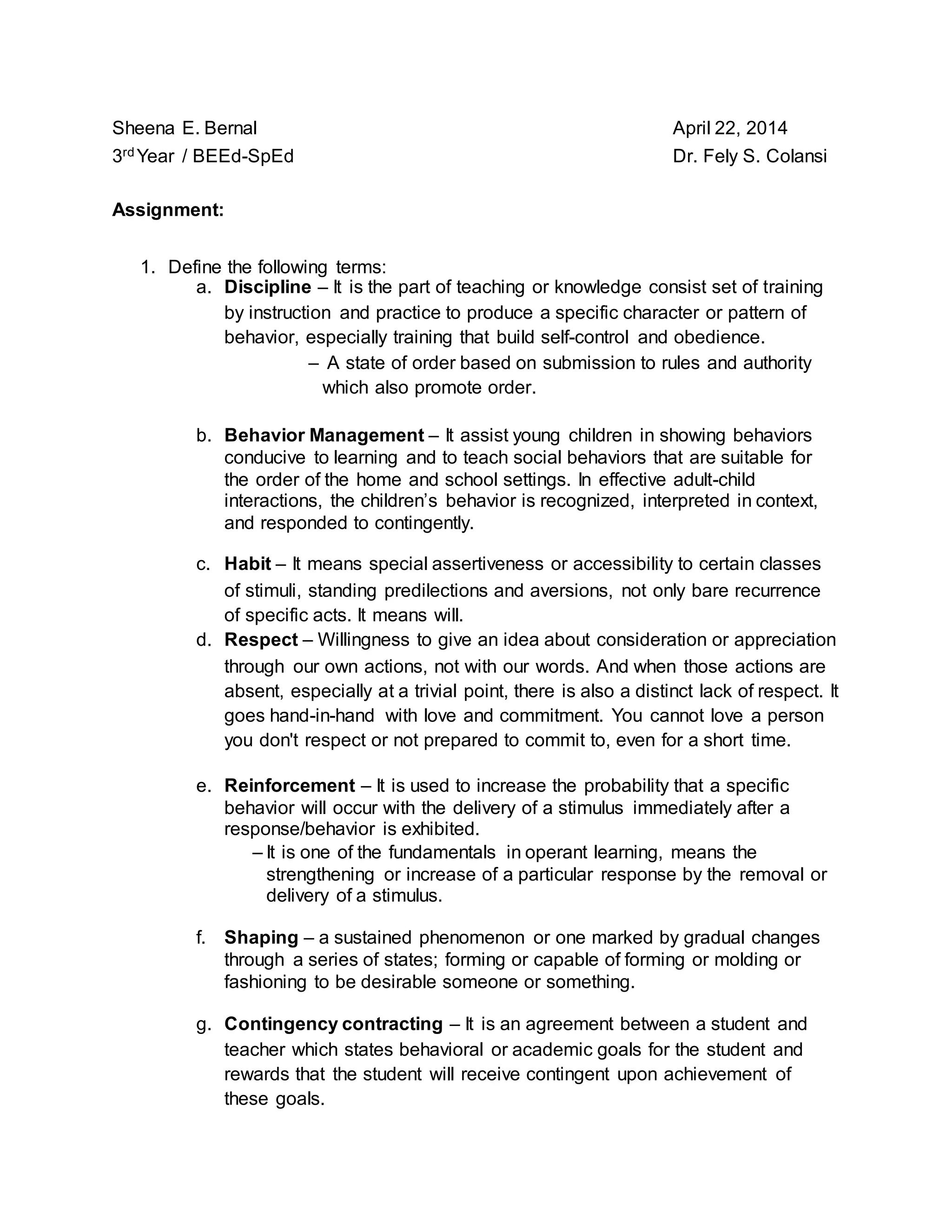
a. Discipline – It is the part of teaching or knowledge consist set of training
by instruction and practice to produce a specific character or pattern of
behavior, especially training that build self-control and obedience.
– A state of order based on submission to rules and authority
which also promote order.
b. Behavior Management – It assist young children in showing behaviors
conducive to learning and to teach social behaviors that are suitable for
the order of the home and school settings. In effective adult-child
interactions, the children’s behavior is recognized, interpreted in context,
and responded to contingently.
c. Habit – It means special assertiveness or accessibility to certain classes
of stimuli, standing predilections and aversions, not only bare recurrence
of specific acts. It means will.
d. Respect – Willingness to give an idea about consideration or appreciation
through our own actions, not with our words. And when those actions are
absent, especially at a trivial point, there is also a distinct lack of respect. It
goes hand-in-hand with love and commitment. You cannot love a person
you don't respect or not prepared to commit to, even for a short time.
e. Reinforcement – It is used to increase the probability that a specific
behavior will occur with the delivery of a stimulus immediately after a
response/behavior is exhibited.
– It is one of the fundamentals in operant learning, means the
strengthening or increase of a particular response by the removal or
delivery of a stimulus.
f. Shaping – a sustained phenomenon or one marked by gradual changes
through a series of states; forming or capable of forming or molding or
fashioning to be desirable someone or something.
g. Contingency contracting – It is an agreement between a student and
teacher which states behavioral or academic goals for the student and
rewards that the student will receive contingent upon achievement of
these goals.
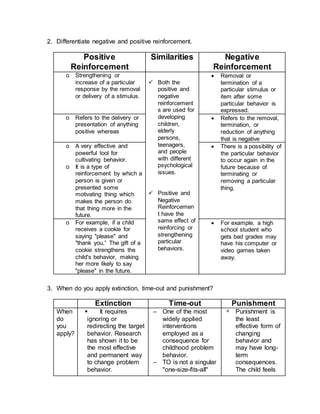
2. Differentiate negative and positive reinforcement.
Positive
Reinforcement
Similarities Negative
Reinforcement
o Strengthening or
increase of a particular
response by the removal
or delivery of a stimulus.
 Both the
positive and
negative
reinforcement
s are used for
developing
children,
elderly
persons,
teenagers,
and people
with different
psychological
issues.
 Positive and
Negative
Reinforcemen
t have the
same effect of
reinforcing or
strengthening
particular
behaviors.
 Removal or
termination of a
particular stimulus or
item after some
particular behavior is
expressed.
o Refers to the delivery or
presentation of anything
positive whereas
 Refers to the removal,
termination, or
reduction of anything
that is negative
o A very effective and
powerful tool for
cultivating behavior.
o It is a type of
reinforcement by which a
person is given or
presented some
motivating thing which
makes the person do
that thing more in the
future.
 There is a possibility of
the particular behavior
to occur again in the
future because of
terminating or
removing a particular
thing.
o For example, if a child
receives a cookie for
saying "please" and
"thank you,” The gift of a
cookie strengthens the
child's behavior, making
her more likely to say
"please" in the future.
 For example, a high
school student who
gets bad grades may
have his computer or
video games taken
away.
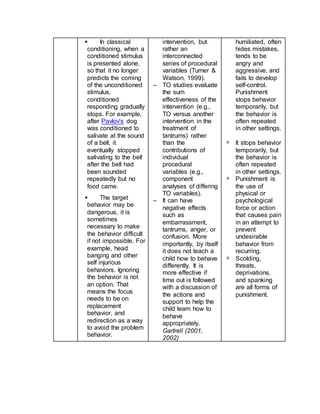
3. When do you apply extinction, time-out and punishment?
Extinction Time-out Punishment
When
do
you
apply?
 It requires
ignoring or
redirecting the target
behavior. Research
has shown it to be
the most effective
and permanent way
to change problem
behavior.
– One of the most
widely applied
interventions
employed as a
consequence for
childhood problem
behavior.
– TO is not a singular
"one-size-fits-all"
٥ Punishment is
the least
effective form of
changing
behavior and
may have long-
term
consequences.
The child feels
 In classical
conditioning, when a
conditioned stimulus
is presented alone,
so that it no longer
predicts the coming
of the unconditioned
stimulus,
conditioned
responding gradually
stops. For example,
after Pavlov's dog
was conditioned to
salivate at the sound
of a bell, it
eventually stopped
salivating to the bell
after the bell had
been sounded
repeatedly but no
food came.
 The target
behavior may be
dangerous, it is
sometimes
necessary to make
the behavior difficult
if not impossible. For
example, head
banging and other
self injurious
behaviors. Ignoring
the behavior is not
an option. That
means the focus
needs to be on
replacement
behavior, and
redirection as a way
to avoid the problem
behavior.
intervention, but
rather an
interconnected
series of procedural
variables (Turner &
Watson, 1999).
– TO studies evaluate
the sum
effectiveness of the
intervention (e.g.,
TO versus another
intervention in the
treatment of
tantrums) rather
than the
contributions of
individual
procedural
variables (e.g.,
component
analyses of differing
TO variables).
– It can have
negative effects
such as
embarrassment,
tantrums, anger, or
confusion. More
importantly, by itself
it does not teach a
child how to behave
differently. It is
more effective if
time out is followed
with a discussion of
the actions and
support to help the
child learn how to
behave
appropriately.
Gartrell (2001,
2002)
humiliated, often
hides mistakes,
tends to be
angry and
aggressive, and
fails to develop
self-control.
Punishment
stops behavior
temporarily, but
the behavior is
often repeated
in other settings.
٥ It stops behavior
temporarily, but
the behavior is
often repeated
in other settings.
٥ Punishment is
the use of
physical or
psychological
force or action
that causes pain
in an attempt to
prevent
undesirable
behavior from
recurring.
٥ Scolding,
threats,
deprivations,
and spanking
are all forms of
punishment.

April 22. assignment kay ma'am colansi (definitions)

  • 1.
    Sheena E. BernalApril 22, 2014 3rd Year / BEEd-SpEd Dr. Fely S. Colansi Assignment: 1. Define the following terms: a. Discipline – It is the part of teaching or knowledge consist set of training by instruction and practice to produce a specific character or pattern of behavior, especially training that build self-control and obedience. – A state of order based on submission to rules and authority which also promote order. b. Behavior Management – It assist young children in showing behaviors conducive to learning and to teach social behaviors that are suitable for the order of the home and school settings. In effective adult-child interactions, the children’s behavior is recognized, interpreted in context, and responded to contingently. c. Habit – It means special assertiveness or accessibility to certain classes of stimuli, standing predilections and aversions, not only bare recurrence of specific acts. It means will. d. Respect – Willingness to give an idea about consideration or appreciation through our own actions, not with our words. And when those actions are absent, especially at a trivial point, there is also a distinct lack of respect. It goes hand-in-hand with love and commitment. You cannot love a person you don't respect or not prepared to commit to, even for a short time. e. Reinforcement – It is used to increase the probability that a specific behavior will occur with the delivery of a stimulus immediately after a response/behavior is exhibited. – It is one of the fundamentals in operant learning, means the strengthening or increase of a particular response by the removal or delivery of a stimulus. f. Shaping – a sustained phenomenon or one marked by gradual changes through a series of states; forming or capable of forming or molding or fashioning to be desirable someone or something. g. Contingency contracting – It is an agreement between a student and teacher which states behavioral or academic goals for the student and rewards that the student will receive contingent upon achievement of these goals.
  • 2.
    2. Differentiate negativeand positive reinforcement. Positive Reinforcement Similarities Negative Reinforcement o Strengthening or increase of a particular response by the removal or delivery of a stimulus.  Both the positive and negative reinforcement s are used for developing children, elderly persons, teenagers, and people with different psychological issues.  Positive and Negative Reinforcemen t have the same effect of reinforcing or strengthening particular behaviors.  Removal or termination of a particular stimulus or item after some particular behavior is expressed. o Refers to the delivery or presentation of anything positive whereas  Refers to the removal, termination, or reduction of anything that is negative o A very effective and powerful tool for cultivating behavior. o It is a type of reinforcement by which a person is given or presented some motivating thing which makes the person do that thing more in the future.  There is a possibility of the particular behavior to occur again in the future because of terminating or removing a particular thing. o For example, if a child receives a cookie for saying "please" and "thank you,” The gift of a cookie strengthens the child's behavior, making her more likely to say "please" in the future.  For example, a high school student who gets bad grades may have his computer or video games taken away. 3. When do you apply extinction, time-out and punishment? Extinction Time-out Punishment When do you apply?  It requires ignoring or redirecting the target behavior. Research has shown it to be the most effective and permanent way to change problem behavior. – One of the most widely applied interventions employed as a consequence for childhood problem behavior. – TO is not a singular "one-size-fits-all" ٥ Punishment is the least effective form of changing behavior and may have long- term consequences. The child feels
  • 3.
     In classical conditioning,when a conditioned stimulus is presented alone, so that it no longer predicts the coming of the unconditioned stimulus, conditioned responding gradually stops. For example, after Pavlov's dog was conditioned to salivate at the sound of a bell, it eventually stopped salivating to the bell after the bell had been sounded repeatedly but no food came.  The target behavior may be dangerous, it is sometimes necessary to make the behavior difficult if not impossible. For example, head banging and other self injurious behaviors. Ignoring the behavior is not an option. That means the focus needs to be on replacement behavior, and redirection as a way to avoid the problem behavior. intervention, but rather an interconnected series of procedural variables (Turner & Watson, 1999). – TO studies evaluate the sum effectiveness of the intervention (e.g., TO versus another intervention in the treatment of tantrums) rather than the contributions of individual procedural variables (e.g., component analyses of differing TO variables). – It can have negative effects such as embarrassment, tantrums, anger, or confusion. More importantly, by itself it does not teach a child how to behave differently. It is more effective if time out is followed with a discussion of the actions and support to help the child learn how to behave appropriately. Gartrell (2001, 2002) humiliated, often hides mistakes, tends to be angry and aggressive, and fails to develop self-control. Punishment stops behavior temporarily, but the behavior is often repeated in other settings. ٥ It stops behavior temporarily, but the behavior is often repeated in other settings. ٥ Punishment is the use of physical or psychological force or action that causes pain in an attempt to prevent undesirable behavior from recurring. ٥ Scolding, threats, deprivations, and spanking are all forms of punishment.