Behaviorism Theory
         Written by Molly Howell
Menu

 What?


 Who?


 How?


 My   Classroom
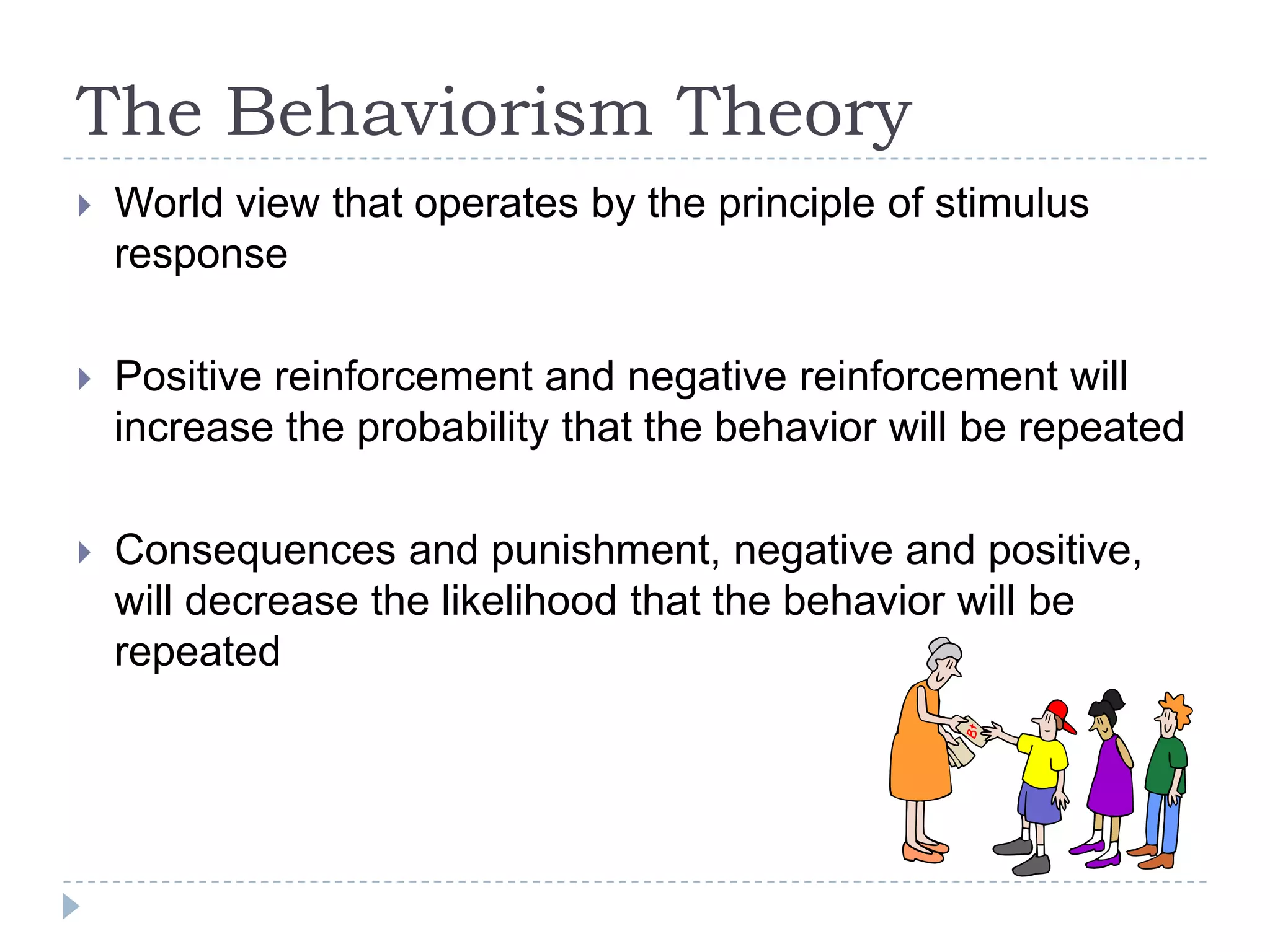
The Behaviorism Theory
   World view that operates by the principle of stimulus
    response

   Positive reinforcement and negative reinforcement will
    increase the probability that the behavior will be repeated

   Consequences and punishment, negative and positive,
    will decrease the likelihood that the behavior will be
    repeated
The Behaviorist Theory Continued
   Mostly focuses on teacher-centered instruction
       Lectures, demonstrations, tutorials


   Concerned with observable and measurable aspects
    of human behavior

   All behavior is caused by external stimuli

   Educational effects are key in developing basic skills
    and foundations of understanding in all subject areas
                         Click to go
                         back to menu!
People of the Behaviorist Approach
   B.F. Skinner
       Most influential of American psychologists
       Theory of operant conditioning
       Radical Behaviorism
   John B Watson
       Thought psychology should be the science of observable
        behavior
       Beginning of the development of learning science
       The “Little Albert” Experiment
Ivan Pavlov
   Russian physiologist

   His research on the physiology of digestion led to the
    first experimental model of learning, classical
    conditioning

   Nobel Prize winner, 1904

   Best known for Pavlov’s Dog Experiment


        Click to go back to menu!
Classroom Implications of Behaviorism
 Direct,   teacher-centered instruction
     Demonstrations, drills, lectures


 Teachers     would check student’s work regularly
     Providing feedback as well as encouragement


 Students can be taught best when focus is directly
  on the content

 Breakingdown skills and information to be learned is
  best when put into small units
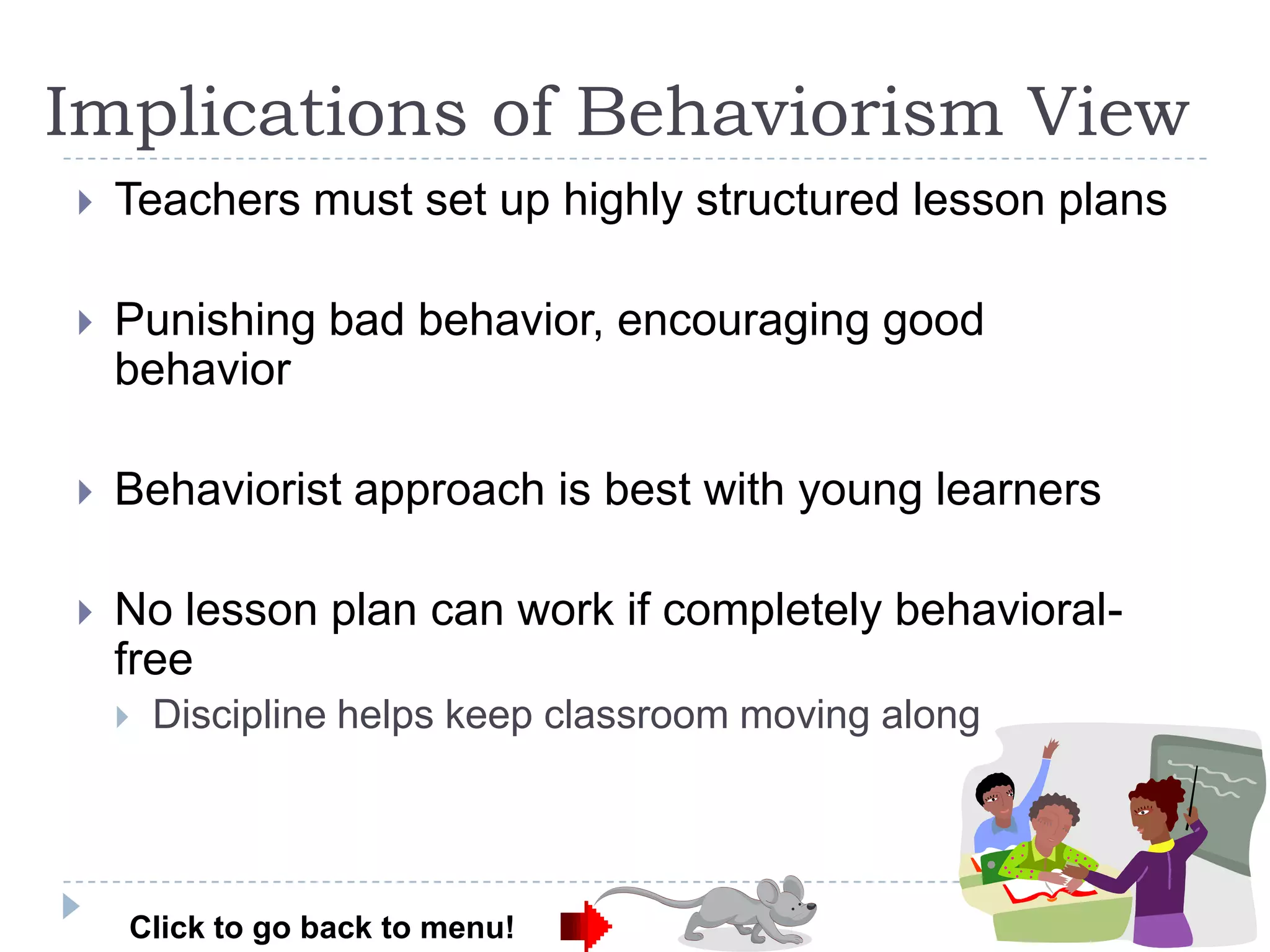
Implications of Behaviorism View
   Teachers must set up highly structured lesson plans

   Punishing bad behavior, encouraging good
    behavior

   Behaviorist approach is best with young learners

   No lesson plan can work if completely behavioral-
    free
       Discipline helps keep classroom moving along


    Click to go back to menu!
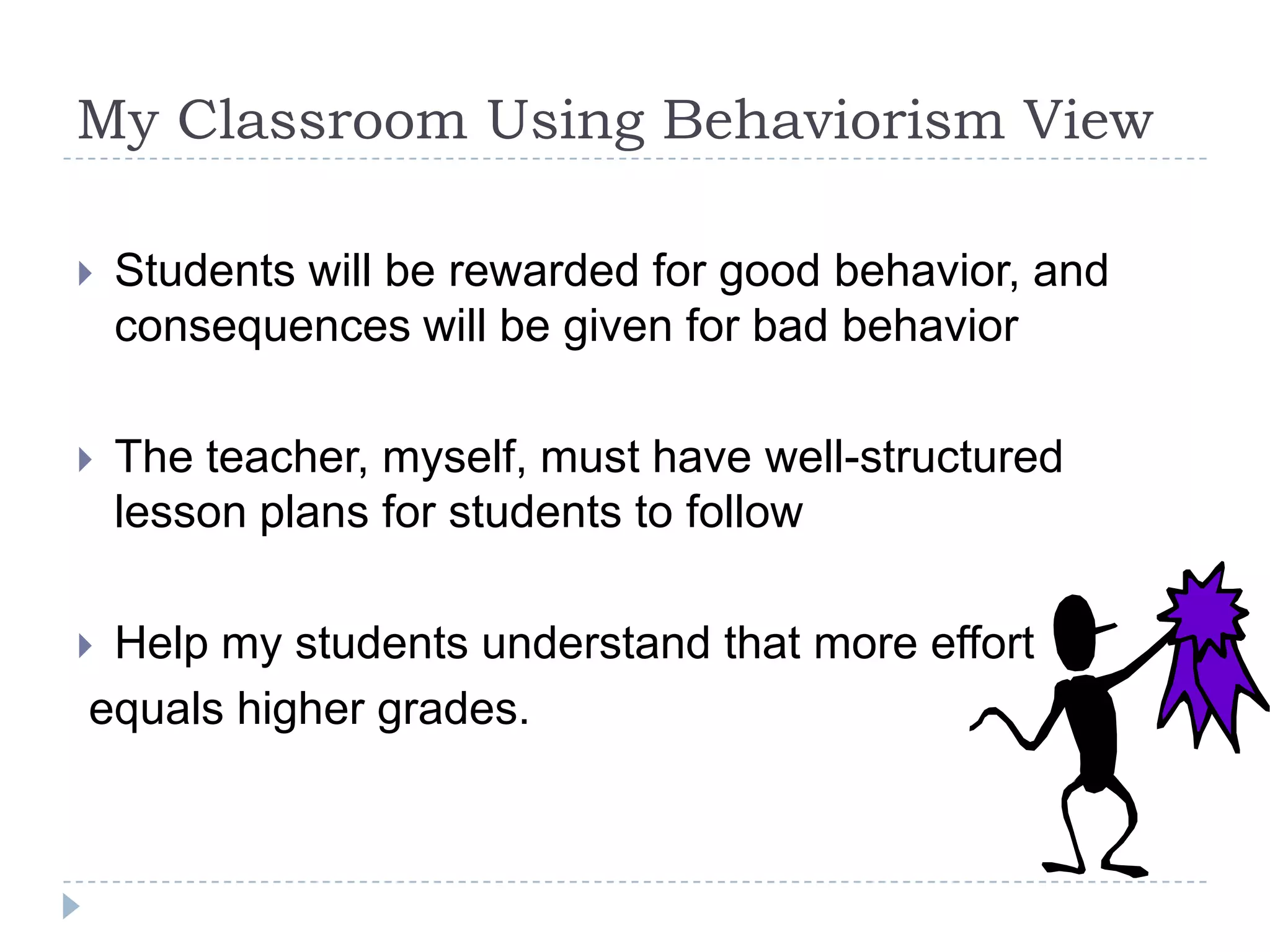
My Classroom Using Behaviorism View

   Students will be rewarded for good behavior, and
    consequences will be given for bad behavior

   The teacher, myself, must have well-structured
    lesson plans for students to follow

Help my students understand that more effort
equals higher grades.
My Classroom and Behaviorism Approach
   I will use high achieving and successful peers as
    models for other students

   Reinforcement will strengthen a behavior while
    punishment will weaken a behavior

   Using Technology with Instruction that Works by
    Pitler et al (2007) (Book)
       Educational strategies such as “Reinforcing Effort” and
        “Homework and Practice” Effort is number one factor


        Click to go back to menu!

Behaviorism

  • 1.
    Behaviorism Theory Written by Molly Howell
  • 2.
    Menu  What?  Who? How?  My Classroom
  • 3.
    The Behaviorism Theory  World view that operates by the principle of stimulus response  Positive reinforcement and negative reinforcement will increase the probability that the behavior will be repeated  Consequences and punishment, negative and positive, will decrease the likelihood that the behavior will be repeated
  • 4.
    The Behaviorist TheoryContinued  Mostly focuses on teacher-centered instruction  Lectures, demonstrations, tutorials  Concerned with observable and measurable aspects of human behavior  All behavior is caused by external stimuli  Educational effects are key in developing basic skills and foundations of understanding in all subject areas Click to go back to menu!
  • 5.
    People of theBehaviorist Approach  B.F. Skinner  Most influential of American psychologists  Theory of operant conditioning  Radical Behaviorism  John B Watson  Thought psychology should be the science of observable behavior  Beginning of the development of learning science  The “Little Albert” Experiment
  • 6.
    Ivan Pavlov  Russian physiologist  His research on the physiology of digestion led to the first experimental model of learning, classical conditioning  Nobel Prize winner, 1904  Best known for Pavlov’s Dog Experiment Click to go back to menu!
  • 7.
    Classroom Implications ofBehaviorism  Direct, teacher-centered instruction  Demonstrations, drills, lectures  Teachers would check student’s work regularly  Providing feedback as well as encouragement  Students can be taught best when focus is directly on the content  Breakingdown skills and information to be learned is best when put into small units
  • 8.
    Implications of BehaviorismView  Teachers must set up highly structured lesson plans  Punishing bad behavior, encouraging good behavior  Behaviorist approach is best with young learners  No lesson plan can work if completely behavioral- free  Discipline helps keep classroom moving along Click to go back to menu!
  • 9.
    My Classroom UsingBehaviorism View  Students will be rewarded for good behavior, and consequences will be given for bad behavior  The teacher, myself, must have well-structured lesson plans for students to follow Help my students understand that more effort equals higher grades.
  • 10.
    My Classroom andBehaviorism Approach  I will use high achieving and successful peers as models for other students  Reinforcement will strengthen a behavior while punishment will weaken a behavior  Using Technology with Instruction that Works by Pitler et al (2007) (Book)  Educational strategies such as “Reinforcing Effort” and “Homework and Practice” Effort is number one factor Click to go back to menu!