Anandhu Thampi
2nd sem M.Sc.Physics
Department of physics
CUSAT, COCHIN
Kerala
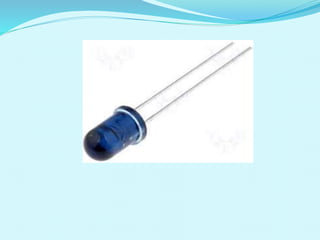
• A Light emitting diode is an
optoelectronic device
• It generates light via electroluminescence
•A PN junction (that consists of direct
band gap semiconductor materials) acts
as the active or recombination region.
•When the PN junction is forward
biased, electrons and holes recombine
either radiatively (emitting photons) or
non-radiatively (emitting heat). This is
simple LED operation.
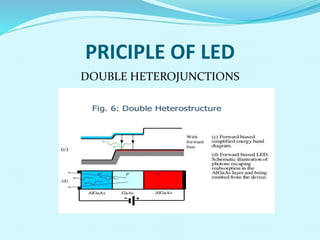
PRICIPLE OF LED
DOUBLE HETEROJUNCTIONS
DOUBLE HETEROJUNCTION
 Heterojunction is the advanced junction design to
reduce light losses
 One of the way to increase light output in LEDs
 The Heterojunction region is realized by sandwiching a
smallest band gap semiconductor between two largest
band gap semiconductor
 Photons are emitted having energy equal to the smallest
band gap active region
 The light emitted doesnot reabsorb because there are
different band gap semiconductors used.
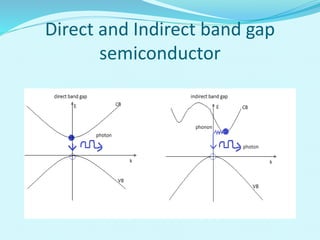
Direct and Indirect band gap
semiconductor
Direct and Indirect band gap
semiconductor
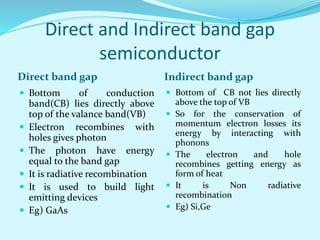
Direct band gap Indirect band gap
 Bottom of conduction
band(CB) lies directly above
top of the valance band(VB)
 Electron recombines with
holes gives photon
 The photon have energy
equal to the band gap
 It is radiative recombination
 It is used to build light
emitting devices
 Eg) GaAs
 Bottom of CB not lies directly
above the top of VB
 So for the conservation of
momentum electron losses its
energy by interacting with
phonons
 The electron and hole
recombines getting energy as
form of heat
 It is Non radiative
recombination
 Eg) Si,Ge
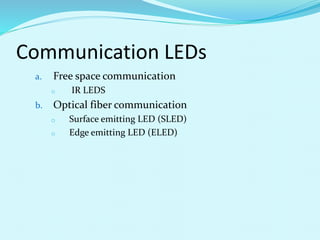
Communication LEDs
a. Free space communication
o IR LEDS
b. Optical fiber communication
o Surface emitting LED (SLED)
o Edge emitting LED (ELED)
LED for free space communication
 IR LEDs are commonly used in free space
communication
 It is commonly made with GaAs or GaInAs active
region and GaAS substrate
 Transmission distance is very short ( less than 100m)
 For GaAs active region gives IR ranging from 870nm
 For GaInAs it is 950nm
LED for fiber optics communication
 Mainly there are two types of LEDs
1. Burrus type surface emitting LED (SLED)
2. Edge emitting LED (ELED)
 It is widely used in local area low and medium bit
rate optical communication
 Light emitting spot should be smaller than core
diameter of optical fiber
 Circular emission region with
• 20-50 µm – multimode fiber
• 50-100µm – silica multimode fiber
• 1mm- plastic fiber
Types of LED
The basic LED types used for fiber optic
communication systems are
 Surface-emitting LED (SLED),
 Edge-emitting LED (ELED)
Burrus type surface emitting LED
(SLED)
Burrus type surface emitting LED
 This LED was developed in AT & Bell laboratories in
1971
 The surface-emitting LED is also known as the Burrus
LED in honor of C. A. Burrus, its developer.
 For short-distance (0 to 3 km), low-data-rate fiber optic
systems, SLEDs and ELEDs are the preferred optical
source.
 Typically, SLEDs operate efficiently for bit rates up to 250
megabits per second (Mb/s). Because SLEDs emit light
over a wide area , they are almost exclusively used in
multimode systems.
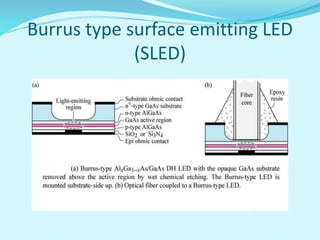
 In SLEDs, the size of the primary active region is limited
to a small circular area of 20 mm to 50 mm in diameter.
 The active region is the portion of the LED where
photons are emitted.
 A well is etched into the substrate to allow direct coupling
of the emitted light to the optical fiber. The etched well
allows the optical fiber to come into close contact with the
emitting surface.
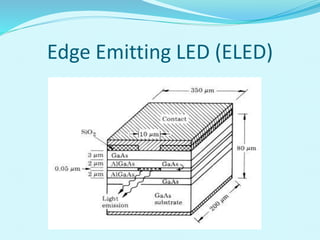
Edge Emitting LED (ELED)
Edge emitting LED
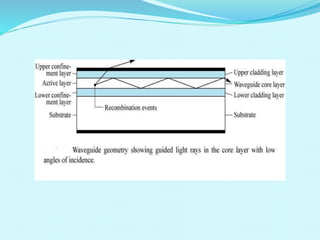
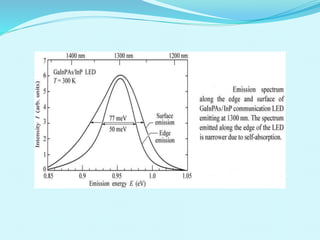
This type of LEDs make use of the transparent guiding
layers with a very thin active layer (50 to 100 μm) in order
that the light produced in the active layer spreads into the
transparent guiding layers.
Majority of the propagating light are emitted at one end
face with the light reflected back from the other end face.
Its coupling efficiency is higher than the surface emitter
LEDs for smaller NA fiber.
The edge emitter LEDs radiate less power to the air
compared to the surface emitter LEDs
The edge emitter LEDs can transfer higher data rate, as
much as 100 MHz than the surface emitter LEDs.
 For medium-distance, medium-data-rate systems, ELEDs
are preferred.
 ELEDs may be modulated at rates up to 400 Mb/s.
ELEDs may be used for both single mode and multimode
fiber systems.
 Both SLDs and ELEDs are used in long-distance, high-
data-rate systems.
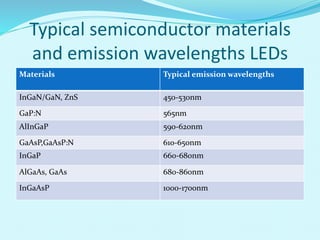
Typical semiconductor materials
and emission wavelengths LEDs
Materials Typical emission wavelengths
InGaN/GaN, ZnS 450-530nm
GaP:N 565nm
AlInGaP 590-620nm
GaAsP,GaAsP:N 610-650nm
InGaP 660-680nm
AlGaAs, GaAs 680-860nm
InGaAsP 1000-1700nm
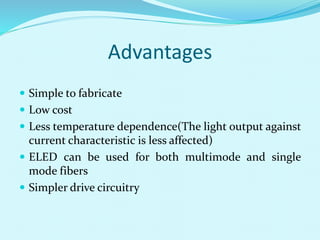
Advantages
 Simple to fabricate
 Low cost
 Less temperature dependence(The light output against
current characteristic is less affected)
 ELED can be used for both multimode and single
mode fibers
 Simpler drive circuitry
Drawbacks of LED
 Large line width (30-40 nm)
 Large beam width (Low coupling to the fiber)
 Low output power
 Low E/O conversion efficiency
The LASER
 Light Amplification by ‘Stimulated Emission’ of
Radiation (L A S E R)
 Coherent light (stimulated emission)
 Narrow beam width (very focused beam)
 High output power (amplification)
 Useful in long distant communication
 So it is very helpful to send data without noises
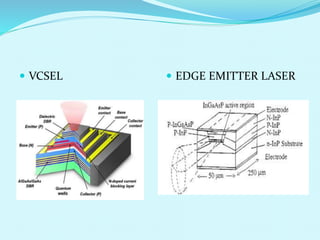
 Two types of LASERS used for communication
• VCSEL (Vertical Cavity Surface Emitting Laser)
• EDGE EMITTING LASER
 VCSEL  EDGE EMITTER LASER
Reference
1. E . Fred Schubert:, Light-Emitting Diode, first
edition, The press syndicate of the university of
Cambridge, 2003
2. S . C Gupta:, Optoelectronics Devices and systems,
second edition, PHI Learning private limited, 2015
3. E . W Williams & R . Hall:, Luminescence and the
Light Emitting Diode, first edition, Pergamon press,
1978
4. www.rp-photonics.com/encylopedia.html
5. John M Senior:, Optical Fibre Communication,
second edition, PHI Learning private limited, 1998
Thank you

COMMUNICATION LED

  • 1.
    Anandhu Thampi 2nd semM.Sc.Physics Department of physics CUSAT, COCHIN Kerala
  • 2.
    • A Lightemitting diode is an optoelectronic device • It generates light via electroluminescence •A PN junction (that consists of direct band gap semiconductor materials) acts as the active or recombination region. •When the PN junction is forward biased, electrons and holes recombine either radiatively (emitting photons) or non-radiatively (emitting heat). This is simple LED operation.
  • 3.
    PRICIPLE OF LED DOUBLEHETEROJUNCTIONS
  • 4.
    DOUBLE HETEROJUNCTION  Heterojunctionis the advanced junction design to reduce light losses  One of the way to increase light output in LEDs  The Heterojunction region is realized by sandwiching a smallest band gap semiconductor between two largest band gap semiconductor  Photons are emitted having energy equal to the smallest band gap active region  The light emitted doesnot reabsorb because there are different band gap semiconductors used.
  • 5.
    Direct and Indirectband gap semiconductor
  • 6.
    Direct and Indirectband gap semiconductor Direct band gap Indirect band gap  Bottom of conduction band(CB) lies directly above top of the valance band(VB)  Electron recombines with holes gives photon  The photon have energy equal to the band gap  It is radiative recombination  It is used to build light emitting devices  Eg) GaAs  Bottom of CB not lies directly above the top of VB  So for the conservation of momentum electron losses its energy by interacting with phonons  The electron and hole recombines getting energy as form of heat  It is Non radiative recombination  Eg) Si,Ge
  • 7.
    Communication LEDs a. Freespace communication o IR LEDS b. Optical fiber communication o Surface emitting LED (SLED) o Edge emitting LED (ELED)
  • 8.
    LED for freespace communication  IR LEDs are commonly used in free space communication  It is commonly made with GaAs or GaInAs active region and GaAS substrate  Transmission distance is very short ( less than 100m)  For GaAs active region gives IR ranging from 870nm  For GaInAs it is 950nm
  • 10.
    LED for fiberoptics communication  Mainly there are two types of LEDs 1. Burrus type surface emitting LED (SLED) 2. Edge emitting LED (ELED)  It is widely used in local area low and medium bit rate optical communication  Light emitting spot should be smaller than core diameter of optical fiber  Circular emission region with • 20-50 µm – multimode fiber • 50-100µm – silica multimode fiber • 1mm- plastic fiber
  • 11.
    Types of LED Thebasic LED types used for fiber optic communication systems are  Surface-emitting LED (SLED),  Edge-emitting LED (ELED)
  • 12.
    Burrus type surfaceemitting LED (SLED)
  • 13.
    Burrus type surfaceemitting LED  This LED was developed in AT & Bell laboratories in 1971  The surface-emitting LED is also known as the Burrus LED in honor of C. A. Burrus, its developer.  For short-distance (0 to 3 km), low-data-rate fiber optic systems, SLEDs and ELEDs are the preferred optical source.  Typically, SLEDs operate efficiently for bit rates up to 250 megabits per second (Mb/s). Because SLEDs emit light over a wide area , they are almost exclusively used in multimode systems.
  • 14.
     In SLEDs,the size of the primary active region is limited to a small circular area of 20 mm to 50 mm in diameter.  The active region is the portion of the LED where photons are emitted.  A well is etched into the substrate to allow direct coupling of the emitted light to the optical fiber. The etched well allows the optical fiber to come into close contact with the emitting surface.
  • 15.
  • 16.
    Edge emitting LED Thistype of LEDs make use of the transparent guiding layers with a very thin active layer (50 to 100 μm) in order that the light produced in the active layer spreads into the transparent guiding layers. Majority of the propagating light are emitted at one end face with the light reflected back from the other end face. Its coupling efficiency is higher than the surface emitter LEDs for smaller NA fiber. The edge emitter LEDs radiate less power to the air compared to the surface emitter LEDs The edge emitter LEDs can transfer higher data rate, as much as 100 MHz than the surface emitter LEDs.
  • 17.
     For medium-distance,medium-data-rate systems, ELEDs are preferred.  ELEDs may be modulated at rates up to 400 Mb/s. ELEDs may be used for both single mode and multimode fiber systems.  Both SLDs and ELEDs are used in long-distance, high- data-rate systems.
  • 20.
    Typical semiconductor materials andemission wavelengths LEDs Materials Typical emission wavelengths InGaN/GaN, ZnS 450-530nm GaP:N 565nm AlInGaP 590-620nm GaAsP,GaAsP:N 610-650nm InGaP 660-680nm AlGaAs, GaAs 680-860nm InGaAsP 1000-1700nm
  • 21.
    Advantages  Simple tofabricate  Low cost  Less temperature dependence(The light output against current characteristic is less affected)  ELED can be used for both multimode and single mode fibers  Simpler drive circuitry
  • 22.
    Drawbacks of LED Large line width (30-40 nm)  Large beam width (Low coupling to the fiber)  Low output power  Low E/O conversion efficiency
  • 23.
    The LASER  LightAmplification by ‘Stimulated Emission’ of Radiation (L A S E R)  Coherent light (stimulated emission)  Narrow beam width (very focused beam)  High output power (amplification)  Useful in long distant communication  So it is very helpful to send data without noises  Two types of LASERS used for communication • VCSEL (Vertical Cavity Surface Emitting Laser) • EDGE EMITTING LASER
  • 24.
     VCSEL EDGE EMITTER LASER
  • 25.
    Reference 1. E .Fred Schubert:, Light-Emitting Diode, first edition, The press syndicate of the university of Cambridge, 2003 2. S . C Gupta:, Optoelectronics Devices and systems, second edition, PHI Learning private limited, 2015 3. E . W Williams & R . Hall:, Luminescence and the Light Emitting Diode, first edition, Pergamon press, 1978 4. www.rp-photonics.com/encylopedia.html 5. John M Senior:, Optical Fibre Communication, second edition, PHI Learning private limited, 1998
  • 26.

Editor's Notes

  • #12 The numerical aperture (NA) of the fiber is the sine of the maximum angle of an incident ray with respect to the fiber axis, so that the transmitted beam is guided in the core. The NA is determined by the refractive index difference between core and cladding, more precisely by the relation numerical aperture The acceptance angle of an optical fiber is defined based on a purely geometrical consideration (ray optics): it is the maximum angle of a ray (against the fiber axis) hitting the fiber core which allows the incident light to be guided by the core.