Topic :
Light sources :
LED & LASER
By: Danish Amin
M.Tech Ist Year
Overview
 What is an Optical Source
 LEDs
 SLEDs – Surface Emitting LEDs
 ELEDs – Edge Emitting LEDs
 LDs – Laser Diodes
 Tunable Lasers
 Laser (Basic concepts)
What is an Optic Source?
• The heart of a fiber optical data system
• A Hybrid Device
– Converts electrical signals into optical signals
– Launches these optical signals into an optical
fiber for data transmission.
• Device consists of an interface circuit, drive
circuit, and components for optical source.
(LED’s, ELEDs, SLEDs, LDs, etc)
LEDs – Light Emitting Diode
•Emits incoherent light
through spontaneous
emission.
•Used for Multimode systems
w/ 100-200 Mb/s rates.
•Broad spectral width and
wide output pattern 850nm
region: GaAs and
AlGaAs 1300–1550nm region:
InGaAsP and InP
•Two commonly used types:
ELEDs and SLEDs
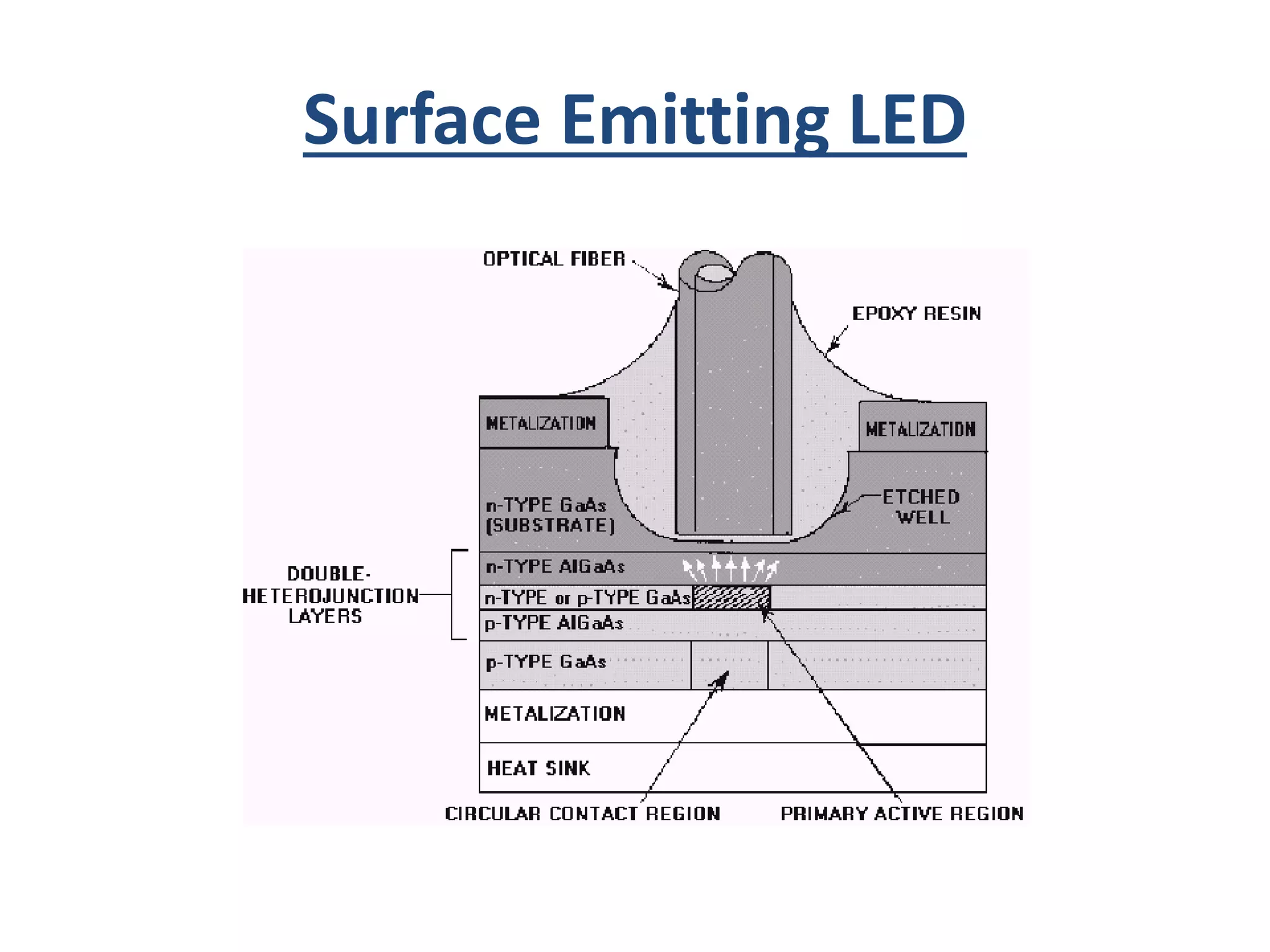
SLEDs – Surface Emitting LEDs
• Primary active region is a small circular area located
below the surface of the semiconductor substrate, 20-
50μm diameter and up to 2.5μm thick.
• Emission is isotropic and in lambertian pattern.
• A well is etched in the substrate to allow the direct
coupling of emitted light to the optical fiber
• Emission area of substrate is perpendicular to axis of
optical fiber
• Coupling efficiency optimized by binding fiber to the
substrate surface by epoxy resin with matching
refractive index
Surface Emitting LED
ELEDs – Edge Emitting LEDs
• Primary active region is a narrow strip that lies beneath the
semiconductor substrate
• Semiconductor is cut and polished so emission strip region
runs between front and back.
• Rear face of semiconductor is polished so it is highly reflective
while front face is coated with anti-reflective, light will reflect
from rear and emit through front face
• Active Regions are usually 100-150μm long and the strips are
50-70μm wide which are designed to match typical core fibers
of 50-100μm.
• Emit light at narrower angle which allows for better coupling
and efficiency than SLEDs
Edge Emitting LED
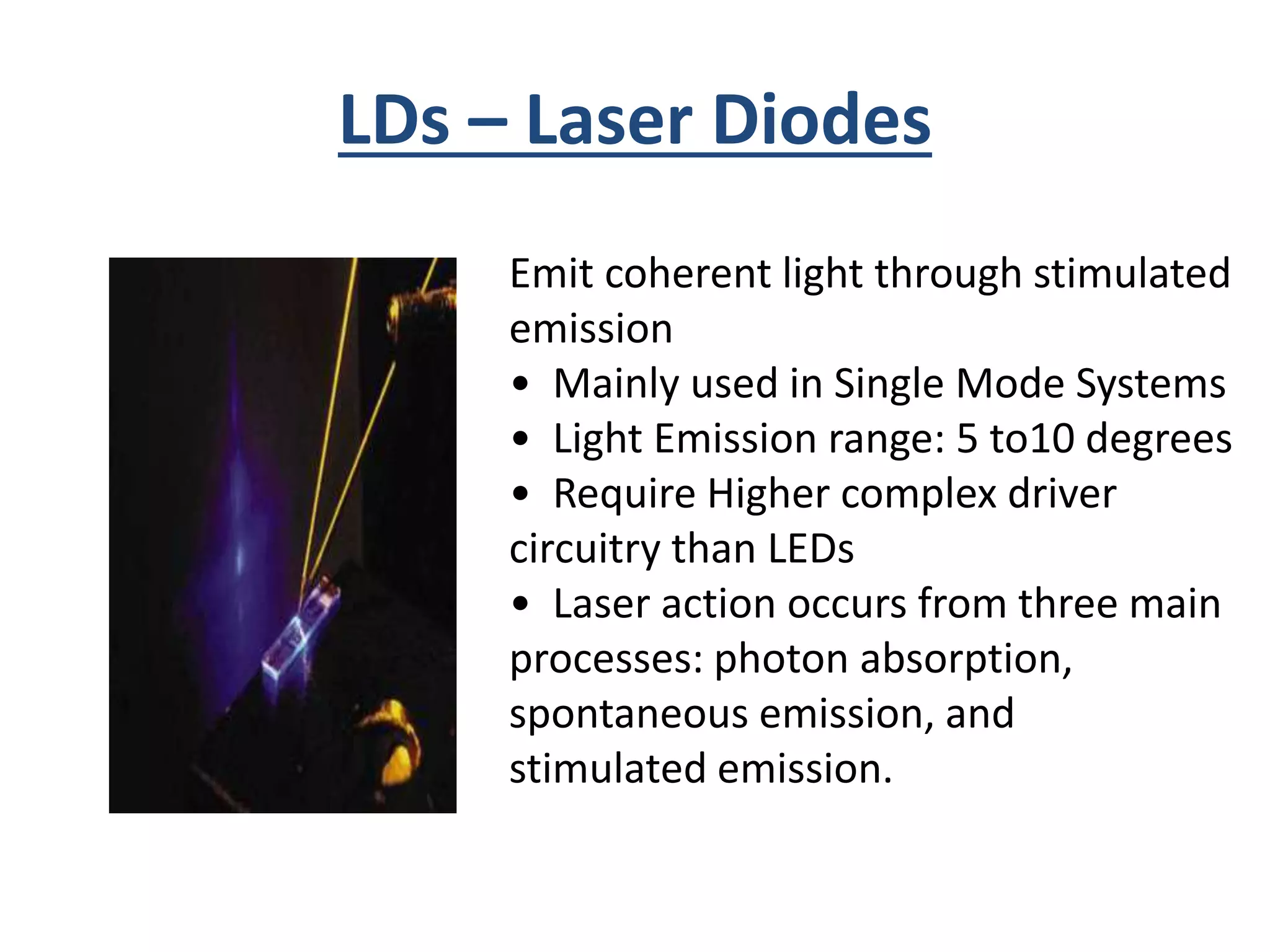
LDs – Laser Diodes
Emit coherent light through stimulated
emission
• Mainly used in Single Mode Systems
• Light Emission range: 5 to10 degrees
• Require Higher complex driver
circuitry than LEDs
• Laser action occurs from three main
processes: photon absorption,
spontaneous emission, and
stimulated emission.
Laser Diode Optical Cavity
One reflecting mirror is at one end while the other end
has a partially reflecting mirror for partial emission
• Remaining power reflects through cavity for
amplification of certain wavelengths, a process known
as optical feedback.
• Construction very similar to the ELEDs.
Lasing Characteristics
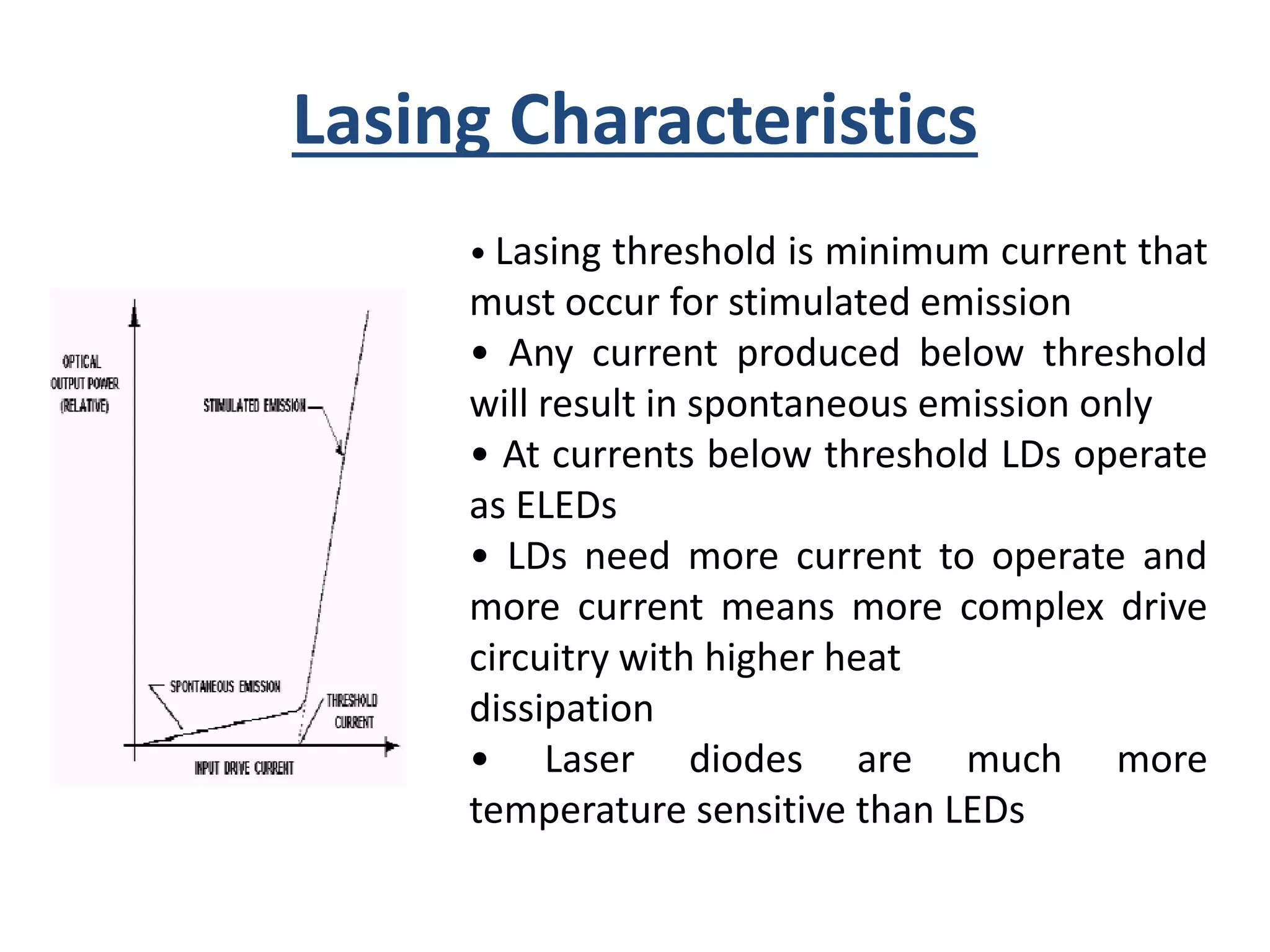
• Lasing threshold is minimum current that
must occur for stimulated emission
• Any current produced below threshold
will result in spontaneous emission only
• At currents below threshold LDs operate
as ELEDs
• LDs need more current to operate and
more current means more complex drive
circuitry with higher heat
dissipation
• Laser diodes are much more
temperature sensitive than LEDs
Tunable Laser
• Tunable Laser
– Employed in broad-band interconnections and
broadcast networks where the need for high power,
narrow line width, and a tunable single-frequency
emission is a must.
– Laser that is able to produce controllable multiple
wavelengths within single cavity.
– Able to switch transmission of different wavelengths
without using multiplexer for transmission to many
different channels at by tuning the output frequency to
its designated channel.
Tunable Laser Operation
• Current is injected into the Active Region causing
the entire optical cavity to oscillate in a single
longitudinal mode.
• A current is then injected into the grating control
region causing a refractive index decrease which
induces a shift of the Bragg wavelength and
variation in the mode.
• The phase region with the injected phase current
allows for recovery in Bragg wavelength in order
to keep the same mode in the center of the filter
band.
• This results in an output with variable wavelength.
Tunable Laser Cavity
Consists of an Active Region, and
two passive regions:
Phase Control and Grating
• Active region is a double hetero
structure of a low band gap
between two high gap low index
claddings.
• Two passive regions made from
semiconductor with intermediate
band gap between active and
cladding.
Basic Concept (LASER)
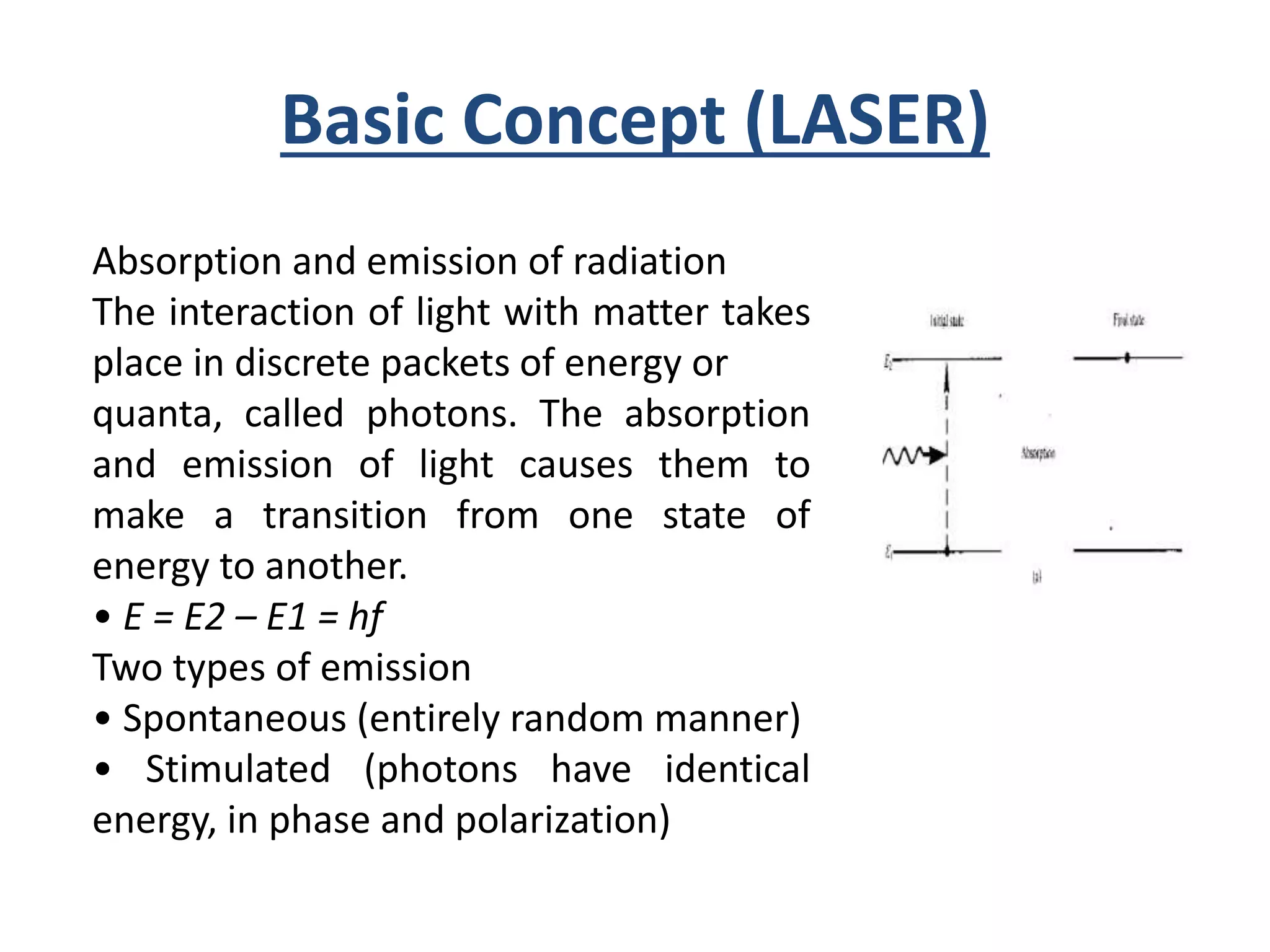
Absorption and emission of radiation
The interaction of light with matter takes
place in discrete packets of energy or
quanta, called photons. The absorption
and emission of light causes them to
make a transition from one state of
energy to another.
• E = E2 – E1 = hf
Two types of emission
• Spontaneous (entirely random manner)
• Stimulated (photons have identical
energy, in phase and polarization)
Basic Concept (LASER) Cont…
Population inversion
• More electrons in higher
energy level.
• Necessary to achieve
optical amplification
• Pumping
• Process to achieve
population inversion usually
through external energy
Source.
Basic Concept (LASER) Cont…
Basic Concept (LASER)
• Optical feedback and laser oscillations
• Photon striking an excited atom causes emission of a second
photon which release two more photons creating an avalanche
multiplication.
• Amplification &Coherence achieved by (Febry – Perot resonator)
• Placing mirrors at either end of the amplifying medium
• Providing positive feedback
• Amplification in a single go is quite small but after multiple passes
the net gain can be large
• One mirror is partially transmitting from where useful radiation
may escape from the cavity
• Stable output occurs when optical gain is exactly matched with
losses incurred (Absorption, scattering and diffraction).
Basic Concept (LASER) Cont…
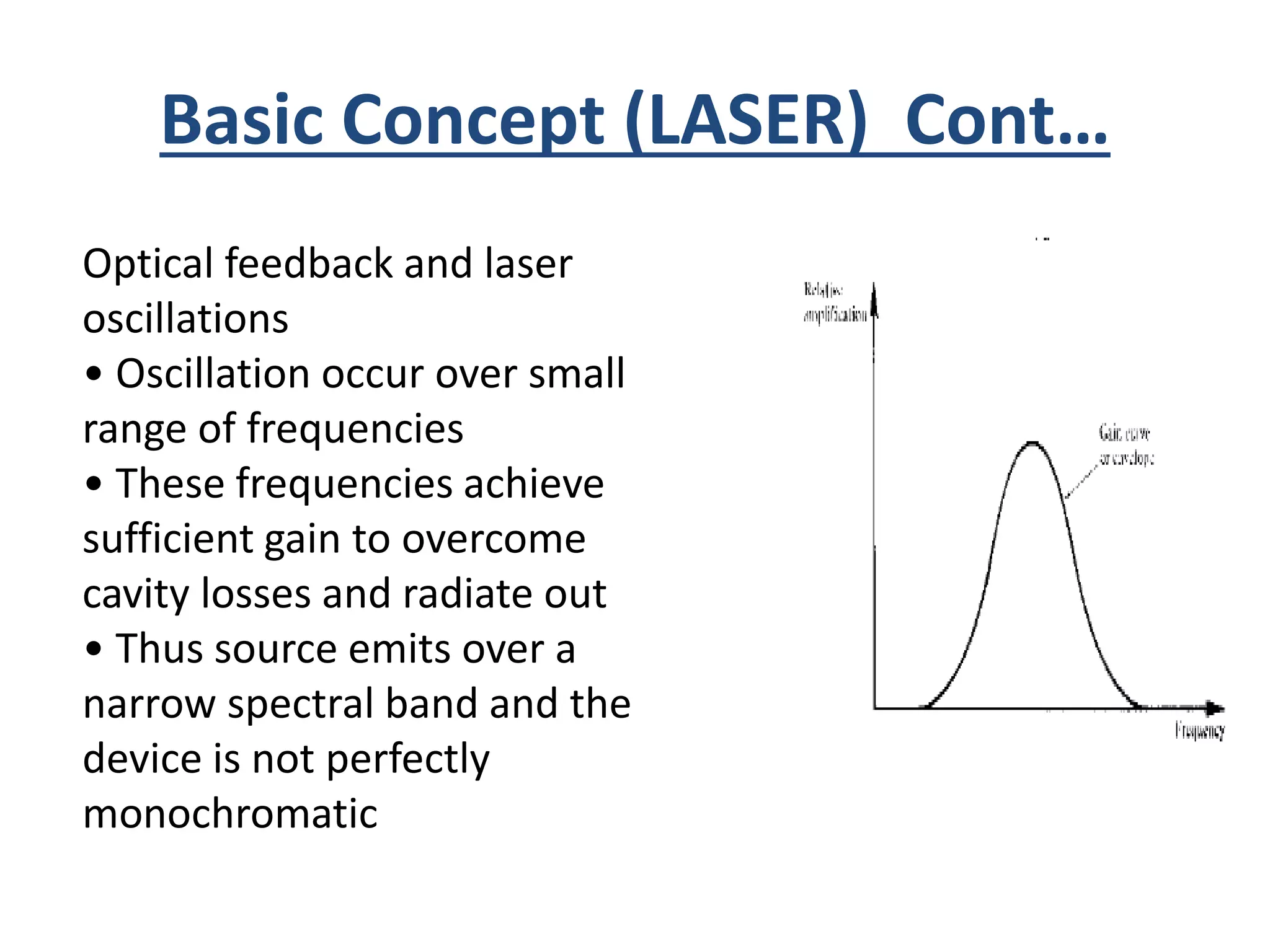
Optical feedback and laser
oscillations
• Oscillation occur over small
range of frequencies
• These frequencies achieve
sufficient gain to overcome
cavity losses and radiate out
• Thus source emits over a
narrow spectral band and the
device is not perfectly
monochromatic
Thank U

led and laser ___ light sources

  • 1.
    Topic : Light sources: LED & LASER By: Danish Amin M.Tech Ist Year
  • 2.
    Overview  What isan Optical Source  LEDs  SLEDs – Surface Emitting LEDs  ELEDs – Edge Emitting LEDs  LDs – Laser Diodes  Tunable Lasers  Laser (Basic concepts)
  • 3.
    What is anOptic Source? • The heart of a fiber optical data system • A Hybrid Device – Converts electrical signals into optical signals – Launches these optical signals into an optical fiber for data transmission. • Device consists of an interface circuit, drive circuit, and components for optical source. (LED’s, ELEDs, SLEDs, LDs, etc)
  • 4.
    LEDs – LightEmitting Diode •Emits incoherent light through spontaneous emission. •Used for Multimode systems w/ 100-200 Mb/s rates. •Broad spectral width and wide output pattern 850nm region: GaAs and AlGaAs 1300–1550nm region: InGaAsP and InP •Two commonly used types: ELEDs and SLEDs
  • 5.
    SLEDs – SurfaceEmitting LEDs • Primary active region is a small circular area located below the surface of the semiconductor substrate, 20- 50μm diameter and up to 2.5μm thick. • Emission is isotropic and in lambertian pattern. • A well is etched in the substrate to allow the direct coupling of emitted light to the optical fiber • Emission area of substrate is perpendicular to axis of optical fiber • Coupling efficiency optimized by binding fiber to the substrate surface by epoxy resin with matching refractive index
  • 6.
  • 7.
    ELEDs – EdgeEmitting LEDs • Primary active region is a narrow strip that lies beneath the semiconductor substrate • Semiconductor is cut and polished so emission strip region runs between front and back. • Rear face of semiconductor is polished so it is highly reflective while front face is coated with anti-reflective, light will reflect from rear and emit through front face • Active Regions are usually 100-150μm long and the strips are 50-70μm wide which are designed to match typical core fibers of 50-100μm. • Emit light at narrower angle which allows for better coupling and efficiency than SLEDs
  • 8.
  • 9.
    LDs – LaserDiodes Emit coherent light through stimulated emission • Mainly used in Single Mode Systems • Light Emission range: 5 to10 degrees • Require Higher complex driver circuitry than LEDs • Laser action occurs from three main processes: photon absorption, spontaneous emission, and stimulated emission.
  • 10.
    Laser Diode OpticalCavity One reflecting mirror is at one end while the other end has a partially reflecting mirror for partial emission • Remaining power reflects through cavity for amplification of certain wavelengths, a process known as optical feedback. • Construction very similar to the ELEDs.
  • 11.
    Lasing Characteristics • Lasingthreshold is minimum current that must occur for stimulated emission • Any current produced below threshold will result in spontaneous emission only • At currents below threshold LDs operate as ELEDs • LDs need more current to operate and more current means more complex drive circuitry with higher heat dissipation • Laser diodes are much more temperature sensitive than LEDs
  • 12.
    Tunable Laser • TunableLaser – Employed in broad-band interconnections and broadcast networks where the need for high power, narrow line width, and a tunable single-frequency emission is a must. – Laser that is able to produce controllable multiple wavelengths within single cavity. – Able to switch transmission of different wavelengths without using multiplexer for transmission to many different channels at by tuning the output frequency to its designated channel.
  • 13.
    Tunable Laser Operation •Current is injected into the Active Region causing the entire optical cavity to oscillate in a single longitudinal mode. • A current is then injected into the grating control region causing a refractive index decrease which induces a shift of the Bragg wavelength and variation in the mode. • The phase region with the injected phase current allows for recovery in Bragg wavelength in order to keep the same mode in the center of the filter band. • This results in an output with variable wavelength.
  • 14.
    Tunable Laser Cavity Consistsof an Active Region, and two passive regions: Phase Control and Grating • Active region is a double hetero structure of a low band gap between two high gap low index claddings. • Two passive regions made from semiconductor with intermediate band gap between active and cladding.
  • 15.
    Basic Concept (LASER) Absorptionand emission of radiation The interaction of light with matter takes place in discrete packets of energy or quanta, called photons. The absorption and emission of light causes them to make a transition from one state of energy to another. • E = E2 – E1 = hf Two types of emission • Spontaneous (entirely random manner) • Stimulated (photons have identical energy, in phase and polarization)
  • 16.
    Basic Concept (LASER)Cont… Population inversion • More electrons in higher energy level. • Necessary to achieve optical amplification • Pumping • Process to achieve population inversion usually through external energy Source.
  • 17.
  • 18.
    Basic Concept (LASER)Cont… Basic Concept (LASER) • Optical feedback and laser oscillations • Photon striking an excited atom causes emission of a second photon which release two more photons creating an avalanche multiplication. • Amplification &Coherence achieved by (Febry – Perot resonator) • Placing mirrors at either end of the amplifying medium • Providing positive feedback • Amplification in a single go is quite small but after multiple passes the net gain can be large • One mirror is partially transmitting from where useful radiation may escape from the cavity • Stable output occurs when optical gain is exactly matched with losses incurred (Absorption, scattering and diffraction).
  • 19.
    Basic Concept (LASER)Cont… Optical feedback and laser oscillations • Oscillation occur over small range of frequencies • These frequencies achieve sufficient gain to overcome cavity losses and radiate out • Thus source emits over a narrow spectral band and the device is not perfectly monochromatic
  • 20.