Supervised by : Prof. Magdy Ibrahim
Contents
• Modulation.
• Electro-optic Effect.
• Electro-optic Modulator (EOM).
• Acousto-optic Effect.
• Acousto-optic Modulator (AOM).
Contents
• Modulation.
• Electro-optic Effect.
• Electro-optic Modulator (EOM).
• Acousto-optic Effect.
• Acousto-optic Modulator (AOM).
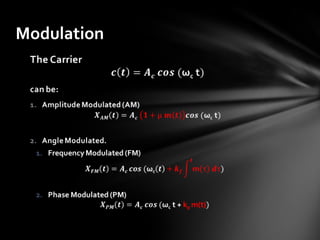
Modulation
Modulation
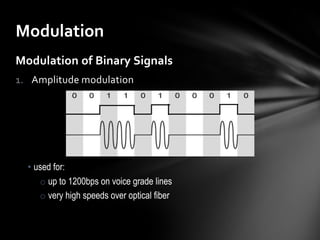
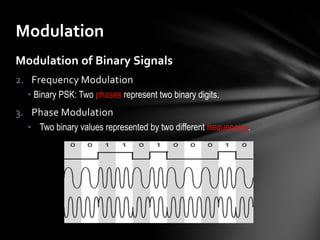
Modulation of Binary Signals
1. Amplitude modulation


  • used for:
     o up to 1200bps on voice grade lines
     o very high speeds over optical fiber
Modulation
Modulation of Binary Signals
2. Frequency Modulation
  • Binary PSK: Two phases represent two binary digits.
3. Phase Modulation
  • Two binary values represented by two different frequencies.
Contents
• Modulation.
• Electro-optic Effect.
• Electro-optic Modulator (EOM).
• Acousto-optic Effect.
• Acousto-optic Modulator (AOM).
Electro-optic Effect
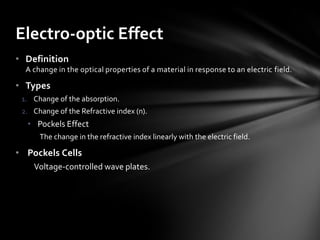
• Definition
  A change in the optical properties of a material in response to an electric field.

• Types
 1. Change of the absorption.
 2. Change of the Refractive index (n).
  • Pockels Effect
      The change in the refractive index linearly with the electric field.

• Pockels Cells
    Voltage-controlled wave plates.
Electro-optic Effect
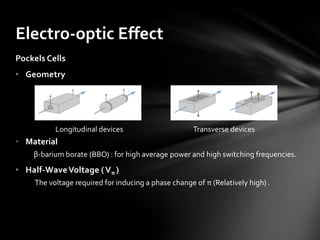
Pockels Cells
• Geometry


           Longitudinal devices                       Transverse devices
• Material
    β-barium borate (BBO) : for high average power and high switching frequencies.
• Half-Wave Voltage ( V π )
     The voltage required for inducing a phase change of π (Relatively high) .
Contents
• Modulation.
• Electro-optic Effect.
• Electro-optic Modulator (EOM).
• Acousto-optic Effect.
• Acousto-optic Modulator (AOM).
Electro-optic Modulator (EOM)
• Definition
  An optical device in which a signal-controlled element displaying electro-
  optic effect is used to modulate a beam of light.

• Types of EOMs
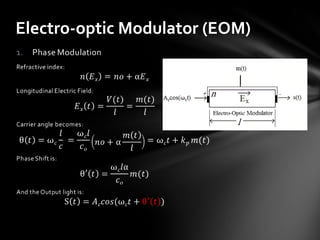
1. Phase Modulation
2. Amplitude Modulation
3. Polarization Modulation
4. Frequency Modulation
Electro-optic Modulator (EOM)
• Definition
  An optical device in which a signal-controlled element displaying electro-
  optic effect is used to modulate a beam of light.

• Types of EOMs
1. Phase Modulation
2. Amplitude Modulation
3. Polarization Modulation
Electro-optic Modulator (EOM)
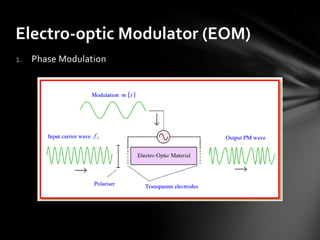
1. Phase Modulation
Electro-optic Modulator (EOM)
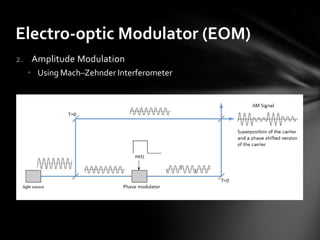
2. Amplitude Modulation
  • Using Mach–Zehnder Interferometer
Electro-optic Modulator (EOM)
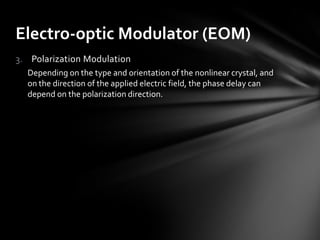
3. Polarization Modulation
  Depending on the type and orientation of the nonlinear crystal, and
  on the direction of the applied electric field, the phase delay can
  depend on the polarization direction.
Contents
• Modulation.
• Electro-optic Effect.
• Electro-optic Modulator (EOM).
• Acousto-optic Effect.
• Acousto-optic Modulator (AOM).
Acousto-Optic Effect
• Definition
  It is a change of a material's permittivity (ε) due to a mechanical strain
• Materials
  Fused silica, arsenic trisulfide, lead silicate, and other materials.
• Acousto optic Devices
 o Acousto-optic Filter
   By tuning the frequency of the acoustic wave, the desired wavelength of the optical
   wave can be diffracted acousto-optically.
 o Acousto-optic Deflector
   Controls the optical beam spatially. the power driving the acoustic transducer is
   kept on, at a constant level, while the acoustic frequency is varied to deflect the
   beam to different angular positions.
 o Acousto-optic Modulator
Contents
• Modulation.
• Electro-optic Effect.
• Electro-optic Modulator (EOM).
• Acousto-optic Effect.
• Acousto-optic Modulator (AOM).
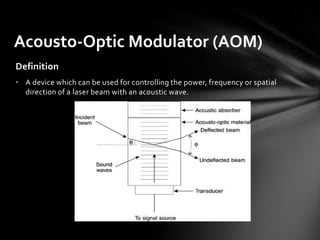
Acousto-Optic Modulator (AOM)
Definition
• A device which can be used for controlling the power, frequency or spatial
  direction of a laser beam with an acoustic wave.
Summary
• Modulation is the process of varying one or more properties of a high-
  frequency periodic waveform with a modulating signal which typically
  contains information to be transmitted.
• Electro-optic effect is a change in the optical properties of a material in
  response to an electric field that varies slowly compared with the
  frequency of light.
• EOM is an optical device in which a signal-controlled element displaying
  electro-optic effect is used to modulate a beam of light.
• The acousto-optic effect is a change of a material's permittivity (and
  refractive index), due to a mechanical strain.
• AOM is a device which can be used for controlling the power, frequency
  or spatial direction of a laser beam with an acoustic wave.
References
• Modulation:
 •   “Communication Systems 4Th Edition” by Simon Haykin – Chapter 2.

• Electro-Optic effect:
 •   http://www.rp-photonics.com/electro_optic_effect.html

• Acousto-Optic effect:
 •   http://en.wikipedia.org/wiki/Acousto-optics
 •   http://www.mt-berlin.com/frames_ao/descriptions/ao_effect.htm

• Electro-optic modulator:
 •   http://en.wikipedia.org/wiki/Electro-optic_modulator
 •   http://www.rp-photonics.com/electro_optic_modulators.html
 •   “Photonics Optical Electronics for Modern Communications” by AMNON YARIV – Chapter 9.

• Acousto-optic Modulator:
 •   http://www.rp-photonics.com/acousto_optic_modulators.html

Electro-optic Modulator

  • 1.
    Supervised by :Prof. Magdy Ibrahim
  • 2.
    Contents • Modulation. • Electro-opticEffect. • Electro-optic Modulator (EOM). • Acousto-optic Effect. • Acousto-optic Modulator (AOM).
  • 3.
    Contents • Modulation. • Electro-opticEffect. • Electro-optic Modulator (EOM). • Acousto-optic Effect. • Acousto-optic Modulator (AOM).
  • 4.
  • 5.
    Modulation Modulation of BinarySignals 1. Amplitude modulation • used for: o up to 1200bps on voice grade lines o very high speeds over optical fiber
  • 6.
    Modulation Modulation of BinarySignals 2. Frequency Modulation • Binary PSK: Two phases represent two binary digits. 3. Phase Modulation • Two binary values represented by two different frequencies.
  • 7.
    Contents • Modulation. • Electro-opticEffect. • Electro-optic Modulator (EOM). • Acousto-optic Effect. • Acousto-optic Modulator (AOM).
  • 8.
    Electro-optic Effect • Definition A change in the optical properties of a material in response to an electric field. • Types 1. Change of the absorption. 2. Change of the Refractive index (n). • Pockels Effect The change in the refractive index linearly with the electric field. • Pockels Cells Voltage-controlled wave plates.
  • 9.
    Electro-optic Effect Pockels Cells •Geometry Longitudinal devices Transverse devices • Material β-barium borate (BBO) : for high average power and high switching frequencies. • Half-Wave Voltage ( V π ) The voltage required for inducing a phase change of π (Relatively high) .
  • 10.
    Contents • Modulation. • Electro-opticEffect. • Electro-optic Modulator (EOM). • Acousto-optic Effect. • Acousto-optic Modulator (AOM).
  • 11.
    Electro-optic Modulator (EOM) •Definition An optical device in which a signal-controlled element displaying electro- optic effect is used to modulate a beam of light. • Types of EOMs 1. Phase Modulation 2. Amplitude Modulation 3. Polarization Modulation 4. Frequency Modulation
  • 12.
    Electro-optic Modulator (EOM) •Definition An optical device in which a signal-controlled element displaying electro- optic effect is used to modulate a beam of light. • Types of EOMs 1. Phase Modulation 2. Amplitude Modulation 3. Polarization Modulation
  • 13.
  • 14.
  • 15.
    Electro-optic Modulator (EOM) 2.Amplitude Modulation • Using Mach–Zehnder Interferometer
  • 16.
    Electro-optic Modulator (EOM) 3.Polarization Modulation Depending on the type and orientation of the nonlinear crystal, and on the direction of the applied electric field, the phase delay can depend on the polarization direction.
  • 17.
    Contents • Modulation. • Electro-opticEffect. • Electro-optic Modulator (EOM). • Acousto-optic Effect. • Acousto-optic Modulator (AOM).
  • 18.
    Acousto-Optic Effect • Definition It is a change of a material's permittivity (ε) due to a mechanical strain • Materials Fused silica, arsenic trisulfide, lead silicate, and other materials. • Acousto optic Devices o Acousto-optic Filter By tuning the frequency of the acoustic wave, the desired wavelength of the optical wave can be diffracted acousto-optically. o Acousto-optic Deflector Controls the optical beam spatially. the power driving the acoustic transducer is kept on, at a constant level, while the acoustic frequency is varied to deflect the beam to different angular positions. o Acousto-optic Modulator
  • 19.
    Contents • Modulation. • Electro-opticEffect. • Electro-optic Modulator (EOM). • Acousto-optic Effect. • Acousto-optic Modulator (AOM).
  • 20.
    Acousto-Optic Modulator (AOM) Definition •A device which can be used for controlling the power, frequency or spatial direction of a laser beam with an acoustic wave.
  • 21.
    Summary • Modulation isthe process of varying one or more properties of a high- frequency periodic waveform with a modulating signal which typically contains information to be transmitted. • Electro-optic effect is a change in the optical properties of a material in response to an electric field that varies slowly compared with the frequency of light. • EOM is an optical device in which a signal-controlled element displaying electro-optic effect is used to modulate a beam of light. • The acousto-optic effect is a change of a material's permittivity (and refractive index), due to a mechanical strain. • AOM is a device which can be used for controlling the power, frequency or spatial direction of a laser beam with an acoustic wave.
  • 22.
    References • Modulation: • “Communication Systems 4Th Edition” by Simon Haykin – Chapter 2. • Electro-Optic effect: • http://www.rp-photonics.com/electro_optic_effect.html • Acousto-Optic effect: • http://en.wikipedia.org/wiki/Acousto-optics • http://www.mt-berlin.com/frames_ao/descriptions/ao_effect.htm • Electro-optic modulator: • http://en.wikipedia.org/wiki/Electro-optic_modulator • http://www.rp-photonics.com/electro_optic_modulators.html • “Photonics Optical Electronics for Modern Communications” by AMNON YARIV – Chapter 9. • Acousto-optic Modulator: • http://www.rp-photonics.com/acousto_optic_modulators.html