1
EST 200, Divergent and
Convergent Thinking
MEC
2
Contents
• Engineering Design.
• Express –Test - Cycle.
• Divergence – Convergence Model.
• Divergent Thinking.
• Convergent Thinking.
• Approaches to Finalize a Concept.
• Reasons for Non-creativity.
3
Engineering Design
“Engineering design is the systematic,
intelligent generation and evaluation of
specifications for artifacts whose form and
function achieve stated objectives and
satisfy specified constraint".
4
Engineering Design
• An amalgamation of knowledge, process
and enabling skills.
• Highly non-linear process with designers
going back and forth, switching between
different aspects of design.
• Combines elements to form a whole or
decomposes an element to sub-elements.
• A continuous improvement process.
5
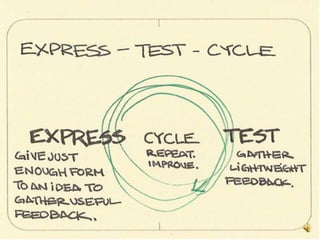
Express-Test-Cycle
• A rapid simple design approach put
forward by Brian.
• Doing the minimum you can to create a
testable prototype fast.
• Express stage corresponds to concept
generation.
• Test stage corresponds to concept
evaluation.
• Cycle symbolizes the iterative nature of
the process.
6
7
What Designers Should Do?
“Engineering designers are expected to
be adept at translating innovative ideas
into products or artifacts that have
exceptional and at the same time useful
functionality while adhering to given
constraints”.
8
What Designers Should Do?
• Design a highly complex cognitive
process.
• Designer to perform multiple tasks in
staggered as well as iterative process.
• Designer to ask a number of questions to
understand a given problem.
• Designer to explore the problem space
and the possible solution space in depth
as well as breadth.
9
What Designers Should Do?
• Designer to restructure the problem or
solution specifications when necessary.
• Designer to evaluate promising solution
options in a detailed manner.
• Variety of thinking skills required to
perform the series of design activities.
• Divergent thinking and convergent thinking
required.
10
Engineering Design Thinking
• Complex process, use of cognitive skills.
• Includes wide range of activities ranging
from analytical reasoning to being creative
and inquisitive.
• Designer to perform multiple tasks in
staggered as well as iterative process.
• Systematic questioning that includes low
level (existential) and deep reasoning
(phenomenon) questions, help shape the
design process.
11
Design Thinking Abilities
• Design thinking as divergent convergent
questioning.
• Thinking about system dynamics.
• Reasoning about uncertainty.
• Making estimates.
• Conducting experiments.
• Making design decisions.
12
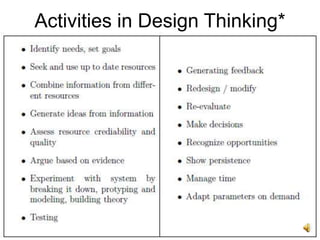
Activities in Design Thinking*
13
Skills in Engineering Design
Thinking.
• Important skills in engineering design
proposed by Mavinkurve.
• Need effective use of competencies and
sub-competencies, include:
• Structure open problem.
• Information gathering.
• Multiple representations.
• Divergent thinking.
• Convergent thinking.
14
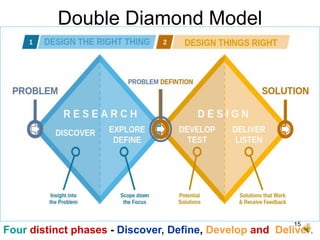
Divergence - Convergence Model
• Proposed in 1996 by Hungarian-American
linguist Béla H. Bánáthy.
• British Design Council in 2005 adapted
and popularized it as the Double Diamond
Model, a design process model.
• A simple graphical way of describing the
design process.
• Two diamonds represent the processes of
exploring an issue more widely and deeply
and then taking focused action.
15
Double Diamond Model
Four distinct phases - Discover, Define, Develop and Deliver.
16
Divergent and Convergent Thinking
Phases
• Information acquisition phase - activities
include perceiving, learning and
remembering, demands convergent
thinking.
• Preparation phase - identifying problem
and setting goals, includes understanding
constraints and defining functional
requirements of the problem, demands
convergent thinking.
17
Divergent and Convergent Thinking
Phases
• Incubation phase - associations are made,
networks are built, activities predominantly
divergent.
• Illumination phase - a promising new
configuration made, demands divergent
thinking.
18
Divergent and Convergent Thinking
Phases
• Verification phase - relevance and
effectiveness of the new configuration in
illumination stage checked, includes the
evaluation and decision making aspect,
competing options analyzed, requires a
combination of convergent and divergent
thinking.
19
Divergent and Convergent Thinking
Phases
• Communication phase - idea presented
and feedback obtained, reflected and
acted upon, requires both convergent and
divergent thinking.
• Validation phase - effectiveness and
relevance judged, requires convergent
thinking.
20
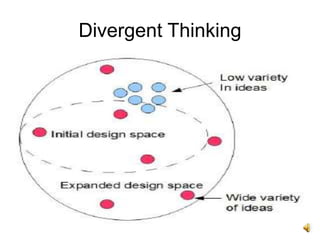
Divergent Thinking
• Characterized by the action of ideation
and creation of multiple choices.
• Supports pushing past the obvious so as
to explore uncharted territory (also called
exploratory enquiry).
• More concept domain based rather than
knowledge domain based.
• Predominant in the early design stage
when concept generation process in
progress.
21
Divergent Thinking
• Seen at almost all stages of design,
especially when the designer is at cross-
roads and needs multiple options to make
right decisions.
• Early stage divergent thinking focuses on
generating diverse ideas.
• Later stage divergent thinking looks at
ways to achieve specific characteristics of
the selected concept.
• Generates novelty.
22
Divergent Thinking
23
Activities in Divergent Thinking
• Shifting perspectives.
• Seeing new possibilities.
• Being unconventional.
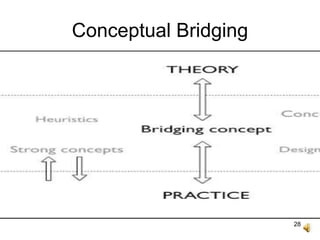
• Combining the disparate (conceptual
bridging).
• Taking risks.
• Producing multiple answers.
24
25
26
27
Bridging Concepts
• Address the challenge of facilitating
exchange between theory and practice.
• Three defining constituents:
- a theoretical foundation.
- a set of design articulations.
- a range of exemplars that demonstrate
the scope and potential of their
application.
28
Conceptual Bridging
29
30
Activities in Divergent Thinking
• Transforming the known.
• Reframing and contextual shifting.
• Branching out.
• Crossing boundaries.
• Reinterpreting.
31
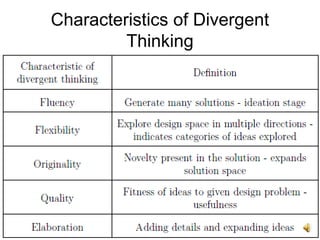
Characteristics of Divergent
Thinking
32
Indirect Characteristics of
Divergent Thinking
• Afixability (avoid getting fixated on an
idea).
• Abstractability (make connections and
analogies).
• Detailability (ability to think at a detailed
level).
• Cognitive restructuring ability (when the
existing cognitive knowledge structures
applied to the design are either insufficient
or inappropriate)
33
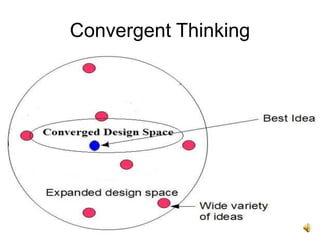
Convergent Thinking
• Responsible for sifting and sorting through
the choices and narrowing down the
design pathway.
• A directive process that uses logical
reasoning to converge to correct answer
that is also unambiguous.
• Relies on existing understanding of a
given topic.
34
Convergent Thinking
• Operates in the knowledge domain.
• Explores novelty.
• Characterizes the ability to dig deeper into
the ideas.
35
Convergent Thinking
36
Characteristics of Convergent
Thinking
37
Activities in Convergent Thinking
• Seeking single best solution.
• Testing and evaluation.
• Validating.
• Synthesizing existing information.
• Being logical.
• Recognizing the familiar.
• Combining what belongs together.
38
Activities in Convergent Thinking
• Reapplying set techniques.
• Preserving the already known.
• Achieving accuracy and correctness.
• Abiding by obviously relevant information.
• Making only the nearest neighbour
associations.
39
Approaches to Finalize on a
Concept
• Intuition.
• Feasibility judgement.
• Multi-voting.
• Numeric and nonnumeric selection charts.
• Pairwise comparisons.
• Decision matrices.
• Prototype testing.
40
Reasons for Non-creativity in
Design
• Fear of the unknown.
• Fear of failure.
• Frustration avoidance.
• Failing to see one's strengths.
• Over emphasis on traditional approaches.
• Reluctance to experiment.
• Reluctance to let go.
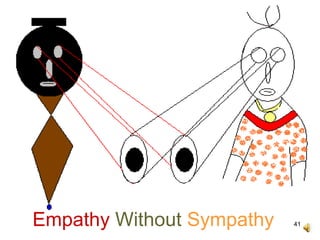
41
Empathy Without Sympathy
42
Thank You

EST 200, Convergent and Divergent Thinking

  • 1.
    1 EST 200, Divergentand Convergent Thinking MEC
  • 2.
    2 Contents • Engineering Design. •Express –Test - Cycle. • Divergence – Convergence Model. • Divergent Thinking. • Convergent Thinking. • Approaches to Finalize a Concept. • Reasons for Non-creativity.
  • 3.
    3 Engineering Design “Engineering designis the systematic, intelligent generation and evaluation of specifications for artifacts whose form and function achieve stated objectives and satisfy specified constraint".
  • 4.
    4 Engineering Design • Anamalgamation of knowledge, process and enabling skills. • Highly non-linear process with designers going back and forth, switching between different aspects of design. • Combines elements to form a whole or decomposes an element to sub-elements. • A continuous improvement process.
  • 5.
    5 Express-Test-Cycle • A rapidsimple design approach put forward by Brian. • Doing the minimum you can to create a testable prototype fast. • Express stage corresponds to concept generation. • Test stage corresponds to concept evaluation. • Cycle symbolizes the iterative nature of the process.
  • 6.
  • 7.
    7 What Designers ShouldDo? “Engineering designers are expected to be adept at translating innovative ideas into products or artifacts that have exceptional and at the same time useful functionality while adhering to given constraints”.
  • 8.
    8 What Designers ShouldDo? • Design a highly complex cognitive process. • Designer to perform multiple tasks in staggered as well as iterative process. • Designer to ask a number of questions to understand a given problem. • Designer to explore the problem space and the possible solution space in depth as well as breadth.
  • 9.
    9 What Designers ShouldDo? • Designer to restructure the problem or solution specifications when necessary. • Designer to evaluate promising solution options in a detailed manner. • Variety of thinking skills required to perform the series of design activities. • Divergent thinking and convergent thinking required.
  • 10.
    10 Engineering Design Thinking •Complex process, use of cognitive skills. • Includes wide range of activities ranging from analytical reasoning to being creative and inquisitive. • Designer to perform multiple tasks in staggered as well as iterative process. • Systematic questioning that includes low level (existential) and deep reasoning (phenomenon) questions, help shape the design process.
  • 11.
    11 Design Thinking Abilities •Design thinking as divergent convergent questioning. • Thinking about system dynamics. • Reasoning about uncertainty. • Making estimates. • Conducting experiments. • Making design decisions.
  • 12.
  • 13.
    13 Skills in EngineeringDesign Thinking. • Important skills in engineering design proposed by Mavinkurve. • Need effective use of competencies and sub-competencies, include: • Structure open problem. • Information gathering. • Multiple representations. • Divergent thinking. • Convergent thinking.
  • 14.
    14 Divergence - ConvergenceModel • Proposed in 1996 by Hungarian-American linguist Béla H. Bánáthy. • British Design Council in 2005 adapted and popularized it as the Double Diamond Model, a design process model. • A simple graphical way of describing the design process. • Two diamonds represent the processes of exploring an issue more widely and deeply and then taking focused action.
  • 15.
    15 Double Diamond Model Fourdistinct phases - Discover, Define, Develop and Deliver.
  • 16.
    16 Divergent and ConvergentThinking Phases • Information acquisition phase - activities include perceiving, learning and remembering, demands convergent thinking. • Preparation phase - identifying problem and setting goals, includes understanding constraints and defining functional requirements of the problem, demands convergent thinking.
  • 17.
    17 Divergent and ConvergentThinking Phases • Incubation phase - associations are made, networks are built, activities predominantly divergent. • Illumination phase - a promising new configuration made, demands divergent thinking.
  • 18.
    18 Divergent and ConvergentThinking Phases • Verification phase - relevance and effectiveness of the new configuration in illumination stage checked, includes the evaluation and decision making aspect, competing options analyzed, requires a combination of convergent and divergent thinking.
  • 19.
    19 Divergent and ConvergentThinking Phases • Communication phase - idea presented and feedback obtained, reflected and acted upon, requires both convergent and divergent thinking. • Validation phase - effectiveness and relevance judged, requires convergent thinking.
  • 20.
    20 Divergent Thinking • Characterizedby the action of ideation and creation of multiple choices. • Supports pushing past the obvious so as to explore uncharted territory (also called exploratory enquiry). • More concept domain based rather than knowledge domain based. • Predominant in the early design stage when concept generation process in progress.
  • 21.
    21 Divergent Thinking • Seenat almost all stages of design, especially when the designer is at cross- roads and needs multiple options to make right decisions. • Early stage divergent thinking focuses on generating diverse ideas. • Later stage divergent thinking looks at ways to achieve specific characteristics of the selected concept. • Generates novelty.
  • 22.
  • 23.
    23 Activities in DivergentThinking • Shifting perspectives. • Seeing new possibilities. • Being unconventional. • Combining the disparate (conceptual bridging). • Taking risks. • Producing multiple answers.
  • 24.
  • 25.
  • 26.
  • 27.
    27 Bridging Concepts • Addressthe challenge of facilitating exchange between theory and practice. • Three defining constituents: - a theoretical foundation. - a set of design articulations. - a range of exemplars that demonstrate the scope and potential of their application.
  • 28.
  • 29.
  • 30.
    30 Activities in DivergentThinking • Transforming the known. • Reframing and contextual shifting. • Branching out. • Crossing boundaries. • Reinterpreting.
  • 31.
  • 32.
    32 Indirect Characteristics of DivergentThinking • Afixability (avoid getting fixated on an idea). • Abstractability (make connections and analogies). • Detailability (ability to think at a detailed level). • Cognitive restructuring ability (when the existing cognitive knowledge structures applied to the design are either insufficient or inappropriate)
  • 33.
    33 Convergent Thinking • Responsiblefor sifting and sorting through the choices and narrowing down the design pathway. • A directive process that uses logical reasoning to converge to correct answer that is also unambiguous. • Relies on existing understanding of a given topic.
  • 34.
    34 Convergent Thinking • Operatesin the knowledge domain. • Explores novelty. • Characterizes the ability to dig deeper into the ideas.
  • 35.
  • 36.
  • 37.
    37 Activities in ConvergentThinking • Seeking single best solution. • Testing and evaluation. • Validating. • Synthesizing existing information. • Being logical. • Recognizing the familiar. • Combining what belongs together.
  • 38.
    38 Activities in ConvergentThinking • Reapplying set techniques. • Preserving the already known. • Achieving accuracy and correctness. • Abiding by obviously relevant information. • Making only the nearest neighbour associations.
  • 39.
    39 Approaches to Finalizeon a Concept • Intuition. • Feasibility judgement. • Multi-voting. • Numeric and nonnumeric selection charts. • Pairwise comparisons. • Decision matrices. • Prototype testing.
  • 40.
    40 Reasons for Non-creativityin Design • Fear of the unknown. • Fear of failure. • Frustration avoidance. • Failing to see one's strengths. • Over emphasis on traditional approaches. • Reluctance to experiment. • Reluctance to let go.
  • 41.
  • 42.