Polarization
Ali Sufyan
Islamia University of Bahawalpur
Bahawalpur, Punjab, Pakistan
ali.sufyan@iub.edu.pk
 Polarization is an expression of the orientation of the lines of electric flux in
an electromagnetic field ( EM field ).
 An electromagnetic (radio) wave (satellite signal) consists of two
components.
 A magnetic field
 An electric field.
 These two fields oscillates (vibrates) in the same direction on the same
(parallel) axis 90 degrees apart. See figure below
Types of polarization
 Signals transmitted by satellite can be polarized in one of four different ways:
1. linear polarization
- horizontal
-vertical
2. Circular polarization
-right-hand circular
- left-hand
Linear Polarization
linear polarization is defined as polarization of
an electromagnetic wave in which the
electric vector at a fixed point in space
remains pointing in a fixed direction, although
varying in magnitude.
Vertically polarized
 An antenna is vertically polarized when its electric field is perpendicular to
the Earth’s surface.
 Vertically polarized signals oscillate from top to bottom.
 Signals are transmitted in all directions. Therefore vertical polarization is
used for ground-wave transmission, allowing the radio wave to travel a
considerable distance along the ground surface with minimum
attenuation.
Horizontally polarized
 Horizontally polarized antennas have their electric field parallel to the
Earth’s surface.
 Horizontally polarized signals oscillate from left to right.
 Horizontal polarization frequencies are parallel to and touch the earth.
Since the earth acts as a good conductor at low frequencies, it shorts some
of the frequencies and prevents the signals from traveling very far.
Circular polarization
 Circular polarization is most often use on satellites. The polarization
of the signals is rotating. Due the position of the Earth with respect
to the satellite, geometric differences may vary. Circular
polarization will keep the signal constant regardless of anomalies.
 FSS (Fixed Service Satellites) satellites use horizontal and vertical
polarization. FFS are used for:
 telephone calls
 data transmission
 TV signals for broadcasting
 cable organizations (cable TV networks)
 communications
 The low power FSS requiring a larger antennas with the advantage that more
programs can be broadcast.
 DBS (Direct Broadcasting Satellite) satellites use left- and right-hand circular
polarization. DBS are especially designed used for:
 Radio
 TV programs
 Because of its high power, its signals can be received with smaller antennae and
received much easier
 MPS (Medium Powered Satellite) which is a satellite with more power than a FSS
and its signals can therefore be received much easier. Although it has less power
than a DBS, it broadcast more programs. The ASTRA satellite is an example.
 Home Task: Search ASTRA on internet and read about it.
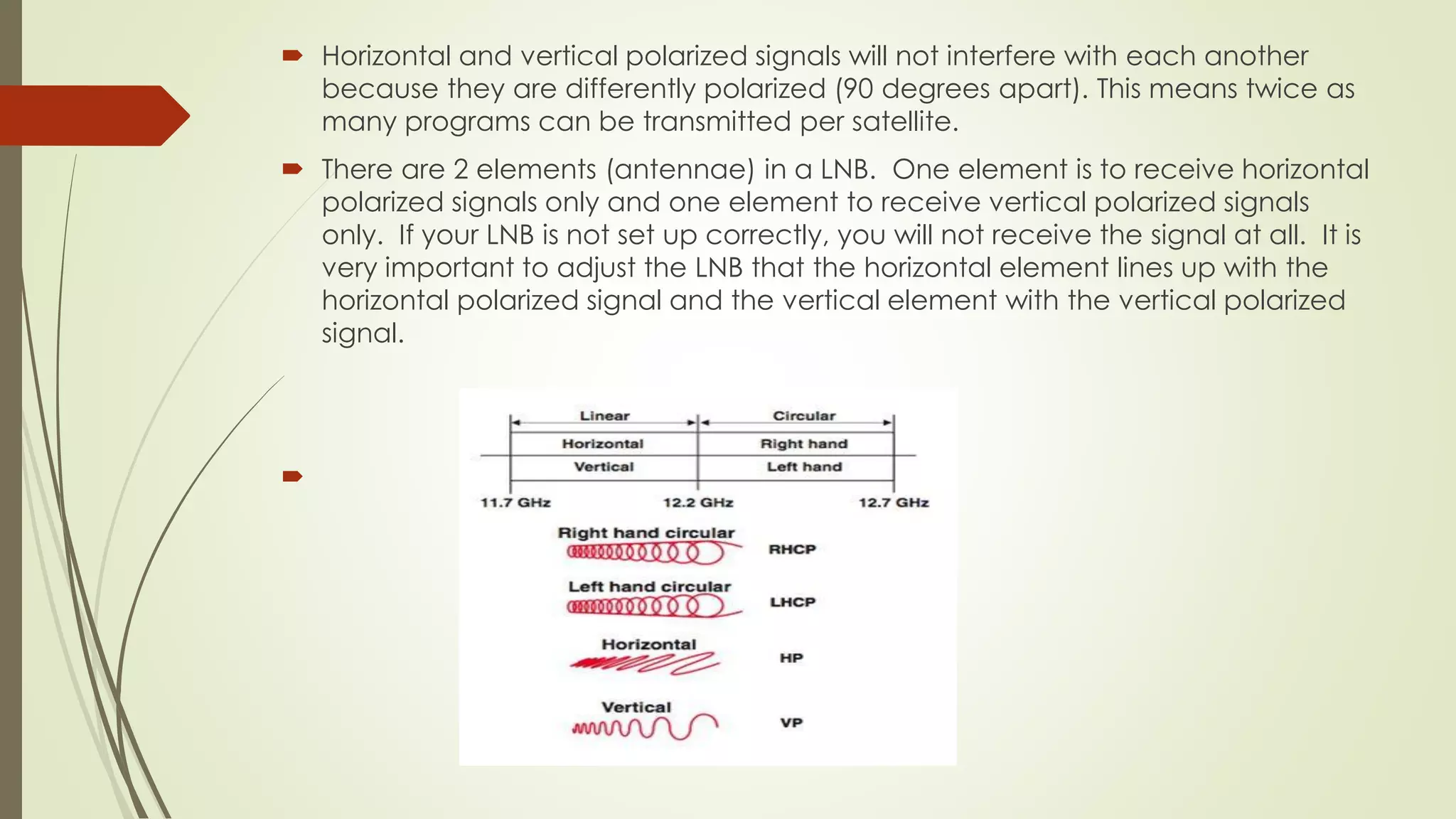
 Horizontal and vertical polarized signals will not interfere with each another
because they are differently polarized (90 degrees apart). This means twice as
many programs can be transmitted per satellite.
 There are 2 elements (antennae) in a LNB. One element is to receive horizontal
polarized signals only and one element to receive vertical polarized signals
only. If your LNB is not set up correctly, you will not receive the signal at all. It is
very important to adjust the LNB that the horizontal element lines up with the
horizontal polarized signal and the vertical element with the vertical polarized
signal.

What is an LNB?
 The abbreviation LNB: Low Noise Block down-converter.
 The LNB is the device installed in front of the satellite dish and is connected with a cable
(or more) to your decoder. The LNB receives the very low level microwave signal that is
transmitted from the satellite, amplifies it, changes the signals to the right frequency band
and sends it with the cable to the decoder/receiver.
Advantages of Circular Polarization
 There are several key advantages for circular polarization over linear polarization,
which make it more appealing:
 The Faraday effect
 Atmospheric Conditions
 Easier installation
 Higher link reliability
 Availability on the Intelsat Fleet
The Faraday effect
 The Faraday effect deals with the interaction between light and magnetic fields.
 It affects linear, but not circular, polarized signals
 The effects are more severe at lower frequencies, such as C-Band, and not
noticeable at higher ones, such as Ku-Band.
 Linear polarized feeds are aligned in such a way to compensate for the Faraday
effect, usually with the help of a tracking device; corrections can be made either
by rotating the feed system or using adjustable polarizer’s within the feed system.
 This can be very time consuming because the alignment must be exact.
 One result of incorrect alignment is increased interference.
 Fortunately, this is not a concern for circular polarization since there is no need for
exact signal alignment. Ku-Band is at a high enough frequency that Faraday’s
effect is not a factor.
Atmospheric Conditions
 Circular polarization is more resistant to signal degradation due to atmospheric
conditions.
 These conditions can cause changes in the rotation of the signal, and will more
adversely affect linear polarization than circular polarization.
 The effect of a high frequency signal passing through rain can cause signal
attenuation and responsible for many problems with rain fade.
 Moisture loaded clouds are also a factor; by the time a signal passes through a
cloud system it can be attenuated by as much as 1dB.
 Water droplets on the feed horn may also cause harmful effects.
 The most important aspect to note is that higher frequencies (like Ku-Band)
degrade faster, harder, and longer than their frequency counterparts (C-Band).
Easier installation
 The only requirement is ensuring that the antenna is aimed in the correct
direction on the satellite; simply point and transmit.
 This allows for circular feeds to be set up quicker.
 There is less of a risk of being misaligned.
Higher link reliability
 There is higher link reliability since there is a low risk of misalignment, and
meeting interference.
 Faraday’s effect will not affect transmission with circular C-band, so there
will be no need to readjust the alignment.
 Finally, because transmission is sent and/or received at different
frequencies, interference (cross polarization) is less of a concern.
Availability on the Intelsat Fleet
 Circular polarized C-band is available on key roles on the Intelsat fleet.
Breakdown of Polarization on Intelsat
satellites
Refrence:
- http://www.intelsat.com/wp-content/uploads/2013/02/Polarization.pdf
- https://techbaron.com/what-are-the-differences-between-horizontally-polarized-and-vertically-polarized-signals/

Polarization

  • 1.
    Polarization Ali Sufyan Islamia Universityof Bahawalpur Bahawalpur, Punjab, Pakistan ali.sufyan@iub.edu.pk
  • 2.
     Polarization isan expression of the orientation of the lines of electric flux in an electromagnetic field ( EM field ).  An electromagnetic (radio) wave (satellite signal) consists of two components.  A magnetic field  An electric field.  These two fields oscillates (vibrates) in the same direction on the same (parallel) axis 90 degrees apart. See figure below
  • 3.
    Types of polarization Signals transmitted by satellite can be polarized in one of four different ways: 1. linear polarization - horizontal -vertical 2. Circular polarization -right-hand circular - left-hand
  • 4.
    Linear Polarization linear polarizationis defined as polarization of an electromagnetic wave in which the electric vector at a fixed point in space remains pointing in a fixed direction, although varying in magnitude.
  • 5.
    Vertically polarized  Anantenna is vertically polarized when its electric field is perpendicular to the Earth’s surface.  Vertically polarized signals oscillate from top to bottom.  Signals are transmitted in all directions. Therefore vertical polarization is used for ground-wave transmission, allowing the radio wave to travel a considerable distance along the ground surface with minimum attenuation.
  • 6.
    Horizontally polarized  Horizontallypolarized antennas have their electric field parallel to the Earth’s surface.  Horizontally polarized signals oscillate from left to right.  Horizontal polarization frequencies are parallel to and touch the earth. Since the earth acts as a good conductor at low frequencies, it shorts some of the frequencies and prevents the signals from traveling very far.
  • 7.
    Circular polarization  Circularpolarization is most often use on satellites. The polarization of the signals is rotating. Due the position of the Earth with respect to the satellite, geometric differences may vary. Circular polarization will keep the signal constant regardless of anomalies.  FSS (Fixed Service Satellites) satellites use horizontal and vertical polarization. FFS are used for:  telephone calls  data transmission  TV signals for broadcasting  cable organizations (cable TV networks)  communications
  • 9.
     The lowpower FSS requiring a larger antennas with the advantage that more programs can be broadcast.  DBS (Direct Broadcasting Satellite) satellites use left- and right-hand circular polarization. DBS are especially designed used for:  Radio  TV programs  Because of its high power, its signals can be received with smaller antennae and received much easier  MPS (Medium Powered Satellite) which is a satellite with more power than a FSS and its signals can therefore be received much easier. Although it has less power than a DBS, it broadcast more programs. The ASTRA satellite is an example.  Home Task: Search ASTRA on internet and read about it.
  • 10.
     Horizontal andvertical polarized signals will not interfere with each another because they are differently polarized (90 degrees apart). This means twice as many programs can be transmitted per satellite.  There are 2 elements (antennae) in a LNB. One element is to receive horizontal polarized signals only and one element to receive vertical polarized signals only. If your LNB is not set up correctly, you will not receive the signal at all. It is very important to adjust the LNB that the horizontal element lines up with the horizontal polarized signal and the vertical element with the vertical polarized signal. 
  • 11.
    What is anLNB?  The abbreviation LNB: Low Noise Block down-converter.  The LNB is the device installed in front of the satellite dish and is connected with a cable (or more) to your decoder. The LNB receives the very low level microwave signal that is transmitted from the satellite, amplifies it, changes the signals to the right frequency band and sends it with the cable to the decoder/receiver.
  • 12.
    Advantages of CircularPolarization  There are several key advantages for circular polarization over linear polarization, which make it more appealing:  The Faraday effect  Atmospheric Conditions  Easier installation  Higher link reliability  Availability on the Intelsat Fleet
  • 13.
    The Faraday effect The Faraday effect deals with the interaction between light and magnetic fields.  It affects linear, but not circular, polarized signals  The effects are more severe at lower frequencies, such as C-Band, and not noticeable at higher ones, such as Ku-Band.  Linear polarized feeds are aligned in such a way to compensate for the Faraday effect, usually with the help of a tracking device; corrections can be made either by rotating the feed system or using adjustable polarizer’s within the feed system.  This can be very time consuming because the alignment must be exact.  One result of incorrect alignment is increased interference.  Fortunately, this is not a concern for circular polarization since there is no need for exact signal alignment. Ku-Band is at a high enough frequency that Faraday’s effect is not a factor.
  • 14.
    Atmospheric Conditions  Circularpolarization is more resistant to signal degradation due to atmospheric conditions.  These conditions can cause changes in the rotation of the signal, and will more adversely affect linear polarization than circular polarization.  The effect of a high frequency signal passing through rain can cause signal attenuation and responsible for many problems with rain fade.  Moisture loaded clouds are also a factor; by the time a signal passes through a cloud system it can be attenuated by as much as 1dB.  Water droplets on the feed horn may also cause harmful effects.  The most important aspect to note is that higher frequencies (like Ku-Band) degrade faster, harder, and longer than their frequency counterparts (C-Band).
  • 15.
    Easier installation  Theonly requirement is ensuring that the antenna is aimed in the correct direction on the satellite; simply point and transmit.  This allows for circular feeds to be set up quicker.  There is less of a risk of being misaligned.
  • 16.
    Higher link reliability There is higher link reliability since there is a low risk of misalignment, and meeting interference.  Faraday’s effect will not affect transmission with circular C-band, so there will be no need to readjust the alignment.  Finally, because transmission is sent and/or received at different frequencies, interference (cross polarization) is less of a concern.
  • 17.
    Availability on theIntelsat Fleet  Circular polarized C-band is available on key roles on the Intelsat fleet.
  • 18.
    Breakdown of Polarizationon Intelsat satellites Refrence: - http://www.intelsat.com/wp-content/uploads/2013/02/Polarization.pdf - https://techbaron.com/what-are-the-differences-between-horizontally-polarized-and-vertically-polarized-signals/