Heterostructure
Laser Diodes
Both carrier and photon confinements
are readily achieved in modern laser by
the use of heterostructure devices!
Heterostructure Laser Diodes
• Fig.7 shows a Double Heterostructure (DH) device based
on two junctions between different semiconductor
materials with different bandgaps.
– Semiconductors are AlGaAs with Eg 2eV
– and GaAs with Eg 1.4eV
• The p-GaAs region is a thin layer (0.1-0.2mm) and
constitutes the active layer in which lasing combination
takes place
– Both p-GaAs and p-AlGaAs are heavily p-type doped and are
degenerate with EF in the valence band.
Refractive
index
Photon
density
Active
region
n ~ 5%
2 eV
Holes in VB
Electrons in CB
AlGaAsAlGaAs
1.4 eV
Ec
Ev
Ec
Ev
(a)
(b)
pn p
Ec
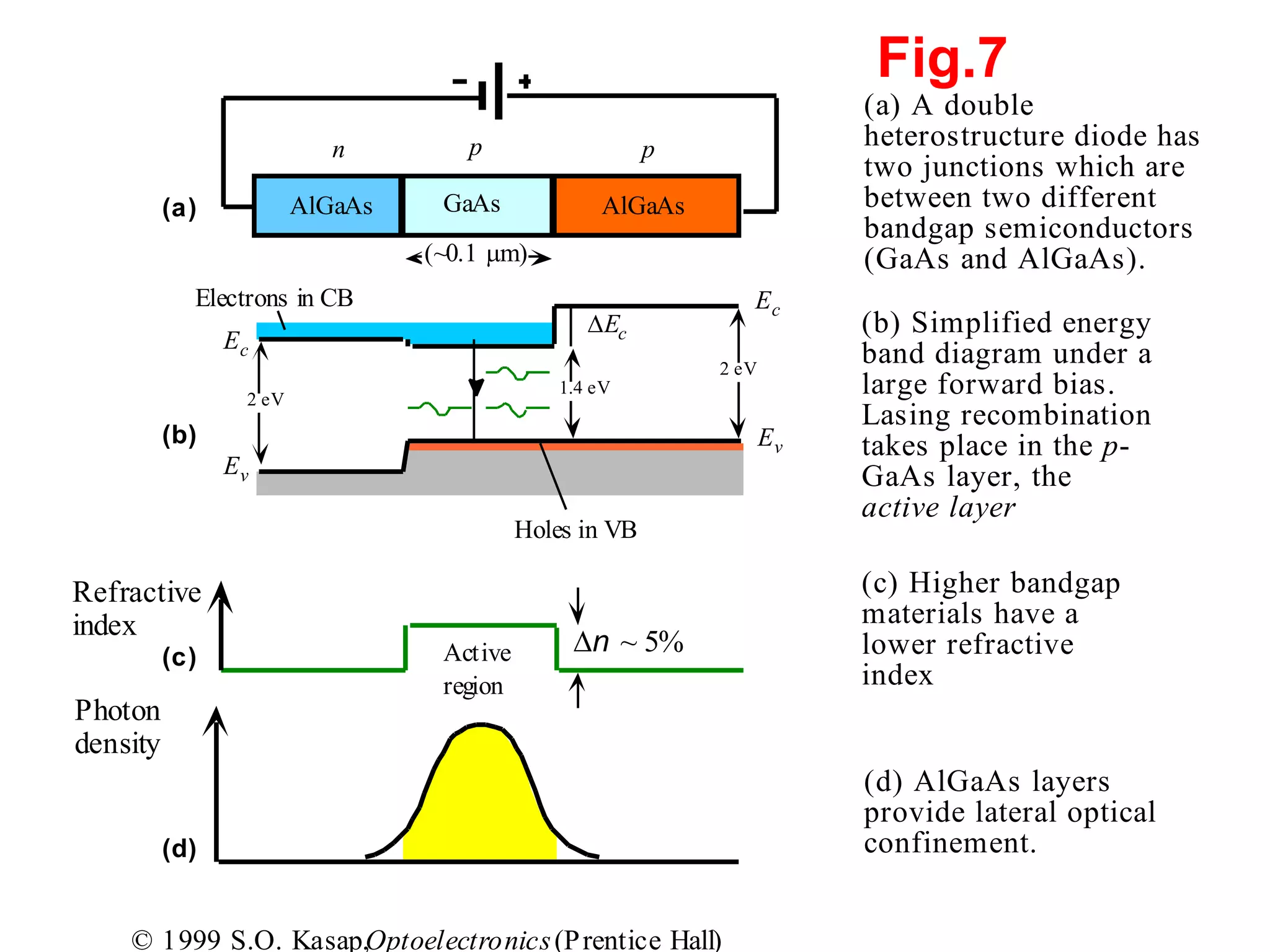
(a) A double
heterostructure diode has
two junctions which are
between two different
bandgap semiconductors
(GaAs and AlGaAs).
2 eV
(b) Simplified energy
band diagram under a
large forward bias.
Lasing recombination
takes place in the p-
GaAs layer, the
active layer
(~0.1 mm)
(c) Higher bandgap
materials have a
lower refractive
index
(d) AlGaAs layers
provide lateral optical
confinement.
(c)
(d)
© 1999 S.O. Kasap,Optoelectronics(Prentice Hall)
GaAs
Fig.7
Carrier confinement in DH
• When a sufficiently large forward bias is applied,
– Ecof n-AlGaAs moves above Ecof p-GaAs, which leads to a large
injection of electrons in the CB of n-AlGaAs into p-GaAs as shown
in Fig.7.
– These electrons are confined to the CB of p-GaAs since there is a
barrier Ec between p-GaAs and p-AlGaAs
• Since p-GaAs is a thin layer, the concentration of injected
electrons can be increased quickly even with moderate
increase in forward current.
– This effectively reduces the threshold current for population
inversion or optical gain
Photon confinement in DH
• AlGaAs has a lower refractive index than that of GaAs
– Note: a wider bandgap semiconductor generally has a lower
refractive index
• The change in the refractive index defines an optical
dielectric waveguide that confines the photons to the
active region of the optical cavity
– Thereby reduces photon losses & increases photon concentration
– It increases the rate of stimulated emissions
• Both carrier & photon confinement lead to reduction in
the threshold current density.
The structure of DH
• A typical structure of a double heterostructure
laser diode is similar to a double heterostructure
LED.
– The doped layers are grown epitaxially on a
crystalline substrate, which is n-GaAs
– It consists of the first layer substrate, n-AlGaAs,
the active p-GaAs layer and the p-AlGaAs layer
– There is an additional p-GaAs layer called
contacting layer, next to p-AlGaAs.
The structure of DH, cont
• The electrodes are attached to the GaAs rather than AlGaAs
– This allows better contacting and avoids Schottky junctions
which limits the current
• The p- and n-AlGaAs layers provide carrier and optical
confinement in the vertical direction by forming
heterojunction with p-GaAs.
• The active layer is p-GaAs
– which means that the lasing emission will be in in the range 870-
900nm depending on the doping level
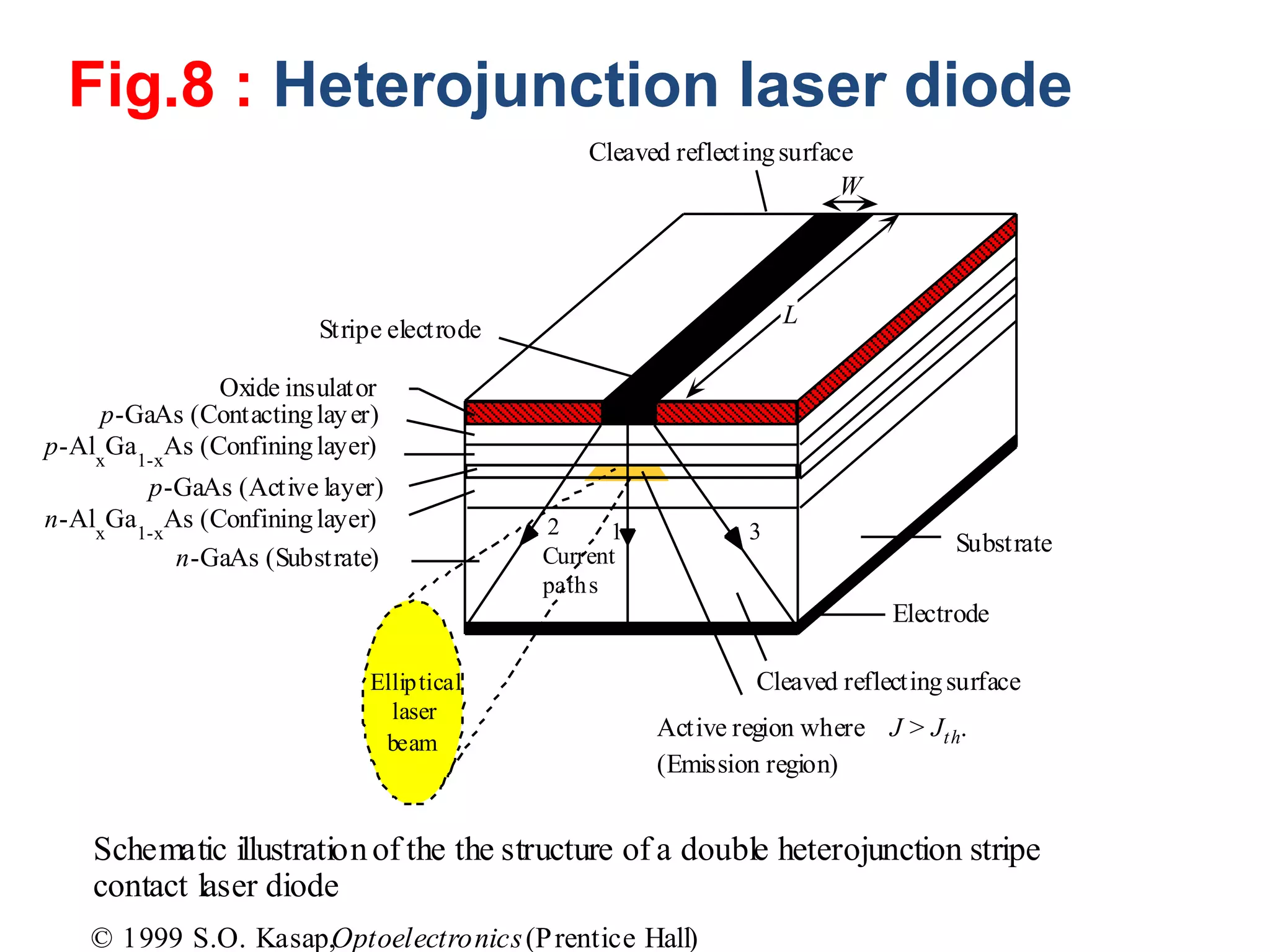
• An important feature of this laser diode is the stripe
geometry (stripe contact) on p-GaAs
Schematic illustrationof the the structure of a double heterojunction stripe
contact laser diode
Oxide insulator
Stripe electrode
Substrate
Electrode
Active region where J > Jth.
(Emission region)
p-GaAs (Contactinglayer)
n-GaAs (Substrate)
p-GaAs (Active layer)
Current
paths
L
W
Cleaved reflectingsurfaceElliptical
laser
beam
p-Alx
Ga1-x
As (Confininglayer)
n-Alx
Ga1-x
As (Confininglayer) 12 3
Cleaved reflectingsurface
Substrate
© 1999 S.O. Kasap,Optoelectronics(Prentice Hall)
Fig.8 : Heterojunction laser diode
Current Paths in DH
• Current density J from the stripe contact is not uniform
laterally
– J is greatest along the central path, 1, and decreases away
from path 1 towards 2 or 3
– The current is confined within path 2 & 3
• The current density paths through active region where J >Jth
as shown in Fig.8
– defines the active region where the lasing emission emerges
– The width of the active region is defined by J from the stripe
contact
• The optical gain is highest where the current density is
greatest
– Such lasers are called gain guided.
Two advantages of using a stripe
geometry
1. The reduced contact area also reduces the
threshold current Ith.
– Typical stripe width may be as small as a few mm
leading to typical threshold currents that may be
tens of mA.
2. The reduced emission area makes light
coupling to optical fibers easier.
Improving rear facet reflectance
• The laser efficiency can be further improved by
reducing the reflection losses from the rear
crystal facet
• The refractive index of GaAs is ~3.7, the
reflectance is 0.33
– By fabricating a dielectric mirror at the rear facet,
which is mirror consisting of a number of quarter
wavelength semiconductor layers of different
refractive index
– It is possible to bring the reflectance close to unity
and thereby improve the optical gain of the cavity
Lateral optical confinement
• The lateral optical confinement of photons to the
active region is poor
– because there is no marked change in the refractive
index laterally
• Laterally optical confinement can increase the rate
of stimulated emissions
– It can be achieved by shaping the refractive index profile in
the same way the vertical confinement
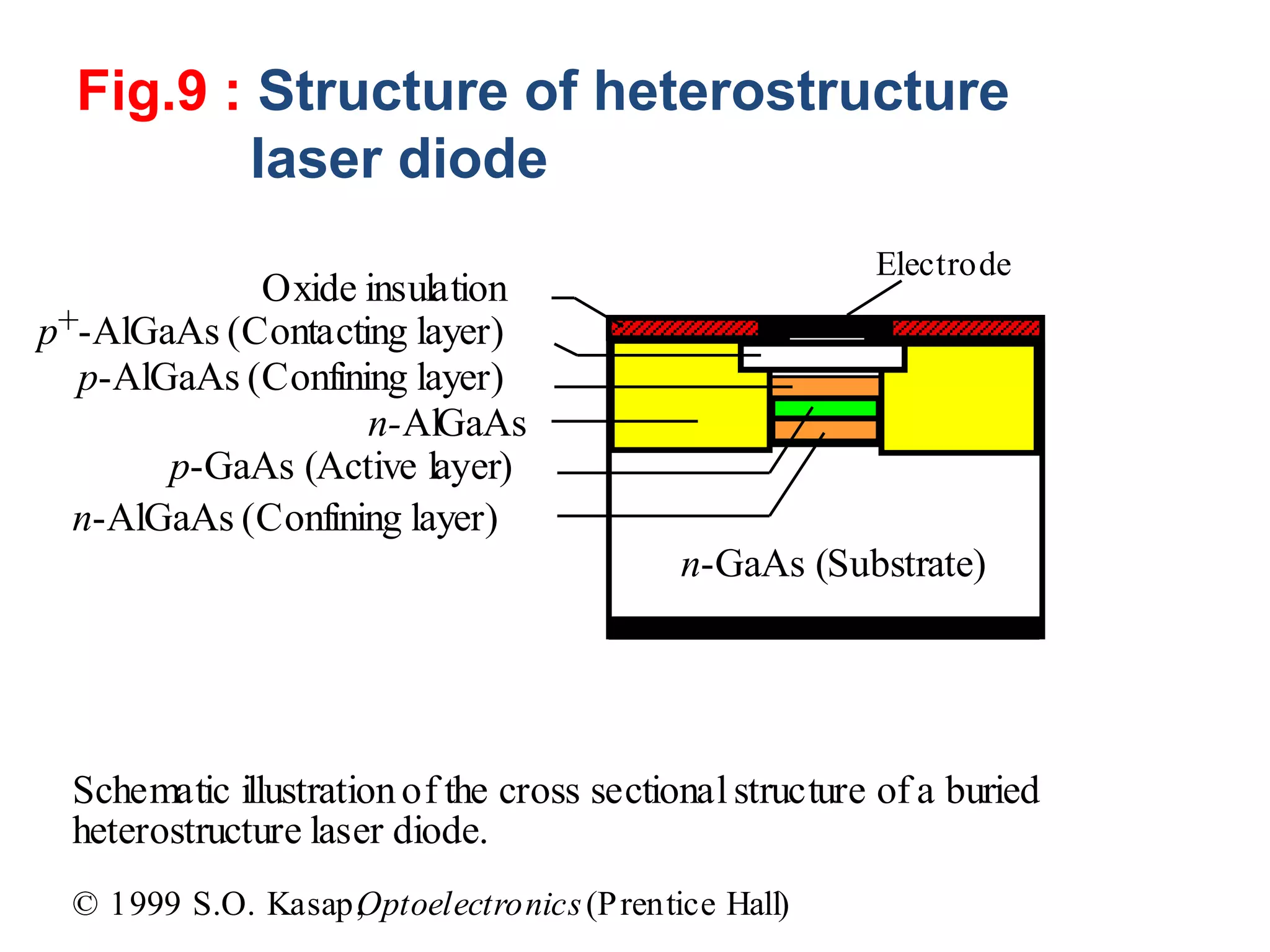
Oxide insulation
n-AlGaAs
p+-AlGaAs (Contacting layer)
n-GaAs (Substrate)
p-GaAs (Active layer)
n-AlGaAs (Confining layer)
p-AlGaAs (Confining layer)
Schematic illustrationof the cross sectionalstructure of a buried
heterostructure laser diode.
Electrode
© 1999 S.O. Kasap,Optoelectronics(Prentice Hall)
Fig.9 : Structure of heterostructure
laser diode
Index Guided
• Fig.9 shows the active layer p-GaAs is bound both vertically
and laterally by a lower index AlGaAs.
– It behaves as a dielectric waveguide and ensure the
photons are confined to the optical gain region
– It is called buried double heterostructure laser diode
• Since the optical power is confined to the waveguide
defined by the refractive index variation
– these diodes are called index guided
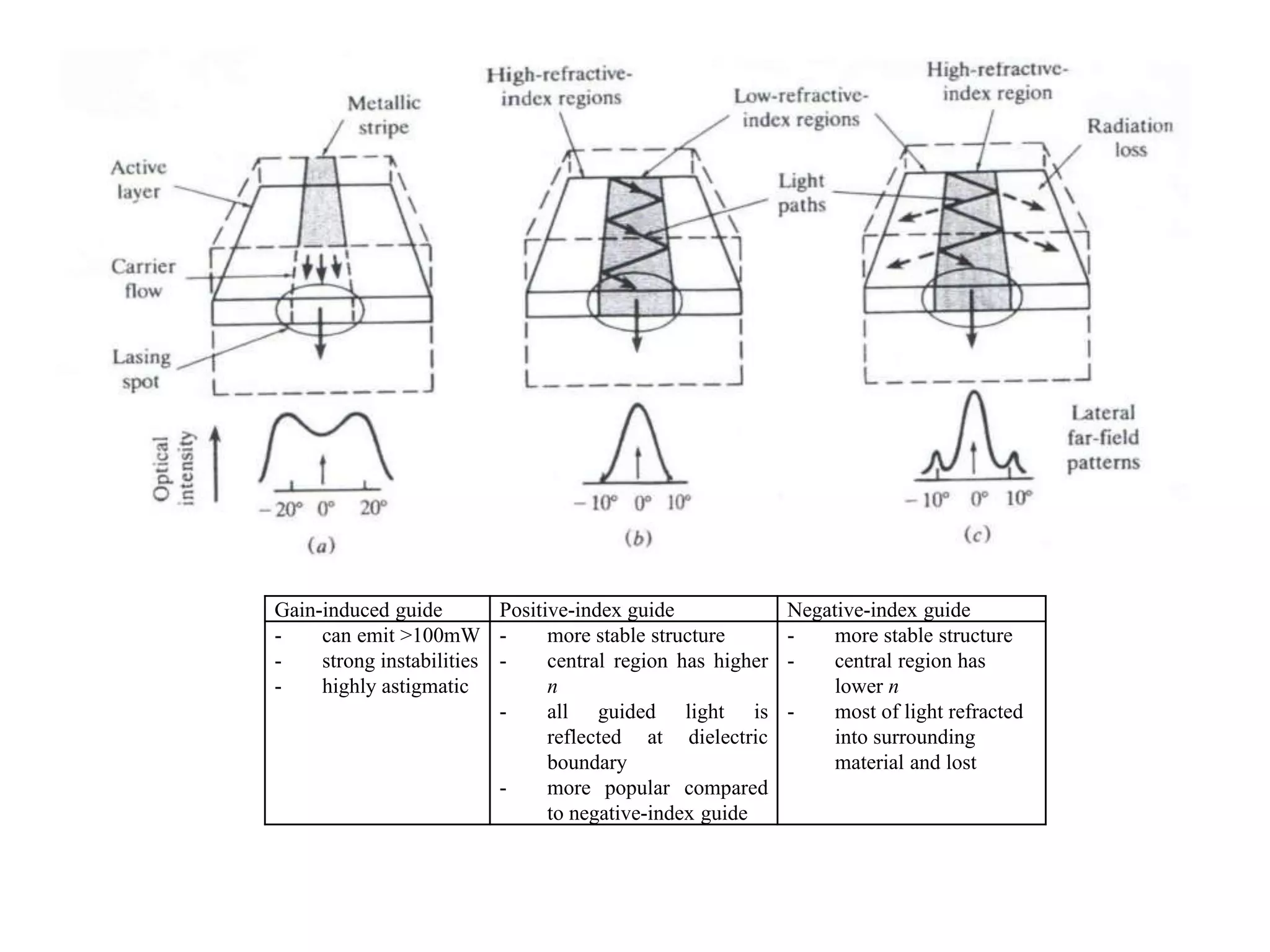
Gain-induced guide Positive-index guide Negative-index guide
- can emit >100mW
- strong instabilities
- highly astigmatic
- more stable structure
- central region has higher
n
- all guided light is
reflected at dielectric
boundary
- more popular compared
to negative-index guide
- more stable structure
- central region has
lower n
- most of light refracted
into surrounding
material and lost
Types of laser diodes
• The laser diode heterostructure based on GaAs
and AlGaAs are suitable for emission ~900nm
• For operation in the optical communication,
wavelength of 1.3 and 1.55 mm,
– Typical heterostructure are based on InP
(substrate) and quarternary alloys InGaAsP which
has a greater refractive index.
– The composition of the InGaAsP alloy is adjusted to
obtain the required bandgap for the active and
confining layers
Laser mode
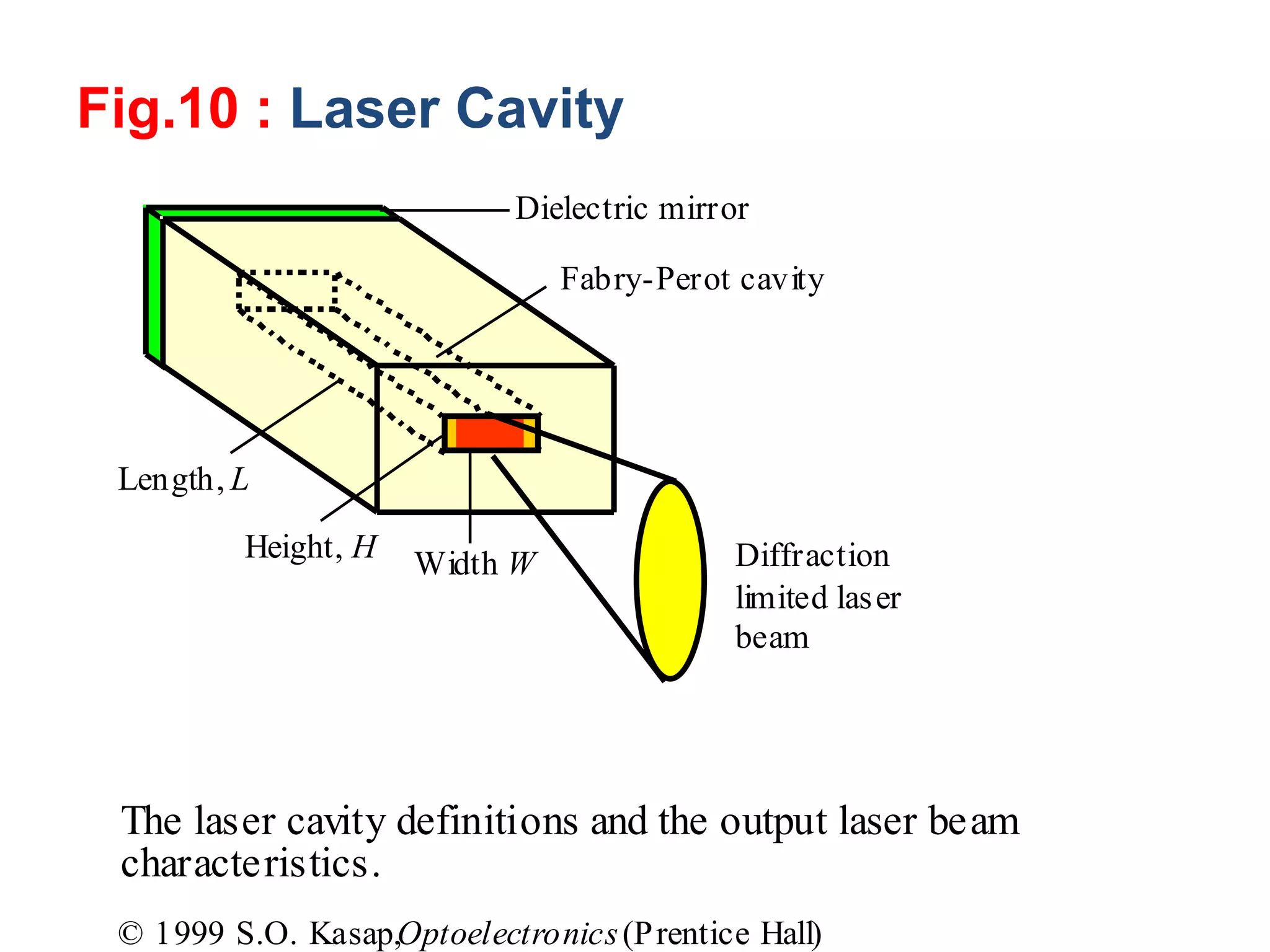
• The optical resonator is essentially Fabry-Perot
cavity as shown in Fig.10 which can be
assigned a length (L), width (W) and height
(H).
– L determines the longitudinal mode separation
– W and H determine the transverse (lateral) modes
• If the transverse dimensions (W & H) are
sufficiently small, only the lowest transverse
mode, TEM00, will exit.
Height, H Width W
Length, L
The laser cavity definitions and the output laser beam
characteristics.
Fabry-Perot cavity
Dielectric mirror
Diffraction
limited laser
beam
© 1999 S.O. Kasap,Optoelectronics(Prentice Hall)
Fig.10 : Laser Cavity
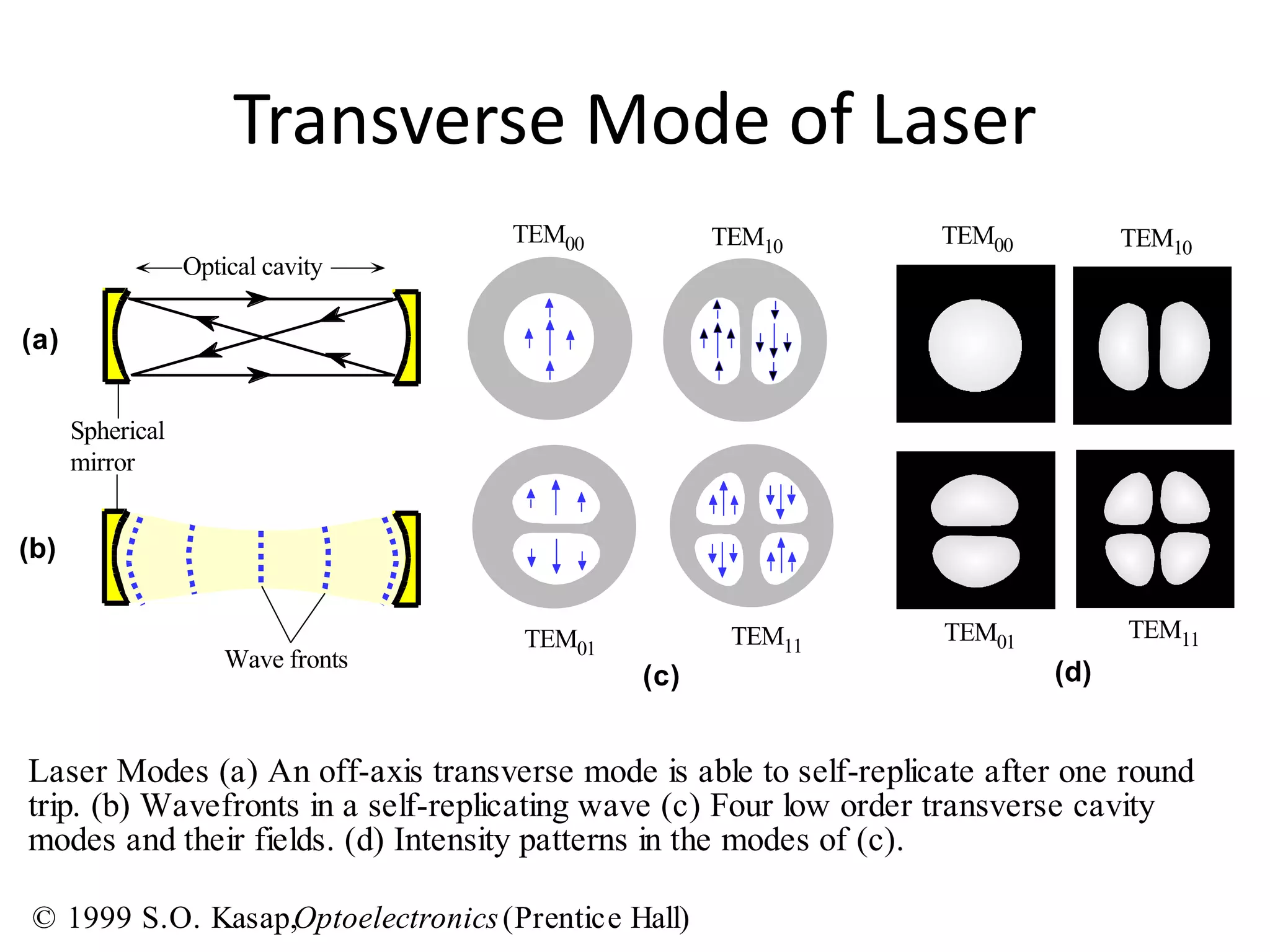
Transverse Mode of Laser
Wave fronts
Spherical
mirror
Optical cavity
TEM00 TEM10
TEM01
TEM11
TEM00 TEM10
TEM01
TEM11
(b)
(c) (d)
Laser Modes (a) An off-axis transverse mode is able to self-replicate after one round
trip. (b) Wavefronts in a self-replicating wave (c) Four low order transverse cavity
modes and their fields. (d) Intensity patterns in the modes of (c).
(a)
© 1999 S.O. Kasap,Optoelectronics(Prentice Hall)
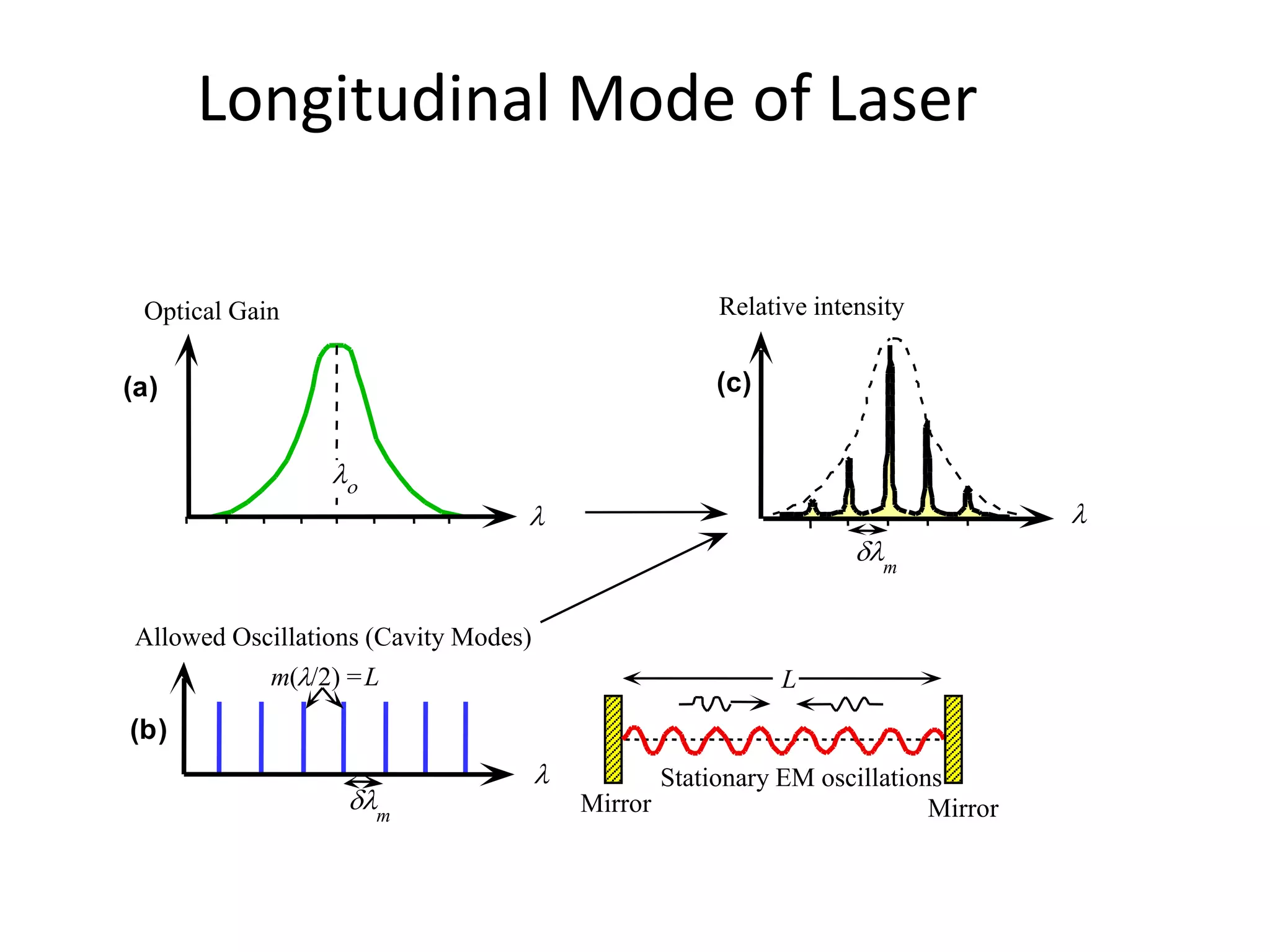
Longitudinal Mode of Laser
(c)
Relative intensity
dlm
Optical Gain
l
Allowed Oscillations (Cavity Modes)
dlm
(b)
L
Stationary EM oscillations
MirrorMirror
ll
m(l/2) =L
(a)
lo
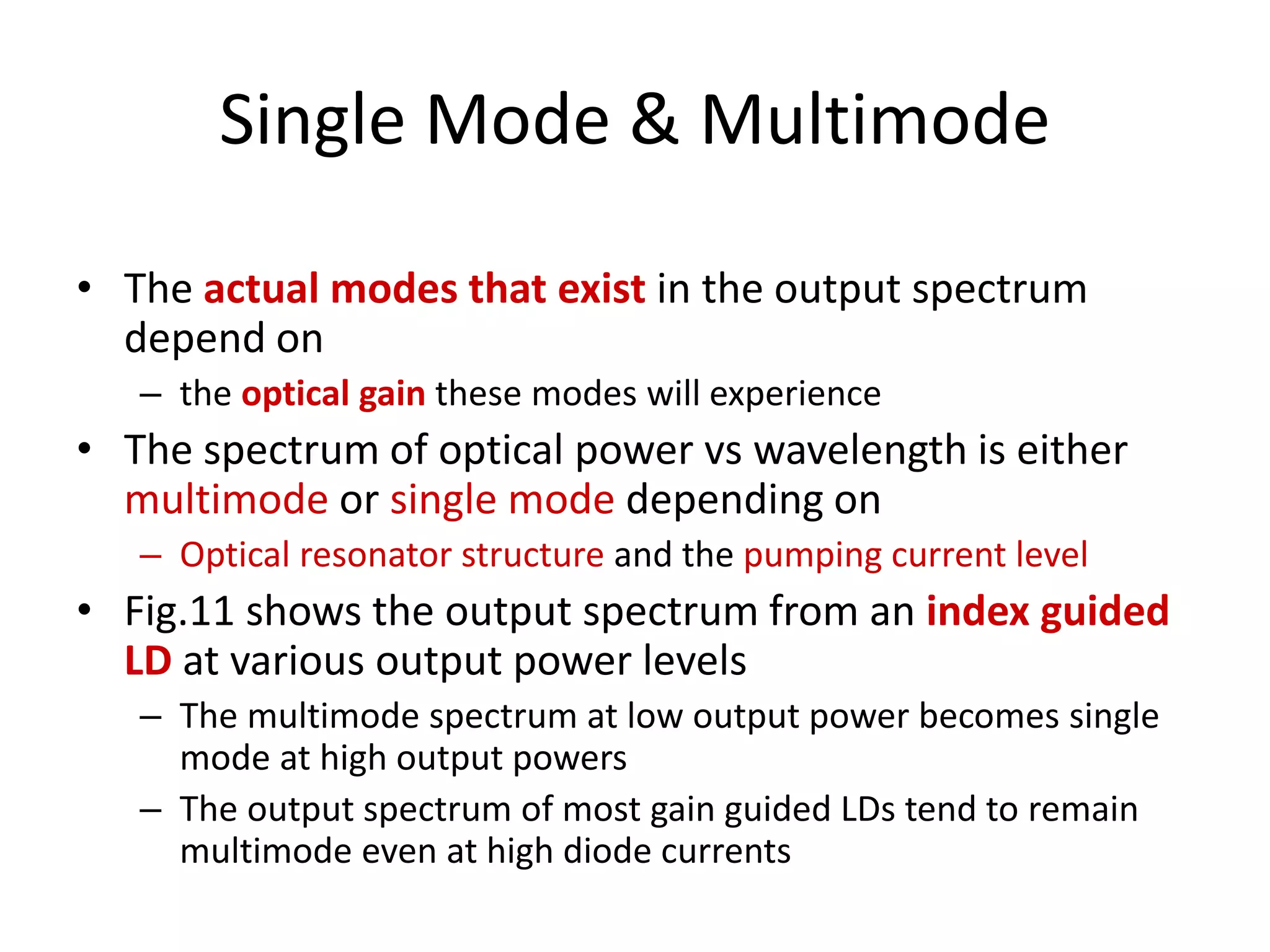
Elementary Laser Diode Characteristics
• The output spectrum from a laser diode (LD)
depends on two factors
1. The nature of the optical resonator used to
build the laser oscillations
2. The optical gain curve (line-shape) of the
active medium
Single Mode & Multimode
• The actual modes that exist in the output spectrum
depend on
– the optical gain these modes will experience
• The spectrum of optical power vs wavelength is either
multimode or single mode depending on
– Optical resonator structure and the pumping current level
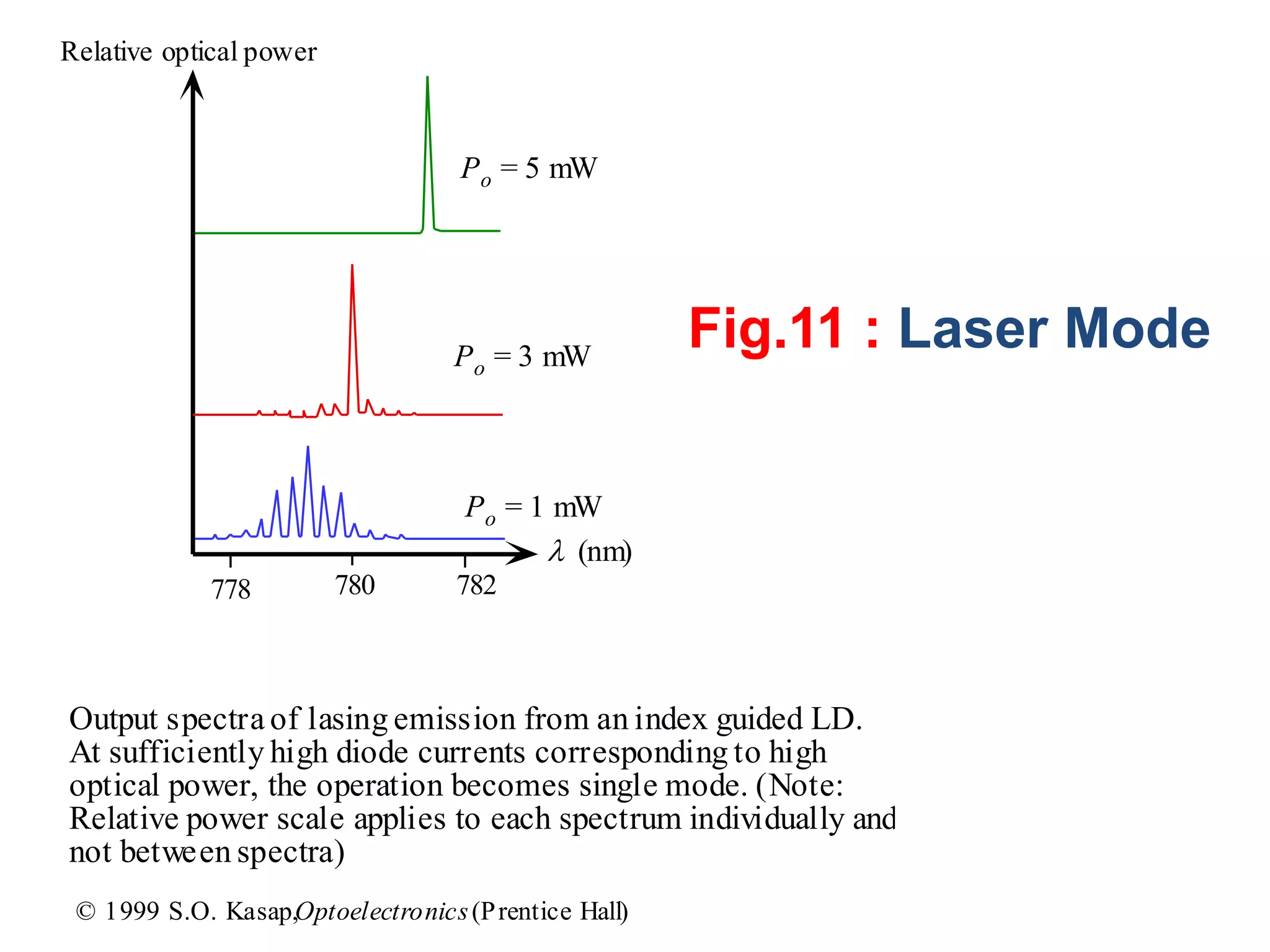
• Fig.11 shows the output spectrum from an index guided
LD at various output power levels
– The multimode spectrum at low output power becomes single
mode at high output powers
– The output spectrum of most gain guided LDs tend to remain
multimode even at high diode currents
778 780 782
Po = 1 mW
Po = 5 mW
Relative optical power
l (nm)
Po = 3 mW
Output spectra of lasing emission from an index guided LD.
At sufficiently high diode currents corresponding to high
optical power, the operation becomes single mode. (Note:
Relative power scale applies to each spectrum individually and
not between spectra)
© 1999 S.O. Kasap,Optoelectronics(Prentice Hall)
Fig.11 : Laser Mode
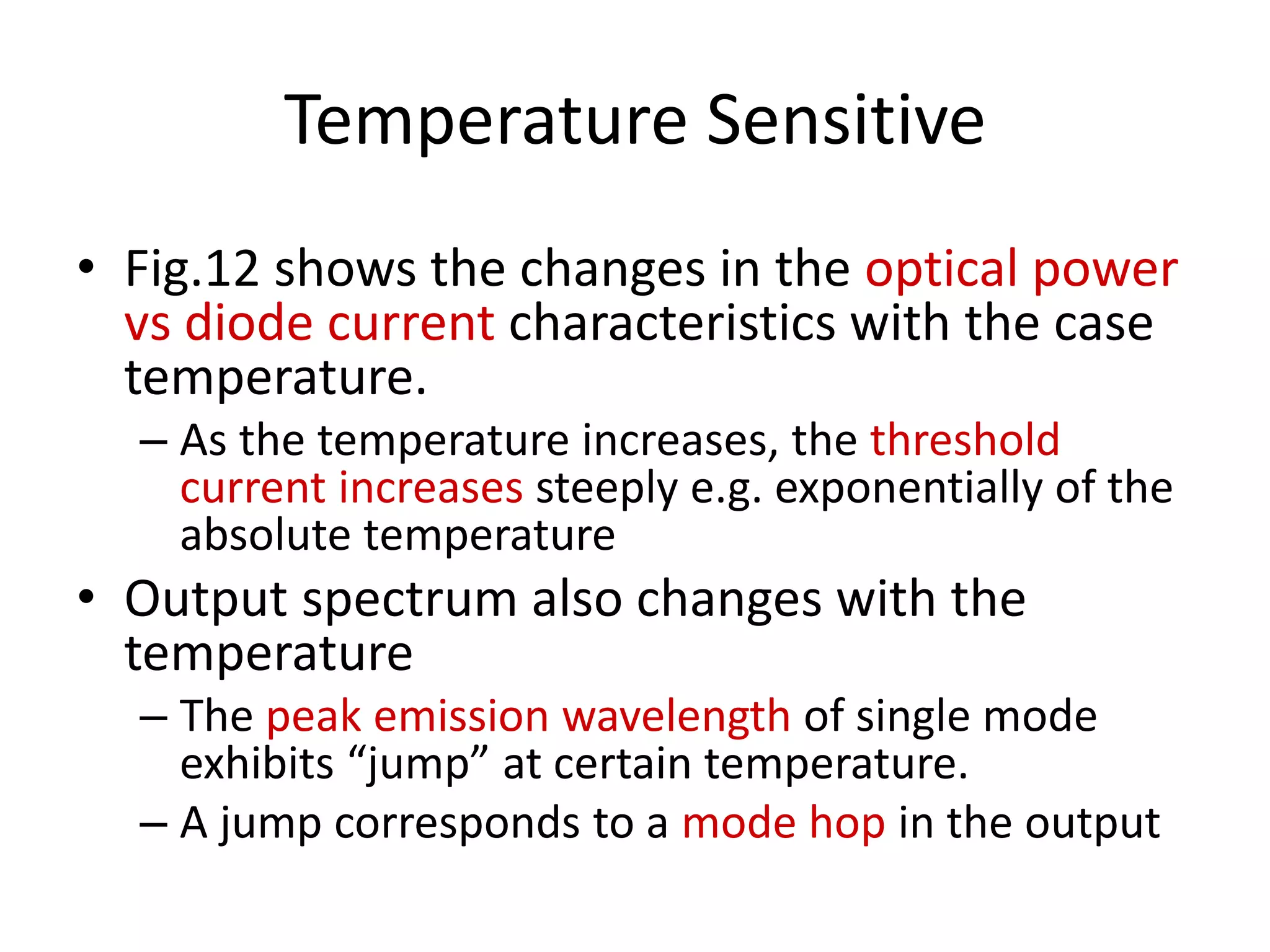
Temperature Sensitive
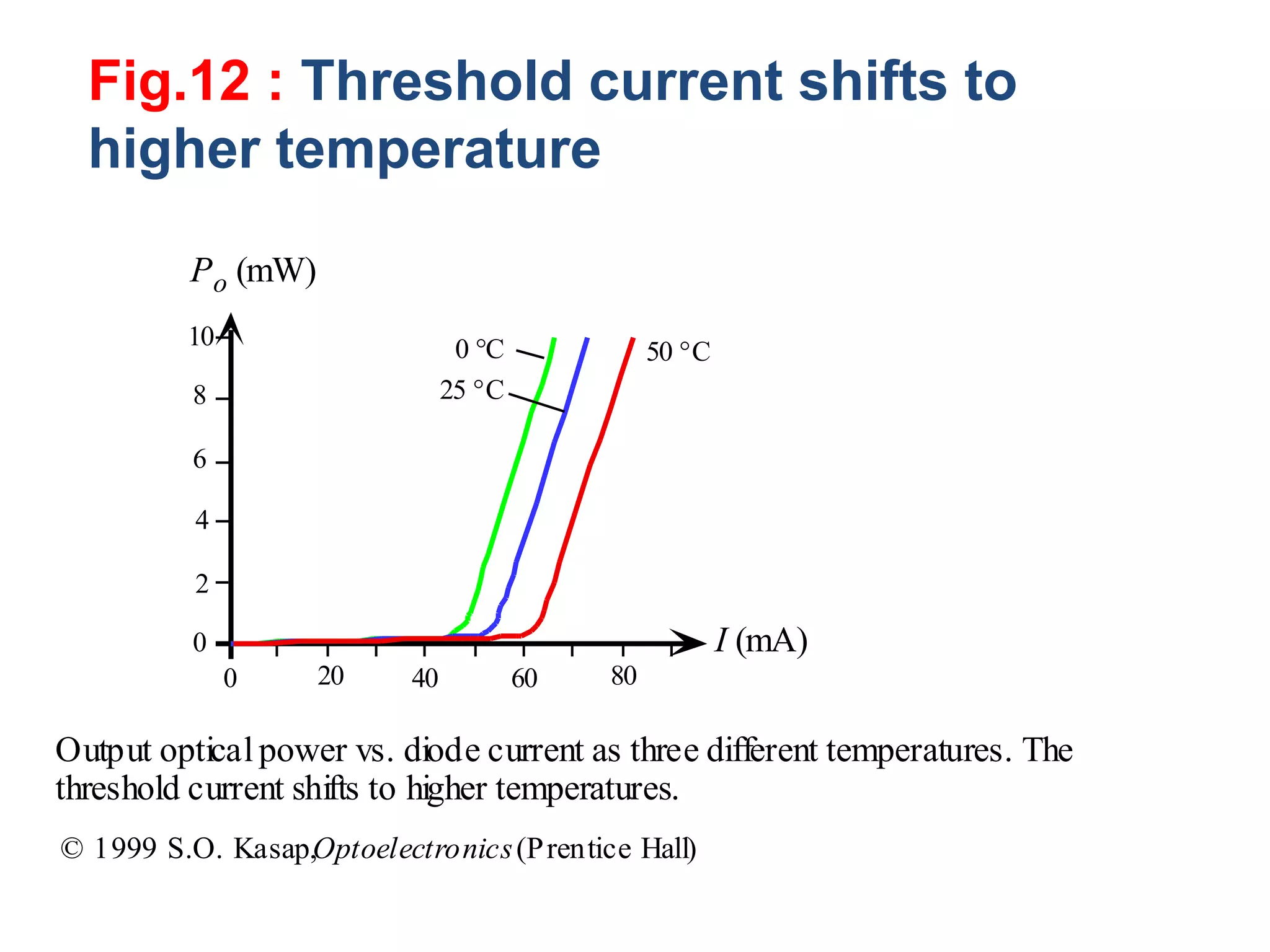
• Fig.12 shows the changes in the optical power
vs diode current characteristics with the case
temperature.
– As the temperature increases, the threshold
current increases steeply e.g. exponentially of the
absolute temperature
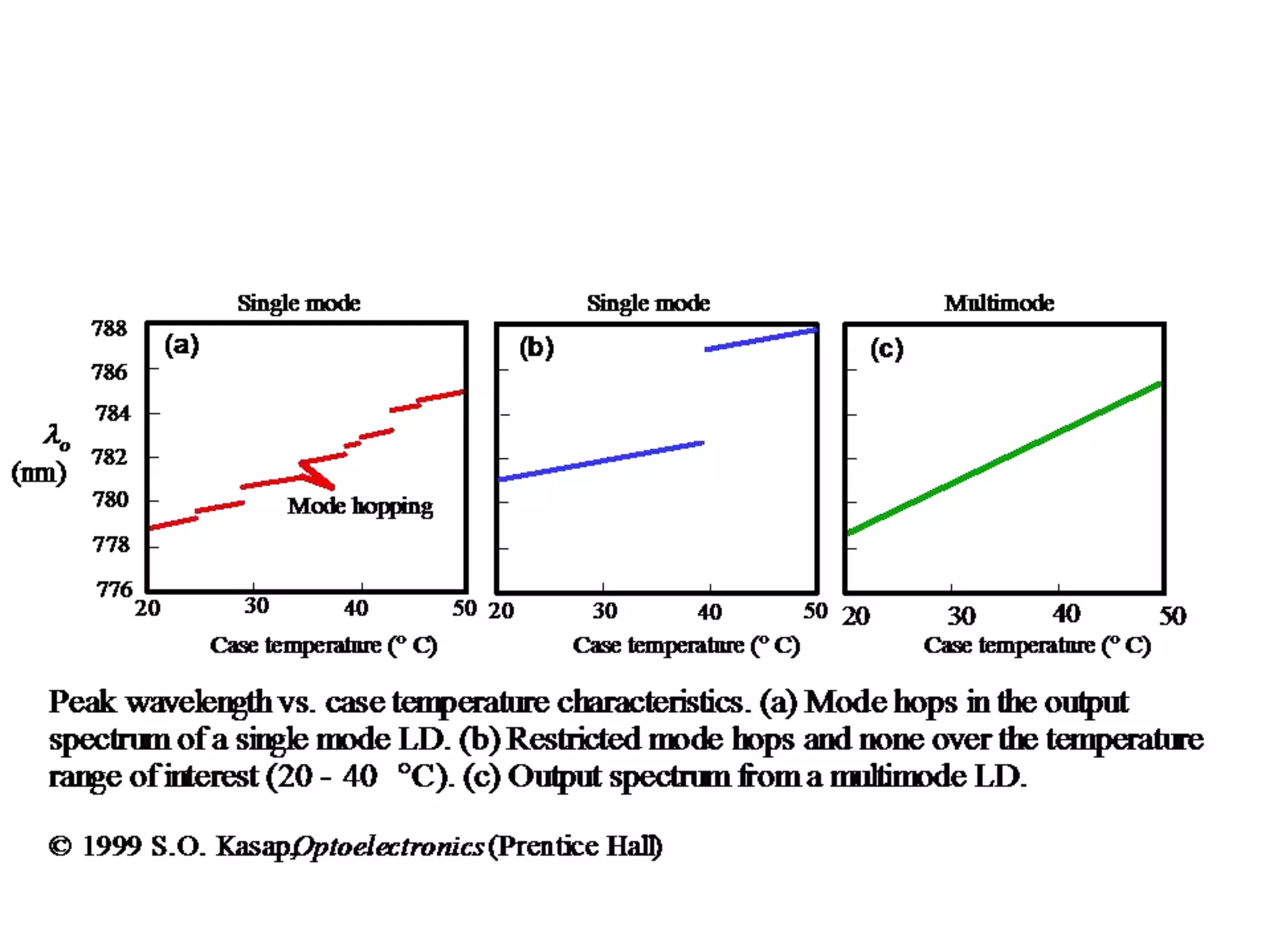
• Output spectrum also changes with the
temperature
– The peak emission wavelength of single mode
exhibits “jump” at certain temperature.
– A jump corresponds to a mode hop in the output
0 20 40 60 80
0
2
4
6
8
10
Po (mW)
I (mA)
0 C
25 C
50 C
Output opticalpower vs. diode current as three different temperatures. The
threshold current shifts to higher temperatures.
© 1999 S.O. Kasap,Optoelectronics(Prentice Hall)
Fig.12 : Threshold current shifts to
higher temperature
Mode Hop
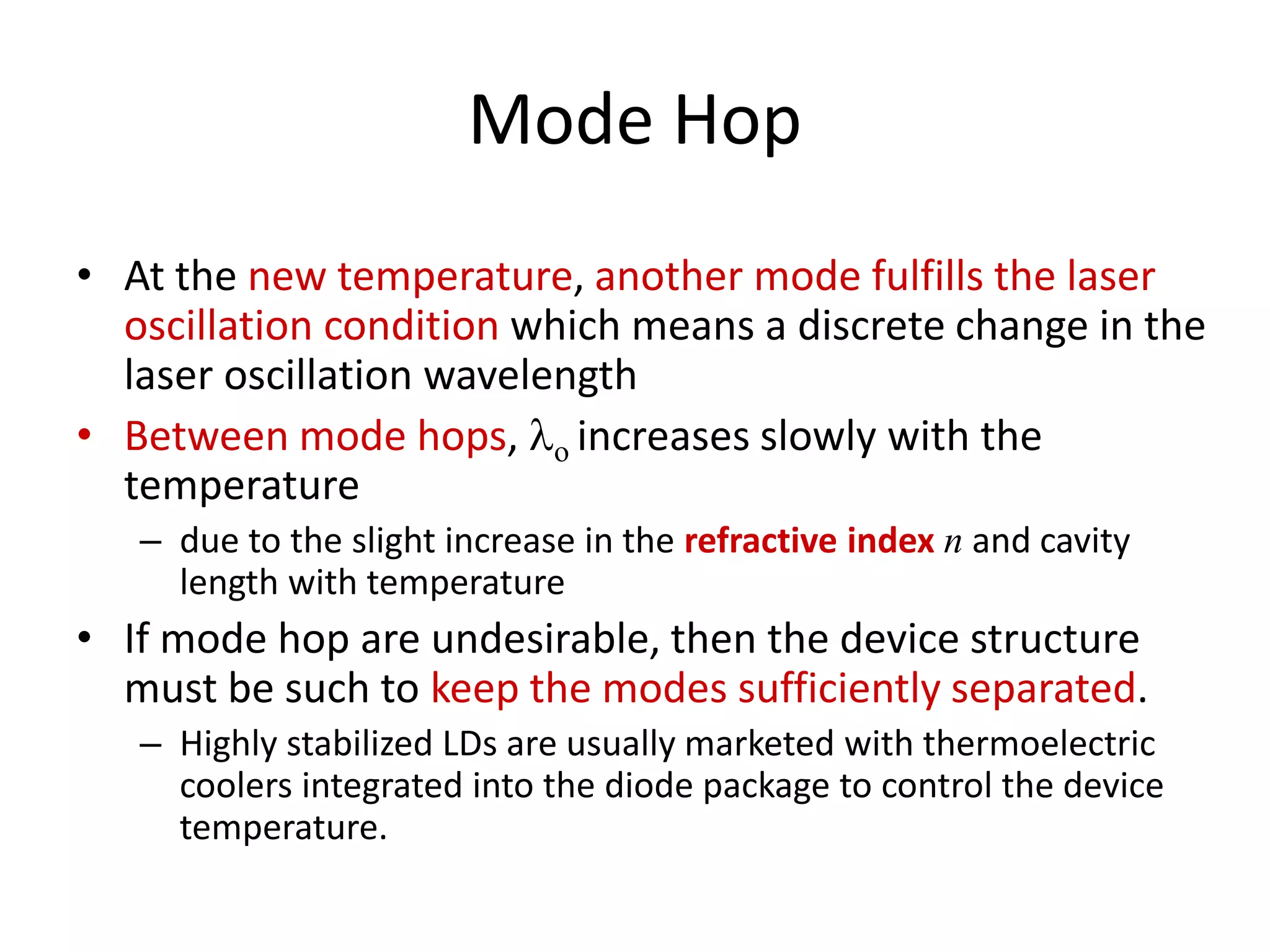
• At the new temperature, another mode fulfills the laser
oscillation condition which means a discrete change in the
laser oscillation wavelength
• Between mode hops, lo increases slowly with the
temperature
– due to the slight increase in the refractive index n and cavity
length with temperature
• If mode hop are undesirable, then the device structure
must be such to keep the modes sufficiently separated.
– Highly stabilized LDs are usually marketed with thermoelectric
coolers integrated into the diode package to control the device
temperature.
Slope Efficiency
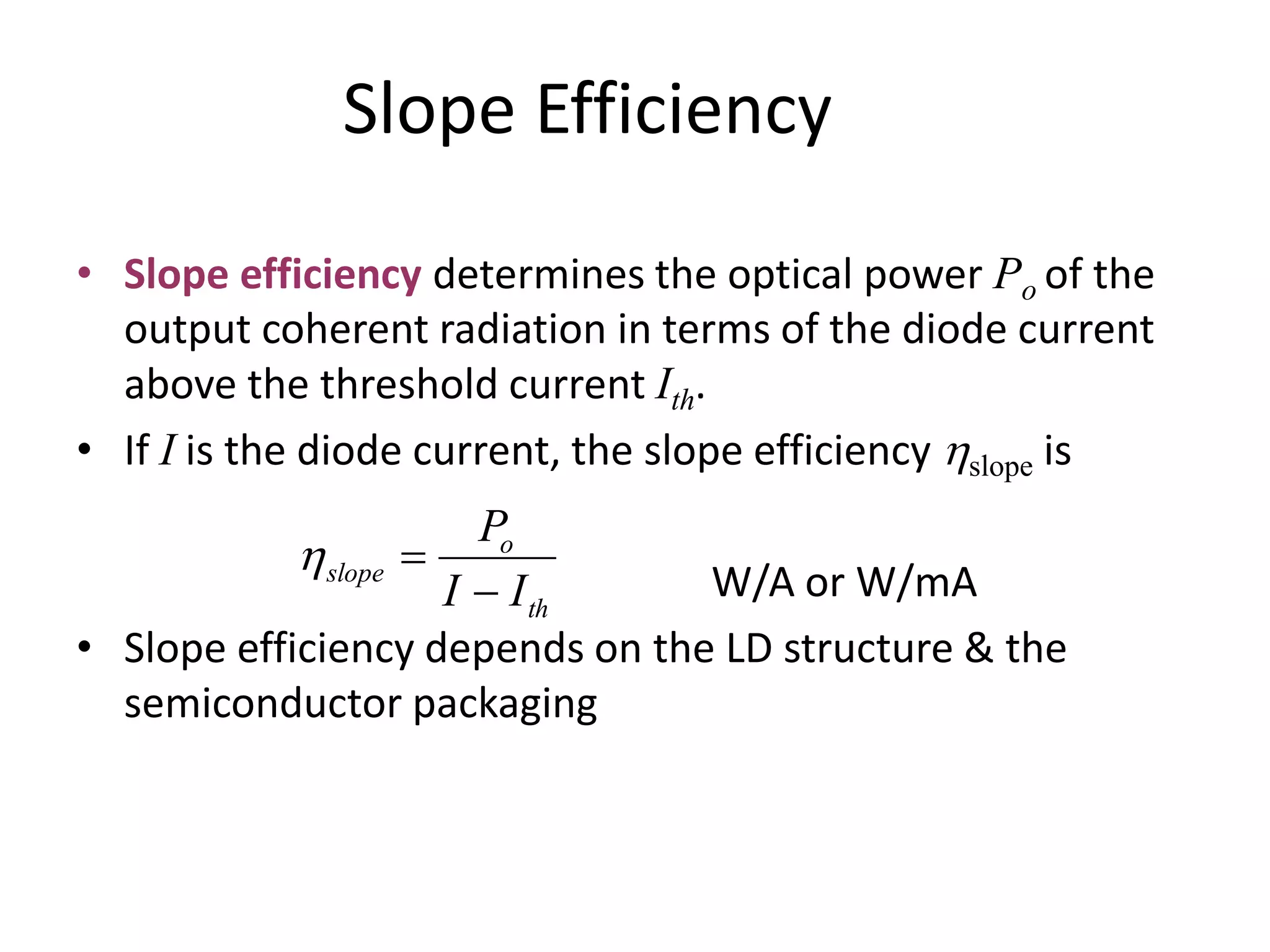
• Slope efficiency determines the optical power Po of the
output coherent radiation in terms of the diode current
above the threshold current Ith.
• If I is the diode current, the slope efficiency hslope is
W/A or W/mA
• Slope efficiency depends on the LD structure & the
semiconductor packaging
th
o
slope
II
P

h
Conversion Efficiency
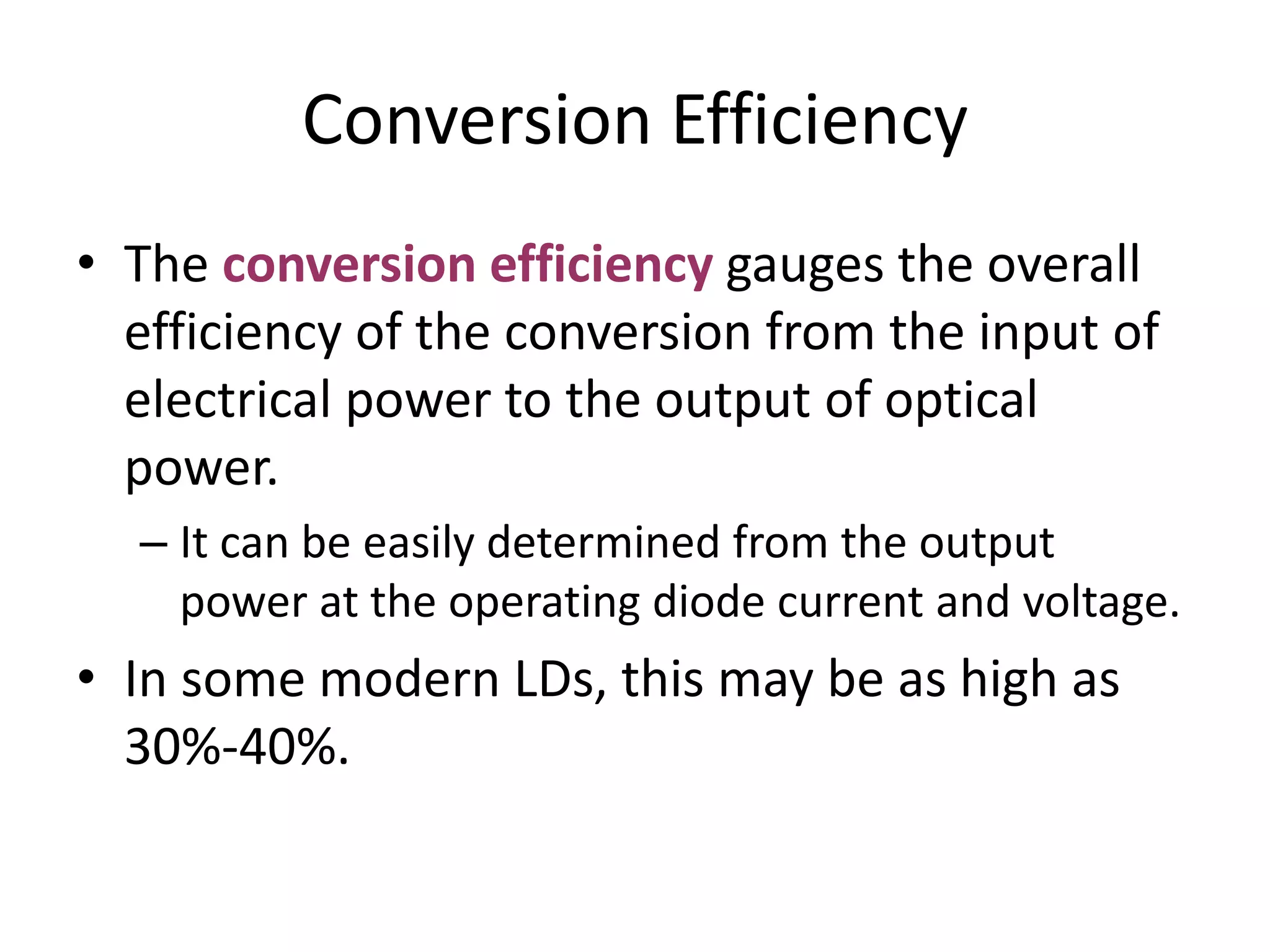
• The conversion efficiency gauges the overall
efficiency of the conversion from the input of
electrical power to the output of optical
power.
– It can be easily determined from the output
power at the operating diode current and voltage.
• In some modern LDs, this may be as high as
30%-40%.
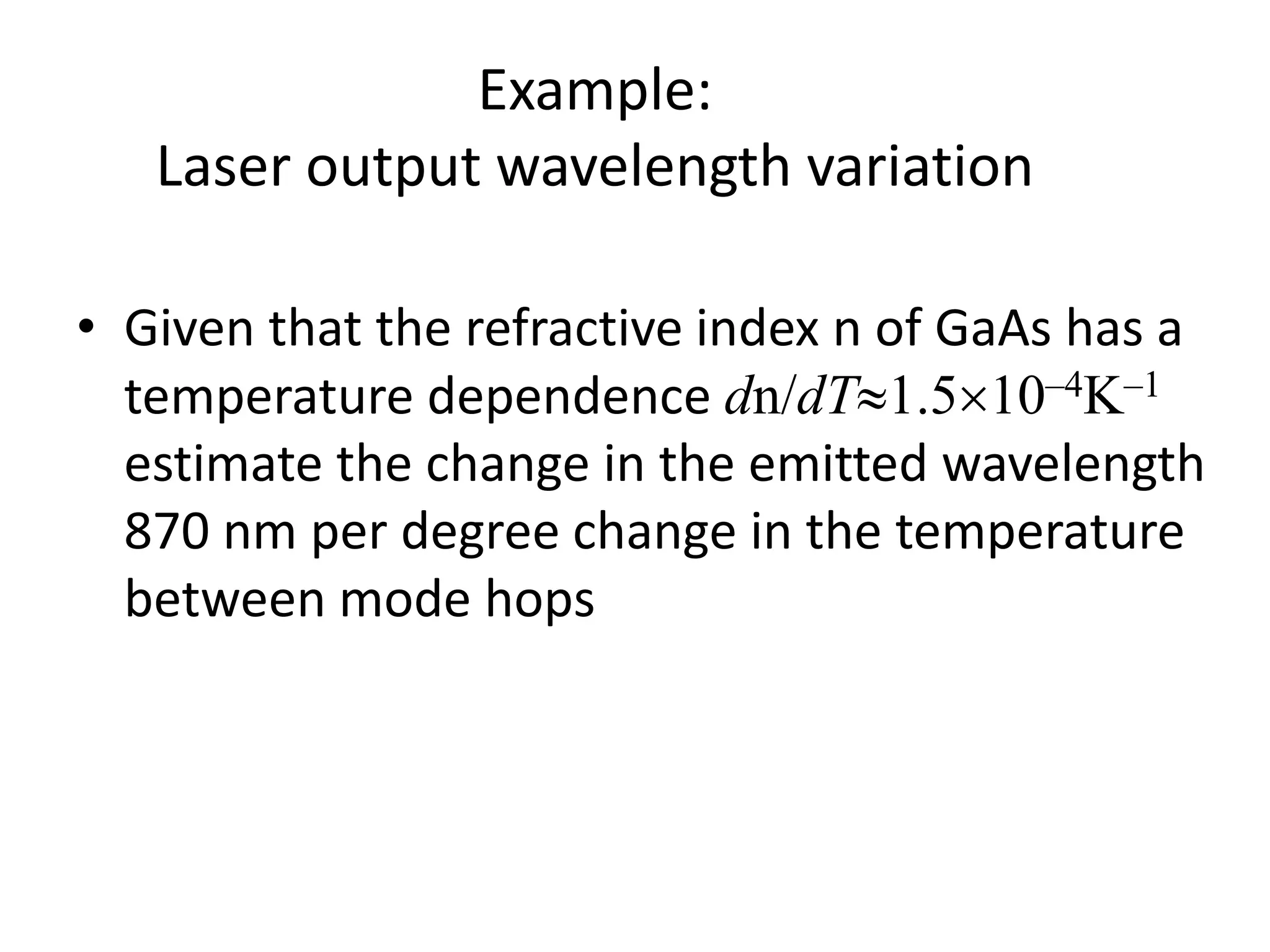
Example:
Laser output wavelength variation
• Given that the refractive index n of GaAs has a
temperature dependence dn/dT1.510–4K–1
estimate the change in the emitted wavelength
870 nm per degree change in the temperature
between mode hops
Solution
• Consider a particular given mode with wavelength lm,
m (lm/2n) = L
dlm/dT = d/dT [2nL/m]  2 L/m (dn/dT)
Substituting for L/m in terms of lm,
dlm/dT  lm/n (dn/dT)
=1.510–4K–1870nm/(3.7) =0.035nmK–1
Note that we used n for a passive cavity whereas n above should be
the effective refractive index of the active cavity which will also
depend on the optical gain of the medium, and hence its
temperature dependence is likely to be somewhat higher than the
dn/dt value we used

Chapter 5b

  • 1.
    Heterostructure Laser Diodes Both carrierand photon confinements are readily achieved in modern laser by the use of heterostructure devices!
  • 2.
    Heterostructure Laser Diodes •Fig.7 shows a Double Heterostructure (DH) device based on two junctions between different semiconductor materials with different bandgaps. – Semiconductors are AlGaAs with Eg 2eV – and GaAs with Eg 1.4eV • The p-GaAs region is a thin layer (0.1-0.2mm) and constitutes the active layer in which lasing combination takes place – Both p-GaAs and p-AlGaAs are heavily p-type doped and are degenerate with EF in the valence band.
  • 3.
    Refractive index Photon density Active region n ~ 5% 2eV Holes in VB Electrons in CB AlGaAsAlGaAs 1.4 eV Ec Ev Ec Ev (a) (b) pn p Ec (a) A double heterostructure diode has two junctions which are between two different bandgap semiconductors (GaAs and AlGaAs). 2 eV (b) Simplified energy band diagram under a large forward bias. Lasing recombination takes place in the p- GaAs layer, the active layer (~0.1 mm) (c) Higher bandgap materials have a lower refractive index (d) AlGaAs layers provide lateral optical confinement. (c) (d) © 1999 S.O. Kasap,Optoelectronics(Prentice Hall) GaAs Fig.7
  • 4.
    Carrier confinement inDH • When a sufficiently large forward bias is applied, – Ecof n-AlGaAs moves above Ecof p-GaAs, which leads to a large injection of electrons in the CB of n-AlGaAs into p-GaAs as shown in Fig.7. – These electrons are confined to the CB of p-GaAs since there is a barrier Ec between p-GaAs and p-AlGaAs • Since p-GaAs is a thin layer, the concentration of injected electrons can be increased quickly even with moderate increase in forward current. – This effectively reduces the threshold current for population inversion or optical gain
  • 5.
    Photon confinement inDH • AlGaAs has a lower refractive index than that of GaAs – Note: a wider bandgap semiconductor generally has a lower refractive index • The change in the refractive index defines an optical dielectric waveguide that confines the photons to the active region of the optical cavity – Thereby reduces photon losses & increases photon concentration – It increases the rate of stimulated emissions • Both carrier & photon confinement lead to reduction in the threshold current density.
  • 6.
    The structure ofDH • A typical structure of a double heterostructure laser diode is similar to a double heterostructure LED. – The doped layers are grown epitaxially on a crystalline substrate, which is n-GaAs – It consists of the first layer substrate, n-AlGaAs, the active p-GaAs layer and the p-AlGaAs layer – There is an additional p-GaAs layer called contacting layer, next to p-AlGaAs.
  • 7.
    The structure ofDH, cont • The electrodes are attached to the GaAs rather than AlGaAs – This allows better contacting and avoids Schottky junctions which limits the current • The p- and n-AlGaAs layers provide carrier and optical confinement in the vertical direction by forming heterojunction with p-GaAs. • The active layer is p-GaAs – which means that the lasing emission will be in in the range 870- 900nm depending on the doping level • An important feature of this laser diode is the stripe geometry (stripe contact) on p-GaAs
  • 8.
    Schematic illustrationof thethe structure of a double heterojunction stripe contact laser diode Oxide insulator Stripe electrode Substrate Electrode Active region where J > Jth. (Emission region) p-GaAs (Contactinglayer) n-GaAs (Substrate) p-GaAs (Active layer) Current paths L W Cleaved reflectingsurfaceElliptical laser beam p-Alx Ga1-x As (Confininglayer) n-Alx Ga1-x As (Confininglayer) 12 3 Cleaved reflectingsurface Substrate © 1999 S.O. Kasap,Optoelectronics(Prentice Hall) Fig.8 : Heterojunction laser diode
  • 9.
    Current Paths inDH • Current density J from the stripe contact is not uniform laterally – J is greatest along the central path, 1, and decreases away from path 1 towards 2 or 3 – The current is confined within path 2 & 3 • The current density paths through active region where J >Jth as shown in Fig.8 – defines the active region where the lasing emission emerges – The width of the active region is defined by J from the stripe contact • The optical gain is highest where the current density is greatest – Such lasers are called gain guided.
  • 10.
    Two advantages ofusing a stripe geometry 1. The reduced contact area also reduces the threshold current Ith. – Typical stripe width may be as small as a few mm leading to typical threshold currents that may be tens of mA. 2. The reduced emission area makes light coupling to optical fibers easier.
  • 11.
    Improving rear facetreflectance • The laser efficiency can be further improved by reducing the reflection losses from the rear crystal facet • The refractive index of GaAs is ~3.7, the reflectance is 0.33 – By fabricating a dielectric mirror at the rear facet, which is mirror consisting of a number of quarter wavelength semiconductor layers of different refractive index – It is possible to bring the reflectance close to unity and thereby improve the optical gain of the cavity
  • 12.
    Lateral optical confinement •The lateral optical confinement of photons to the active region is poor – because there is no marked change in the refractive index laterally • Laterally optical confinement can increase the rate of stimulated emissions – It can be achieved by shaping the refractive index profile in the same way the vertical confinement
  • 13.
    Oxide insulation n-AlGaAs p+-AlGaAs (Contactinglayer) n-GaAs (Substrate) p-GaAs (Active layer) n-AlGaAs (Confining layer) p-AlGaAs (Confining layer) Schematic illustrationof the cross sectionalstructure of a buried heterostructure laser diode. Electrode © 1999 S.O. Kasap,Optoelectronics(Prentice Hall) Fig.9 : Structure of heterostructure laser diode
  • 14.
    Index Guided • Fig.9shows the active layer p-GaAs is bound both vertically and laterally by a lower index AlGaAs. – It behaves as a dielectric waveguide and ensure the photons are confined to the optical gain region – It is called buried double heterostructure laser diode • Since the optical power is confined to the waveguide defined by the refractive index variation – these diodes are called index guided
  • 15.
    Gain-induced guide Positive-indexguide Negative-index guide - can emit >100mW - strong instabilities - highly astigmatic - more stable structure - central region has higher n - all guided light is reflected at dielectric boundary - more popular compared to negative-index guide - more stable structure - central region has lower n - most of light refracted into surrounding material and lost
  • 16.
    Types of laserdiodes • The laser diode heterostructure based on GaAs and AlGaAs are suitable for emission ~900nm • For operation in the optical communication, wavelength of 1.3 and 1.55 mm, – Typical heterostructure are based on InP (substrate) and quarternary alloys InGaAsP which has a greater refractive index. – The composition of the InGaAsP alloy is adjusted to obtain the required bandgap for the active and confining layers
  • 17.
    Laser mode • Theoptical resonator is essentially Fabry-Perot cavity as shown in Fig.10 which can be assigned a length (L), width (W) and height (H). – L determines the longitudinal mode separation – W and H determine the transverse (lateral) modes • If the transverse dimensions (W & H) are sufficiently small, only the lowest transverse mode, TEM00, will exit.
  • 18.
    Height, H WidthW Length, L The laser cavity definitions and the output laser beam characteristics. Fabry-Perot cavity Dielectric mirror Diffraction limited laser beam © 1999 S.O. Kasap,Optoelectronics(Prentice Hall) Fig.10 : Laser Cavity
  • 19.
    Transverse Mode ofLaser Wave fronts Spherical mirror Optical cavity TEM00 TEM10 TEM01 TEM11 TEM00 TEM10 TEM01 TEM11 (b) (c) (d) Laser Modes (a) An off-axis transverse mode is able to self-replicate after one round trip. (b) Wavefronts in a self-replicating wave (c) Four low order transverse cavity modes and their fields. (d) Intensity patterns in the modes of (c). (a) © 1999 S.O. Kasap,Optoelectronics(Prentice Hall)
  • 20.
    Longitudinal Mode ofLaser (c) Relative intensity dlm Optical Gain l Allowed Oscillations (Cavity Modes) dlm (b) L Stationary EM oscillations MirrorMirror ll m(l/2) =L (a) lo
  • 21.
    Elementary Laser DiodeCharacteristics • The output spectrum from a laser diode (LD) depends on two factors 1. The nature of the optical resonator used to build the laser oscillations 2. The optical gain curve (line-shape) of the active medium
  • 22.
    Single Mode &Multimode • The actual modes that exist in the output spectrum depend on – the optical gain these modes will experience • The spectrum of optical power vs wavelength is either multimode or single mode depending on – Optical resonator structure and the pumping current level • Fig.11 shows the output spectrum from an index guided LD at various output power levels – The multimode spectrum at low output power becomes single mode at high output powers – The output spectrum of most gain guided LDs tend to remain multimode even at high diode currents
  • 23.
    778 780 782 Po= 1 mW Po = 5 mW Relative optical power l (nm) Po = 3 mW Output spectra of lasing emission from an index guided LD. At sufficiently high diode currents corresponding to high optical power, the operation becomes single mode. (Note: Relative power scale applies to each spectrum individually and not between spectra) © 1999 S.O. Kasap,Optoelectronics(Prentice Hall) Fig.11 : Laser Mode
  • 24.
    Temperature Sensitive • Fig.12shows the changes in the optical power vs diode current characteristics with the case temperature. – As the temperature increases, the threshold current increases steeply e.g. exponentially of the absolute temperature • Output spectrum also changes with the temperature – The peak emission wavelength of single mode exhibits “jump” at certain temperature. – A jump corresponds to a mode hop in the output
  • 25.
    0 20 4060 80 0 2 4 6 8 10 Po (mW) I (mA) 0 C 25 C 50 C Output opticalpower vs. diode current as three different temperatures. The threshold current shifts to higher temperatures. © 1999 S.O. Kasap,Optoelectronics(Prentice Hall) Fig.12 : Threshold current shifts to higher temperature
  • 27.
    Mode Hop • Atthe new temperature, another mode fulfills the laser oscillation condition which means a discrete change in the laser oscillation wavelength • Between mode hops, lo increases slowly with the temperature – due to the slight increase in the refractive index n and cavity length with temperature • If mode hop are undesirable, then the device structure must be such to keep the modes sufficiently separated. – Highly stabilized LDs are usually marketed with thermoelectric coolers integrated into the diode package to control the device temperature.
  • 28.
    Slope Efficiency • Slopeefficiency determines the optical power Po of the output coherent radiation in terms of the diode current above the threshold current Ith. • If I is the diode current, the slope efficiency hslope is W/A or W/mA • Slope efficiency depends on the LD structure & the semiconductor packaging th o slope II P  h
  • 29.
    Conversion Efficiency • Theconversion efficiency gauges the overall efficiency of the conversion from the input of electrical power to the output of optical power. – It can be easily determined from the output power at the operating diode current and voltage. • In some modern LDs, this may be as high as 30%-40%.
  • 30.
    Example: Laser output wavelengthvariation • Given that the refractive index n of GaAs has a temperature dependence dn/dT1.510–4K–1 estimate the change in the emitted wavelength 870 nm per degree change in the temperature between mode hops
  • 31.
    Solution • Consider aparticular given mode with wavelength lm, m (lm/2n) = L dlm/dT = d/dT [2nL/m]  2 L/m (dn/dT) Substituting for L/m in terms of lm, dlm/dT  lm/n (dn/dT) =1.510–4K–1870nm/(3.7) =0.035nmK–1 Note that we used n for a passive cavity whereas n above should be the effective refractive index of the active cavity which will also depend on the optical gain of the medium, and hence its temperature dependence is likely to be somewhat higher than the dn/dt value we used