CONTENTS
Introduction
Losses due to Fresnel Reflection.
Losses due to Geometric and Optical Parameter
variations.
Multimode Fiber Joints.
Single Mode Fiber Joints.
INTRODUCTION
 Fiber splices: These are semipermanent or permanent joints which find
major use in most optical fiber telecommunication systems (analogous to
electrical soldered joints).
 Demountable fiber connectors or simple connectors: These are
removable
joints which allow easy, fast, manual coupling and uncoupling of fibers
(analogous to electrical plugs and sockets).
 A crucial aspect of fiber jointing concerns the optical loss associated with the
connection.
 A major consideration with all types of fiber–fiber connection is the optical
loss encountered at the interface.
Losses due to Fresnel
Reflection
A small proportion of the light may be reflected back into the
transmitting fiber causing attenuation at the joint. This phenomenon,
known as Fresnel reflection
Associated with the step changes in refractive index at the jointed
interface (i.e. glass–air–glass).
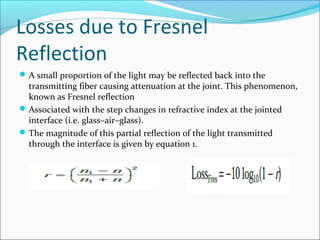
The magnitude of this partial reflection of the light transmitted
through the interface is given by equation 1.
Losses due to Fresnel
Reflection
The loss in decibels due to Fresnel reflection at a single interface is
given by equation 2.
Where n1 is the refractive index of the fiber core and n is the refractive
index of the medium between the two jointed fibers.
The effect of Fresnel reflection at a fiber–fiber connection can be
reduced by the use of an index-matching fluid between the gap.
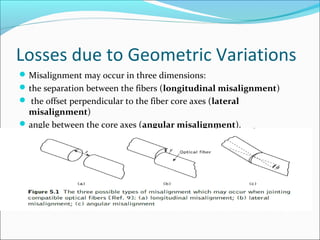
Losses due to Geometric Variations
Misalignment may occur in three dimensions:
the separation between the fibers (longitudinal misalignment)
 the offset perpendicular to the fiber core axes (lateral
misalignment)
angle between the core axes (angular misalignment).
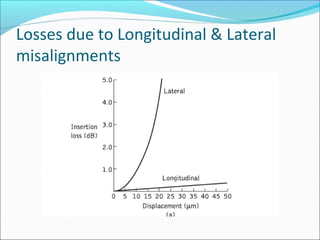
Losses due to Longitudinal & Lateral
misalignments
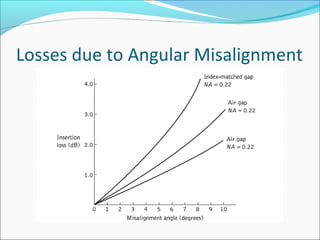
Losses due to Angular Misalignment
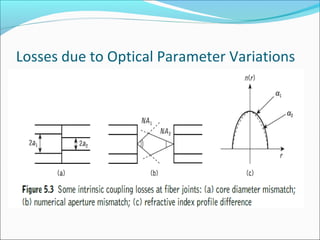
Losses due to Optical Parameter Variations
Losses at joints may occur due to the following reasons:
 variations in core and/or cladding diameters.
 variations in numerical apertures and/or relative refractive index
differences.
 variations in refractive index profiles.
 fiber faults (core ellipticity, core concentricity, etc.).
Losses due to Optical Parameter Variations
Multimode Fiber Joints
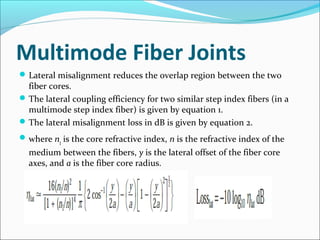
Lateral misalignment reduces the overlap region between the two
fiber cores.
The lateral coupling efficiency for two similar step index fibers (in a
multimode step index fiber) is given by equation 1.
The lateral misalignment loss in dB is given by equation 2.
where n1 is the core refractive index, n is the refractive index of the
medium between the fibers, y is the lateral offset of the fiber core
axes, and a is the fiber core radius.
Multimode Fiber Joints
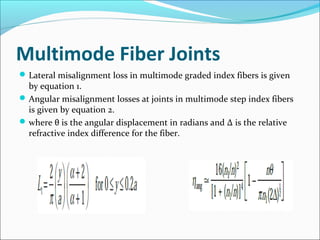
Lateral misalignment loss in multimode graded index fibers is given
by equation 1.
Angular misalignment losses at joints in multimode step index fibers
is given by equation 2.
where θ is the angular displacement in radians and Δ is the relative
refractive index difference for the fiber.
Losses due to Geometric Variations
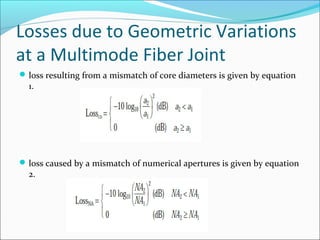
at a Multimode Fiber Joint
loss resulting from a mismatch of core diameters is given by equation
1.
loss caused by a mismatch of numerical apertures is given by equation
2.
Losses due to Geometric Variations
at a Multimode Fiber Joint
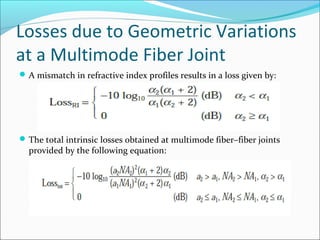
A mismatch in refractive index profiles results in a loss given by:
The total intrinsic losses obtained at multimode fiber–fiber joints
provided by the following equation:

Fiber alignment and joint loss

  • 2.
    CONTENTS Introduction Losses due toFresnel Reflection. Losses due to Geometric and Optical Parameter variations. Multimode Fiber Joints. Single Mode Fiber Joints.
  • 3.
    INTRODUCTION  Fiber splices:These are semipermanent or permanent joints which find major use in most optical fiber telecommunication systems (analogous to electrical soldered joints).  Demountable fiber connectors or simple connectors: These are removable joints which allow easy, fast, manual coupling and uncoupling of fibers (analogous to electrical plugs and sockets).  A crucial aspect of fiber jointing concerns the optical loss associated with the connection.  A major consideration with all types of fiber–fiber connection is the optical loss encountered at the interface.
  • 4.
    Losses due toFresnel Reflection A small proportion of the light may be reflected back into the transmitting fiber causing attenuation at the joint. This phenomenon, known as Fresnel reflection Associated with the step changes in refractive index at the jointed interface (i.e. glass–air–glass). The magnitude of this partial reflection of the light transmitted through the interface is given by equation 1.
  • 5.
    Losses due toFresnel Reflection The loss in decibels due to Fresnel reflection at a single interface is given by equation 2. Where n1 is the refractive index of the fiber core and n is the refractive index of the medium between the two jointed fibers. The effect of Fresnel reflection at a fiber–fiber connection can be reduced by the use of an index-matching fluid between the gap.
  • 6.
    Losses due toGeometric Variations Misalignment may occur in three dimensions: the separation between the fibers (longitudinal misalignment)  the offset perpendicular to the fiber core axes (lateral misalignment) angle between the core axes (angular misalignment).
  • 7.
    Losses due toLongitudinal & Lateral misalignments
  • 8.
    Losses due toAngular Misalignment
  • 9.
    Losses due toOptical Parameter Variations Losses at joints may occur due to the following reasons:  variations in core and/or cladding diameters.  variations in numerical apertures and/or relative refractive index differences.  variations in refractive index profiles.  fiber faults (core ellipticity, core concentricity, etc.).
  • 10.
    Losses due toOptical Parameter Variations
  • 11.
    Multimode Fiber Joints Lateralmisalignment reduces the overlap region between the two fiber cores. The lateral coupling efficiency for two similar step index fibers (in a multimode step index fiber) is given by equation 1. The lateral misalignment loss in dB is given by equation 2. where n1 is the core refractive index, n is the refractive index of the medium between the fibers, y is the lateral offset of the fiber core axes, and a is the fiber core radius.
  • 12.
    Multimode Fiber Joints Lateralmisalignment loss in multimode graded index fibers is given by equation 1. Angular misalignment losses at joints in multimode step index fibers is given by equation 2. where θ is the angular displacement in radians and Δ is the relative refractive index difference for the fiber.
  • 13.
    Losses due toGeometric Variations at a Multimode Fiber Joint loss resulting from a mismatch of core diameters is given by equation 1. loss caused by a mismatch of numerical apertures is given by equation 2.
  • 14.
    Losses due toGeometric Variations at a Multimode Fiber Joint A mismatch in refractive index profiles results in a loss given by: The total intrinsic losses obtained at multimode fiber–fiber joints provided by the following equation: