MINISTRY OF SCIENTIFIC EDUCATION AND HIGHER RESEARCHES
NORTHERN TECHNICAL UNIVERSITY
ENGINEERING TECHNICAL COLLEGE / MOSUL
DEPARTMENT OF COMPUTER TECHNOLOGY
1
ENGINEERING ANALYSIS LECTURE
DEPARTMENT OF COMPUTER
TECHNOLOGY –THIRD CLASS
2018 -2019
ARJUWAN MOHAMMED ABDULJAWAD
ALJAWADI
LECTURER
2
- ENGINEERING ANALYSIS
One of important transforms used in linear- system analysis. It is
named in honor of the great French mathematician, Pierre Simon De
Laplace (1749-1827).
3
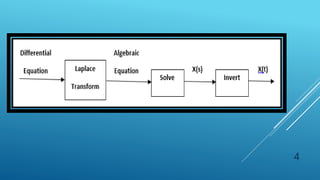
- Purpose of Laplace Transform
• To convert from one type of operation to another
operations of different types in more simple form.
• A well-known technique for solving differential
equations.
4
- THE TIME DOMAIN SIGNAL IS CONTINUOUS , EXTENDS
TO:
1. POSITIVE AND NEGATIVE INFINITY.
2. PERIODIC OR APERIODIC SIGNAL
5
- Laplace Transform Definition:
The Laplace transform F(s) of a time function F (t) is given by the
integral:
6
This definition is called the bilateral, or two-sided, Laplace transform—hence, the
subscript b. Notice that the bilateral Laplace transform integral becomes the Fourier
transform integral if is replaced by (𝑗𝑤 ) . The Laplace transform variable is
complex 𝑠 = 𝛼 + 𝑗𝑤, we can rewrite (1) as:
𝐹 𝑠 =
−∞
∞
𝑓(𝑡)𝑒−(𝜎+𝑗𝜔)𝑡
𝑑𝑡
=
−∞
∞
𝑓(𝑡)𝑒−𝜎𝑡
𝑒−𝑗𝑤
𝑑𝑡
7
𝑓 𝑡 𝑖𝑠 𝑧𝑒𝑟𝑜 𝑓𝑜𝑟 𝑎𝑙𝑙 𝑡 < 0 Thus the first integral in above equation
is zero.
The resulting transform, called the unilateral, or single-sided Laplace
transform, is given by:
8
THE LAPLACE-TRANSFORM VARIABLE S IS COMPLEX, AND WE
DENOTE ITS REAL PART AS ∝ AND ITS IMAGINARY PART AS
𝑗𝑤 THAT IS: 𝑠 = ∝ +𝑗𝑤
The S-plane
9
Some Elementary Functions F(t) and their Laplace Transform
F(t) F(s)
U(t) 1
s
t 1/s2
tn n!/ sn+1
e−at
1
s + a
eat
1
s − a
sin wt w/s2+w2
cos at s/s2+a2
sin hat w/s2- w2
cos hat s/s2- w2
10
- Laplace Transform of some important functions
1. Laplace Transform of a unit –step function 𝑓(𝑡) = 1.
11
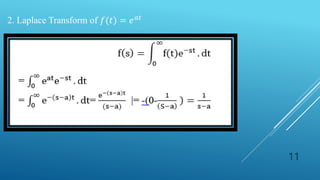
2. Laplace Transform of 𝑓(𝑡) = 𝑒𝑎𝑡
12
3. Laplace Transform of 𝑓(𝑡) = 𝑡𝑛
Where n= (1,2,3,4,…………………………….)
f s = 0
∞
e−st tn .dt
udv = uv − v . du
U=tn , du = (𝑛 𝑡𝑛−1) , dv= e−st , v=-
e−st
s
f s = − e−st.tn/s |- 0
∞
𝑛
𝑒−𝑠𝑡
𝑠
.tn-1.dt
13
The first term limits will be form (0 to ∞) by substituting it yields zero while the second
term by substitution we get:
f s = 0
∞ −ne−st
s
n tn-1.dt
u=ntn-1 , du=n(n-1)tn-2 , dv=
e−st
s
, v= - e−st/s2
f s = ne−st
tn-1 /s2 | - 0
∞
−n(n − 1)tn-2/s2 .e−st
. dt
f s = 0
∞
n(n − 1)e−st tn-2 /s2 .dt
Then after n times integration we have :
f s =
0
∞
n!
sn
tn−ne−st. dt
f s =
0
∞
n!
sn
e−st. dt
=
n!
sn+1 e−st
| =
n!
sn+1
NOTE: IN THIS SAME METHOD YOU CAN FIND LAPLACE TRANSFORM OF COS 𝑤𝑡
14
𝐿𝑎𝑝𝑙𝑎𝑐𝑒 [𝑠𝑖𝑛 𝑤𝑡] =
0
∞
𝑠𝑖𝑛𝑤𝑡𝑒−𝑠𝑡
. 𝑑𝑡
𝑒𝑗𝑤𝑡
= 𝑐𝑜𝑠 𝑤𝑡 + 𝑗𝑠𝑖𝑛 𝑤𝑡
𝑠𝑖𝑛 𝑤𝑡 𝑖𝑠 𝑡ℎ𝑒 𝐼𝑚𝑎𝑔𝑖𝑛𝑎𝑟𝑦 𝑝𝑎𝑟𝑡 (𝐼𝑚) 𝑜𝑓 𝑒𝑗𝑤𝑡
𝑠𝑖𝑛 𝑤𝑡 = 𝐼𝑚 (𝑒𝑗𝑤𝑡
)
𝐿𝑎𝑝𝑙𝑎𝑐𝑒 [𝑠𝑖𝑛 𝑤𝑡] = 𝐼𝑚
0
∞
𝑒𝑗𝑤𝑡𝑒−𝑠𝑡. 𝑑𝑡
= 𝐼𝑚
0
∞
𝑒−(𝑠−𝑗𝑤). 𝑑𝑡
= 𝐼𝑚 [−
𝑒− 𝑠−𝑗𝑤 𝑡
(𝑠 − 𝑗𝑤)
] = 𝐼𝑚 [0 − (−
𝑒0
𝑠 − 𝑗𝑤)
)
= 𝐼𝑚
1
𝑠 − 𝑗𝑤
= 𝐼𝑚 [
1
𝑎 − 𝑗𝑤
∗
𝑠 + 𝑗𝑤
𝑠 + 𝑗𝑤
]
= 𝐼𝑚 (𝑠 + 𝑗𝑤) / (𝑠2 + 𝑤2) = 𝑤 / (𝑠2 + 𝑤2)
4. Laplace Transform of f t = 𝑠𝑖𝑛 𝑤𝑡
5. LAPLACE TRANSFORM OF F T = 𝐶𝑜𝑠ℎ(𝑎𝑡)
15
𝐶𝑜𝑠ℎ(𝑎𝑡) =
𝑒𝑎𝑡
+ 𝑒−𝑎𝑡
2
ℒ cosh 𝑎𝑡 =
1
2
1
𝑠 − 𝑎
+
1
𝑠 + 𝑎
=
1
2
∗ [
𝑠 + 𝑎 + 𝑠 − 𝑎
(𝑠 − 𝑎)(𝑠 + 𝑎)
]
=
1
2
∗ [
2𝑠
𝑠2 + 𝑎𝑠 − 𝑎𝑠 − 𝑎2
]
=
1
2
[
2𝑠
𝑠2 − 𝑎2
]
=
𝑠
𝑠2 − 𝑎2
16
- Laplace Transform Properties:
1. Multiplication by Constant:
ℒ 𝑘. 𝐹 𝑡 = 0
∞
𝑘. 𝐹 𝑡 𝑒−𝑠𝑡
. 𝑑𝑡
= k. 0
∞
𝐹(𝑡)𝑒−𝑠𝑡 . 𝑑𝑡
=𝑘. 𝐹(𝑠)
Example:
ℒ3. 𝑒2𝑡
= 3.
1
𝑠 − 2
=
3
𝑠 − 2
17
2. Linearity:
If 𝐹 𝑡 = 𝐹1 𝑡 + 𝐹2 𝑡
ℒ 𝐹 𝑡 = 0
∞
𝐹(𝑡)𝑒−𝑠𝑡
.dt
= 0
∞
𝐹1 𝑡 + 𝐹2 𝑡 𝑒−𝑠𝑡
. 𝑑𝑡
= 0
∞
𝐹1 𝑡 𝑒−𝑠𝑡. 𝑑𝑡 + 0
∞
𝐹2 𝑡 𝑒−𝑠𝑡. 𝑑𝑡
= ℒ 𝐹1 𝑡 + ℒ[𝐹2 𝑡 ] = 𝐹1 𝑠 + 𝐹2(𝑠)
If 𝐹 𝑡 = 𝑎1𝐹1 𝑡 + 𝑎2𝐹2 𝑡
Where a1 and a2 are constants
Then ℒ[𝑎1𝐹1 𝑡 + 𝑎2𝐹2 𝑡 ]
= 𝑎1ℒ 𝐹1 𝑡 + 𝑎2ℒ 𝐹2 𝑡
18
Examples:
1. ℒ[2𝑠𝑖𝑛3𝑡 + 𝑐𝑜𝑠3𝑡]
= 2 ℒ 𝑠𝑖𝑛3𝑡 + ℒ[𝑐𝑜𝑠3𝑡]
= 2.
3
𝑠2+9
+
𝑠
𝑠2+9
=
𝑠+6
𝑠2+9
2. ℒ[ 4 𝑒5𝑡
+ 6𝑡3
− 3𝑠𝑖𝑛4𝑡 + 2𝑐𝑜𝑠2𝑡]
=
4
𝑠 − 5
+
6.3!
𝑠4
−
12
𝑠2 + 16
+
2𝑠
𝑠2 + 4
=
4
𝑠 − 5
+
36
𝑠4 −
12
𝑠2 + 16
+
2𝑠
𝑠2 + 4
- Home Work:
- ℒ[3𝑐𝑜𝑠6𝑡 − 5𝑠𝑖𝑛6]
- ℒ[3𝑡10
− 8𝑒−3𝑡
+ 5𝑐𝑜𝑠3𝑡 + 4𝑠𝑖𝑛2𝑡]
- ℒ[3𝑐𝑜𝑠5𝑡 − 4𝑠𝑖𝑛ℎ5𝑡]
19
3. Multiplication by exponential:
𝑓1 𝑡 = 𝑓 𝑡 𝑒−𝑎𝑡
ℒ 𝑓 𝑡 𝑒−𝑎𝑡
=
0
∞
𝑓 𝑡 𝑒−𝑎𝑡
𝑒−𝑠𝑡
0
∞
𝑓 𝑡 𝑒− 𝑠+𝑎 𝑡
. 𝑑𝑡 Then 𝑓(𝑠 + 𝑎)
The transform ℒ 𝑓 𝑡 𝑒−𝑎𝑡
is thus the same as ℒ 𝑓 𝑡
with everywhere in the result replaced by (𝑠 + 𝑎).
20
- Example:
ℒ 𝑒−𝑎𝑡
𝑠𝑖𝑛𝑤𝑡 =
𝑤
(𝑠+𝑎)2+ 𝑤2
ℒ 𝑡2
𝑒−4𝑡
=
2
(𝑠 + 4)3
- Example:
1. ℒ 𝑡2𝑒3𝑡 =
2
(𝑠−3)2
2. ℒ 𝑒−2𝑡
𝑠𝑖𝑛4𝑡 =
4
(𝑠+2)2+16
=
4
𝑠2+2𝑠+20
3. ℒ 𝑒−4𝑡
𝑐𝑜𝑠ℎ5𝑡 =
(𝑠−4)
(𝑠−4)2−25
=
(𝑠−4)
𝑠2−4𝑠+16−25
=
𝑠−4
𝑠2−4𝑠−9
- Home Work:
Find ℒ 𝑒−2𝑡
(3𝑐𝑜𝑠6𝑡 − 5𝑠𝑖𝑛6𝑡
- Home Work:
Find ℒ 𝑒−4𝑡
𝑐𝑜𝑠ℎ5𝑡 using cosh =
1
2
( 𝑒𝑎𝑡
+ 𝑒−𝑎𝑡
)
21
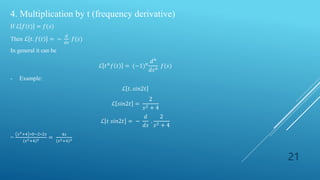
4. Multiplication by t (frequency derivative)
If ℒ 𝑓(𝑡) = 𝑓(𝑠)
Then ℒ 𝑡. 𝑓 𝑡 = −
𝑑
𝑑𝑠
𝑓(𝑠)
In general it can be
ℒ 𝑡𝑛
𝑓 𝑡 = (−1)𝑛
𝑑𝑛
𝑑𝑠𝑛
𝑓(𝑠)
- Example:
ℒ 𝑡. 𝑠𝑖𝑛2𝑡
ℒ 𝑠𝑖𝑛2𝑡 =
2
𝑠2 + 4
ℒ 𝑡 𝑠𝑖𝑛2𝑡 = −
𝑑
𝑑𝑠
.
2
𝑠2 + 4
=
𝑠2+4 ∗0−2∗2𝑠
(𝑠2+4)2 =
4𝑠
(𝑠2+4)2
22
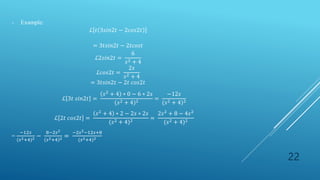
- Example:
ℒ 𝑡 3𝑠𝑖𝑛2𝑡 − 2𝑐𝑜𝑠2𝑡
= 3𝑡𝑠𝑖𝑛2𝑡 − 2𝑡𝑐𝑜𝑠𝑡
ℒ2𝑠𝑖𝑛2𝑡 =
6
𝑠2 + 4
ℒ𝑐𝑜𝑠2𝑡 =
2𝑠
𝑠2 + 4
= 3𝑡𝑠𝑖𝑛2𝑡 − 2𝑡 𝑐𝑜𝑠2𝑡
ℒ 3𝑡 𝑠𝑖𝑛2𝑡 =
𝑠2
+ 4 ∗ 0 − 6 ∗ 2𝑠
(𝑠2 + 4)2
=
−12𝑠
(𝑠2 + 4)2
ℒ 2𝑡 𝑐𝑜𝑠2𝑡 =
𝑠2 + 4 ∗ 2 − 2𝑠 ∗ 2𝑠
(𝑠2 + 4)2 =
2𝑠2 + 8 − 4𝑠2
(𝑠2 + 4)2
=
−12𝑠
(𝑠2+4)2 −
8−2𝑠2
𝑠2+4 2 =
−2𝑠2−12𝑠+8
(𝑠2+4)2
23
5.Time Derivative:
ℒ
𝑑𝑓 𝑡
𝑑𝑡
= 𝑠𝑓 𝑠 − 𝑓(0)
Where 𝑓(0) is the initial value of 𝑓(𝑡) ,evaluated as the one - side limit of 𝑓(𝑡) as 𝑡 → 0 from
positive valued.
ℒ 𝑓 𝑡 ′
=
0
∞
𝑓 𝑡 ′
𝑒−𝑠𝑡
. 𝑑𝑡
Using 𝑢𝑑𝑣 = 𝑢𝑣 − 𝑣𝑑𝑢
𝑢 = 𝑒−𝑠𝑡 , 𝑑𝑢 = −𝑠𝑒−𝑠𝑡, 𝑑𝑣 = 𝑓 𝑡 ′ , 𝑣 = 𝑓(𝑡)
= 𝑒−𝑠𝑡
𝑓 𝑡 𝑤𝑖𝑡ℎ 𝑙𝑖𝑚𝑖𝑡𝑠 𝑓𝑟𝑜𝑚 0 − ∞ − 0
∞
𝑓(𝑡)(−𝑠𝑒−𝑠𝑡
). 𝑑𝑡
= 0 − 𝑓 0 + 𝑠𝑓(𝑠)
Then ℒ
𝑑2𝑓 𝑡
𝑑𝑡2 = 𝑠2
𝑓 𝑠 − 𝑠𝑓 0 − 𝑓(0)′
and in general:
ℒ
𝑑𝑛
𝑓 𝑡
𝑑𝑡𝑛 = 𝑠𝑛
𝑓 𝑠 −
𝑖=1
𝑛
𝑓(0)(𝑖−1)
𝑠𝑛−𝑖
24
- Example:
𝑓 𝑡 = 𝑡 , 𝐹𝑖𝑛𝑑 ℒ 1 𝑢𝑠𝑖𝑛𝑔 𝑡𝑖𝑚𝑒 − 𝑑𝑒𝑟𝑖𝑣𝑎𝑡𝑖𝑣𝑒
Since ℒ 1 =
1
𝑠
, 𝑓 0 = 0
ℒ
𝑑𝑓 𝑡
𝑑𝑡
= 𝑠𝑓 𝑠 − 𝑓 0
ℒ
𝑑𝑓 1
𝑑𝑡
= 𝑠𝑓 𝑠 − 𝑓 0
ℒ 1 = 𝑠 ∗
1
𝑠2 − 0 =
1
𝑠
25
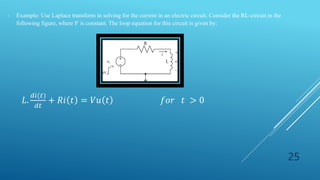
- Example: Use Laplace transform in solving for the current in an electric circuit. Consider the RL-circuit in the
following figure, where 𝑉 is constant. The loop equation for this circuit is given by:
𝐿.
𝑑𝑖(𝑡)
𝑑𝑡
+ 𝑅𝑖 𝑡 = 𝑉𝑢 𝑡 𝑓𝑜𝑟 𝑡 > 0
26
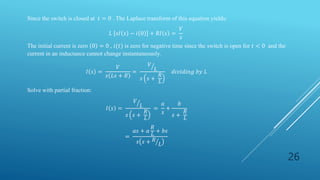
Since the switch is closed at 𝑡 = 0 . The Laplace transform of this equation yields:
𝐿 𝑠𝐼 𝑠 − 𝑖 0 + 𝑅𝐼 𝑠 =
𝑉
𝑠
The initial current is zero 0 = 0 , 𝑖(𝑡) is zero for negative time since the switch is open for 𝑡 < 0 and the
current in an inductance cannot change instantaneously.
𝐼 𝑠 =
𝑉
𝑠 𝐿𝑠 + 𝑅
=
𝑉
𝐿
𝑠 𝑠 +
𝑅
𝐿
𝑑𝑖𝑣𝑖𝑑𝑖𝑛𝑔 𝑏𝑦 𝐿
Solve with partial fraction:
𝐼 𝑠 =
𝑉
𝐿
𝑠 𝑠 +
𝑅
𝐿
=
𝑎
𝑠
+
𝑏
𝑠 +
𝑅
𝐿
=
𝑎𝑠 + 𝑎
𝑅
𝐿
+ 𝑏𝑠
𝑠 𝑠 + 𝑅
𝐿
27
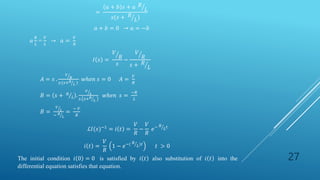
=
𝑎 + 𝑏 𝑠 + 𝑎 𝑅
𝐿
𝑠(𝑠 + 𝑅
𝐿)
𝑎 + 𝑏 = 0 → 𝑎 = −𝑏
𝑎
𝑅
𝐿
=
𝑉
𝐿
→ 𝑎 =
𝑉
𝑅
𝐼 𝑠 =
𝑉
𝑅
𝑠
−
𝑉
𝑅
𝑠 + 𝑅
𝐿
𝐴 = 𝑠 .
𝑉
𝑅
𝑠.(𝑠+𝑅
𝐿 )
𝑤ℎ𝑒𝑛 𝑠 = 0 𝐴 =
𝑉
𝑅
𝐵 = 𝑠 + 𝑅
𝐿 .
𝑉
𝐿
𝑠. 𝑠+𝑅
𝐿
𝑤ℎ𝑒𝑛 𝑠 =
−𝑅
𝐿
𝐵 =
𝑉
𝐿
− 𝑅
𝐿
=
− 𝑉
𝑅
ℒ𝐼(𝑠)−1
= 𝑖 𝑡 =
𝑉
𝑅
−
𝑉
𝑅
𝑒− 𝑅
𝐿𝑡
𝑖 𝑡 =
𝑉
𝑅
1 − 𝑒−( 𝑅
𝐿)𝑡
𝑡 > 0
The initial condition 𝑖 0 = 0 is satisfied by 𝑖 𝑡 also substitution of 𝑖 𝑡 into the
differential equation satisfies that equation.
28
- Example:
Solve the following differential equation:
𝑦′′
− 4𝑦′
+ 5𝑦 = 𝑥 𝑡 𝑦 0 = 0 , 𝑦 0 ′
𝑠2
𝑦 𝑠 − 𝑠𝑦 0 − 𝑦′
0 − 4 𝑠𝑦 𝑠 − 𝑦 0 + 5𝑦 𝑠 = 𝑥 𝑠
𝑠2𝑦 𝑠 − 4𝑠𝑦 𝑠 + 5𝑦 𝑠 = 𝑥 𝑠
𝑦 𝑠 𝑠2 − 4𝑠 + 5 = 𝑥 𝑠
𝑦(𝑠)
𝑥(𝑠)
=
1
𝑠2 − 4𝑠 + 5
- Home Work :
1. 𝑦′′
− 3𝑦′
+ 2𝑦 = 𝑢 𝑡
2. 𝑦′′
+ 4𝑦′
+ 20𝑦 = 𝑢(𝑡)
29
6. Real Shifting:
𝑓 𝑡 − 𝑡0 𝑢 𝑡 − 𝑡0 = 𝑓 𝑡 − 𝑡0 𝑡 > 𝑡0
1. 𝑡 < 𝑡0
ℒ 𝑓 𝑡 − 𝑡0 𝑢 𝑡 − 𝑡0 =
0
∞
𝑓 𝑡 − 𝑡0 𝑢 𝑡 − 𝑡0 𝑒−𝑠𝑡. 𝑑𝑡
=
0
∞
𝑓(𝑡 − 𝑡0) 𝑒−𝑠𝑡
. 𝑑𝑡
We make the change of variable 𝑡 − 𝑡0 = 𝜏 , hence
𝑡 = (𝜏 + 𝑡0), 𝑑𝑡 = 𝑑𝜏 and
ℒ 𝑓 𝑡 − 𝑡0 𝑢 𝑡 − 𝑡0 =
0
∞
𝑓 𝜏 𝑒−𝑠(𝜏+𝑡0). 𝑑𝜏
= 𝑒−𝑡0𝑠
0
∞
𝑓 𝜏 𝑒−𝑠𝜏
. 𝑑𝜏
= 𝑒−𝑡0𝑠
. 𝑓(𝑠)
30
Since 𝜏 is the variable of integration and can be replaced with , the integral on the right side is
𝑓(𝑠) , hence the Laplace transform of the shifted time function is given by:
ℒ 𝑓 𝑡 − 𝑡0 𝑢 𝑡 − 𝑡0 = 𝑒−𝑡0𝑠𝑓(𝑠)
𝑡0 ≥ 0 And ℒ 𝑓 𝑡 = 𝑓(𝑠). This relationship called the real translation, properly applies for a
function of the type in the figure:
It is necessary that the function to be zero in time less than 𝑡0 , the amount of the shift.
31
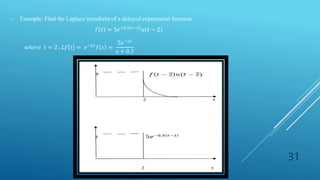
- Example: Find the Laplace transform of a delayed exponential function:
𝑓 𝑡 = 5𝑒−0.3 𝑡−2 𝑢(𝑡 − 2)
𝑤ℎ𝑒𝑟𝑒 𝑡 = 2 , ℒ𝑓 𝑡 = 𝑒−2𝑠
𝑓 𝑠 =
5𝑒−2𝑠
𝑠 + 0.3
32
7. Time Integral:
𝑔 𝑡 =
0
𝑡
𝑓 𝜏 . 𝑑𝜏
ℒ𝑔 𝑡 = ℒ[
0
𝑡
𝑓 𝜏 . 𝑑𝜏]
∴
0
∞
[
0
𝑡
𝑓 𝜏 . 𝑑𝜏]𝑒−𝑠𝑡
. 𝑑𝑡
𝑢 =
0
𝑡
𝑓 𝜏 . 𝑑𝜏 𝑑𝑣 = 𝑒−𝑠𝑡
𝑑𝑢 = 𝑓 𝑡 . 𝑑𝑡 𝑣 =
𝑒−𝑠𝑡
−𝑠
𝑢𝑑𝑣 = 𝑢𝑣 − 𝑣𝑑𝑢
𝑒−𝑠𝑡
−𝑠
.
0
𝑡
𝑓 𝜏 . 𝑑𝜏 𝑤𝑖𝑡ℎ 𝑙𝑖𝑚𝑖𝑡𝑠 𝑓𝑟𝑜𝑚 0 𝑡𝑜 ∞ −
0
∞
𝑒−𝑠𝑡
−𝑠
𝑓 𝑡 . 𝑑𝑡
=
1
𝑠
0 − 0 +
1
𝑠 0
∞
𝑓(𝑡)𝑒−𝑠𝑡
. 𝑑𝑡
33
∴ ℒ[
0
𝑡
𝑓 𝜏 . 𝑑𝜏] =
1
𝑠 0
∞
𝑓 𝑡 𝑒−𝑠𝑡
. 𝑑𝑡
∴
𝑓(𝑠)
𝑠
- Example:
Find the Laplace transform for 𝑓 𝑡 = 0
∞
𝑠𝑖𝑛𝑡. 𝑑𝑡
By integration the sine the result will be cosine and have the Laplace
𝑠
𝑠2+1
By using the Laplace transform properties, the result will be ℒ
1
𝑠2+1
Then the Laplace transform for integration the sine is
1
𝑠2+1
𝑠
Which leads the result to
𝑠
𝑠2+1
34
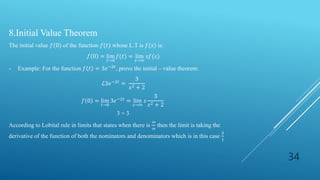
8.Initial Value Theorem
The initial value 𝑓(0) of the function 𝑓(𝑡) whose L.T is 𝑓(𝑠) is:
𝑓 0 = lim
𝑡→0
𝑓(𝑡) = lim
𝑠→∞
𝑠𝑓(𝑠)
- Example: For the function 𝑓 𝑡 = 3𝑒−2𝑡, prove the initial – value theorem:
ℒ3𝑒−2𝑡 =
3
𝑠2 + 2
𝑓 0 = lim
𝑡→0
3𝑒−2𝑡 = lim
𝑠→∞
𝑠
3
𝑠2 + 2
3 = 3
According to Lobital rule in limits that states when there is
∞
∞
then the limit is taking the
derivative of the function of both the nominators and denominators which is in this case
3
1
35
9. Final value theorem:
The final value of the function 𝑓(𝑡) whose L.T is𝑓 ∞ =
lim
𝑡→∞
𝑓(𝑡) = lim
𝑠→0
𝑠𝑓(𝑠)
- Example: For the function 𝑓 𝑡 = 3𝑒−2𝑡
, prove the final –
value theorem:
𝑓 ∞ = lim
𝑡→∞
3𝑒−2𝑡 = lim
𝑠→0
𝑠
3
𝑠2 + 2
0 = 0
THANK YOU
36

Engineering Analysis -Third Class.ppsx

  • 1.
    MINISTRY OF SCIENTIFICEDUCATION AND HIGHER RESEARCHES NORTHERN TECHNICAL UNIVERSITY ENGINEERING TECHNICAL COLLEGE / MOSUL DEPARTMENT OF COMPUTER TECHNOLOGY 1 ENGINEERING ANALYSIS LECTURE DEPARTMENT OF COMPUTER TECHNOLOGY –THIRD CLASS 2018 -2019 ARJUWAN MOHAMMED ABDULJAWAD ALJAWADI LECTURER
  • 2.
    2 - ENGINEERING ANALYSIS Oneof important transforms used in linear- system analysis. It is named in honor of the great French mathematician, Pierre Simon De Laplace (1749-1827).
  • 3.
    3 - Purpose ofLaplace Transform • To convert from one type of operation to another operations of different types in more simple form. • A well-known technique for solving differential equations.
  • 4.
  • 5.
    - THE TIMEDOMAIN SIGNAL IS CONTINUOUS , EXTENDS TO: 1. POSITIVE AND NEGATIVE INFINITY. 2. PERIODIC OR APERIODIC SIGNAL 5 - Laplace Transform Definition: The Laplace transform F(s) of a time function F (t) is given by the integral:
  • 6.
    6 This definition iscalled the bilateral, or two-sided, Laplace transform—hence, the subscript b. Notice that the bilateral Laplace transform integral becomes the Fourier transform integral if is replaced by (𝑗𝑤 ) . The Laplace transform variable is complex 𝑠 = 𝛼 + 𝑗𝑤, we can rewrite (1) as: 𝐹 𝑠 = −∞ ∞ 𝑓(𝑡)𝑒−(𝜎+𝑗𝜔)𝑡 𝑑𝑡 = −∞ ∞ 𝑓(𝑡)𝑒−𝜎𝑡 𝑒−𝑗𝑤 𝑑𝑡
  • 7.
    7 𝑓 𝑡 𝑖𝑠𝑧𝑒𝑟𝑜 𝑓𝑜𝑟 𝑎𝑙𝑙 𝑡 < 0 Thus the first integral in above equation is zero. The resulting transform, called the unilateral, or single-sided Laplace transform, is given by:
  • 8.
    8 THE LAPLACE-TRANSFORM VARIABLES IS COMPLEX, AND WE DENOTE ITS REAL PART AS ∝ AND ITS IMAGINARY PART AS 𝑗𝑤 THAT IS: 𝑠 = ∝ +𝑗𝑤 The S-plane
  • 9.
    9 Some Elementary FunctionsF(t) and their Laplace Transform F(t) F(s) U(t) 1 s t 1/s2 tn n!/ sn+1 e−at 1 s + a eat 1 s − a sin wt w/s2+w2 cos at s/s2+a2 sin hat w/s2- w2 cos hat s/s2- w2
  • 10.
    10 - Laplace Transformof some important functions 1. Laplace Transform of a unit –step function 𝑓(𝑡) = 1.
  • 11.
    11 2. Laplace Transformof 𝑓(𝑡) = 𝑒𝑎𝑡
  • 12.
    12 3. Laplace Transformof 𝑓(𝑡) = 𝑡𝑛 Where n= (1,2,3,4,…………………………….) f s = 0 ∞ e−st tn .dt udv = uv − v . du U=tn , du = (𝑛 𝑡𝑛−1) , dv= e−st , v=- e−st s f s = − e−st.tn/s |- 0 ∞ 𝑛 𝑒−𝑠𝑡 𝑠 .tn-1.dt
  • 13.
    13 The first termlimits will be form (0 to ∞) by substituting it yields zero while the second term by substitution we get: f s = 0 ∞ −ne−st s n tn-1.dt u=ntn-1 , du=n(n-1)tn-2 , dv= e−st s , v= - e−st/s2 f s = ne−st tn-1 /s2 | - 0 ∞ −n(n − 1)tn-2/s2 .e−st . dt f s = 0 ∞ n(n − 1)e−st tn-2 /s2 .dt Then after n times integration we have : f s = 0 ∞ n! sn tn−ne−st. dt f s = 0 ∞ n! sn e−st. dt = n! sn+1 e−st | = n! sn+1
  • 14.
    NOTE: IN THISSAME METHOD YOU CAN FIND LAPLACE TRANSFORM OF COS 𝑤𝑡 14 𝐿𝑎𝑝𝑙𝑎𝑐𝑒 [𝑠𝑖𝑛 𝑤𝑡] = 0 ∞ 𝑠𝑖𝑛𝑤𝑡𝑒−𝑠𝑡 . 𝑑𝑡 𝑒𝑗𝑤𝑡 = 𝑐𝑜𝑠 𝑤𝑡 + 𝑗𝑠𝑖𝑛 𝑤𝑡 𝑠𝑖𝑛 𝑤𝑡 𝑖𝑠 𝑡ℎ𝑒 𝐼𝑚𝑎𝑔𝑖𝑛𝑎𝑟𝑦 𝑝𝑎𝑟𝑡 (𝐼𝑚) 𝑜𝑓 𝑒𝑗𝑤𝑡 𝑠𝑖𝑛 𝑤𝑡 = 𝐼𝑚 (𝑒𝑗𝑤𝑡 ) 𝐿𝑎𝑝𝑙𝑎𝑐𝑒 [𝑠𝑖𝑛 𝑤𝑡] = 𝐼𝑚 0 ∞ 𝑒𝑗𝑤𝑡𝑒−𝑠𝑡. 𝑑𝑡 = 𝐼𝑚 0 ∞ 𝑒−(𝑠−𝑗𝑤). 𝑑𝑡 = 𝐼𝑚 [− 𝑒− 𝑠−𝑗𝑤 𝑡 (𝑠 − 𝑗𝑤) ] = 𝐼𝑚 [0 − (− 𝑒0 𝑠 − 𝑗𝑤) ) = 𝐼𝑚 1 𝑠 − 𝑗𝑤 = 𝐼𝑚 [ 1 𝑎 − 𝑗𝑤 ∗ 𝑠 + 𝑗𝑤 𝑠 + 𝑗𝑤 ] = 𝐼𝑚 (𝑠 + 𝑗𝑤) / (𝑠2 + 𝑤2) = 𝑤 / (𝑠2 + 𝑤2) 4. Laplace Transform of f t = 𝑠𝑖𝑛 𝑤𝑡
  • 15.
    5. LAPLACE TRANSFORMOF F T = 𝐶𝑜𝑠ℎ(𝑎𝑡) 15 𝐶𝑜𝑠ℎ(𝑎𝑡) = 𝑒𝑎𝑡 + 𝑒−𝑎𝑡 2 ℒ cosh 𝑎𝑡 = 1 2 1 𝑠 − 𝑎 + 1 𝑠 + 𝑎 = 1 2 ∗ [ 𝑠 + 𝑎 + 𝑠 − 𝑎 (𝑠 − 𝑎)(𝑠 + 𝑎) ] = 1 2 ∗ [ 2𝑠 𝑠2 + 𝑎𝑠 − 𝑎𝑠 − 𝑎2 ] = 1 2 [ 2𝑠 𝑠2 − 𝑎2 ] = 𝑠 𝑠2 − 𝑎2
  • 16.
    16 - Laplace TransformProperties: 1. Multiplication by Constant: ℒ 𝑘. 𝐹 𝑡 = 0 ∞ 𝑘. 𝐹 𝑡 𝑒−𝑠𝑡 . 𝑑𝑡 = k. 0 ∞ 𝐹(𝑡)𝑒−𝑠𝑡 . 𝑑𝑡 =𝑘. 𝐹(𝑠) Example: ℒ3. 𝑒2𝑡 = 3. 1 𝑠 − 2 = 3 𝑠 − 2
  • 17.
    17 2. Linearity: If 𝐹𝑡 = 𝐹1 𝑡 + 𝐹2 𝑡 ℒ 𝐹 𝑡 = 0 ∞ 𝐹(𝑡)𝑒−𝑠𝑡 .dt = 0 ∞ 𝐹1 𝑡 + 𝐹2 𝑡 𝑒−𝑠𝑡 . 𝑑𝑡 = 0 ∞ 𝐹1 𝑡 𝑒−𝑠𝑡. 𝑑𝑡 + 0 ∞ 𝐹2 𝑡 𝑒−𝑠𝑡. 𝑑𝑡 = ℒ 𝐹1 𝑡 + ℒ[𝐹2 𝑡 ] = 𝐹1 𝑠 + 𝐹2(𝑠) If 𝐹 𝑡 = 𝑎1𝐹1 𝑡 + 𝑎2𝐹2 𝑡 Where a1 and a2 are constants Then ℒ[𝑎1𝐹1 𝑡 + 𝑎2𝐹2 𝑡 ] = 𝑎1ℒ 𝐹1 𝑡 + 𝑎2ℒ 𝐹2 𝑡
  • 18.
    18 Examples: 1. ℒ[2𝑠𝑖𝑛3𝑡 +𝑐𝑜𝑠3𝑡] = 2 ℒ 𝑠𝑖𝑛3𝑡 + ℒ[𝑐𝑜𝑠3𝑡] = 2. 3 𝑠2+9 + 𝑠 𝑠2+9 = 𝑠+6 𝑠2+9 2. ℒ[ 4 𝑒5𝑡 + 6𝑡3 − 3𝑠𝑖𝑛4𝑡 + 2𝑐𝑜𝑠2𝑡] = 4 𝑠 − 5 + 6.3! 𝑠4 − 12 𝑠2 + 16 + 2𝑠 𝑠2 + 4 = 4 𝑠 − 5 + 36 𝑠4 − 12 𝑠2 + 16 + 2𝑠 𝑠2 + 4 - Home Work: - ℒ[3𝑐𝑜𝑠6𝑡 − 5𝑠𝑖𝑛6] - ℒ[3𝑡10 − 8𝑒−3𝑡 + 5𝑐𝑜𝑠3𝑡 + 4𝑠𝑖𝑛2𝑡] - ℒ[3𝑐𝑜𝑠5𝑡 − 4𝑠𝑖𝑛ℎ5𝑡]
  • 19.
    19 3. Multiplication byexponential: 𝑓1 𝑡 = 𝑓 𝑡 𝑒−𝑎𝑡 ℒ 𝑓 𝑡 𝑒−𝑎𝑡 = 0 ∞ 𝑓 𝑡 𝑒−𝑎𝑡 𝑒−𝑠𝑡 0 ∞ 𝑓 𝑡 𝑒− 𝑠+𝑎 𝑡 . 𝑑𝑡 Then 𝑓(𝑠 + 𝑎) The transform ℒ 𝑓 𝑡 𝑒−𝑎𝑡 is thus the same as ℒ 𝑓 𝑡 with everywhere in the result replaced by (𝑠 + 𝑎).
  • 20.
    20 - Example: ℒ 𝑒−𝑎𝑡 𝑠𝑖𝑛𝑤𝑡= 𝑤 (𝑠+𝑎)2+ 𝑤2 ℒ 𝑡2 𝑒−4𝑡 = 2 (𝑠 + 4)3 - Example: 1. ℒ 𝑡2𝑒3𝑡 = 2 (𝑠−3)2 2. ℒ 𝑒−2𝑡 𝑠𝑖𝑛4𝑡 = 4 (𝑠+2)2+16 = 4 𝑠2+2𝑠+20 3. ℒ 𝑒−4𝑡 𝑐𝑜𝑠ℎ5𝑡 = (𝑠−4) (𝑠−4)2−25 = (𝑠−4) 𝑠2−4𝑠+16−25 = 𝑠−4 𝑠2−4𝑠−9 - Home Work: Find ℒ 𝑒−2𝑡 (3𝑐𝑜𝑠6𝑡 − 5𝑠𝑖𝑛6𝑡 - Home Work: Find ℒ 𝑒−4𝑡 𝑐𝑜𝑠ℎ5𝑡 using cosh = 1 2 ( 𝑒𝑎𝑡 + 𝑒−𝑎𝑡 )
  • 21.
    21 4. Multiplication byt (frequency derivative) If ℒ 𝑓(𝑡) = 𝑓(𝑠) Then ℒ 𝑡. 𝑓 𝑡 = − 𝑑 𝑑𝑠 𝑓(𝑠) In general it can be ℒ 𝑡𝑛 𝑓 𝑡 = (−1)𝑛 𝑑𝑛 𝑑𝑠𝑛 𝑓(𝑠) - Example: ℒ 𝑡. 𝑠𝑖𝑛2𝑡 ℒ 𝑠𝑖𝑛2𝑡 = 2 𝑠2 + 4 ℒ 𝑡 𝑠𝑖𝑛2𝑡 = − 𝑑 𝑑𝑠 . 2 𝑠2 + 4 = 𝑠2+4 ∗0−2∗2𝑠 (𝑠2+4)2 = 4𝑠 (𝑠2+4)2
  • 22.
    22 - Example: ℒ 𝑡3𝑠𝑖𝑛2𝑡 − 2𝑐𝑜𝑠2𝑡 = 3𝑡𝑠𝑖𝑛2𝑡 − 2𝑡𝑐𝑜𝑠𝑡 ℒ2𝑠𝑖𝑛2𝑡 = 6 𝑠2 + 4 ℒ𝑐𝑜𝑠2𝑡 = 2𝑠 𝑠2 + 4 = 3𝑡𝑠𝑖𝑛2𝑡 − 2𝑡 𝑐𝑜𝑠2𝑡 ℒ 3𝑡 𝑠𝑖𝑛2𝑡 = 𝑠2 + 4 ∗ 0 − 6 ∗ 2𝑠 (𝑠2 + 4)2 = −12𝑠 (𝑠2 + 4)2 ℒ 2𝑡 𝑐𝑜𝑠2𝑡 = 𝑠2 + 4 ∗ 2 − 2𝑠 ∗ 2𝑠 (𝑠2 + 4)2 = 2𝑠2 + 8 − 4𝑠2 (𝑠2 + 4)2 = −12𝑠 (𝑠2+4)2 − 8−2𝑠2 𝑠2+4 2 = −2𝑠2−12𝑠+8 (𝑠2+4)2
  • 23.
    23 5.Time Derivative: ℒ 𝑑𝑓 𝑡 𝑑𝑡 =𝑠𝑓 𝑠 − 𝑓(0) Where 𝑓(0) is the initial value of 𝑓(𝑡) ,evaluated as the one - side limit of 𝑓(𝑡) as 𝑡 → 0 from positive valued. ℒ 𝑓 𝑡 ′ = 0 ∞ 𝑓 𝑡 ′ 𝑒−𝑠𝑡 . 𝑑𝑡 Using 𝑢𝑑𝑣 = 𝑢𝑣 − 𝑣𝑑𝑢 𝑢 = 𝑒−𝑠𝑡 , 𝑑𝑢 = −𝑠𝑒−𝑠𝑡, 𝑑𝑣 = 𝑓 𝑡 ′ , 𝑣 = 𝑓(𝑡) = 𝑒−𝑠𝑡 𝑓 𝑡 𝑤𝑖𝑡ℎ 𝑙𝑖𝑚𝑖𝑡𝑠 𝑓𝑟𝑜𝑚 0 − ∞ − 0 ∞ 𝑓(𝑡)(−𝑠𝑒−𝑠𝑡 ). 𝑑𝑡 = 0 − 𝑓 0 + 𝑠𝑓(𝑠) Then ℒ 𝑑2𝑓 𝑡 𝑑𝑡2 = 𝑠2 𝑓 𝑠 − 𝑠𝑓 0 − 𝑓(0)′ and in general: ℒ 𝑑𝑛 𝑓 𝑡 𝑑𝑡𝑛 = 𝑠𝑛 𝑓 𝑠 − 𝑖=1 𝑛 𝑓(0)(𝑖−1) 𝑠𝑛−𝑖
  • 24.
    24 - Example: 𝑓 𝑡= 𝑡 , 𝐹𝑖𝑛𝑑 ℒ 1 𝑢𝑠𝑖𝑛𝑔 𝑡𝑖𝑚𝑒 − 𝑑𝑒𝑟𝑖𝑣𝑎𝑡𝑖𝑣𝑒 Since ℒ 1 = 1 𝑠 , 𝑓 0 = 0 ℒ 𝑑𝑓 𝑡 𝑑𝑡 = 𝑠𝑓 𝑠 − 𝑓 0 ℒ 𝑑𝑓 1 𝑑𝑡 = 𝑠𝑓 𝑠 − 𝑓 0 ℒ 1 = 𝑠 ∗ 1 𝑠2 − 0 = 1 𝑠
  • 25.
    25 - Example: UseLaplace transform in solving for the current in an electric circuit. Consider the RL-circuit in the following figure, where 𝑉 is constant. The loop equation for this circuit is given by: 𝐿. 𝑑𝑖(𝑡) 𝑑𝑡 + 𝑅𝑖 𝑡 = 𝑉𝑢 𝑡 𝑓𝑜𝑟 𝑡 > 0
  • 26.
    26 Since the switchis closed at 𝑡 = 0 . The Laplace transform of this equation yields: 𝐿 𝑠𝐼 𝑠 − 𝑖 0 + 𝑅𝐼 𝑠 = 𝑉 𝑠 The initial current is zero 0 = 0 , 𝑖(𝑡) is zero for negative time since the switch is open for 𝑡 < 0 and the current in an inductance cannot change instantaneously. 𝐼 𝑠 = 𝑉 𝑠 𝐿𝑠 + 𝑅 = 𝑉 𝐿 𝑠 𝑠 + 𝑅 𝐿 𝑑𝑖𝑣𝑖𝑑𝑖𝑛𝑔 𝑏𝑦 𝐿 Solve with partial fraction: 𝐼 𝑠 = 𝑉 𝐿 𝑠 𝑠 + 𝑅 𝐿 = 𝑎 𝑠 + 𝑏 𝑠 + 𝑅 𝐿 = 𝑎𝑠 + 𝑎 𝑅 𝐿 + 𝑏𝑠 𝑠 𝑠 + 𝑅 𝐿
  • 27.
    27 = 𝑎 + 𝑏𝑠 + 𝑎 𝑅 𝐿 𝑠(𝑠 + 𝑅 𝐿) 𝑎 + 𝑏 = 0 → 𝑎 = −𝑏 𝑎 𝑅 𝐿 = 𝑉 𝐿 → 𝑎 = 𝑉 𝑅 𝐼 𝑠 = 𝑉 𝑅 𝑠 − 𝑉 𝑅 𝑠 + 𝑅 𝐿 𝐴 = 𝑠 . 𝑉 𝑅 𝑠.(𝑠+𝑅 𝐿 ) 𝑤ℎ𝑒𝑛 𝑠 = 0 𝐴 = 𝑉 𝑅 𝐵 = 𝑠 + 𝑅 𝐿 . 𝑉 𝐿 𝑠. 𝑠+𝑅 𝐿 𝑤ℎ𝑒𝑛 𝑠 = −𝑅 𝐿 𝐵 = 𝑉 𝐿 − 𝑅 𝐿 = − 𝑉 𝑅 ℒ𝐼(𝑠)−1 = 𝑖 𝑡 = 𝑉 𝑅 − 𝑉 𝑅 𝑒− 𝑅 𝐿𝑡 𝑖 𝑡 = 𝑉 𝑅 1 − 𝑒−( 𝑅 𝐿)𝑡 𝑡 > 0 The initial condition 𝑖 0 = 0 is satisfied by 𝑖 𝑡 also substitution of 𝑖 𝑡 into the differential equation satisfies that equation.
  • 28.
    28 - Example: Solve thefollowing differential equation: 𝑦′′ − 4𝑦′ + 5𝑦 = 𝑥 𝑡 𝑦 0 = 0 , 𝑦 0 ′ 𝑠2 𝑦 𝑠 − 𝑠𝑦 0 − 𝑦′ 0 − 4 𝑠𝑦 𝑠 − 𝑦 0 + 5𝑦 𝑠 = 𝑥 𝑠 𝑠2𝑦 𝑠 − 4𝑠𝑦 𝑠 + 5𝑦 𝑠 = 𝑥 𝑠 𝑦 𝑠 𝑠2 − 4𝑠 + 5 = 𝑥 𝑠 𝑦(𝑠) 𝑥(𝑠) = 1 𝑠2 − 4𝑠 + 5 - Home Work : 1. 𝑦′′ − 3𝑦′ + 2𝑦 = 𝑢 𝑡 2. 𝑦′′ + 4𝑦′ + 20𝑦 = 𝑢(𝑡)
  • 29.
    29 6. Real Shifting: 𝑓𝑡 − 𝑡0 𝑢 𝑡 − 𝑡0 = 𝑓 𝑡 − 𝑡0 𝑡 > 𝑡0 1. 𝑡 < 𝑡0 ℒ 𝑓 𝑡 − 𝑡0 𝑢 𝑡 − 𝑡0 = 0 ∞ 𝑓 𝑡 − 𝑡0 𝑢 𝑡 − 𝑡0 𝑒−𝑠𝑡. 𝑑𝑡 = 0 ∞ 𝑓(𝑡 − 𝑡0) 𝑒−𝑠𝑡 . 𝑑𝑡 We make the change of variable 𝑡 − 𝑡0 = 𝜏 , hence 𝑡 = (𝜏 + 𝑡0), 𝑑𝑡 = 𝑑𝜏 and ℒ 𝑓 𝑡 − 𝑡0 𝑢 𝑡 − 𝑡0 = 0 ∞ 𝑓 𝜏 𝑒−𝑠(𝜏+𝑡0). 𝑑𝜏 = 𝑒−𝑡0𝑠 0 ∞ 𝑓 𝜏 𝑒−𝑠𝜏 . 𝑑𝜏 = 𝑒−𝑡0𝑠 . 𝑓(𝑠)
  • 30.
    30 Since 𝜏 isthe variable of integration and can be replaced with , the integral on the right side is 𝑓(𝑠) , hence the Laplace transform of the shifted time function is given by: ℒ 𝑓 𝑡 − 𝑡0 𝑢 𝑡 − 𝑡0 = 𝑒−𝑡0𝑠𝑓(𝑠) 𝑡0 ≥ 0 And ℒ 𝑓 𝑡 = 𝑓(𝑠). This relationship called the real translation, properly applies for a function of the type in the figure: It is necessary that the function to be zero in time less than 𝑡0 , the amount of the shift.
  • 31.
    31 - Example: Findthe Laplace transform of a delayed exponential function: 𝑓 𝑡 = 5𝑒−0.3 𝑡−2 𝑢(𝑡 − 2) 𝑤ℎ𝑒𝑟𝑒 𝑡 = 2 , ℒ𝑓 𝑡 = 𝑒−2𝑠 𝑓 𝑠 = 5𝑒−2𝑠 𝑠 + 0.3
  • 32.
    32 7. Time Integral: 𝑔𝑡 = 0 𝑡 𝑓 𝜏 . 𝑑𝜏 ℒ𝑔 𝑡 = ℒ[ 0 𝑡 𝑓 𝜏 . 𝑑𝜏] ∴ 0 ∞ [ 0 𝑡 𝑓 𝜏 . 𝑑𝜏]𝑒−𝑠𝑡 . 𝑑𝑡 𝑢 = 0 𝑡 𝑓 𝜏 . 𝑑𝜏 𝑑𝑣 = 𝑒−𝑠𝑡 𝑑𝑢 = 𝑓 𝑡 . 𝑑𝑡 𝑣 = 𝑒−𝑠𝑡 −𝑠 𝑢𝑑𝑣 = 𝑢𝑣 − 𝑣𝑑𝑢 𝑒−𝑠𝑡 −𝑠 . 0 𝑡 𝑓 𝜏 . 𝑑𝜏 𝑤𝑖𝑡ℎ 𝑙𝑖𝑚𝑖𝑡𝑠 𝑓𝑟𝑜𝑚 0 𝑡𝑜 ∞ − 0 ∞ 𝑒−𝑠𝑡 −𝑠 𝑓 𝑡 . 𝑑𝑡 = 1 𝑠 0 − 0 + 1 𝑠 0 ∞ 𝑓(𝑡)𝑒−𝑠𝑡 . 𝑑𝑡
  • 33.
    33 ∴ ℒ[ 0 𝑡 𝑓 𝜏. 𝑑𝜏] = 1 𝑠 0 ∞ 𝑓 𝑡 𝑒−𝑠𝑡 . 𝑑𝑡 ∴ 𝑓(𝑠) 𝑠 - Example: Find the Laplace transform for 𝑓 𝑡 = 0 ∞ 𝑠𝑖𝑛𝑡. 𝑑𝑡 By integration the sine the result will be cosine and have the Laplace 𝑠 𝑠2+1 By using the Laplace transform properties, the result will be ℒ 1 𝑠2+1 Then the Laplace transform for integration the sine is 1 𝑠2+1 𝑠 Which leads the result to 𝑠 𝑠2+1
  • 34.
    34 8.Initial Value Theorem Theinitial value 𝑓(0) of the function 𝑓(𝑡) whose L.T is 𝑓(𝑠) is: 𝑓 0 = lim 𝑡→0 𝑓(𝑡) = lim 𝑠→∞ 𝑠𝑓(𝑠) - Example: For the function 𝑓 𝑡 = 3𝑒−2𝑡, prove the initial – value theorem: ℒ3𝑒−2𝑡 = 3 𝑠2 + 2 𝑓 0 = lim 𝑡→0 3𝑒−2𝑡 = lim 𝑠→∞ 𝑠 3 𝑠2 + 2 3 = 3 According to Lobital rule in limits that states when there is ∞ ∞ then the limit is taking the derivative of the function of both the nominators and denominators which is in this case 3 1
  • 35.
    35 9. Final valuetheorem: The final value of the function 𝑓(𝑡) whose L.T is𝑓 ∞ = lim 𝑡→∞ 𝑓(𝑡) = lim 𝑠→0 𝑠𝑓(𝑠) - Example: For the function 𝑓 𝑡 = 3𝑒−2𝑡 , prove the final – value theorem: 𝑓 ∞ = lim 𝑡→∞ 3𝑒−2𝑡 = lim 𝑠→0 𝑠 3 𝑠2 + 2 0 = 0
  • 36.