Introduction
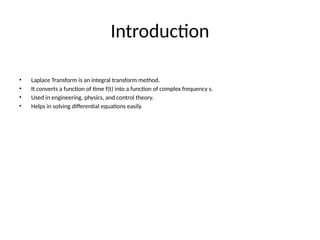
• Laplace Transformis an integral transform method.
• It converts a function of time f(t) into a function of complex frequency s.
• Used in engineering, physics, and control theory.
• Helps in solving differential equations easily.
3.
Definition & Formula
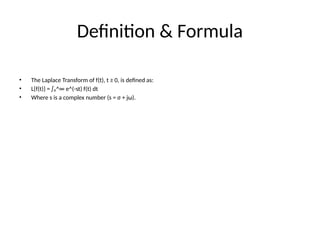
•The Laplace Transform of f(t), t ≥ 0, is defined as:
• L{f(t)} = ∫₀^∞ e^(-st) f(t) dt
• Where s is a complex number (s = σ + jω).
4.
Conditions of Existence
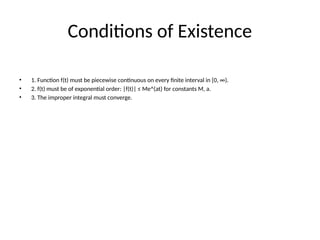
•1. Function f(t) must be piecewise continuous on every finite interval in [0, ∞).
• 2. f(t) must be of exponential order: |f(t)| ≤ Me^(at) for constants M, a.
• 3. The improper integral must converge.
Properties of LaplaceTransform
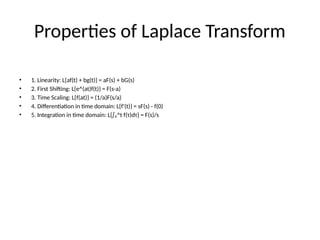
• 1. Linearity: L{af(t) + bg(t)} = aF(s) + bG(s)
• 2. First Shifting: L{e^(at)f(t)} = F(s-a)
• 3. Time Scaling: L{f(at)} = (1/a)F(s/a)
• 4. Differentiation in time domain: L{f'(t)} = sF(s) - f(0)
• 5. Integration in time domain: L{∫₀^t f(τ)dτ} = F(s)/s
7.
Inverse Laplace Transform
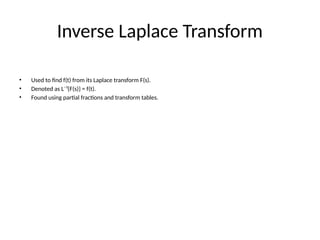
•Used to find f(t) from its Laplace transform F(s).
• Denoted as L⁻¹{F(s)} = f(t).
• Found using partial fractions and transform tables.
8.
Applications
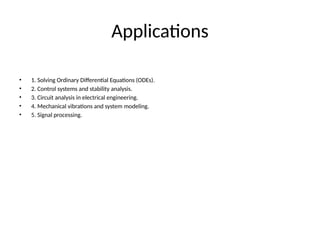
• 1. SolvingOrdinary Differential Equations (ODEs).
• 2. Control systems and stability analysis.
• 3. Circuit analysis in electrical engineering.
• 4. Mechanical vibrations and system modeling.
• 5. Signal processing.
9.
Solved Example
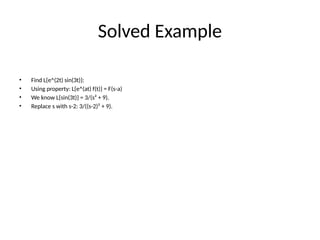
• FindL{e^(2t) sin(3t)}:
• Using property: L{e^(at) f(t)} = F(s-a)
• We know L{sin(3t)} = 3/(s² + 9).
• Replace s with s-2: 3/((s-2)² + 9).
10.
Conclusion
• Laplace Transformsimplifies the process of solving complex problems.
• Transforms time-domain problems into the s-domain for easier computation.
• Widely used in mathematics, engineering, and applied sciences.
![Laplace Transform
College Presentation
By: [Your Name]](https://image.slidesharecdn.com/laplacetransformpresentation-250819033445-38037354/85/Laplace_Transform_Presentation-power-point-presentation-1-320.jpg)
![Laplace Transform
College Presentation
By: [Your Name]](https://image.slidesharecdn.com/laplacetransformpresentation-250819033445-38037354/75/Laplace_Transform_Presentation-power-point-presentation-1-2048.jpg)