Laplace Transform
BIOE 4200
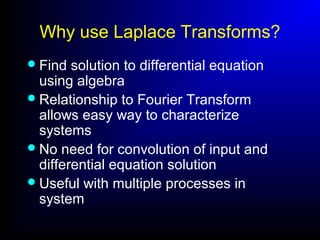
Why use Laplace Transforms?
Find solution to differential equation
using algebra
Relationship to Fourier Transform
allows easy way to characterize
systems
No need for convolution of input and
differential equation solution
Useful with multiple processes in
system
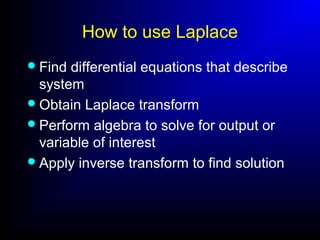
How to use Laplace
Find differential equations that describe
system
Obtain Laplace transform
Perform algebra to solve for output or
variable of interest
Apply inverse transform to find solution
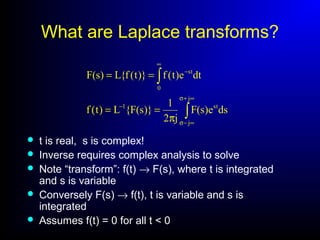
What are Laplace transforms?
∫
∫
∞+σ
∞−σ
−
∞
−
π
==
==
j
j
st1
0
st
dse)s(F
j2
1
)}s(F{L)t(f
dte)t(f)}t(f{L)s(F
 t is real, s is complex!
 Inverse requires complex analysis to solve
 Note “transform”: f(t) → F(s), where t is integrated
and s is variable
 Conversely F(s) → f(t), t is variable and s is
integrated
 Assumes f(t) = 0 for all t < 0
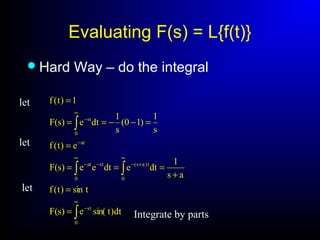
Evaluating F(s) = L{f(t)}
Hard Way – do the integral
∫
∫ ∫
∫
∞
−
∞ ∞
+−−−
−
∞
−
=
=
+
===
=
=−−==
=
0
st
0 0
t)as(stat
at
0
st
dt)tsin(e)s(F
tsin)t(f
as
1
dtedtee)s(F
e)t(f
s
1
)10(
s
1
dte)s(F
1)t(flet
let
let
Integrate by parts
Evaluating F(s)=L{f(t)}- Hard Way
remember ∫ ∫−= vduuvudv
)tcos(v,dt)tsin(dv
dtsedu,eu stst
−==
−== −−
∫
∫ ∫
∞
−−
∞ ∞
−∞−−
−−
=−−=∴
0
stst
0 0
st
0
stst
dt)tcos(es)1(e
dt)tcos(es)tcos(e[dt)tsin(e ]
)tsin(v,dt)tcos(dv
dtsedu,eu stst
==
−== −−
∫∫
∫
∞
−−
∞
−∞−
∞
−
+−=+−
=∴
0
stst
0
st
0
st
0
st
dt)tsin(es)0(edt)tsin(es)tsin(e[
dt)tcos(e
]
2
0
st
0
st2
0 0
st2st
s1
1
dt)tsin(e
1dt)tsin(e)s1(
dt)tsin(es1dt)tsin(se
+
=
=+
=−=
∫
∫
∫ ∫
∞
−
∞
−
∞ ∞
−−
let
let
Substituting, we get:
It only gets worse…
Evaluating F(s) = L{f(t)}
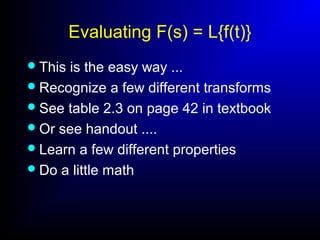
This is the easy way ...
Recognize a few different transforms
See table 2.3 on page 42 in textbook
Or see handout ....
Learn a few different properties
Do a little math
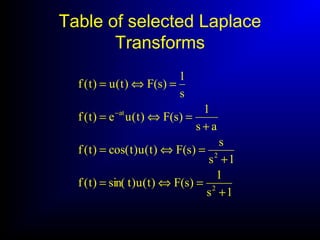
Table of selected Laplace
Transforms
1s
1
)s(F)t(u)tsin()t(f
1s
s
)s(F)t(u)tcos()t(f
as
1
)s(F)t(ue)t(f
s
1
)s(F)t(u)t(f
2
2
at
+
=⇔=
+
=⇔=
+
=⇔=
=⇔=
−
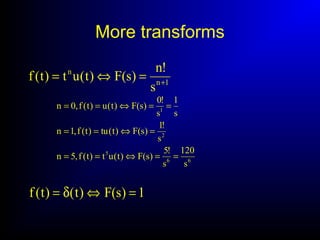
More transforms
1n
n
s
!n
)s(F)t(ut)t(f +
=⇔=
66
5
2
1
s
120
s
!5
)s(F)t(ut)t(f,5n
s
!1
)s(F)t(tu)t(f,1n
s
1
s
!0
)s(F)t(u)t(f,0n
==⇔==
=⇔==
==⇔==
1)s(F)t()t(f =⇔δ=
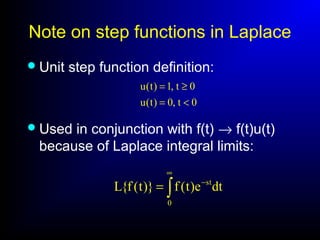
Note on step functions in Laplace
∫
∞
−
=
0
st
dte)t(f)}t(f{L
0t,0)t(u
0t,1)t(u
<=
≥=
Unit step function definition:
Used in conjunction with f(t) → f(t)u(t)
because of Laplace integral limits:
Properties of Laplace Transforms
Linearity
Scaling in time
Time shift
“frequency” or s-plane shift
Multiplication by tn
Integration
Differentiation
Properties: Linearity
)s(Fc)s(Fc)}t(fc)t(fc{L 22112211 +=+
Example :
1s
1
)
1s
)1s()1s(
(
2
1
)
1s
1
1s
1
(
2
1
}e{L
2
1
}e{L
2
1
}e
2
1
e
2
1
{y
)}t{sinh(L
22
tt
tt
−
=
−
−−+
=
+
−
−
=−
=−
=
−
−
Proof :
)s(Fc)s(Fc
dte)t(fcdte)t(fc
dte)]t(fc)t(fc[
)}t(fc)t(fc{L
2211
0
st
22
0
st
11
st
22
0
11
2211
+
=+
=+
=+
∫∫
∫
∞
−
∞
−
−
∞
)
a
s
(F
a
1
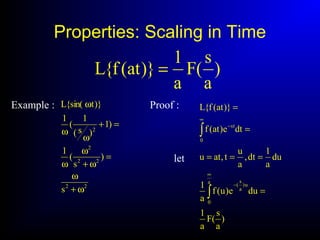
)}at(f{L =
Example :
22
22
2
2
s
)
s
(
1
)1
)s(
1
(
1
)}t{sin(L
ω+
ω
=
ω+
ω
ω
=+
ω
ω
ω Proof :
)
a
s
(F
a
1
due)u(f
a
1
du
a
1
dt,
a
u
t,atu
dte)at(f
)}at(f{L
a
0
u)
a
s
(
0
st
∫
∫
∞
−
∞
−
=
===
=
=
let
Properties: Scaling in Time
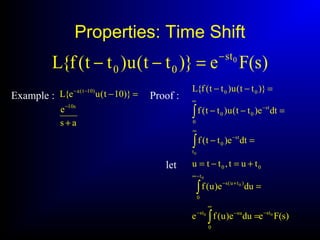
Properties: Time Shift
)s(Fe)}tt(u)tt(f{L 0st
00
−
=−−
Example :
as
e
)}10t(ue{L
s10
)10t(a
+
=−
−
−−
Proof :
)s(Fedue)u(fe
due)u(f
tut,ttu
dte)tt(f
dte)tt(u)tt(f
)}tt(u)tt(f{L
00
0
0
0
st
0
sust
t
0
)tu(s
00
t
st
0
0
st
00
00
−
∞
−−
−∞
+−
∞
−
∞
−
∫
∫
∫
∫
=
=
+=−=
=−
=−−
=−−
let
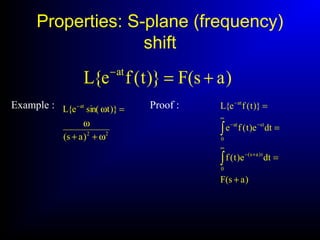
Properties: S-plane (frequency)
shift
)as(F)}t(fe{L at
+=−
Example :
22
at
)as(
)}tsin(e{L
ω++
ω
=ω− Proof :
)as(F
dte)t(f
dte)t(fe
)}t(fe{L
0
t)as(
0
stat
at
+
=
=
=
∫
∫
∞
+−
∞
−−
−
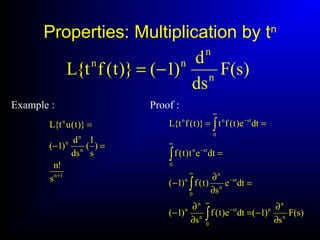
Properties: Multiplication by tn
)s(F
ds
d
)1()}t(ft{L n
n
nn
−=
Example :
1n
n
n
n
n
s
!n
)
s
1
(
ds
d
)1(
)}t(ut{L
+
=−
=
Proof :
)s(F
s
)1(dte)t(f
s
)1(
dte
s
)t(f)1(
dtet)t(f
dte)t(ft)}t(ft{L
n
n
n
0
st
n
n
n
0
st
n
n
n
0
stn
0
stnn
∂
∂
−=
∂
∂
−
=
∂
∂
−
=
==
∫
∫
∫
∫
∞
−
∞
−
∞
−
∞
−
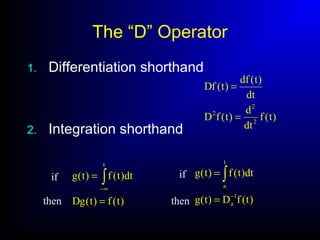
The “D” Operator
1. Differentiation shorthand
2. Integration shorthand
)t(f
dt
d
)t(fD
dt
)t(df
)t(Df
2
2
2
=
=
)t(f)t(Dg
dt)t(f)t(g
t
=
= ∫∞−
)t(fD)t(g
dt)t(f)t(g
1
a
t
a
−
=
= ∫if
then then
if
Properties: Integrals
s
)s(F
)}t(fD{L 1
0 =−
Example :
)}t{sin(L
1s
1
)
1s
s
)(
s
1
(
)}tcos(D{L
22
1
0
+
=
+
=−
Proof :
let
stst
0
st
1
0
e
s
1
v,dtedv
dt)t(fdu),t(gu
dte)t(g)}t{sin(L
)t(fD)t(g
−−
∞
−
−
−==
==
=
=
∫
∫
∫
=
=+−= −∞−
t
0
st
0
st
dt)t(f)t(g
s
)s(F
dte)t(f
s
1
]e)t(g
s
1
[
∫
∞
−
∞<⇒∞=
0
)()( dtetft st
If t=0, g(t)=0
for so
slower than∫
∞
∞→=
0
)()( tgdttf 0→−st
e
Properties: Derivatives
(this is the big one)
)0(f)s(sF)}t(Df{L +
−=
Example :
)}tsin({L
1s
1
1s
)1s(s
1
1s
s
)0(f
1s
s
)}tcos(D{L
2
2
22
2
2
2
2
−=
+
−
+
+−
=−
+
=−
+
=
+
Proof :
)s(sF)0(f
dte)t(fs)]t(fe[
)t(fv,dt)t(f
dt
d
dv
sedu,eu
dte)t(f
dt
d
)}t(Df{L
0
st
0
st
stst
0
st
+−
=+
==
−==
=
+
∞
−∞−
−−
∞
−
∫
∫
let
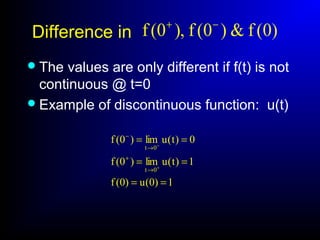
Difference in
The values are only different if f(t) is not
continuous @ t=0
Example of discontinuous function: u(t)
)0(f&)0(f),0(f −+
1)0(u)0(f
1)t(ulim)0(f
0)t(ulim)0(f
0t
0t
==
==
==
+
−
→
+
→
−
?)}t(fD{L 2
=
)0('f)0(sF)s(Fs)0('f))0(f)s(sF(s
)0('f)}t(Df{sL)0(g)s(sG)}t(gD{L
)0('f)0(Df)0(g),t(Df)t(g
2
2
−−=−−=
−=−==
===let
)0(f)0(sf)0('fs)0(fs)s(Fs)}t(fD{L )'1n()'2n()2n()1n(nn −−−−
−−−−−= 
NOTE: to take
you need the value @ t=0 for
called initial conditions!
We will use this to solve differential equations!
→−−
)t(f),t(Df),...t(fD),t(fD 2n1n
)}t(fD{L n
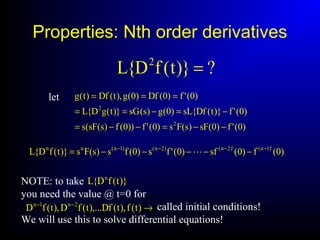
Properties: Nth order derivatives
)0(f)s(sF)}t(Df{L −=
)}t(fD{L 2
)0(f)s(sF)}t(Df{L)}t(g{L)s(G
)0('f)0(g
)t(Df)t(g
)0(g)s(sG)}t(Dg{L
)t(fD)t(Dgand)t(Df)t(g 2
−===
=∴
=
−=
==
)0('f)0(sf)s(Fs)0('f)]0(f)s(sF[s)0(g)s(sG)}t(Dg{L 2
−−=−−=−=∴
.etc),t(fD),t(fD 43
Start with
Now apply again
let
then
remember
Can repeat for
)0(f)0(sf)0('fs)0(fs)s(Fs)}t(fD{L )'1n()'2n()2n()1n(nn −−−−
−−−−−= 
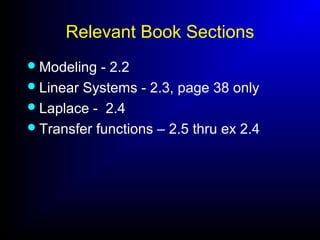
Relevant Book Sections
Modeling - 2.2
Linear Systems - 2.3, page 38 only
Laplace - 2.4
Transfer functions – 2.5 thru ex 2.4

Laplace

  • 1.
  • 2.
    Why use LaplaceTransforms? Find solution to differential equation using algebra Relationship to Fourier Transform allows easy way to characterize systems No need for convolution of input and differential equation solution Useful with multiple processes in system
  • 3.
    How to useLaplace Find differential equations that describe system Obtain Laplace transform Perform algebra to solve for output or variable of interest Apply inverse transform to find solution
  • 4.
    What are Laplacetransforms? ∫ ∫ ∞+σ ∞−σ − ∞ − π == == j j st1 0 st dse)s(F j2 1 )}s(F{L)t(f dte)t(f)}t(f{L)s(F  t is real, s is complex!  Inverse requires complex analysis to solve  Note “transform”: f(t) → F(s), where t is integrated and s is variable  Conversely F(s) → f(t), t is variable and s is integrated  Assumes f(t) = 0 for all t < 0
  • 5.
    Evaluating F(s) =L{f(t)} Hard Way – do the integral ∫ ∫ ∫ ∫ ∞ − ∞ ∞ +−−− − ∞ − = = + === = =−−== = 0 st 0 0 t)as(stat at 0 st dt)tsin(e)s(F tsin)t(f as 1 dtedtee)s(F e)t(f s 1 )10( s 1 dte)s(F 1)t(flet let let Integrate by parts
  • 6.
    Evaluating F(s)=L{f(t)}- HardWay remember ∫ ∫−= vduuvudv )tcos(v,dt)tsin(dv dtsedu,eu stst −== −== −− ∫ ∫ ∫ ∞ −− ∞ ∞ −∞−− −− =−−=∴ 0 stst 0 0 st 0 stst dt)tcos(es)1(e dt)tcos(es)tcos(e[dt)tsin(e ] )tsin(v,dt)tcos(dv dtsedu,eu stst == −== −− ∫∫ ∫ ∞ −− ∞ −∞− ∞ − +−=+− =∴ 0 stst 0 st 0 st 0 st dt)tsin(es)0(edt)tsin(es)tsin(e[ dt)tcos(e ] 2 0 st 0 st2 0 0 st2st s1 1 dt)tsin(e 1dt)tsin(e)s1( dt)tsin(es1dt)tsin(se + = =+ =−= ∫ ∫ ∫ ∫ ∞ − ∞ − ∞ ∞ −− let let Substituting, we get: It only gets worse…
  • 7.
    Evaluating F(s) =L{f(t)} This is the easy way ... Recognize a few different transforms See table 2.3 on page 42 in textbook Or see handout .... Learn a few different properties Do a little math
  • 8.
    Table of selectedLaplace Transforms 1s 1 )s(F)t(u)tsin()t(f 1s s )s(F)t(u)tcos()t(f as 1 )s(F)t(ue)t(f s 1 )s(F)t(u)t(f 2 2 at + =⇔= + =⇔= + =⇔= =⇔= −
  • 9.
  • 10.
    Note on stepfunctions in Laplace ∫ ∞ − = 0 st dte)t(f)}t(f{L 0t,0)t(u 0t,1)t(u <= ≥= Unit step function definition: Used in conjunction with f(t) → f(t)u(t) because of Laplace integral limits:
  • 11.
    Properties of LaplaceTransforms Linearity Scaling in time Time shift “frequency” or s-plane shift Multiplication by tn Integration Differentiation
  • 12.
    Properties: Linearity )s(Fc)s(Fc)}t(fc)t(fc{L 22112211+=+ Example : 1s 1 ) 1s )1s()1s( ( 2 1 ) 1s 1 1s 1 ( 2 1 }e{L 2 1 }e{L 2 1 }e 2 1 e 2 1 {y )}t{sinh(L 22 tt tt − = − −−+ = + − − =− =− = − − Proof : )s(Fc)s(Fc dte)t(fcdte)t(fc dte)]t(fc)t(fc[ )}t(fc)t(fc{L 2211 0 st 22 0 st 11 st 22 0 11 2211 + =+ =+ =+ ∫∫ ∫ ∞ − ∞ − − ∞
  • 13.
    ) a s (F a 1 )}at(f{L = Example : 22 22 2 2 s ) s ( 1 )1 )s( 1 ( 1 )}t{sin(L ω+ ω = ω+ ω ω =+ ω ω ωProof : ) a s (F a 1 due)u(f a 1 du a 1 dt, a u t,atu dte)at(f )}at(f{L a 0 u) a s ( 0 st ∫ ∫ ∞ − ∞ − = === = = let Properties: Scaling in Time
  • 14.
    Properties: Time Shift )s(Fe)}tt(u)tt(f{L0st 00 − =−− Example : as e )}10t(ue{L s10 )10t(a + =− − −− Proof : )s(Fedue)u(fe due)u(f tut,ttu dte)tt(f dte)tt(u)tt(f )}tt(u)tt(f{L 00 0 0 0 st 0 sust t 0 )tu(s 00 t st 0 0 st 00 00 − ∞ −− −∞ +− ∞ − ∞ − ∫ ∫ ∫ ∫ = = +=−= =− =−− =−− let
  • 15.
    Properties: S-plane (frequency) shift )as(F)}t(fe{Lat +=− Example : 22 at )as( )}tsin(e{L ω++ ω =ω− Proof : )as(F dte)t(f dte)t(fe )}t(fe{L 0 t)as( 0 stat at + = = = ∫ ∫ ∞ +− ∞ −− −
  • 16.
    Properties: Multiplication bytn )s(F ds d )1()}t(ft{L n n nn −= Example : 1n n n n n s !n ) s 1 ( ds d )1( )}t(ut{L + =− = Proof : )s(F s )1(dte)t(f s )1( dte s )t(f)1( dtet)t(f dte)t(ft)}t(ft{L n n n 0 st n n n 0 st n n n 0 stn 0 stnn ∂ ∂ −= ∂ ∂ − = ∂ ∂ − = == ∫ ∫ ∫ ∫ ∞ − ∞ − ∞ − ∞ −
  • 17.
    The “D” Operator 1.Differentiation shorthand 2. Integration shorthand )t(f dt d )t(fD dt )t(df )t(Df 2 2 2 = = )t(f)t(Dg dt)t(f)t(g t = = ∫∞− )t(fD)t(g dt)t(f)t(g 1 a t a − = = ∫if then then if
  • 18.
    Properties: Integrals s )s(F )}t(fD{L 1 0=− Example : )}t{sin(L 1s 1 ) 1s s )( s 1 ( )}tcos(D{L 22 1 0 + = + =− Proof : let stst 0 st 1 0 e s 1 v,dtedv dt)t(fdu),t(gu dte)t(g)}t{sin(L )t(fD)t(g −− ∞ − − −== == = = ∫ ∫ ∫ = =+−= −∞− t 0 st 0 st dt)t(f)t(g s )s(F dte)t(f s 1 ]e)t(g s 1 [ ∫ ∞ − ∞<⇒∞= 0 )()( dtetft st If t=0, g(t)=0 for so slower than∫ ∞ ∞→= 0 )()( tgdttf 0→−st e
  • 19.
    Properties: Derivatives (this isthe big one) )0(f)s(sF)}t(Df{L + −= Example : )}tsin({L 1s 1 1s )1s(s 1 1s s )0(f 1s s )}tcos(D{L 2 2 22 2 2 2 2 −= + − + +− =− + =− + = + Proof : )s(sF)0(f dte)t(fs)]t(fe[ )t(fv,dt)t(f dt d dv sedu,eu dte)t(f dt d )}t(Df{L 0 st 0 st stst 0 st +− =+ == −== = + ∞ −∞− −− ∞ − ∫ ∫ let
  • 20.
    Difference in The valuesare only different if f(t) is not continuous @ t=0 Example of discontinuous function: u(t) )0(f&)0(f),0(f −+ 1)0(u)0(f 1)t(ulim)0(f 0)t(ulim)0(f 0t 0t == == == + − → + → −
  • 21.
    ?)}t(fD{L 2 = )0('f)0(sF)s(Fs)0('f))0(f)s(sF(s )0('f)}t(Df{sL)0(g)s(sG)}t(gD{L )0('f)0(Df)0(g),t(Df)t(g 2 2 −−=−−= −=−== ===let )0(f)0(sf)0('fs)0(fs)s(Fs)}t(fD{L )'1n()'2n()2n()1n(nn−−−− −−−−−=  NOTE: to take you need the value @ t=0 for called initial conditions! We will use this to solve differential equations! →−− )t(f),t(Df),...t(fD),t(fD 2n1n )}t(fD{L n Properties: Nth order derivatives
  • 22.
    Properties: Nth orderderivatives )0(f)s(sF)}t(Df{L −= )}t(fD{L 2 )0(f)s(sF)}t(Df{L)}t(g{L)s(G )0('f)0(g )t(Df)t(g )0(g)s(sG)}t(Dg{L )t(fD)t(Dgand)t(Df)t(g 2 −=== =∴ = −= == )0('f)0(sf)s(Fs)0('f)]0(f)s(sF[s)0(g)s(sG)}t(Dg{L 2 −−=−−=−=∴ .etc),t(fD),t(fD 43 Start with Now apply again let then remember Can repeat for )0(f)0(sf)0('fs)0(fs)s(Fs)}t(fD{L )'1n()'2n()2n()1n(nn −−−− −−−−−= 
  • 23.
    Relevant Book Sections Modeling- 2.2 Linear Systems - 2.3, page 38 only Laplace - 2.4 Transfer functions – 2.5 thru ex 2.4