LAPLACE TRANSFORM
CREATED BY:
BASSIT A. GOLRA
23:51:49 1
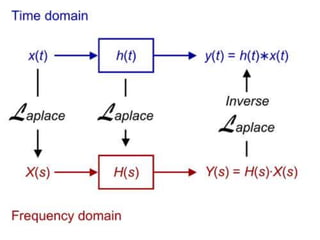
Laplace Transform
• Definition:
It takes function of a positive real
variable t (time) to a function of a complex
variable s ( complex frequency).
• Irrespective of whether stable or unstable
system
Source:
https://en.wikipedia.org/wiki/Laplace_transform
23:51:49 2
23:51:49 3
Laplace Continued …
• For continues time we use Laplace transform.
• For discrete time we use Z-Transform
23:51:49 4
Laplace Continued …
• There are two types of Laplace transform:
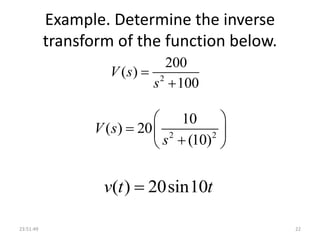
i) Unilateral Laplace transform
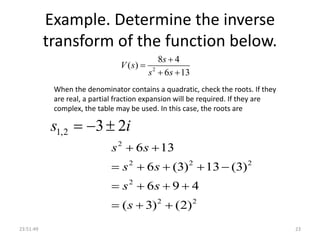
ii) Bilateral Laplace transform
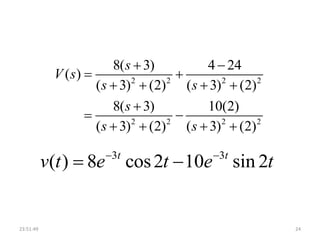
23:51:49 5
Unilateral Laplace
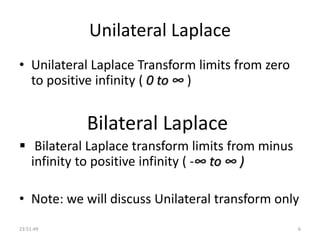
• Unilateral Laplace Transform limits from zero
to positive infinity ( 0 to ∞ )
Bilateral Laplace
 Bilateral Laplace transform limits from minus
infinity to positive infinity ( -∞ to ∞ )
• Note: we will discuss Unilateral transform only
23:51:49 6
Mathematical definition:
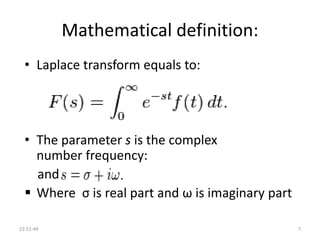
• Laplace transform equals to:
• The parameter s is the complex
number frequency:
and
 Where σ is real part and ω is imaginary part
23:51:49 7
8/13
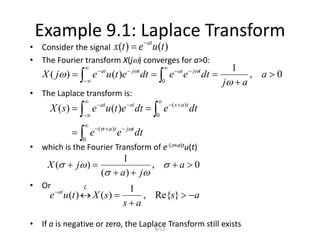
Example 9.1: Laplace Transform
• Consider the signal
• The Fourier transform X(jw) converges for a>0:
• The Laplace transform is:
• which is the Fourier Transform of e-(s+a)tu(t)
• Or
• If a is negative or zero, the Laplace Transform still exists
)()( tuetx at

0,
1
)()(
0


 





a
aj
dteedtetuejX tjattjat
w
w ww











0
)(
0
)(
)()(
dtee
dtedtetuesX
tjta
tasstat
ws
0,
)(
1
)( 

 a
ja
jX s
ws
ws
as
as
sXtue
L
at



}Re{,
1
)()(
EE-2027 SaS, L12 9/13
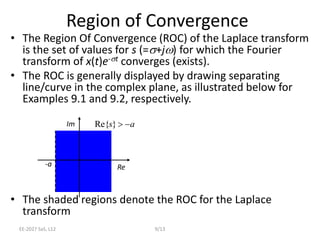
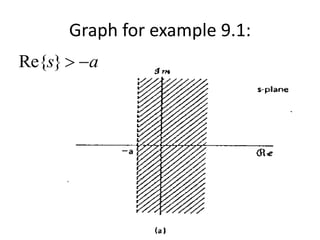
• The Region Of Convergence (ROC) of the Laplace transform
is the set of values for s (=s+jw) for which the Fourier
transform of x(t)e-st converges (exists).
• The ROC is generally displayed by drawing separating
line/curve in the complex plane, as illustrated below for
Examples 9.1 and 9.2, respectively.
• The shaded regions denote the ROC for the Laplace
transform
Region of Convergence
Re
Im
-a
as }Re{
Graph for example 9.1:
23:51:49 10
as }Re{
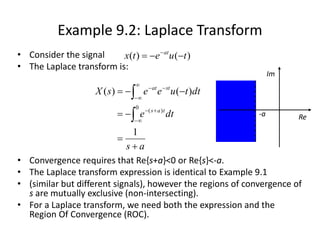
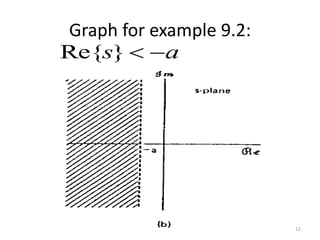
Example 9.2: Laplace Transform
• Consider the signal
• The Laplace transform is:
• Convergence requires that Re{s+a}<0 or Re{s}<-a.
• The Laplace transform expression is identical to Example 9.1
• (similar but different signals), however the regions of convergence of
s are mutually exclusive (non-intersecting).
• For a Laplace transform, we need both the expression and the
Region Of Convergence (ROC).
)()( tuetx at
 
as
dte
dttueesX
tas
stat











1
)()(
0
)(
Re
Im
-a
Graph for example 9.2:
12
as }Re{
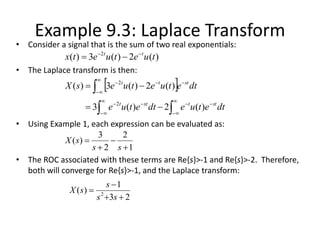
Example 9.3: Laplace Transform
• Consider a signal that is the sum of two real exponentials:
• The Laplace transform is then:
• Using Example 1, each expression can be evaluated as:
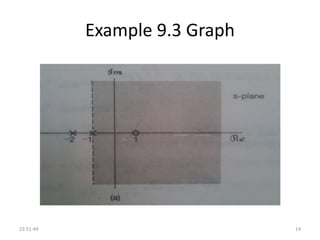
• The ROC associated with these terms are Re{s}>-1 and Re{s}>-2. Therefore,
both will converge for Re{s}>-1, and the Laplace transform:
)(2)(3)( 2
tuetuetx tt 

 













dtetuedtetue
dtetuetuesX
sttstt
sttt
)(2)(3
)(2)(3)(
2
2
1
2
2
3
)(




ss
sX
23
1
)( 2



ss
s
sX
Example 9.3 Graph
23:51:49 14
Properties of ROC of Laplace
Transform
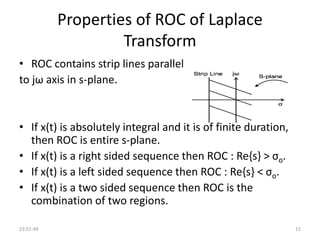
• ROC contains strip lines parallel
to jω axis in s-plane.
• If x(t) is absolutely integral and it is of finite duration,
then ROC is entire s-plane.
• If x(t) is a right sided sequence then ROC : Re{s} > σo.
• If x(t) is a left sided sequence then ROC : Re{s} < σo.
• If x(t) is a two sided sequence then ROC is the
combination of two regions.
23:51:49 15
Common transform pairs
23:51:49 16
( )f t ( ) [ ( )]F s L f t
1 or ( )u t 1
s
T-1
t
e  1
s 
T-2
sin tw
2 2
s
w
w
T-3
cos tw
2 2
s
s w
T-4
sint
e t
w
2 2
( )s
w
 w 
T-5*
cost
e t
w
2 2
( )
s
s

 w

 
T-6*
t
2
1
s
T-7
n
t 1
!
n
n
s 
T-8
t n
e t
1
!
( )n
n
s  

T-9
( )t 1 T-10
*Use when roots are complex.
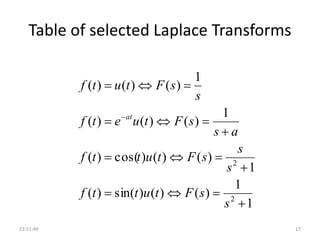
Table of selected Laplace Transforms
23:51:49 17
1
1
)()()sin()(
1
)()()cos()(
1
)()()(
1
)()()(
2
2








s
sFtuttf
s
s
sFtuttf
as
sFtuetf
s
sFtutf
at
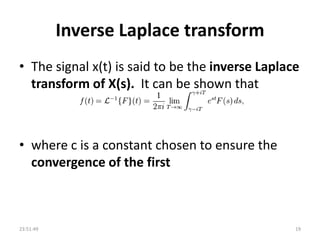
Inverse Laplace transform
• The signal x(t) is said to be the inverse Laplace
transform of X(s). It can be shown that
• where c is a constant chosen to ensure the
convergence of the first
23:51:49 19
Inverse Laplace Transforms:
• When a differential equation is solved by Laplace
transforms, the solution is obtained as a function
of the variable s. The inverse transform must be
formed in order to determine the time response.
• The simplest forms are those that can be
recognized within the tables and a few of those
will now be considered.
• If inverse Laplace transform is complicated we
use partial fraction
23:51:49 20
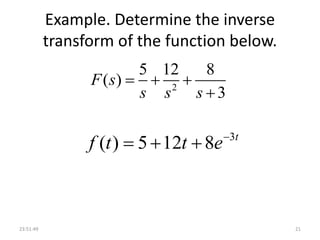
Example. Determine the inverse
transform of the function below.
2
5 12 8
( )
3
F s
s s s
  

23:51:49 21
3
( ) 5 12 8 t
f t t e
  
Example. Determine the inverse
transform of the function below.
2
200
( )
100
V s
s


23:51:49 22
2 2
10
( ) 20
(10)
V s
s
 
  
 
( ) 20sin10v t t
Example. Determine the inverse
transform of the function below.
2
8 4
( )
6 13
s
V s
s s


 
23:51:49 23
When the denominator contains a quadratic, check the roots. If they
are real, a partial fraction expansion will be required. If they are
complex, the table may be used. In this case, the roots are
1,2 3 2s i  
2
2 2 2
2
2 2
6 13
6 (3) 13 (3)
6 9 4
( 3) (2)
s s
s s
s s
s
 
    
   
  
2 2 2 2
2 2 2 2
8( 3) 4 24
( )
( 3) (2) ( 3) (2)
8( 3) 10(2)
( 3) (2) ( 3) (2)
s
V s
s s
s
s s
 
 
   

 
   
23:51:49 24
3 3
( ) 8 cos2 10 sin 2t t
v t e t e t 
 
Properties of Laplace Transforms
• Linearity
• Scaling in time
• Time shift
• “frequency” or s-plane shift
• Multiplication by tn
• Integration
• Differentiation
23:51:49 25
Linearity Property
23:51:49 26
With ROC containing R1∩R2
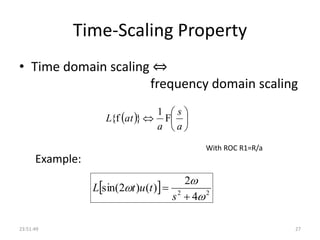
Time-Scaling Property
• Time domain scaling ⇔
frequency domain scaling
Example:
23:51:49 27
  






a
s
a
atL F
1
}{f
  22
4
2
)()2sin(
w
w
w


s
tutL
With ROC R1=R/a
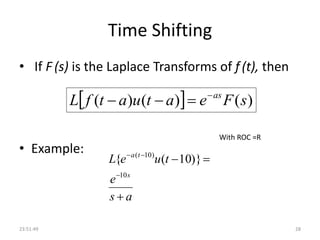
Time Shifting
• If F (s) is the Laplace Transforms of f (t), then
• Example:
23:51:49 28
  )()()( sFeatuatfL as

as
e
tueL
s
ta




10
)10(
)}10({
With ROC =R
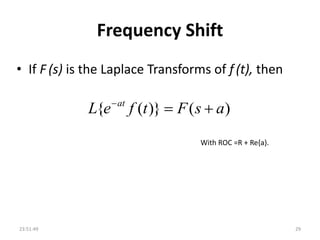
Frequency Shift
• If F (s) is the Laplace Transforms of f (t), then
23:51:49 29
)()}({ asFtfeL at

With ROC =R + Re{a}.
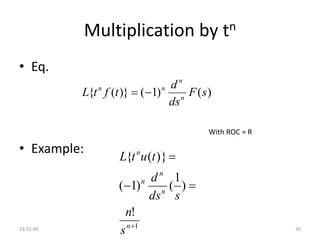
Multiplication by tn
• Eq.
• Example:
23:51:49 30
)()1()}({ sF
ds
d
tftL n
n
nn

1
!
)
1
()1(
)}({



n
n
n
n
n
s
n
sds
d
tutL
With ROC = R
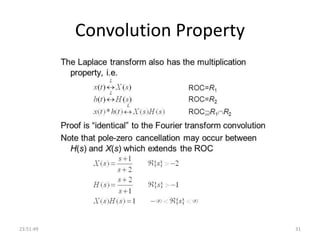
Convolution Property
23:51:49 31
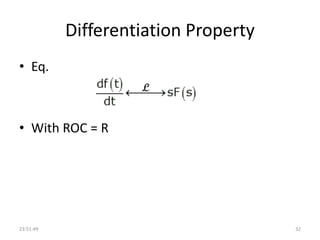
Differentiation Property
23:51:49 32
• Eq.
• With ROC = R
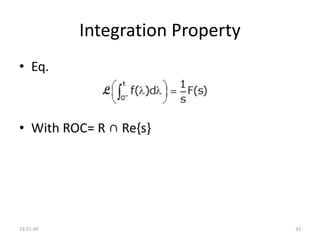
Integration Property
• Eq.
• With ROC= R ∩ Re{s}
23:51:49 33
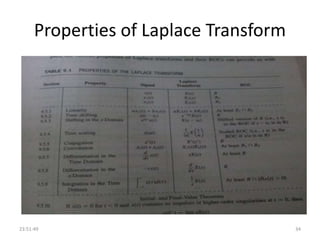
Properties of Laplace Transform
23:51:49 34
Analysis of LTI System using Laplace
Transform
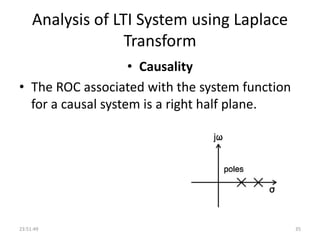
• Causality
• The ROC associated with the system function
for a causal system is a right half plane.
23:51:49 35
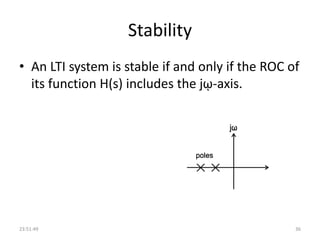
Stability
• An LTI system is stable if and only if the ROC of
its function H(s) includes the jῳ-axis.
23:51:49 36
Thanks!!
23:51:49 37

Laplace transform

  • 1.
  • 2.
    Laplace Transform • Definition: Ittakes function of a positive real variable t (time) to a function of a complex variable s ( complex frequency). • Irrespective of whether stable or unstable system Source: https://en.wikipedia.org/wiki/Laplace_transform 23:51:49 2
  • 3.
  • 4.
    Laplace Continued … •For continues time we use Laplace transform. • For discrete time we use Z-Transform 23:51:49 4
  • 5.
    Laplace Continued … •There are two types of Laplace transform: i) Unilateral Laplace transform ii) Bilateral Laplace transform 23:51:49 5
  • 6.
    Unilateral Laplace • UnilateralLaplace Transform limits from zero to positive infinity ( 0 to ∞ ) Bilateral Laplace  Bilateral Laplace transform limits from minus infinity to positive infinity ( -∞ to ∞ ) • Note: we will discuss Unilateral transform only 23:51:49 6
  • 7.
    Mathematical definition: • Laplacetransform equals to: • The parameter s is the complex number frequency: and  Where σ is real part and ω is imaginary part 23:51:49 7
  • 8.
    8/13 Example 9.1: LaplaceTransform • Consider the signal • The Fourier transform X(jw) converges for a>0: • The Laplace transform is: • which is the Fourier Transform of e-(s+a)tu(t) • Or • If a is negative or zero, the Laplace Transform still exists )()( tuetx at  0, 1 )()( 0          a aj dteedtetuejX tjattjat w w ww            0 )( 0 )( )()( dtee dtedtetuesX tjta tasstat ws 0, )( 1 )(    a ja jX s ws ws as as sXtue L at    }Re{, 1 )()(
  • 9.
    EE-2027 SaS, L129/13 • The Region Of Convergence (ROC) of the Laplace transform is the set of values for s (=s+jw) for which the Fourier transform of x(t)e-st converges (exists). • The ROC is generally displayed by drawing separating line/curve in the complex plane, as illustrated below for Examples 9.1 and 9.2, respectively. • The shaded regions denote the ROC for the Laplace transform Region of Convergence Re Im -a as }Re{
  • 10.
    Graph for example9.1: 23:51:49 10 as }Re{
  • 11.
    Example 9.2: LaplaceTransform • Consider the signal • The Laplace transform is: • Convergence requires that Re{s+a}<0 or Re{s}<-a. • The Laplace transform expression is identical to Example 9.1 • (similar but different signals), however the regions of convergence of s are mutually exclusive (non-intersecting). • For a Laplace transform, we need both the expression and the Region Of Convergence (ROC). )()( tuetx at   as dte dttueesX tas stat            1 )()( 0 )( Re Im -a
  • 12.
    Graph for example9.2: 12 as }Re{
  • 13.
    Example 9.3: LaplaceTransform • Consider a signal that is the sum of two real exponentials: • The Laplace transform is then: • Using Example 1, each expression can be evaluated as: • The ROC associated with these terms are Re{s}>-1 and Re{s}>-2. Therefore, both will converge for Re{s}>-1, and the Laplace transform: )(2)(3)( 2 tuetuetx tt                  dtetuedtetue dtetuetuesX sttstt sttt )(2)(3 )(2)(3)( 2 2 1 2 2 3 )(     ss sX 23 1 )( 2    ss s sX
  • 14.
  • 15.
    Properties of ROCof Laplace Transform • ROC contains strip lines parallel to jω axis in s-plane. • If x(t) is absolutely integral and it is of finite duration, then ROC is entire s-plane. • If x(t) is a right sided sequence then ROC : Re{s} > σo. • If x(t) is a left sided sequence then ROC : Re{s} < σo. • If x(t) is a two sided sequence then ROC is the combination of two regions. 23:51:49 15
  • 16.
    Common transform pairs 23:51:4916 ( )f t ( ) [ ( )]F s L f t 1 or ( )u t 1 s T-1 t e  1 s  T-2 sin tw 2 2 s w w T-3 cos tw 2 2 s s w T-4 sint e t w 2 2 ( )s w  w  T-5* cost e t w 2 2 ( ) s s   w    T-6* t 2 1 s T-7 n t 1 ! n n s  T-8 t n e t 1 ! ( )n n s    T-9 ( )t 1 T-10 *Use when roots are complex.
  • 17.
    Table of selectedLaplace Transforms 23:51:49 17 1 1 )()()sin()( 1 )()()cos()( 1 )()()( 1 )()()( 2 2         s sFtuttf s s sFtuttf as sFtuetf s sFtutf at
  • 18.
    Inverse Laplace transform •The signal x(t) is said to be the inverse Laplace transform of X(s). It can be shown that • where c is a constant chosen to ensure the convergence of the first 23:51:49 19
  • 19.
    Inverse Laplace Transforms: •When a differential equation is solved by Laplace transforms, the solution is obtained as a function of the variable s. The inverse transform must be formed in order to determine the time response. • The simplest forms are those that can be recognized within the tables and a few of those will now be considered. • If inverse Laplace transform is complicated we use partial fraction 23:51:49 20
  • 20.
    Example. Determine theinverse transform of the function below. 2 5 12 8 ( ) 3 F s s s s     23:51:49 21 3 ( ) 5 12 8 t f t t e   
  • 21.
    Example. Determine theinverse transform of the function below. 2 200 ( ) 100 V s s   23:51:49 22 2 2 10 ( ) 20 (10) V s s        ( ) 20sin10v t t
  • 22.
    Example. Determine theinverse transform of the function below. 2 8 4 ( ) 6 13 s V s s s     23:51:49 23 When the denominator contains a quadratic, check the roots. If they are real, a partial fraction expansion will be required. If they are complex, the table may be used. In this case, the roots are 1,2 3 2s i   2 2 2 2 2 2 2 6 13 6 (3) 13 (3) 6 9 4 ( 3) (2) s s s s s s s              
  • 23.
    2 2 22 2 2 2 2 8( 3) 4 24 ( ) ( 3) (2) ( 3) (2) 8( 3) 10(2) ( 3) (2) ( 3) (2) s V s s s s s s                23:51:49 24 3 3 ( ) 8 cos2 10 sin 2t t v t e t e t   
  • 24.
    Properties of LaplaceTransforms • Linearity • Scaling in time • Time shift • “frequency” or s-plane shift • Multiplication by tn • Integration • Differentiation 23:51:49 25
  • 25.
  • 26.
    Time-Scaling Property • Timedomain scaling ⇔ frequency domain scaling Example: 23:51:49 27          a s a atL F 1 }{f   22 4 2 )()2sin( w w w   s tutL With ROC R1=R/a
  • 27.
    Time Shifting • IfF (s) is the Laplace Transforms of f (t), then • Example: 23:51:49 28   )()()( sFeatuatfL as  as e tueL s ta     10 )10( )}10({ With ROC =R
  • 28.
    Frequency Shift • IfF (s) is the Laplace Transforms of f (t), then 23:51:49 29 )()}({ asFtfeL at  With ROC =R + Re{a}.
  • 29.
    Multiplication by tn •Eq. • Example: 23:51:49 30 )()1()}({ sF ds d tftL n n nn  1 ! ) 1 ()1( )}({    n n n n n s n sds d tutL With ROC = R
  • 30.
  • 31.
  • 32.
    Integration Property • Eq. •With ROC= R ∩ Re{s} 23:51:49 33
  • 33.
    Properties of LaplaceTransform 23:51:49 34
  • 34.
    Analysis of LTISystem using Laplace Transform • Causality • The ROC associated with the system function for a causal system is a right half plane. 23:51:49 35
  • 35.
    Stability • An LTIsystem is stable if and only if the ROC of its function H(s) includes the jῳ-axis. 23:51:49 36
  • 36.