CITRIC ACID CYCLE
KREBS CYCLE
TRICARBOXYLIC ACID - TCA CYCLE
• The citric acid cycle (Krebs cycle or tricarboxylic acid-TCA
cycle) is the most important metabolic pathway for the
energy supply to the body.
• About 65-70% of the ATP is synthesized in Krebs cycle.
• Citric acid cycle essentially involves the oxidation of acetyl
CoA to CO2 and H2O.
• This cycle utilizes about two thirds of total oxygen
consumed by the body.
• The name TCA cycle is used, since, at the outset of the cycle,
tricarboxylic acids (citrate, cis-aconitate and isocitrate,
oxalosuccinate) participate.
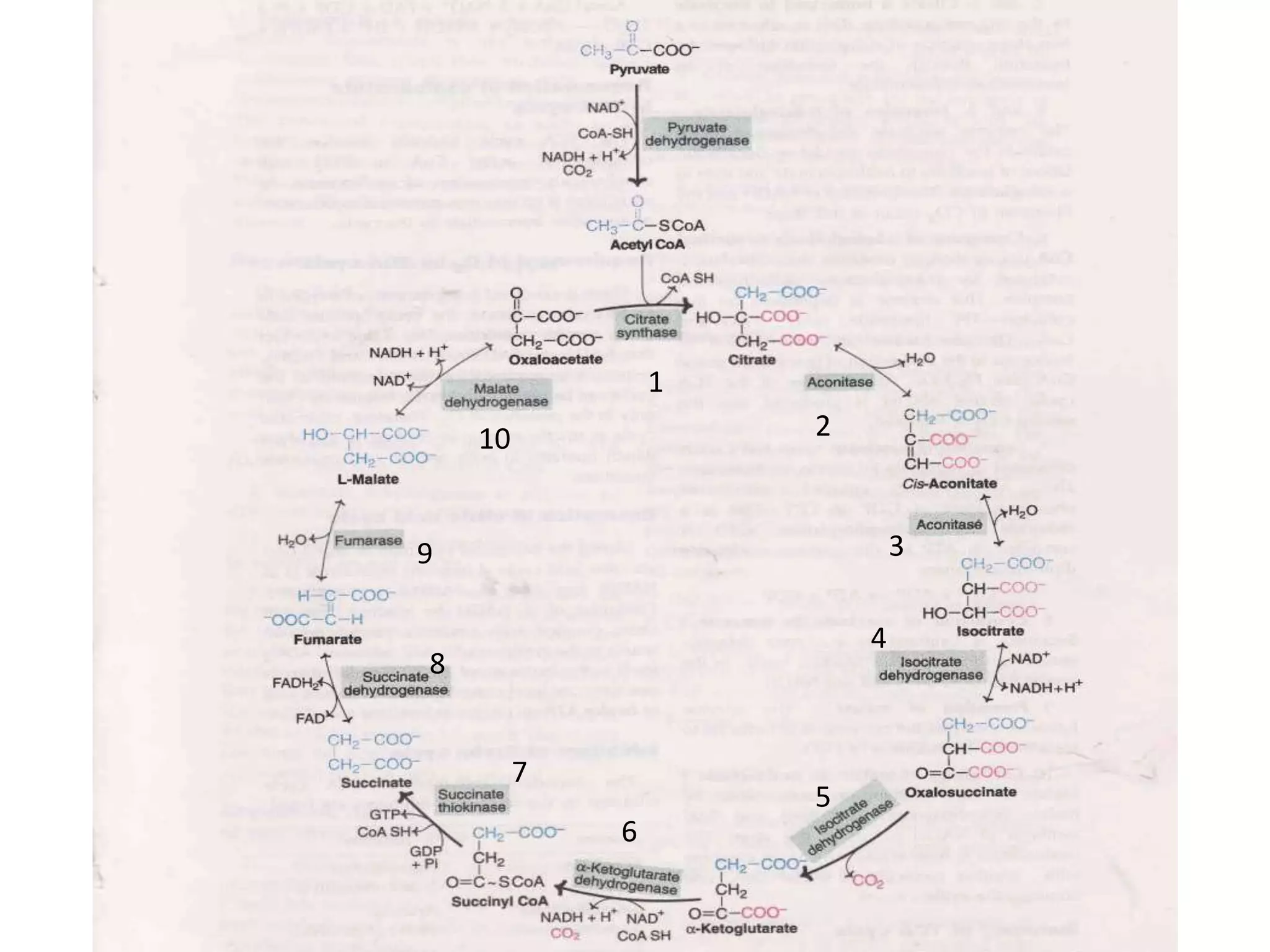
TCA – Cycle : An overview
• TCA cycle basically involves the combination of a
two carbon acetyl CoA with a four carbon
oxaloacetate to produce a six carbon tricarboxylic
acid, citrate.
• In the reactions that follow, the two carbons are
oxidized to CO2 and oxaloacetate is regenerated
and recycled.
2
3
4
5
6
7
8
9
10
1
Reactions of citric acid cycle
• Oxidative decarboxylation of pyruvate to acetyl CoA by
pyruvate dehydrogenase complex.
• This step is a connecting link between glycolysis and TCA
cycle.
1. Formation of citrate : Krebs cycle proper starts with the
condensation of acetyl CoA and oxaloacetate, catalysed
by the enzyme citrate synthase.
2. And 3. Citrate is isomerized to isocitrate by the enzyme
aconitase.
• This is a two step reaction of dehydration followed by
hydration through the formation of an intermediate cis-
aconitate.
4. And 5. Formation of a-ketoglutarate : The enzyme
isocitrate dehydrogenase (lCD) catalyses the conversion
(oxidative decarboxylation) of isocitrate to
oxalosuccinate and then to α-ketoglutarate.
• The formation of NADH and the liberation of CO2 occur at
this stage.
6. Conversion of α-ketoglutarate to succinyl CoA occurs
through oxidative decarboxylation, catalysed by α-
ketoglutarate dehydrogenase complex.
• This enzyme is dependent on five cofactors-TPP, lipoamide,
NAD+, FAD and CoA.
• The mechanism of the reaction is analogous to the
conversion of pyruvate to acetyl CoA.
• At this stage of the TCA cycle, second NADH is produced and
the second CO2 is liberated.
7. Formation of succinate : Succinyl CoA is converted to
succinate by succinate thiokinase.
• This reaction is coupled with the phosphorylation of
GDP to GTP.
• This is a substrate level phosphorylation.
• GTP is converted to ATP by the enzyme nucleoside
diphosphate kinase.
• GTP + ADP ATP + GDP
8. Conversion of succinate to fumarate : Succinate is
oxidized by succinate dehydrogenase to fumarate.
• This reaction results in the production of FADH2 and
not NADH.
9. Formation of malate : The enzyme fumarase
catalyses the conversion of fumarate to malate with
the addition of H2O.
10. Conversion of malate to oxaloacetate : Malate is
then oxidized to oxaloacetate by malate
dehydrogenase.
• The third and final synthesis of NADH occurs at this
stage.
• The oxaloacetate is regenerated which can combine
with another molecule of acetyl CoA, and continue the
cycle.
• Summery of TCA cycle :
• Acetyl CoA + 3 NAD+ + FAD + GDP + Pi + 2H2O 2CO2 +
3NADH + 3H+ + FADH2 + GTP + CoA
• Requirement of oxygen by TCA cycle :
• There is no direct participation of oxygen in Krebs cycle.
• However, the cycle operates only under aerobic conditions.
• This is due to the fact that NAD+ and FAD (from NADH and
FADH2, respectively) required for the operation of the cycle
can be regenerated in the respiratory chain only in the
presence of O2.
• Therefore, citric acid cycle is strictly aerobic in contrast to
glycolysis which operates in both aerobic and anaerobic
condition.
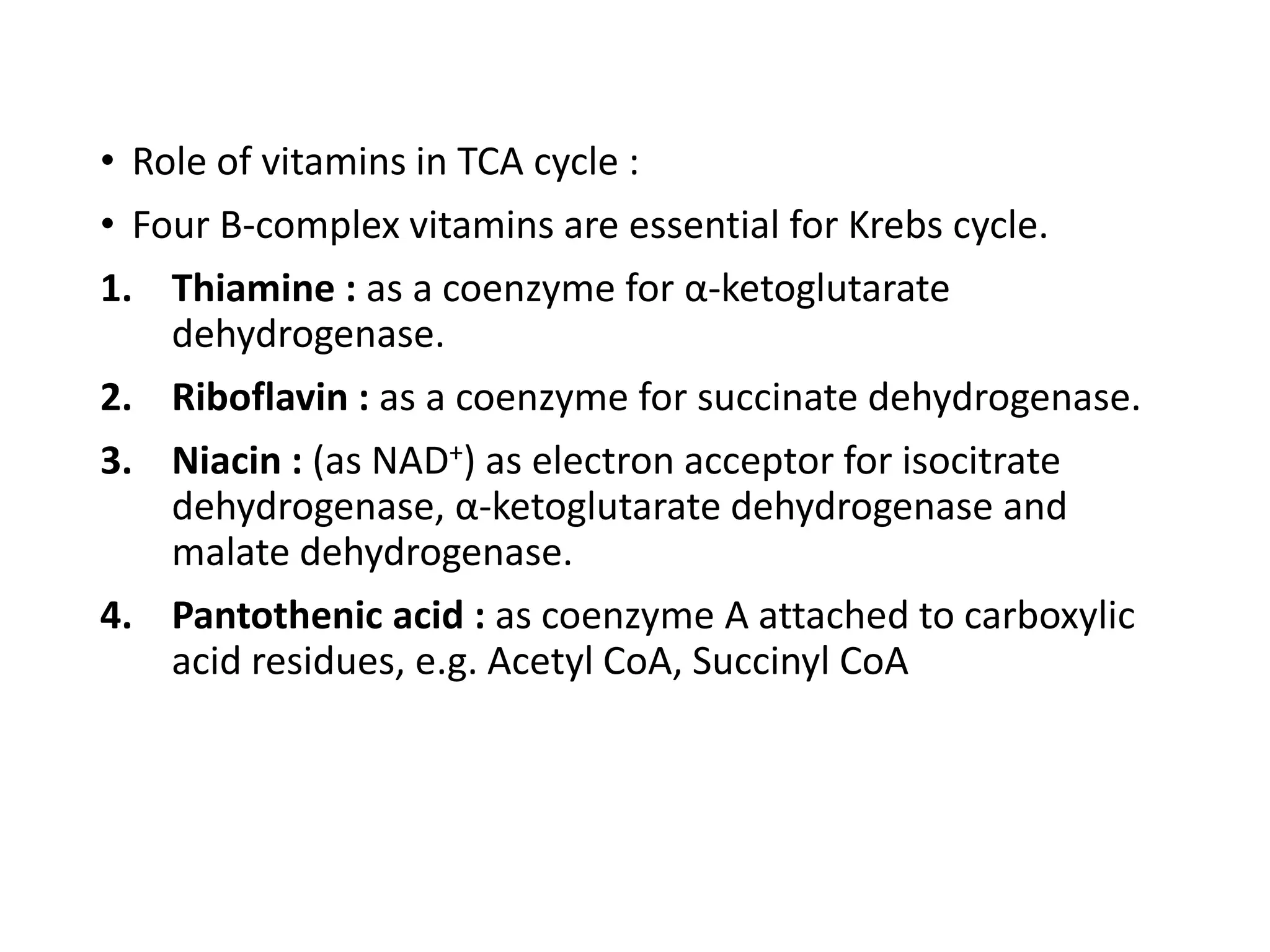
• Role of vitamins in TCA cycle :
• Four B-complex vitamins are essential for Krebs cycle.
1. Thiamine : as a coenzyme for α-ketoglutarate
dehydrogenase.
2. Riboflavin : as a coenzyme for succinate dehydrogenase.
3. Niacin : (as NAD+) as electron acceptor for isocitrate
dehydrogenase, α-ketoglutarate dehydrogenase and
malate dehydrogenase.
4. Pantothenic acid : as coenzyme A attached to carboxylic
acid residues, e.g. Acetyl CoA, Succinyl CoA
Energetics of TCA cycle
• During the process of oxidation of acetyl CoA via citric acid
cycle, 3 NADH and one FADH2 are produced.
• Oxidation of 3 NADH by electron transport chain coupled
with oxidative phosphorylation results in the synthesis of 9
ATP, whereas FADH2 leads to the formation of 2 ATP.
• Besides, there is one substrate level phosphorylation.
• Thus, a total of twelve ATP are produced from one acetyl
CoA.
Regulation of TCA cycle
• The cellular demands of ATP are crucial in controlling the rate of
citric acid cycle.
• The regulation is brought about either by enzymes or the levels of
ADP.
• Three enzymes-namely citrate synthase, isocitrate dehydrogenase
and a-ketoglutarate dehydrogenase regulate citric acid cycle.
1. Availability of ADP is very important for the citric acid cycle to
proceed.
• This is due to the fact that unless sufficient levels of ADP are
available, oxidation (coupled with phosphorylation of ADP to ATP)
of NADH and FADH2 through electron transport chain stops.
• The accumulation of NADH and FADH2 will lead to inhibition of
the enzymes and also limits the supply of NAD+ and FAD which
are essential for TCA cycle to proceed.
Total ATP synthesis by oxidation of one molecule of
Glucose
Enzyme (method of ATP synthesis) Number of ATP synthesis
Glycolysis (glucose to pyruvate under
aerobic condition*)
8 ATP
Pyruvate to acetyl - CoA 6 ATP
TCA cycle# 12 * 2 = 24 ATP
Total ATP synthesis from oxidation of
one molecule of glucose
38 ATP
* Since TCA cycle operates only under aerobic condition, we are counting ATP
from Glycolysis only in aerobic condition.
# one molecule of Acetyl CoA produce 12 ATP, Since we are counting ATP from
one molecule of Glucose; one molecule of Glucose will produce two molecules of
pyruvate followed by two molecules of Acetyl CoA.

Kreb's cycle (Citric acid cycle, TCA cycle)

  • 1.
    CITRIC ACID CYCLE KREBSCYCLE TRICARBOXYLIC ACID - TCA CYCLE
  • 2.
    • The citricacid cycle (Krebs cycle or tricarboxylic acid-TCA cycle) is the most important metabolic pathway for the energy supply to the body. • About 65-70% of the ATP is synthesized in Krebs cycle. • Citric acid cycle essentially involves the oxidation of acetyl CoA to CO2 and H2O. • This cycle utilizes about two thirds of total oxygen consumed by the body. • The name TCA cycle is used, since, at the outset of the cycle, tricarboxylic acids (citrate, cis-aconitate and isocitrate, oxalosuccinate) participate.
  • 3.
    TCA – Cycle: An overview • TCA cycle basically involves the combination of a two carbon acetyl CoA with a four carbon oxaloacetate to produce a six carbon tricarboxylic acid, citrate. • In the reactions that follow, the two carbons are oxidized to CO2 and oxaloacetate is regenerated and recycled.
  • 4.
  • 5.
    Reactions of citricacid cycle • Oxidative decarboxylation of pyruvate to acetyl CoA by pyruvate dehydrogenase complex. • This step is a connecting link between glycolysis and TCA cycle. 1. Formation of citrate : Krebs cycle proper starts with the condensation of acetyl CoA and oxaloacetate, catalysed by the enzyme citrate synthase. 2. And 3. Citrate is isomerized to isocitrate by the enzyme aconitase. • This is a two step reaction of dehydration followed by hydration through the formation of an intermediate cis- aconitate.
  • 6.
    4. And 5.Formation of a-ketoglutarate : The enzyme isocitrate dehydrogenase (lCD) catalyses the conversion (oxidative decarboxylation) of isocitrate to oxalosuccinate and then to α-ketoglutarate. • The formation of NADH and the liberation of CO2 occur at this stage. 6. Conversion of α-ketoglutarate to succinyl CoA occurs through oxidative decarboxylation, catalysed by α- ketoglutarate dehydrogenase complex. • This enzyme is dependent on five cofactors-TPP, lipoamide, NAD+, FAD and CoA. • The mechanism of the reaction is analogous to the conversion of pyruvate to acetyl CoA. • At this stage of the TCA cycle, second NADH is produced and the second CO2 is liberated.
  • 7.
    7. Formation ofsuccinate : Succinyl CoA is converted to succinate by succinate thiokinase. • This reaction is coupled with the phosphorylation of GDP to GTP. • This is a substrate level phosphorylation. • GTP is converted to ATP by the enzyme nucleoside diphosphate kinase. • GTP + ADP ATP + GDP 8. Conversion of succinate to fumarate : Succinate is oxidized by succinate dehydrogenase to fumarate. • This reaction results in the production of FADH2 and not NADH.
  • 8.
    9. Formation ofmalate : The enzyme fumarase catalyses the conversion of fumarate to malate with the addition of H2O. 10. Conversion of malate to oxaloacetate : Malate is then oxidized to oxaloacetate by malate dehydrogenase. • The third and final synthesis of NADH occurs at this stage. • The oxaloacetate is regenerated which can combine with another molecule of acetyl CoA, and continue the cycle. • Summery of TCA cycle : • Acetyl CoA + 3 NAD+ + FAD + GDP + Pi + 2H2O 2CO2 + 3NADH + 3H+ + FADH2 + GTP + CoA
  • 9.
    • Requirement ofoxygen by TCA cycle : • There is no direct participation of oxygen in Krebs cycle. • However, the cycle operates only under aerobic conditions. • This is due to the fact that NAD+ and FAD (from NADH and FADH2, respectively) required for the operation of the cycle can be regenerated in the respiratory chain only in the presence of O2. • Therefore, citric acid cycle is strictly aerobic in contrast to glycolysis which operates in both aerobic and anaerobic condition.
  • 10.
    • Role ofvitamins in TCA cycle : • Four B-complex vitamins are essential for Krebs cycle. 1. Thiamine : as a coenzyme for α-ketoglutarate dehydrogenase. 2. Riboflavin : as a coenzyme for succinate dehydrogenase. 3. Niacin : (as NAD+) as electron acceptor for isocitrate dehydrogenase, α-ketoglutarate dehydrogenase and malate dehydrogenase. 4. Pantothenic acid : as coenzyme A attached to carboxylic acid residues, e.g. Acetyl CoA, Succinyl CoA
  • 11.
    Energetics of TCAcycle • During the process of oxidation of acetyl CoA via citric acid cycle, 3 NADH and one FADH2 are produced. • Oxidation of 3 NADH by electron transport chain coupled with oxidative phosphorylation results in the synthesis of 9 ATP, whereas FADH2 leads to the formation of 2 ATP. • Besides, there is one substrate level phosphorylation. • Thus, a total of twelve ATP are produced from one acetyl CoA.
  • 12.
    Regulation of TCAcycle • The cellular demands of ATP are crucial in controlling the rate of citric acid cycle. • The regulation is brought about either by enzymes or the levels of ADP. • Three enzymes-namely citrate synthase, isocitrate dehydrogenase and a-ketoglutarate dehydrogenase regulate citric acid cycle. 1. Availability of ADP is very important for the citric acid cycle to proceed. • This is due to the fact that unless sufficient levels of ADP are available, oxidation (coupled with phosphorylation of ADP to ATP) of NADH and FADH2 through electron transport chain stops. • The accumulation of NADH and FADH2 will lead to inhibition of the enzymes and also limits the supply of NAD+ and FAD which are essential for TCA cycle to proceed.
  • 13.
    Total ATP synthesisby oxidation of one molecule of Glucose Enzyme (method of ATP synthesis) Number of ATP synthesis Glycolysis (glucose to pyruvate under aerobic condition*) 8 ATP Pyruvate to acetyl - CoA 6 ATP TCA cycle# 12 * 2 = 24 ATP Total ATP synthesis from oxidation of one molecule of glucose 38 ATP * Since TCA cycle operates only under aerobic condition, we are counting ATP from Glycolysis only in aerobic condition. # one molecule of Acetyl CoA produce 12 ATP, Since we are counting ATP from one molecule of Glucose; one molecule of Glucose will produce two molecules of pyruvate followed by two molecules of Acetyl CoA.