DRUG ADULTERATION
INTRODUCTION
๏‚ง Medicinal plants constitute an effective source of traditional
(e.g. Ayurvedic, Chinese, Homeopathy and Unani) and modern
medicine.
๏‚ง Herbal medicine has been shown to have genuine utility.
Germany and France, together represent 39% of the $14 billion
global retail market.
๏‚ง In India, about 80% of the rural population depends on
medicinal herbs and/or indigenous systems of medicine.
๏‚ง In fact today, approximately 70% of โ€˜syntheticโ€™ medicines are
derived from plants.
๏‚ง Popularity among the common people increased the usage of
medicinal plants/herbal drugs.
ADULTERATION
Definition
The term adulteration is defined as substituting original crude drug
partially or wholly with other similar-looking substances. The
substance, which is mixed, is free from or inferior in chemical
constituents and therapeutic property.
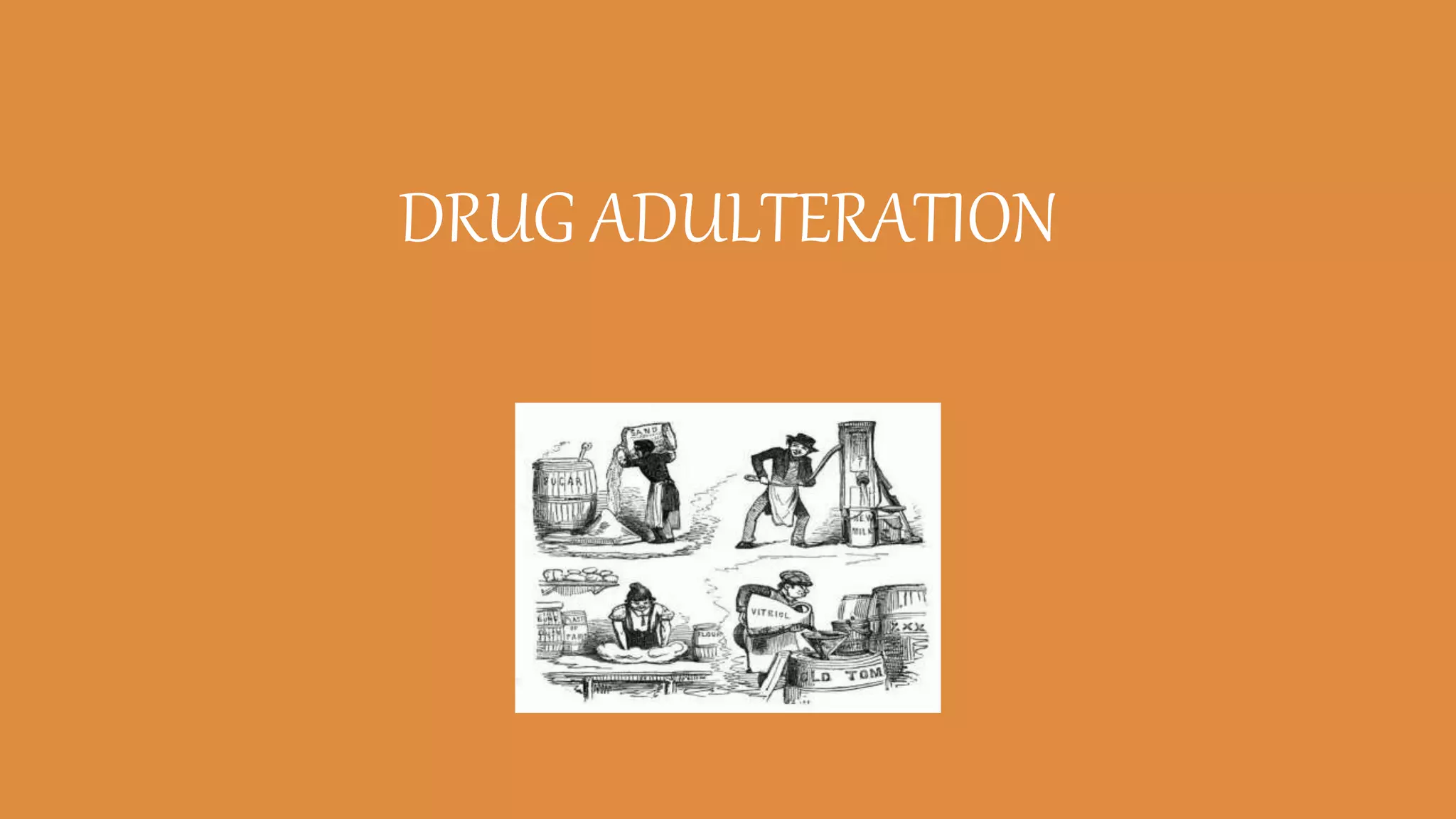
๏‚ง Herbal adulteration is one of the common malpractices in herbal raw material trade.
๏‚ง Adulteration is described as intentional substitution with another plant species or
intentional addition of a foreign substance to increase the weight or potency of the product
or to decrease its cost.
๏‚ง In general, adulteration is considered as an intentional practice. However, unintentional
adulterations also exist in herbal raw-material trade due to various reasons.
๏‚ง Due to adulteration, faith in herbal drugs has declined. Adulteration in market samples is
one of the greatest drawbacks in promotion of herbal products.
๏‚ง Many researchers have contributed in checking adulterations and authenticating them.
๏‚ง It is found that the adverse event reports are not due to the intended herb, but rather due
to the presence of an unintended herb. Medicinal plant dealers have discovered the
methods in creating adulteration of such a high quality that without microscopic and
chemical analysis, it is very difficult to trace these adulterations.
TYPES OF Adulterations
๏ถ Two types of adulterations are there :
1. Intentional adulteration
2. Unintentional adulteration
๏‚ง The motives for intentional adulteration are normally commercial and are
originated mainly with the intension of enhancement of profits.
๏‚ง Some of the reasons that can be cited here are scarcity of drug and its high price
prevailing in market.
๏‚ง The adulteration is done deliberately, but it may occur accidentally in some
cases.
๏‚ง Adulteration involves different terminologies such as deterioration, admixture,
sophistication, substitution, inferiority and spoilage.
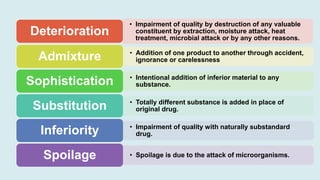
โ€ข Impairment of quality by destruction of any valuable
constituent by extraction, moisture attack, heat
treatment, microbial attack or by any other reasons.
Deterioration
โ€ข Addition of one product to another through accident,
ignorance or carelessness
Admixture
โ€ข Intentional addition of inferior material to any
substance.
Sophistication
โ€ข Totally different substance is added in place of
original drug.
Substitution
โ€ข Impairment of quality with naturally substandard
drug.
Inferiority
โ€ข Spoilage is due to the attack of microorganisms.
Spoilage
Intentional adulteration
1. Adulteration using manufactured substances
โ€ข In this type of adulteration the original substances are adulterated by the
materials that are artificially manufactured.
โ€ข E.g. artificial invert sugars are mixed with or replaced with pure honey
โ€ข Bass wood is cut exactly the required shape of nutmeg and used to
adulterate.
โ€ข Yellow Paraffin wax for Bees wax.
โ€ข Citral is added to Lemon oil.
2. Adulteration with substandard commercial varieties
โ€ข In this type, the original drugs are substituted using inferior quality drugs that
may be similar in morphological characters, chemical constituents or
therapeutic activity.
โ€ข E.g. Obovate senna and Provence senna are used to adulterate Senna.
โ€ข Cochin, African and Japanese ginger are used to adulterate Ginger.
3. Substitution using exhausted drugs
โ€ข In this type of substitution the active medicaments of the main drugs are extracted out.
โ€ข This technique is frequently used for the drugs containing volatile oils, such as Clove,
Fennel, Ginger, etc.
โ€ข Saffron and Rose petals are recolored by artificial dyes after extraction.
4. Adulteration with superficially similar inferior drugs
โ€ข In this type of adulteration, adulterant used is morphologically similar to the original
drug but will not be having actual chemical constituents or therapeutic activity.
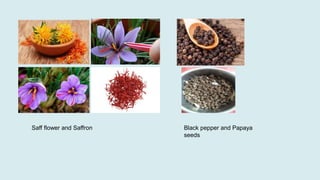
โ€ข E.g. Pipali or Black Pepper (Piper longum, Piper nigrum) adulterated by Papaya seeds
because of similarity in morphology.
โ€ข Japan wax is used to adulterate Bees wax
โ€ข Saff flower for Saffron.
Saff flower and Saffron Black pepper and Papaya
seeds
5. Adulteration using the vegetative part of the same plant
โ€ข The presence of vegetative parts of the same plant with the drug in excessive amount
is also a part of an adulteration.
โ€ข e.g. excessive stem part in Senna leaves and Mint leaves.
6. Adulteration of the species belonging to same family
โ€ข Due to any reasons, the original drug is mixed or totally replaced by the another drug
from the same family.
โ€ข Mixing or replacement of Datura metel with Datura stramonium
โ€ข both belongs to Solanaceae family
7. Adulteration of Powder :
โ€ข Besides the entire drugs, the powdered drugs are frequently found to be adulterated.
โ€ข E.g. Red color in chilli powder,
โ€ข Exhausted ginger powder in Ginger.
8. Addition of toxic materials
โ€ข In this type of adulteration the materials used as adulterant is toxic in nature.
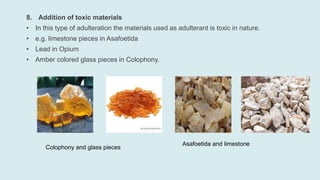
โ€ข e.g. limestone pieces in Asafoetida
โ€ข Lead in Opium
โ€ข Amber colored glass pieces in Colophony.
Colophony and glass pieces
Asafoetida and limestone
UNINTENTIONAL ADULTERATION
1. Misidentification due to confusion in name :
โ€ข Some herbal drugs are controversial drugs, like they have same name in different
region but plant used in the name of such drugs are different.
โ€ข E.g. for drug Rasna, various plants are used in different region.
โ€ข Pluchea lanceolata in Northeast India, UP, Bihar
โ€ข Tylophora indica Mumbai and Gujarat
โ€ข Alpinia galanga in South India
โ€ข Rauwolfia serpentina
โ€ข Because of popularity of Siddha medicine in South India, traders supply Tylophora
indica as Rasna, while in North they supply Pluchea lanceolata as Rasna.
โ€ข E.g. 2 Brahmi : Bacopa moniera and Hydrocotyle asiatica
โ€ข 3. Punarnava : Trienthema partulacastrum and Boerhavia diffusa
2. Lack of knowledge about authentic plant :
โ€ข Nagakesar is one of the important drugs in Ayurveda.
โ€ข Authentic source of Nagakesar is Mesua ferrea.
โ€ข But market samples are adulterated with flowers of Calophyllum inophyllum.
โ€ข Authentic plant is available throughout western ghats and parts of Himalayas, But suppliers are
unaware of that.
โ€ข Due to these reasons Calophyllum inophyllum is sold as Nagakesar.
3. Similarity in Morphology :
โ€ข Due to morphological similarities of both species of Senna, Cassia angustifolia and Cassia
acutifolia, original Senna drug is replaced/mixed with Alexandrian senna.
โ€ข There is very minute difference in both leaves, that apex of the leaves of both species of
Senna is different.
โ€ข Due to this minute difference, unintentional adulteration can be take place at a time of
collection of drug.
4. Lack of authentic plant
โ€ข Some herbal drugs are expensive in market, maybe because of unavailability of that plant
drug.
โ€ข Due to lack of authentic plant, some other similar plant is used as substitute to main plant.
โ€ข E.g. Turmeric (Curcuma longa) is used as substitute for Saffron.
โ€ข Synthetic vanilla is used instead of natural vanilla.
โ€ข Some plants are only available or can only cultivate in specific region/country. In that
case, unavailability of particular plant in other region lead to adulteration of that drug.
โ€ข E.g. Hypericum perforatum is cultivated and sold in European markets, In India this
species is very limited.
โ€ข So Hypericum patulum is sold in India-Nepal region in the name of original drug
5. Careless collection
โ€ข Some of herbal drugs are adulterated due to the carelssness at the time of collections of herbal
drug.
โ€ข During the time of collection of herbal drugs, collectors/cultivators tend to collect other plant parts
with original parts.
โ€ข They tend to collect other plant species which is not required or can collect plant part other than
the required one.
โ€ข Also they tend to collect particles of soil, fertilizers, etc in case of collection of roots.
โ€ข E.g. pieces of clove stalk in clove flower buds.
โ€ข Pieces of stem in Senna, Tulsi leaves

Drug adulteration

  • 1.
  • 2.
    INTRODUCTION ๏‚ง Medicinal plantsconstitute an effective source of traditional (e.g. Ayurvedic, Chinese, Homeopathy and Unani) and modern medicine. ๏‚ง Herbal medicine has been shown to have genuine utility. Germany and France, together represent 39% of the $14 billion global retail market. ๏‚ง In India, about 80% of the rural population depends on medicinal herbs and/or indigenous systems of medicine. ๏‚ง In fact today, approximately 70% of โ€˜syntheticโ€™ medicines are derived from plants. ๏‚ง Popularity among the common people increased the usage of medicinal plants/herbal drugs.
  • 3.
    ADULTERATION Definition The term adulterationis defined as substituting original crude drug partially or wholly with other similar-looking substances. The substance, which is mixed, is free from or inferior in chemical constituents and therapeutic property.
  • 4.
    ๏‚ง Herbal adulterationis one of the common malpractices in herbal raw material trade. ๏‚ง Adulteration is described as intentional substitution with another plant species or intentional addition of a foreign substance to increase the weight or potency of the product or to decrease its cost. ๏‚ง In general, adulteration is considered as an intentional practice. However, unintentional adulterations also exist in herbal raw-material trade due to various reasons. ๏‚ง Due to adulteration, faith in herbal drugs has declined. Adulteration in market samples is one of the greatest drawbacks in promotion of herbal products. ๏‚ง Many researchers have contributed in checking adulterations and authenticating them. ๏‚ง It is found that the adverse event reports are not due to the intended herb, but rather due to the presence of an unintended herb. Medicinal plant dealers have discovered the methods in creating adulteration of such a high quality that without microscopic and chemical analysis, it is very difficult to trace these adulterations.
  • 5.
    TYPES OF Adulterations ๏ถTwo types of adulterations are there : 1. Intentional adulteration 2. Unintentional adulteration ๏‚ง The motives for intentional adulteration are normally commercial and are originated mainly with the intension of enhancement of profits. ๏‚ง Some of the reasons that can be cited here are scarcity of drug and its high price prevailing in market. ๏‚ง The adulteration is done deliberately, but it may occur accidentally in some cases. ๏‚ง Adulteration involves different terminologies such as deterioration, admixture, sophistication, substitution, inferiority and spoilage.
  • 6.
    โ€ข Impairment ofquality by destruction of any valuable constituent by extraction, moisture attack, heat treatment, microbial attack or by any other reasons. Deterioration โ€ข Addition of one product to another through accident, ignorance or carelessness Admixture โ€ข Intentional addition of inferior material to any substance. Sophistication โ€ข Totally different substance is added in place of original drug. Substitution โ€ข Impairment of quality with naturally substandard drug. Inferiority โ€ข Spoilage is due to the attack of microorganisms. Spoilage
  • 7.
    Intentional adulteration 1. Adulterationusing manufactured substances โ€ข In this type of adulteration the original substances are adulterated by the materials that are artificially manufactured. โ€ข E.g. artificial invert sugars are mixed with or replaced with pure honey โ€ข Bass wood is cut exactly the required shape of nutmeg and used to adulterate. โ€ข Yellow Paraffin wax for Bees wax. โ€ข Citral is added to Lemon oil. 2. Adulteration with substandard commercial varieties โ€ข In this type, the original drugs are substituted using inferior quality drugs that may be similar in morphological characters, chemical constituents or therapeutic activity. โ€ข E.g. Obovate senna and Provence senna are used to adulterate Senna. โ€ข Cochin, African and Japanese ginger are used to adulterate Ginger.
  • 8.
    3. Substitution usingexhausted drugs โ€ข In this type of substitution the active medicaments of the main drugs are extracted out. โ€ข This technique is frequently used for the drugs containing volatile oils, such as Clove, Fennel, Ginger, etc. โ€ข Saffron and Rose petals are recolored by artificial dyes after extraction. 4. Adulteration with superficially similar inferior drugs โ€ข In this type of adulteration, adulterant used is morphologically similar to the original drug but will not be having actual chemical constituents or therapeutic activity. โ€ข E.g. Pipali or Black Pepper (Piper longum, Piper nigrum) adulterated by Papaya seeds because of similarity in morphology. โ€ข Japan wax is used to adulterate Bees wax โ€ข Saff flower for Saffron.
  • 9.
    Saff flower andSaffron Black pepper and Papaya seeds
  • 10.
    5. Adulteration usingthe vegetative part of the same plant โ€ข The presence of vegetative parts of the same plant with the drug in excessive amount is also a part of an adulteration. โ€ข e.g. excessive stem part in Senna leaves and Mint leaves. 6. Adulteration of the species belonging to same family โ€ข Due to any reasons, the original drug is mixed or totally replaced by the another drug from the same family. โ€ข Mixing or replacement of Datura metel with Datura stramonium โ€ข both belongs to Solanaceae family 7. Adulteration of Powder : โ€ข Besides the entire drugs, the powdered drugs are frequently found to be adulterated. โ€ข E.g. Red color in chilli powder, โ€ข Exhausted ginger powder in Ginger.
  • 11.
    8. Addition oftoxic materials โ€ข In this type of adulteration the materials used as adulterant is toxic in nature. โ€ข e.g. limestone pieces in Asafoetida โ€ข Lead in Opium โ€ข Amber colored glass pieces in Colophony. Colophony and glass pieces Asafoetida and limestone
  • 12.
    UNINTENTIONAL ADULTERATION 1. Misidentificationdue to confusion in name : โ€ข Some herbal drugs are controversial drugs, like they have same name in different region but plant used in the name of such drugs are different. โ€ข E.g. for drug Rasna, various plants are used in different region. โ€ข Pluchea lanceolata in Northeast India, UP, Bihar โ€ข Tylophora indica Mumbai and Gujarat โ€ข Alpinia galanga in South India โ€ข Rauwolfia serpentina โ€ข Because of popularity of Siddha medicine in South India, traders supply Tylophora indica as Rasna, while in North they supply Pluchea lanceolata as Rasna. โ€ข E.g. 2 Brahmi : Bacopa moniera and Hydrocotyle asiatica โ€ข 3. Punarnava : Trienthema partulacastrum and Boerhavia diffusa
  • 13.
    2. Lack ofknowledge about authentic plant : โ€ข Nagakesar is one of the important drugs in Ayurveda. โ€ข Authentic source of Nagakesar is Mesua ferrea. โ€ข But market samples are adulterated with flowers of Calophyllum inophyllum. โ€ข Authentic plant is available throughout western ghats and parts of Himalayas, But suppliers are unaware of that. โ€ข Due to these reasons Calophyllum inophyllum is sold as Nagakesar. 3. Similarity in Morphology : โ€ข Due to morphological similarities of both species of Senna, Cassia angustifolia and Cassia acutifolia, original Senna drug is replaced/mixed with Alexandrian senna. โ€ข There is very minute difference in both leaves, that apex of the leaves of both species of Senna is different. โ€ข Due to this minute difference, unintentional adulteration can be take place at a time of collection of drug.
  • 14.
    4. Lack ofauthentic plant โ€ข Some herbal drugs are expensive in market, maybe because of unavailability of that plant drug. โ€ข Due to lack of authentic plant, some other similar plant is used as substitute to main plant. โ€ข E.g. Turmeric (Curcuma longa) is used as substitute for Saffron. โ€ข Synthetic vanilla is used instead of natural vanilla. โ€ข Some plants are only available or can only cultivate in specific region/country. In that case, unavailability of particular plant in other region lead to adulteration of that drug. โ€ข E.g. Hypericum perforatum is cultivated and sold in European markets, In India this species is very limited. โ€ข So Hypericum patulum is sold in India-Nepal region in the name of original drug
  • 15.
    5. Careless collection โ€ขSome of herbal drugs are adulterated due to the carelssness at the time of collections of herbal drug. โ€ข During the time of collection of herbal drugs, collectors/cultivators tend to collect other plant parts with original parts. โ€ข They tend to collect other plant species which is not required or can collect plant part other than the required one. โ€ข Also they tend to collect particles of soil, fertilizers, etc in case of collection of roots. โ€ข E.g. pieces of clove stalk in clove flower buds. โ€ข Pieces of stem in Senna, Tulsi leaves