CYANOGENIC GLYCOSIDES
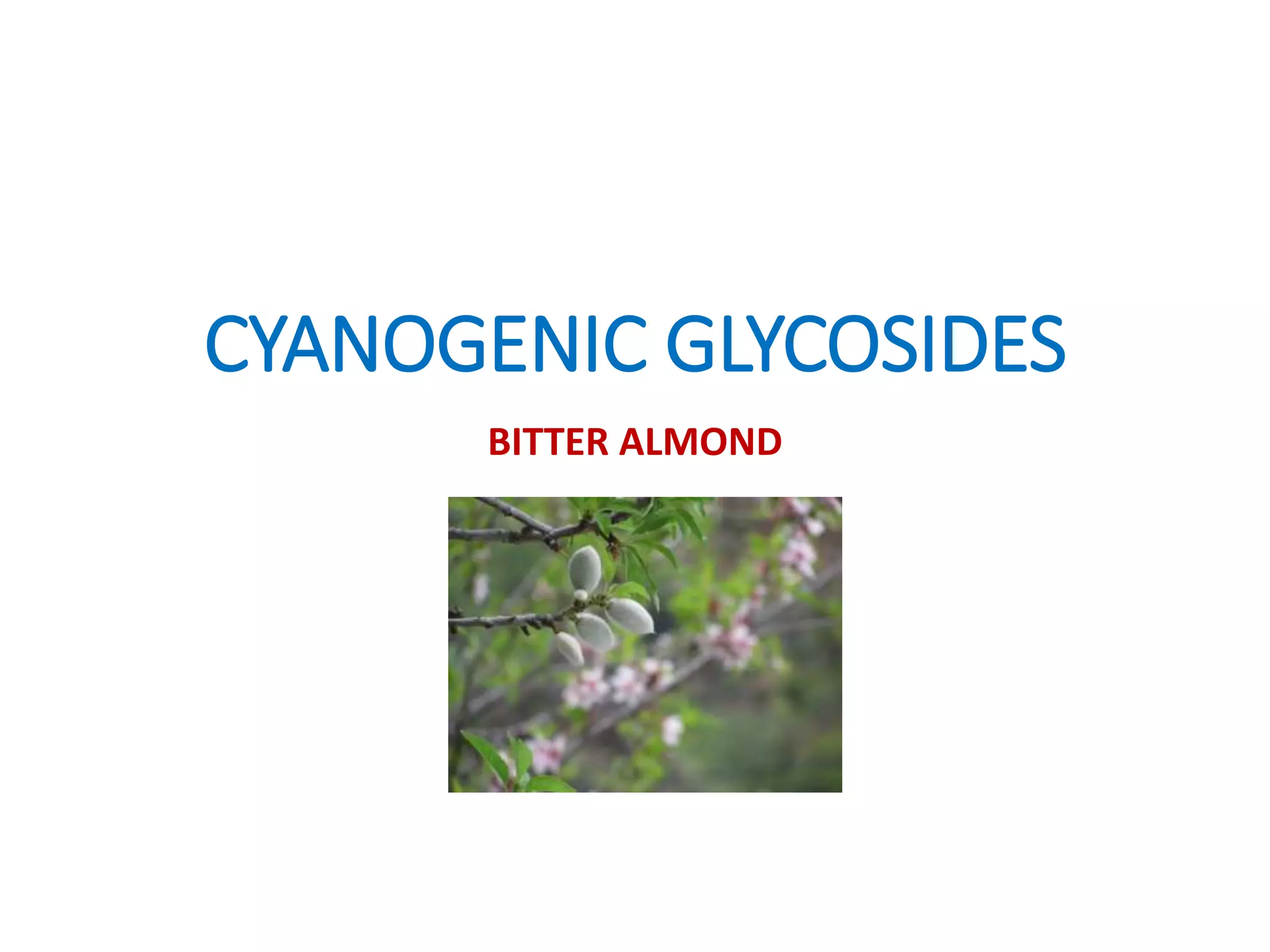
BITTER ALMOND
• INTRODUCTION :
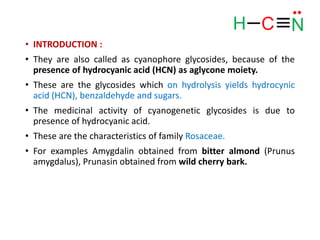
• They are also called as cyanophore glycosides, because of the
presence of hydrocyanic acid (HCN) as aglycone moiety.
• These are the glycosides which on hydrolysis yields hydrocynic
acid (HCN), benzaldehyde and sugars.
• The medicinal activity of cyanogenetic glycosides is due to
presence of hydrocyanic acid.
• These are the characteristics of family Rosaceae.
• For examples Amygdalin obtained from bitter almond (Prunus
amygdalus), Prunasin obtained from wild cherry bark.
BITTER ALMOND
• Biological source :
• It consists of dried ripe seeds of Prunus amygdalus var amara
• Family : Rosaceae
• Geographical source :
• Bitter almonds trees are native of Iran and Asia
• At present they are widely cultivated in Sicily, Italy, Spain,
Portugal, France and Morocco.
• Bitter almonds tress can not be easily distinguished from sweet
almond trees (Prunus communis).
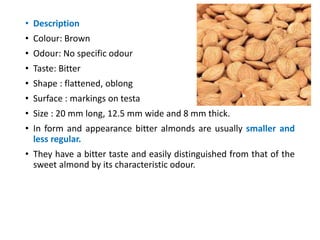
• Description
• Colour: Brown
• Odour: No specific odour
• Taste: Bitter
• Shape : flattened, oblong
• Surface : markings on testa
• Size : 20 mm long, 12.5 mm wide and 8 mm thick.
• In form and appearance bitter almonds are usually smaller and
less regular.
• They have a bitter taste and easily distinguished from that of the
sweet almond by its characteristic odour.
Chemical constituents
• Bitter almond contain fixed oil (40 to 45%) and proteins.
• Enzyme emulsin.
• It contains colorless, crystalline glucoside – Amygdalin (2.5 to 4%).
• Amygdalin on hydrolysis due to presence emulsin in presence of water
decompose into benzaldehyde and hydrocyanic acid.
• This change is effected by the emulsin contained in all the tissues of bitter
almond.
• It contains 0.5 % of volatile oil.
• Sweet almonds do not contain amygdalin and hence they are not bitter
in taste.
• Almond oil consist of a mixture of glycerides of oleic, linoleic, palmitic,
myristic, palmitoleic, margaric, stearic, linolenic, arachidic, gadoleic,
behenic and cruic acid.
• The unsaponifiable matter contains beta sitosterol, avenasterol,
cholesterol, brassica sterol and tocopherols.
Chemical test :
• Grignard Reaction Test:
• Liberation of hydrocyanic acid on hydrolysis, changes sodium
picrate (yellow colour) into sodium purpurate (brick-red colour).
• Procedure :
• First of all, dip a strip of white filter paper into a solution of picric
acid (1 % w/v in water) drain and then dip into a solution of
sodium carbonate (10% w/v in water) and drain. Now, place the
crushed and moistened drug material in a small flask, and
subsequently suspend the strip of the prepared sodium picrate
paper above the material and stopper the flask with an air tight
cork. Maintain the flask in a warm place for 1 hour when the
liberated HCN would turn the sodium picrate paper from its
original yellow colour to brick red colour due to the formation of
sodium isopurpurate (Grignard’s Reaction).
• Uses :
• Hydrocyanic acid is very poisonous and makes the drug
unsuitable for internal administration.
• Bitter almonds are used as sedative due to hydrocyanic acid
content.
• Oil is used in skin lotion as demulcent and emollient.
• Sweet almond oil is used as flavoring agent in food products but
bitter almond oil should not be used as flavoring of foods.

CYANOGENIC GLYCOSIDES.pptx

  • 1.
  • 2.
    • INTRODUCTION : •They are also called as cyanophore glycosides, because of the presence of hydrocyanic acid (HCN) as aglycone moiety. • These are the glycosides which on hydrolysis yields hydrocynic acid (HCN), benzaldehyde and sugars. • The medicinal activity of cyanogenetic glycosides is due to presence of hydrocyanic acid. • These are the characteristics of family Rosaceae. • For examples Amygdalin obtained from bitter almond (Prunus amygdalus), Prunasin obtained from wild cherry bark.
  • 3.
    BITTER ALMOND • Biologicalsource : • It consists of dried ripe seeds of Prunus amygdalus var amara • Family : Rosaceae • Geographical source : • Bitter almonds trees are native of Iran and Asia • At present they are widely cultivated in Sicily, Italy, Spain, Portugal, France and Morocco. • Bitter almonds tress can not be easily distinguished from sweet almond trees (Prunus communis).
  • 4.
    • Description • Colour:Brown • Odour: No specific odour • Taste: Bitter • Shape : flattened, oblong • Surface : markings on testa • Size : 20 mm long, 12.5 mm wide and 8 mm thick. • In form and appearance bitter almonds are usually smaller and less regular. • They have a bitter taste and easily distinguished from that of the sweet almond by its characteristic odour.
  • 5.
    Chemical constituents • Bitteralmond contain fixed oil (40 to 45%) and proteins. • Enzyme emulsin. • It contains colorless, crystalline glucoside – Amygdalin (2.5 to 4%). • Amygdalin on hydrolysis due to presence emulsin in presence of water decompose into benzaldehyde and hydrocyanic acid. • This change is effected by the emulsin contained in all the tissues of bitter almond. • It contains 0.5 % of volatile oil. • Sweet almonds do not contain amygdalin and hence they are not bitter in taste. • Almond oil consist of a mixture of glycerides of oleic, linoleic, palmitic, myristic, palmitoleic, margaric, stearic, linolenic, arachidic, gadoleic, behenic and cruic acid. • The unsaponifiable matter contains beta sitosterol, avenasterol, cholesterol, brassica sterol and tocopherols.
  • 6.
    Chemical test : •Grignard Reaction Test: • Liberation of hydrocyanic acid on hydrolysis, changes sodium picrate (yellow colour) into sodium purpurate (brick-red colour). • Procedure : • First of all, dip a strip of white filter paper into a solution of picric acid (1 % w/v in water) drain and then dip into a solution of sodium carbonate (10% w/v in water) and drain. Now, place the crushed and moistened drug material in a small flask, and subsequently suspend the strip of the prepared sodium picrate paper above the material and stopper the flask with an air tight cork. Maintain the flask in a warm place for 1 hour when the liberated HCN would turn the sodium picrate paper from its original yellow colour to brick red colour due to the formation of sodium isopurpurate (Grignard’s Reaction).
  • 7.
    • Uses : •Hydrocyanic acid is very poisonous and makes the drug unsuitable for internal administration. • Bitter almonds are used as sedative due to hydrocyanic acid content. • Oil is used in skin lotion as demulcent and emollient. • Sweet almond oil is used as flavoring agent in food products but bitter almond oil should not be used as flavoring of foods.