SWEETENERS
• Sugar is a sweetener that provides 4 calories per gram.
• It is acknowledged that excess sugar ingestion amounts to
increased energy intake which, in turn, can lead to weight gain
and chronic diseases associated with obesity and dental caries.
• Therefore, there is need for sugar substitutes, which can help
reduce caloric intake, particularly in overweight individuals.
• The demand for new alternative “low calorie” sweeteners for
dietetic has increased worldwide.
• Many synthetic sweeteners, which are widely used are proved
to be carcinogenic (Aspartame) and are non-nutritive.
• Hence demand greatly increased for natural sweetening agents,
especially for non-sacchariferous sweetening agents, because
they are highly potent, useful, safe and low-calorie sugar
alternatives.
What should be the Ideal properties
of sweetening agents ???
• Ideal properties of sweetening agents
• Sweetening agents should have the following ideal properties
 They are required to be effective when used in small
concentration.
 They must be stable at a wide range of temperature to which the
formulations are likely to be exposed.
 Prolonged use of these agents containing preparations should not
produce any carcinogenic effects
 They should have very low or non-calorific value.
 They should be compatible with other ingredients in formulations.
 They should not show batch to batch variations.
 They should be readily available and inexpensive.
• Uses of Natural Sweetening agents
• Pharmaceutical Uses
 In pharmaceutical industries these are used in
liquid, oral preparations, lozenges, pills and
tablets.
 In liquid orals sugar is used to prepare syrup base,
to maintain the consistency and viscosity of the
preparation and to mask the bitter taste of the
drug.
 Sugar is also employed in the coating of pills and
tablets
 Honey plays an important role in Ayurvedic system
of medicine. It is used as an important vehicle for
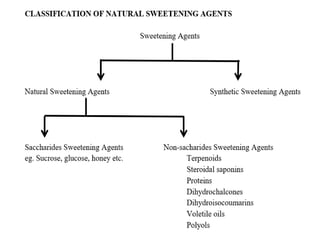
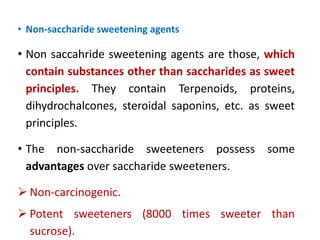
• Non-saccharide sweetening agents
• Non saccahride sweetening agents are those, which
contain substances other than saccharides as sweet
principles. They contain Terpenoids, proteins,
dihydrochalcones, steroidal saponins, etc. as sweet
principles.
• The non-saccharide sweeteners possess some
advantages over saccharide sweeteners.
 Non-carcinogenic.
 Potent sweeteners (8000 times sweeter than
sucrose).
TERPENOIDS
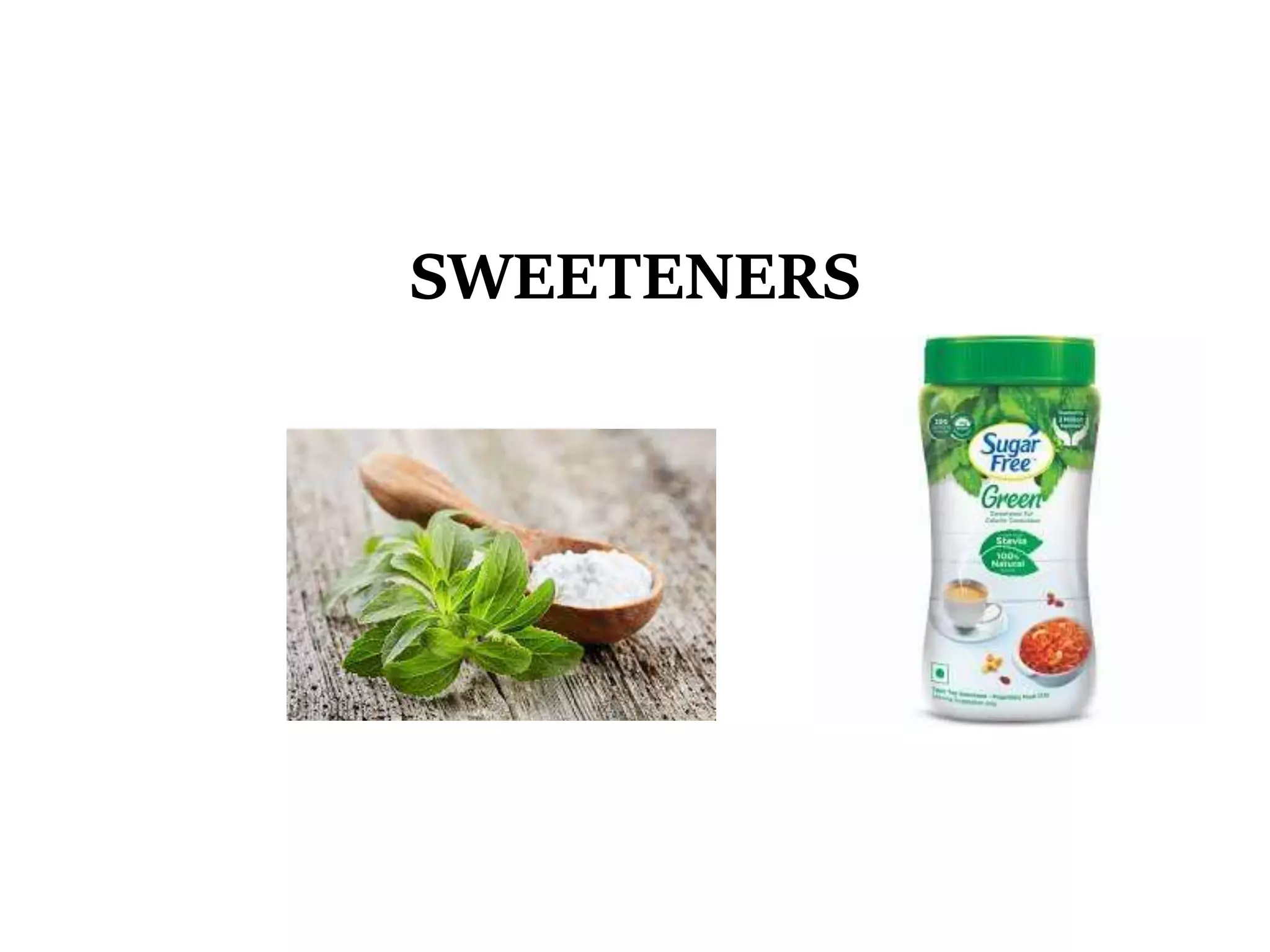
• Stevioside and Rebaudioside
• Stevioside and Rebaudioside-A do not increase the blood sugar levels,
so they can be used by diabetics without adverse glycemic responses.
• It is extracted from Stevia rebaudiana, family Compositae.
• Stevioside can be isolated from the leaves by extraction with water or water-
ethyl alcohol mixture.
• Stevioside is sparingly soluble in water.
• Rebaudioside A is normally purified by crystallization from alcoholic
solution
• Stevioside is 250-300 times sweeter than sucrose.
• The extract provides a sweet taste that lasts for a long time in the mouth
but has a pronounced aftertaste and bitterness, limiting its use at
high concentrations.
• Stevioside is poorly soluble in water but highly soluble in alcohol and is
relatively stable over a wide range of pH values, even at the acid pH
of certain drinks.
• Glycyrrhizin
• Glycyrrhizin is a mixed calcium and potassium salt of gylcyrrhizic acid found
in liquorice root, Glycyrrhiza glabra, family Leguminosae.
• Glycyrrhizic acid is triterpene glycoside and after hydrolysis it gives
glycyrrhetic acid as aglycone.
• Glycyrrhizin is about 50-100 times sweeter than sucrose whereas its salt
ammonium glycyrrhizinate is about 50 times sweeter as compared to
sugar.
• Glycyrrhizin has lingering licorice-like aftertaste and therefore considered
as a flavouring agent rather than sweeteners.
• Glycyrrhizin enhances food flavors, masks bitter flavors, and
increases the sweetness. It has the potential for providing functional
characteristics, including foaming, viscosity control, gel formation,
and possibly antioxidant characteristics.
• It also has anti-ulcer and anti-inflammatory activity.
• It is also used in soft drinks, tobacco products and oral hygiene products.
DIHYDRO ISOCOUMARINS
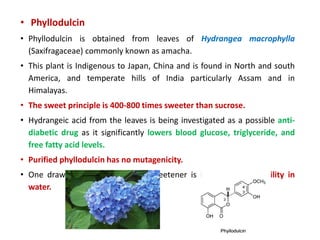
• Phyllodulcin
• Phyllodulcin is obtained from leaves of Hydrangea macrophylla
(Saxifragaceae) commonly known as amacha.
• This plant is Indigenous to Japan, China and is found in North and south
America, and temperate hills of India particularly Assam and in
Himalayas.
• The sweet principle is 400-800 times sweeter than sucrose.
• Hydrangeic acid from the leaves is being investigated as a possible anti-
diabetic drug as it significantly lowers blood glucose, triglyceride, and
free fatty acid levels.
• Purified phyllodulcin has no mutagenicity.
• One drawback for its use as a sweetener is its very low solubility in
water.
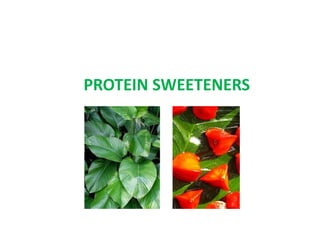
PROTEIN SWEETENERS
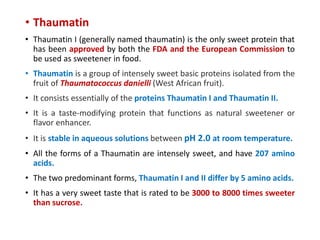
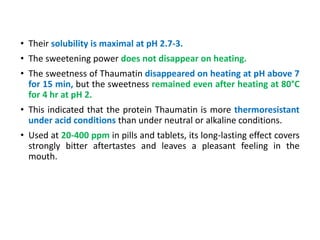
• Thaumatin
• Thaumatin I (generally named thaumatin) is the only sweet protein that
has been approved by both the FDA and the European Commission to
be used as sweetener in food.
• Thaumatin is a group of intensely sweet basic proteins isolated from the
fruit of Thaumatococcus danielli (West African fruit).
• It consists essentially of the proteins Thaumatin I and Thaumatin II.
• It is a taste-modifying protein that functions as natural sweetener or
flavor enhancer.
• It is stable in aqueous solutions between pH 2.0 at room temperature.
• All the forms of a Thaumatin are intensely sweet, and have 207 amino
acids.
• The two predominant forms, Thaumatin I and II differ by 5 amino acids.
• It has a very sweet taste that is rated to be 3000 to 8000 times sweeter
than sucrose.
• Their solubility is maximal at pH 2.7-3.
• The sweetening power does not disappear on heating.
• The sweetness of Thaumatin disappeared on heating at pH above 7
for 15 min, but the sweetness remained even after heating at 80°C
for 4 hr at pH 2.
• This indicated that the protein Thaumatin is more thermoresistant
under acid conditions than under neutral or alkaline conditions.
• Used at 20-400 ppm in pills and tablets, its long-lasting effect covers
strongly bitter aftertastes and leaves a pleasant feeling in the
mouth.
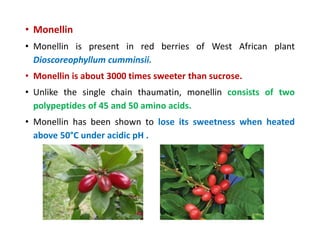
• Monellin
• Monellin is present in red berries of West African plant
Dioscoreophyllum cumminsii.
• Monellin is about 3000 times sweeter than sucrose.
• Unlike the single chain thaumatin, monellin consists of two
polypeptides of 45 and 50 amino acids.
• Monellin has been shown to lose its sweetness when heated
above 50°C under acidic pH .
• Miraculin (taste- modifying protein)
• Miraculin has the unusual property of being able to modify a sour taste
into a sweet taste.
• Miraculin is a basic glycoprotein that was extracted from the miracle fruit
plant, a shrub that is native to West Africa Richadella dulcifica.
• Miraculin itself is not sweet, but the human tongue, once exposed to
miraculin, perceives ordinarily sour foods, such as citrus, as sweet for up
to 2 h afterward.
• This small red berry has been used in West Africa to improve the taste of
acidic foods.
• Since the miracle fruit itself has no distinct taste, this taste-modifying
function of the fruit had been regarded as a miracle.
• The active substance, isolated from plant was named miraculin after the
miracle fruit.
• Miraculin was first sequenced in 1989 and was found to be a glycoprotein
consisting of 191 amino acids and some carbohydrate chains.
• Curculin
• Curculin isolated from fruits of Curculigo latifolia, a plant grown
in Malaysia, has an intriguing property of modifying sour taste
into sweet taste.
• Curculin was reported to be a homodimer of two proteins
connected through two disulfide bridges.
• In addition to this taste modifying activity, Curculin itself elicits a
sweet taste.
• It is a unique sweet protein that has both sweet-tasting and taste-
modifying activities.
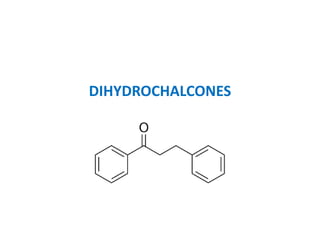
DIHYDROCHALCONES
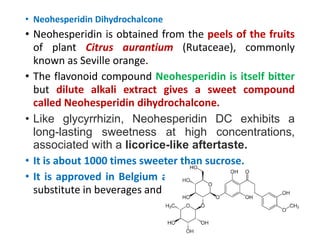
• Neohesperidin Dihydrochalcone
• Neohesperidin is obtained from the peels of the fruits
of plant Citrus aurantium (Rutaceae), commonly
known as Seville orange.
• The flavonoid compound Neohesperidin is itself bitter
but dilute alkali extract gives a sweet compound
called Neohesperidin dihydrochalcone.
• Like glycyrrhizin, Neohesperidin DC exhibits a
long-lasting sweetness at high concentrations,
associated with a licorice-like aftertaste.
• It is about 1000 times sweeter than sucrose.
• It is approved in Belgium and USA for use as a sugar
substitute in beverages and chewing gum.
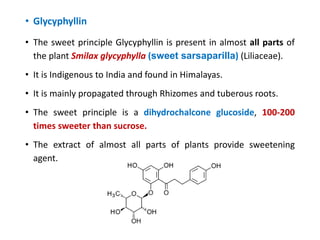
• Glycyphyllin
• The sweet principle Glycyphyllin is present in almost all parts of
the plant Smilax glycyphylla (sweet sarsaparilla) (Liliaceae).
• It is Indigenous to India and found in Himalayas.
• It is mainly propagated through Rhizomes and tuberous roots.
• The sweet principle is a dihydrochalcone glucoside, 100-200
times sweeter than sucrose.
• The extract of almost all parts of plants provide sweetening
agent.
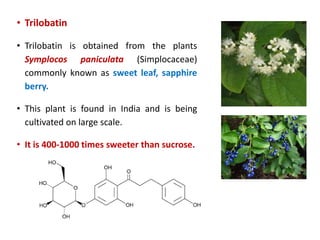
• Trilobatin
• Trilobatin is obtained from the plants
Symplocos paniculata (Simplocaceae)
commonly known as sweet leaf, sapphire
berry.
• This plant is found in India and is being
cultivated on large scale.
• It is 400-1000 times sweeter than sucrose.

SWEETENERS.pptx

  • 1.
  • 2.
    • Sugar isa sweetener that provides 4 calories per gram. • It is acknowledged that excess sugar ingestion amounts to increased energy intake which, in turn, can lead to weight gain and chronic diseases associated with obesity and dental caries. • Therefore, there is need for sugar substitutes, which can help reduce caloric intake, particularly in overweight individuals. • The demand for new alternative “low calorie” sweeteners for dietetic has increased worldwide. • Many synthetic sweeteners, which are widely used are proved to be carcinogenic (Aspartame) and are non-nutritive. • Hence demand greatly increased for natural sweetening agents, especially for non-sacchariferous sweetening agents, because they are highly potent, useful, safe and low-calorie sugar alternatives.
  • 3.
    What should bethe Ideal properties of sweetening agents ???
  • 4.
    • Ideal propertiesof sweetening agents • Sweetening agents should have the following ideal properties  They are required to be effective when used in small concentration.  They must be stable at a wide range of temperature to which the formulations are likely to be exposed.  Prolonged use of these agents containing preparations should not produce any carcinogenic effects  They should have very low or non-calorific value.  They should be compatible with other ingredients in formulations.  They should not show batch to batch variations.  They should be readily available and inexpensive.
  • 5.
    • Uses ofNatural Sweetening agents • Pharmaceutical Uses  In pharmaceutical industries these are used in liquid, oral preparations, lozenges, pills and tablets.  In liquid orals sugar is used to prepare syrup base, to maintain the consistency and viscosity of the preparation and to mask the bitter taste of the drug.  Sugar is also employed in the coating of pills and tablets  Honey plays an important role in Ayurvedic system of medicine. It is used as an important vehicle for
  • 7.
    • Non-saccharide sweeteningagents • Non saccahride sweetening agents are those, which contain substances other than saccharides as sweet principles. They contain Terpenoids, proteins, dihydrochalcones, steroidal saponins, etc. as sweet principles. • The non-saccharide sweeteners possess some advantages over saccharide sweeteners.  Non-carcinogenic.  Potent sweeteners (8000 times sweeter than sucrose).
  • 8.
  • 9.
    • Stevioside andRebaudioside • Stevioside and Rebaudioside-A do not increase the blood sugar levels, so they can be used by diabetics without adverse glycemic responses. • It is extracted from Stevia rebaudiana, family Compositae. • Stevioside can be isolated from the leaves by extraction with water or water- ethyl alcohol mixture. • Stevioside is sparingly soluble in water. • Rebaudioside A is normally purified by crystallization from alcoholic solution • Stevioside is 250-300 times sweeter than sucrose. • The extract provides a sweet taste that lasts for a long time in the mouth but has a pronounced aftertaste and bitterness, limiting its use at high concentrations. • Stevioside is poorly soluble in water but highly soluble in alcohol and is relatively stable over a wide range of pH values, even at the acid pH of certain drinks.
  • 10.
    • Glycyrrhizin • Glycyrrhizinis a mixed calcium and potassium salt of gylcyrrhizic acid found in liquorice root, Glycyrrhiza glabra, family Leguminosae. • Glycyrrhizic acid is triterpene glycoside and after hydrolysis it gives glycyrrhetic acid as aglycone. • Glycyrrhizin is about 50-100 times sweeter than sucrose whereas its salt ammonium glycyrrhizinate is about 50 times sweeter as compared to sugar. • Glycyrrhizin has lingering licorice-like aftertaste and therefore considered as a flavouring agent rather than sweeteners. • Glycyrrhizin enhances food flavors, masks bitter flavors, and increases the sweetness. It has the potential for providing functional characteristics, including foaming, viscosity control, gel formation, and possibly antioxidant characteristics. • It also has anti-ulcer and anti-inflammatory activity. • It is also used in soft drinks, tobacco products and oral hygiene products.
  • 11.
  • 12.
    • Phyllodulcin • Phyllodulcinis obtained from leaves of Hydrangea macrophylla (Saxifragaceae) commonly known as amacha. • This plant is Indigenous to Japan, China and is found in North and south America, and temperate hills of India particularly Assam and in Himalayas. • The sweet principle is 400-800 times sweeter than sucrose. • Hydrangeic acid from the leaves is being investigated as a possible anti- diabetic drug as it significantly lowers blood glucose, triglyceride, and free fatty acid levels. • Purified phyllodulcin has no mutagenicity. • One drawback for its use as a sweetener is its very low solubility in water.
  • 13.
  • 14.
    • Thaumatin • ThaumatinI (generally named thaumatin) is the only sweet protein that has been approved by both the FDA and the European Commission to be used as sweetener in food. • Thaumatin is a group of intensely sweet basic proteins isolated from the fruit of Thaumatococcus danielli (West African fruit). • It consists essentially of the proteins Thaumatin I and Thaumatin II. • It is a taste-modifying protein that functions as natural sweetener or flavor enhancer. • It is stable in aqueous solutions between pH 2.0 at room temperature. • All the forms of a Thaumatin are intensely sweet, and have 207 amino acids. • The two predominant forms, Thaumatin I and II differ by 5 amino acids. • It has a very sweet taste that is rated to be 3000 to 8000 times sweeter than sucrose.
  • 15.
    • Their solubilityis maximal at pH 2.7-3. • The sweetening power does not disappear on heating. • The sweetness of Thaumatin disappeared on heating at pH above 7 for 15 min, but the sweetness remained even after heating at 80°C for 4 hr at pH 2. • This indicated that the protein Thaumatin is more thermoresistant under acid conditions than under neutral or alkaline conditions. • Used at 20-400 ppm in pills and tablets, its long-lasting effect covers strongly bitter aftertastes and leaves a pleasant feeling in the mouth.
  • 16.
    • Monellin • Monellinis present in red berries of West African plant Dioscoreophyllum cumminsii. • Monellin is about 3000 times sweeter than sucrose. • Unlike the single chain thaumatin, monellin consists of two polypeptides of 45 and 50 amino acids. • Monellin has been shown to lose its sweetness when heated above 50°C under acidic pH .
  • 17.
    • Miraculin (taste-modifying protein) • Miraculin has the unusual property of being able to modify a sour taste into a sweet taste. • Miraculin is a basic glycoprotein that was extracted from the miracle fruit plant, a shrub that is native to West Africa Richadella dulcifica. • Miraculin itself is not sweet, but the human tongue, once exposed to miraculin, perceives ordinarily sour foods, such as citrus, as sweet for up to 2 h afterward. • This small red berry has been used in West Africa to improve the taste of acidic foods. • Since the miracle fruit itself has no distinct taste, this taste-modifying function of the fruit had been regarded as a miracle. • The active substance, isolated from plant was named miraculin after the miracle fruit. • Miraculin was first sequenced in 1989 and was found to be a glycoprotein consisting of 191 amino acids and some carbohydrate chains.
  • 18.
    • Curculin • Curculinisolated from fruits of Curculigo latifolia, a plant grown in Malaysia, has an intriguing property of modifying sour taste into sweet taste. • Curculin was reported to be a homodimer of two proteins connected through two disulfide bridges. • In addition to this taste modifying activity, Curculin itself elicits a sweet taste. • It is a unique sweet protein that has both sweet-tasting and taste- modifying activities.
  • 19.
  • 20.
    • Neohesperidin Dihydrochalcone •Neohesperidin is obtained from the peels of the fruits of plant Citrus aurantium (Rutaceae), commonly known as Seville orange. • The flavonoid compound Neohesperidin is itself bitter but dilute alkali extract gives a sweet compound called Neohesperidin dihydrochalcone. • Like glycyrrhizin, Neohesperidin DC exhibits a long-lasting sweetness at high concentrations, associated with a licorice-like aftertaste. • It is about 1000 times sweeter than sucrose. • It is approved in Belgium and USA for use as a sugar substitute in beverages and chewing gum.
  • 21.
    • Glycyphyllin • Thesweet principle Glycyphyllin is present in almost all parts of the plant Smilax glycyphylla (sweet sarsaparilla) (Liliaceae). • It is Indigenous to India and found in Himalayas. • It is mainly propagated through Rhizomes and tuberous roots. • The sweet principle is a dihydrochalcone glucoside, 100-200 times sweeter than sucrose. • The extract of almost all parts of plants provide sweetening agent.
  • 22.
    • Trilobatin • Trilobatinis obtained from the plants Symplocos paniculata (Simplocaceae) commonly known as sweet leaf, sapphire berry. • This plant is found in India and is being cultivated on large scale. • It is 400-1000 times sweeter than sucrose.