Chapter 2


CELL Structure and
organisation
                     1
Learning Outcomes
At the end of the lesson, you should be able
to:
   Identify chloroplasts, cell membrane, cell wall,
    cytoplasm, cell vacuoles, nucleus, mitochondria,
    ribosomes
   Identify endoplasmic reticulum and Golgi
    apparatus (Pure)
   State the functions of the organelles identified above
   Compare the structure of typical animal and plant
    cells
Learning Outcomes
   state, in simple terms, the relationship
    between cell function and cell structure for
    the following:
       absorption – root hair cells
       conduction and support – xylem vessels
       transport of oxygen – red blood cells
   Differentiate cell, tissue, organ and organ
    system

                                                   3
What is a cell?
   Basic structural and functional unit of living
    things

   Building block of life

   All living things are made up of one or more
    cells

   How big is a cell?
    http://www.cellsalive.com/howbig.htm
                                                     4
What are inside a cell?
   Each living cell consists of living material
    called protoplasm
   Protoplasm is made up of cell membrane,
    nucleus and cytoplasm.
   Protoplasm is jelly-like, containing mainly
    water and many other substances
   Protoplasm in one part of the body may be
    different from another part of the body

                                                   5
Cell Membrane
   Cell membrane (plasma membrane)
      Structure                    Function
     Thin, partially   Control movement of substances
     permeable         in and out of the cell. Only allow
     layer around      some substances to pass
     the cell          through, small molecules such as
                       glucose, oxygen and water can
                       enter, but not others such as
                       waste substances.


                                                            7
Cytoplasm
     Structure                   Function
 Jelly-like         Acts as a medium for most
 substance made     chemical activities of the cell to
 up mainly of       occur;
 water (70%         Contains enzymes and organelles.
 water)


Organelles are subcellular structures
(structures smaller than cells) that
perform specific jobs inside the cell.
eg) mitochondria, ribosomes, chloroplasts,
vacuoles                                                 8
Nucleus
  Structure                Function
Contains      Controls cell activities, such as
chromatin /   cell repair and growth;
chromosome
(genetic      Controls cell division.
materials)


                                                  9
vacuole
   Structure                Function
A fluid-filled Store substances such as water
space enclosed and food temporarily.
by a membrane;
                 vacuoles
Exists
temporarily in
animal cells.


                                                10
Mitochondria
   Structure                 Function
Small, rod-      Site where aerobic respiration
shaped           takes place and energy is
organelles;      released.

Highly folded
inner membrane


                 (singular: mitochondrion;
                 plural: mitochondria)
                                                  11
ribosomes
   Structure                  Function
Small, round      Site where protein synthesis takes
structures;       place.

Can be
attached to ER
or found freely
in the
cytoplasm.


                                                   12
Analogy

       Cell Structures:             Chemical Factory:
1. Nucleus                              Main office
(Chromosomes that contain
   genes)


2.   Mitochondria                       Power Plant
3.   Ribosomes                        Factory workers
4.   Golgi Apparatus                Packaging & Delivery
5.   Lysosomes                       Recycling Centre
Endoplasmic reticulum (er)
(PURE)
   Two types:
       Rough ER
       Smooth ER


                             17
Rough ER (PURE)
   Structure                  Function
Ribosomes are     Rough ER helps to transport
attached to its   proteins made by the ribosomes to
outer surface,    the Golgi apparatus for secretion
hence its         out of the cell.
surface appears
rough when
seen under the
microscope


                                                  18
Rough ER (Pure)


                  19
Smooth ER (PURE)
     Structure                Function
Smooth ER does not    Synthesises substances
have ribosomes        such as fats and steroids;
attached to its
membrane;             Converts harmful
                      substances into harmless
Smooth ER is more     substances – Detoxification
tubular than rough
ER. It is connected
to the rough ER.

                                                   20
Smooth ER (Pure)


                   21
Golgi apparatus (PURE)
        Structure                     Function
The Golgi apparatus           Stores and modifies
consists of flattened         substances made by the
spaces surrounded by          ER; and
membranes.                    packages these
                              substances in vesicles for
Vesicles (small spherical     secretion out of the cell
spaces) fuse with one side
of the Golgi apparatus and
pinch off from the opposite
side.
                                                       22
Golgi Apparatus (Pure)


                         23
Question (Pure)


   How are substances made by a cell
        released out of the cell?


                                       24
Overview (Pure)
   Vesicles are tiny spherical spaces enclosed
    by a membrane.

   Vesicles containing substances made by the
    ER are pinched off from the ER

   These vesicles then fuse with the Golgi
    apparatus and release their contents into the
    Golgi apparatus for modification
                                                  25
   Secretory vesicles containing these modified
    substances are pinched off from the Golgi
    apparatus and moves towards the cell
    membrane

   They fuse with the cell membrane and
    release their contents outside the cell


                                               26
Plant Cell


             28
mitochondrion


              chloroplast


           Golgi complex                            central vacuole


      smooth endoplasmic
                reticulum
              vesicle

      rough endoplasmic                                 cell wall
               reticulum

                                                        plasma
                                                        membrane


        nucleolus
nucleus nuclear pore
        chromatin
        nuclear envelope


                            ribosomes           free ribosome
Plant Cell
   Its structures are similar to an animal cell
    except for the presence of:

       Cellulose cell wall

       Chloroplasts

       One large central vacuole


                                                   30
Cell wall
     Structure                      Function
Made of cellulose      The tough cellulose protects the
and surrounds the      cell from injury and gives the cell a
entire plant cell,     regular shape.
surrounding the cell   The cell wall is fully permeable,
membrane.              unlike the cell membrane.
Cellulose is a type
of carbohydrates


                                                          31
chloroplast
     Structure                      Function
Has stacks of disc-     Chlorophyll enables light energy to
like structures which   be trapped and be converted into
contain the green       chemical energy stored in food
substance called        (glucose) during the process
chlorophyll.            photosynthesis.


                                                        32
vacuole
     Structure                     Function
A plant cell has one   Cell sap contains water and
large central          dissolved substances such as
vacuole containing     sugars, mineral salts and amino
cell sap.              acids.

The large vacuole is
enclosed by a
membrane called
the tonoplast.

                                                         33
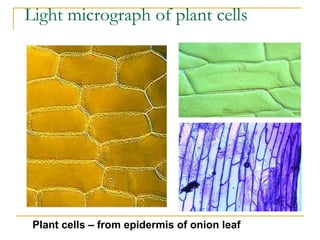
Light micrograph of plant cells


 Plant cells – from epidermis of onion leaf
Light micrograph of animal cells


                          http://iws.ccccd.edu/jbeck/Cellsweb/Cheekcells4.JPG


   Animal cells – from lining epithelium of cheek
MicroQues 1 - Differences
 structure         Animal cell        Plant cell
 Cellulose cell       Absent            Present
      wall
 Chloroplasts         Absent            Present

  Vacuoles        Small, temporary   Large, normally
                    and many          one present


                                                   36
Micro Ques 2

The diagram shows four types of cells.
Which cell does not contain a nucleus?


                                         (   A, B )
Micro Ques 3
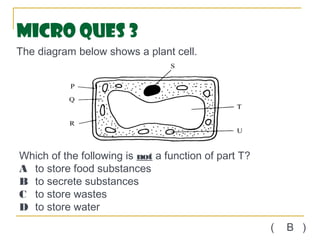
The diagram below shows a plant cell.


Which of the following is not a function of part T?
A to store food substances
B to secrete substances
C to store wastes
D to store water
                                                      (   B )
Micro Ques 4
Which of the following statements describing the cell
membrane is incorrect?
A   It is supported by lignin to give it a regular shape.
B   It is a thin and elastic layer.
C   It is a partially permeable membrane.
D   It is mainly composed of fats and proteins.


                                                            (   A )
Micro Ques 5
Which of the following is a correct description of the
permeability of the cell membrane and cell wall in a plant?
    Cell wall                     Cell membrane

A   fully                         fully
B   fully                         partially
C   partially                     fully
D   partially                     partially


                                                      (   B )
SPECIALISED CELLS,
TISSUES AND ORGANS
Cell Organisation
   Cell is the smallest working unit in a
    multicellular organism.


                                             42
Different cells do different
work
   Each cell type carries out its own particular
    kind of work.

   Cells have different shapes and structures to
    carry out different functions.


                                                    43
Specialised Cells
Tissue Formation
   A tissue is a group of similar cells which
    work together to perform a specific function


         Muscle                     Nerve
         tissue                     tissue         45
Specialised Tissues
        Tissues                     Main Function
Animal

Blood Tissue        Transports food and oxygen
Muscle Tissue       Produces Movement
Nerve Tissue        Transmits impulses
Epithelial Tissue   Protects Cell


Plant
Epidermal Tissue    Forms and protects surface of cell
Xylem Tissue        Transports water and mineral salts
Phloem Tissue       Transports food
Organ Formation
   An organ is made up of different tissues
    working together to perform a particular
    function


                                               48
Organ in animals

             Made up of:

             •Glandular tissue
             •Muscle tissue
             •Connective tissue
             •Nervous tissue
 Stomach                       Etc.


                                      49
Organs in plants
   Plants also have
    organs such as
    leaves, stems,
    roots and flower.


                        51
Micro Ques 6
   Can you name some examples?
   Eg) In Animals:
         Respiratory system –  Lungs
         Circulatory system –  Heart
         Excretory system –    Kidney
         Digestive system –    Intestines, Stomach
         Reproductive System – Ovary, Testes

        In Plants:
        Reproductive System – flowers
        Transport system –    Stem (xylem and phloem),roots
System Formation
   An organ system is made up of different
    organs working together to perform a main
    body function


    Respiratory system
                                digestive system   53
Multicellular organism –
Human Body Systems
Differentiation
   Differentiation is the process by which a cell
    becomes specialised for a specific function

   3 examples:
       Red blood cell
       Xylem vessel
       Root hair cell


                                                 56
Red Blood Cells
Red Blood Cell
Function:
 Haemoglobin (red pigment) in cytoplasm

  transports oxygen from the lungs to all parts
  of the body.

   When haemoglobin combines
    with oxygen, oxyhaemoglobin is
    formed.

                                                  58
Red Blood Cell
Adaptations:
i.   Absence of nucleus so as to contain more
     haemoglobin and hence more oxygen
ii. Circular biconcave shape – increases surface area
     to volume ratio for faster diffusion of gases in and
     out of cell
iii. Elastic and can turn bell-shaped in order to allow the
     cell to squeeze through small blood vessels
iv. Contain a red pigment, haemoglobin, to allow
     oxygen to bind to the RBC to form oxyhaemoglobin.

                                                         59
Red Blood Cells
Xylem Vessels
Xylem Vessels
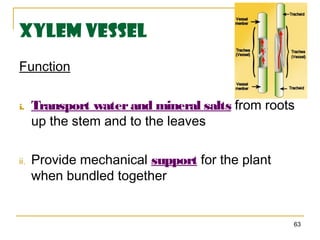
Xylem Vessel
Function

i.    Transport water and mineral salts from roots
      up the stem and to the leaves

ii.   Provide mechanical support for the plant
      when bundled together


                                                 63
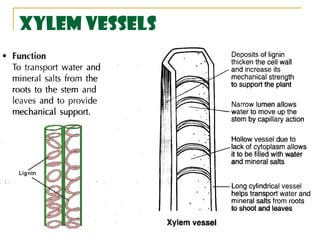
Xylem Vessel
Adaptations
i. Absence of cross-walls and protoplasm
     enable water to move easily through the
     lumen (central space).
ii. Lignin deposited in the walls of xylem
     vessels strengthens it and prevents the
     vessel from collapsing.
iii. Narrow and hollow lumen allows water to
     be moved easily up the stem.

                                               64
Xylem vessels
Root Hair Cell
   Function
    Absorb water via osmosis and mineral salts
    from soil via diffusion.


                                                 66
Root Hair Cell
   Adaptations
    1. long and narrow protrusion/    extension of an
    epidermal cell to increase surface area to volume
    ratio for more efficient absorption of water and
    mineral salts from soil.

    2. It has a very large vacuole that contains
    concentrated cell sap solution, resulting in a
    lower water potential thus allowing absorption
    of water from the soil.
                                                   67
Root Hair Cell
Root hair cell


Vacuole


Nucleus
                 Root hair (long and narrow protrusion)
Micro Ques 7
The table shows the presence, absence of a nucleus in three
types of cells. Which of the following is correct?
      Red blood cell     Root hair cell     Xylem Vessel

A        Present            Absent             Absent
B        Present            Absent             Present
C         Absent            Present            Absent
D         Absent            Present            Present


                                                    (    C )
The End


          71

JYSS Cells 2013

  • 1.
    Chapter 2 CELL Structureand organisation 1
  • 2.
    Learning Outcomes At theend of the lesson, you should be able to:  Identify chloroplasts, cell membrane, cell wall, cytoplasm, cell vacuoles, nucleus, mitochondria, ribosomes  Identify endoplasmic reticulum and Golgi apparatus (Pure)  State the functions of the organelles identified above  Compare the structure of typical animal and plant cells
  • 3.
    Learning Outcomes  state, in simple terms, the relationship between cell function and cell structure for the following:  absorption – root hair cells  conduction and support – xylem vessels  transport of oxygen – red blood cells  Differentiate cell, tissue, organ and organ system 3
  • 4.
    What is acell?  Basic structural and functional unit of living things  Building block of life  All living things are made up of one or more cells  How big is a cell? http://www.cellsalive.com/howbig.htm 4
  • 5.
    What are insidea cell?  Each living cell consists of living material called protoplasm  Protoplasm is made up of cell membrane, nucleus and cytoplasm.  Protoplasm is jelly-like, containing mainly water and many other substances  Protoplasm in one part of the body may be different from another part of the body 5
  • 7.
    Cell Membrane  Cell membrane (plasma membrane) Structure Function Thin, partially Control movement of substances permeable in and out of the cell. Only allow layer around some substances to pass the cell through, small molecules such as glucose, oxygen and water can enter, but not others such as waste substances. 7
  • 8.
    Cytoplasm Structure Function Jelly-like Acts as a medium for most substance made chemical activities of the cell to up mainly of occur; water (70% Contains enzymes and organelles. water) Organelles are subcellular structures (structures smaller than cells) that perform specific jobs inside the cell. eg) mitochondria, ribosomes, chloroplasts, vacuoles 8
  • 9.
    Nucleus Structure Function Contains Controls cell activities, such as chromatin / cell repair and growth; chromosome (genetic Controls cell division. materials) 9
  • 10.
    vacuole Structure Function A fluid-filled Store substances such as water space enclosed and food temporarily. by a membrane; vacuoles Exists temporarily in animal cells. 10
  • 11.
    Mitochondria Structure Function Small, rod- Site where aerobic respiration shaped takes place and energy is organelles; released. Highly folded inner membrane (singular: mitochondrion; plural: mitochondria) 11
  • 12.
    ribosomes Structure Function Small, round Site where protein synthesis takes structures; place. Can be attached to ER or found freely in the cytoplasm. 12
  • 14.
    Analogy Cell Structures: Chemical Factory: 1. Nucleus Main office (Chromosomes that contain genes) 2. Mitochondria Power Plant 3. Ribosomes Factory workers 4. Golgi Apparatus Packaging & Delivery 5. Lysosomes Recycling Centre
  • 17.
    Endoplasmic reticulum (er) (PURE)  Two types:  Rough ER  Smooth ER 17
  • 18.
    Rough ER (PURE) Structure Function Ribosomes are Rough ER helps to transport attached to its proteins made by the ribosomes to outer surface, the Golgi apparatus for secretion hence its out of the cell. surface appears rough when seen under the microscope 18
  • 19.
  • 20.
    Smooth ER (PURE) Structure Function Smooth ER does not Synthesises substances have ribosomes such as fats and steroids; attached to its membrane; Converts harmful substances into harmless Smooth ER is more substances – Detoxification tubular than rough ER. It is connected to the rough ER. 20
  • 21.
  • 22.
    Golgi apparatus (PURE) Structure Function The Golgi apparatus Stores and modifies consists of flattened substances made by the spaces surrounded by ER; and membranes. packages these substances in vesicles for Vesicles (small spherical secretion out of the cell spaces) fuse with one side of the Golgi apparatus and pinch off from the opposite side. 22
  • 23.
  • 24.
    Question (Pure) How are substances made by a cell released out of the cell? 24
  • 25.
    Overview (Pure)  Vesicles are tiny spherical spaces enclosed by a membrane.  Vesicles containing substances made by the ER are pinched off from the ER  These vesicles then fuse with the Golgi apparatus and release their contents into the Golgi apparatus for modification 25
  • 26.
    Secretory vesicles containing these modified substances are pinched off from the Golgi apparatus and moves towards the cell membrane  They fuse with the cell membrane and release their contents outside the cell 26
  • 28.
  • 29.
    mitochondrion chloroplast Golgi complex central vacuole smooth endoplasmic reticulum vesicle rough endoplasmic cell wall reticulum plasma membrane nucleolus nucleus nuclear pore chromatin nuclear envelope ribosomes free ribosome
  • 30.
    Plant Cell  Its structures are similar to an animal cell except for the presence of:  Cellulose cell wall  Chloroplasts  One large central vacuole 30
  • 31.
    Cell wall Structure Function Made of cellulose The tough cellulose protects the and surrounds the cell from injury and gives the cell a entire plant cell, regular shape. surrounding the cell The cell wall is fully permeable, membrane. unlike the cell membrane. Cellulose is a type of carbohydrates 31
  • 32.
    chloroplast Structure Function Has stacks of disc- Chlorophyll enables light energy to like structures which be trapped and be converted into contain the green chemical energy stored in food substance called (glucose) during the process chlorophyll. photosynthesis. 32
  • 33.
    vacuole Structure Function A plant cell has one Cell sap contains water and large central dissolved substances such as vacuole containing sugars, mineral salts and amino cell sap. acids. The large vacuole is enclosed by a membrane called the tonoplast. 33
  • 34.
    Light micrograph ofplant cells Plant cells – from epidermis of onion leaf
  • 35.
    Light micrograph ofanimal cells http://iws.ccccd.edu/jbeck/Cellsweb/Cheekcells4.JPG Animal cells – from lining epithelium of cheek
  • 36.
    MicroQues 1 -Differences structure Animal cell Plant cell Cellulose cell Absent Present wall Chloroplasts Absent Present Vacuoles Small, temporary Large, normally and many one present 36
  • 37.
    Micro Ques 2 Thediagram shows four types of cells. Which cell does not contain a nucleus? ( A, B )
  • 38.
    Micro Ques 3 Thediagram below shows a plant cell. Which of the following is not a function of part T? A to store food substances B to secrete substances C to store wastes D to store water ( B )
  • 39.
    Micro Ques 4 Whichof the following statements describing the cell membrane is incorrect? A It is supported by lignin to give it a regular shape. B It is a thin and elastic layer. C It is a partially permeable membrane. D It is mainly composed of fats and proteins. ( A )
  • 40.
    Micro Ques 5 Whichof the following is a correct description of the permeability of the cell membrane and cell wall in a plant? Cell wall Cell membrane A fully fully B fully partially C partially fully D partially partially ( B )
  • 41.
  • 42.
    Cell Organisation  Cell is the smallest working unit in a multicellular organism. 42
  • 43.
    Different cells dodifferent work  Each cell type carries out its own particular kind of work.  Cells have different shapes and structures to carry out different functions. 43
  • 44.
  • 45.
    Tissue Formation  A tissue is a group of similar cells which work together to perform a specific function Muscle Nerve tissue tissue 45
  • 46.
    Specialised Tissues Tissues Main Function Animal Blood Tissue Transports food and oxygen Muscle Tissue Produces Movement Nerve Tissue Transmits impulses Epithelial Tissue Protects Cell Plant Epidermal Tissue Forms and protects surface of cell Xylem Tissue Transports water and mineral salts Phloem Tissue Transports food
  • 48.
    Organ Formation  An organ is made up of different tissues working together to perform a particular function 48
  • 49.
    Organ in animals Made up of: •Glandular tissue •Muscle tissue •Connective tissue •Nervous tissue Stomach Etc. 49
  • 51.
    Organs in plants  Plants also have organs such as leaves, stems, roots and flower. 51
  • 52.
    Micro Ques 6  Can you name some examples?  Eg) In Animals: Respiratory system – Lungs Circulatory system – Heart Excretory system – Kidney Digestive system – Intestines, Stomach Reproductive System – Ovary, Testes In Plants: Reproductive System – flowers Transport system – Stem (xylem and phloem),roots
  • 53.
    System Formation  An organ system is made up of different organs working together to perform a main body function Respiratory system digestive system 53
  • 55.
  • 56.
    Differentiation  Differentiation is the process by which a cell becomes specialised for a specific function  3 examples:  Red blood cell  Xylem vessel  Root hair cell 56
  • 57.
  • 58.
    Red Blood Cell Function: Haemoglobin (red pigment) in cytoplasm transports oxygen from the lungs to all parts of the body.  When haemoglobin combines with oxygen, oxyhaemoglobin is formed. 58
  • 59.
    Red Blood Cell Adaptations: i. Absence of nucleus so as to contain more haemoglobin and hence more oxygen ii. Circular biconcave shape – increases surface area to volume ratio for faster diffusion of gases in and out of cell iii. Elastic and can turn bell-shaped in order to allow the cell to squeeze through small blood vessels iv. Contain a red pigment, haemoglobin, to allow oxygen to bind to the RBC to form oxyhaemoglobin. 59
  • 60.
  • 61.
  • 62.
  • 63.
    Xylem Vessel Function i. Transport water and mineral salts from roots up the stem and to the leaves ii. Provide mechanical support for the plant when bundled together 63
  • 64.
    Xylem Vessel Adaptations i. Absenceof cross-walls and protoplasm enable water to move easily through the lumen (central space). ii. Lignin deposited in the walls of xylem vessels strengthens it and prevents the vessel from collapsing. iii. Narrow and hollow lumen allows water to be moved easily up the stem. 64
  • 65.
  • 66.
    Root Hair Cell  Function Absorb water via osmosis and mineral salts from soil via diffusion. 66
  • 67.
    Root Hair Cell  Adaptations 1. long and narrow protrusion/ extension of an epidermal cell to increase surface area to volume ratio for more efficient absorption of water and mineral salts from soil. 2. It has a very large vacuole that contains concentrated cell sap solution, resulting in a lower water potential thus allowing absorption of water from the soil. 67
  • 68.
  • 69.
    Root hair cell Vacuole Nucleus Root hair (long and narrow protrusion)
  • 70.
    Micro Ques 7 Thetable shows the presence, absence of a nucleus in three types of cells. Which of the following is correct? Red blood cell Root hair cell Xylem Vessel A Present Absent Absent B Present Absent Present C Absent Present Absent D Absent Present Present ( C )
  • 71.

Editor's Notes

  • #5 Largest known cell is the ostrich egg.
  • #30 Figure: 04-03 Title: A generalized plant cell. Caption: A generalized plant cell.