CHAPTER 5.
CELL STRUCTURE AND ORGANIZATION
Prof. RAHUL MORE
XI BIOLOGY
Cell
• Cell is called a structural and functional unit of life of all
living organisms capable of independent existence and
can perform all functions of life.
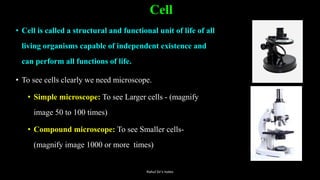
• To see cells clearly we need microscope.
• Simple microscope: To see Larger cells - (magnify
image 50 to 100 times)
• Compound microscope: To see Smaller cells-
(magnify image 1000 or more times)
Rahul Sir's notes
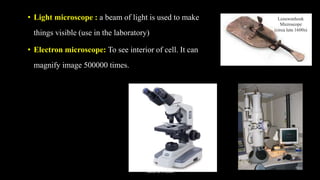
• Light microscope : a beam of light is used to make
things visible (use in the laboratory)
• Electron microscope: To see interior of cell. It can
magnify image 500000 times.
Rahul Sir's notes
Shape and Size
• Shape:
• No typical shape of a cell. It can be varies.
• Spherical, rectangular, flattened, polygonal, oval, triangular, conical, columnar, etc.
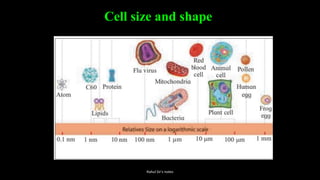
• Cell Size:
• It varies greatly in various plants and animals.
• Some of them are not visible to naked eye. Some are barely visible while some are
microscopic.
• Smallest cell size: Mycoplasma (0.3 μm in length), bacterial cell size is 3 to 5 μm.
• Largest cell size: Ostrich egg (nearly 15cms).
• Longest cells: Nerve cells. Rahul Sir's notes
Cell size and shape
Rahul Sir's notes
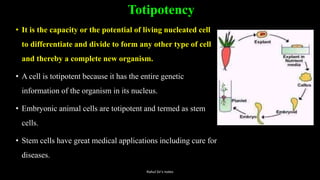
Totipotency
• It is the capacity or the potential of living nucleated cell
to differentiate and divide to form any other type of cell
and thereby a complete new organism.
• A cell is totipotent because it has the entire genetic
information of the organism in its nucleus.
• Embryonic animal cells are totipotent and termed as stem
cells.
• Stem cells have great medical applications including cure for
diseases.
Rahul Sir's notes
Rahul Sir's notes
Postulates of modern cell theory
• Proposed by Schwann and Schleiden.
• Postulates:
• All living organisms are made up of cells.
• Living cells arise from pre-existing cells. (Rudolf Virchow (1855)
• A cell is the structural and functional unit of life.
• Total activities of cells are responsible for activity of an organism.
• Cells show transformation of energy.
• Cells contain nucleic acids; DNA and RNA in the nucleus and cytoplasm.
Rahul Sir's notes
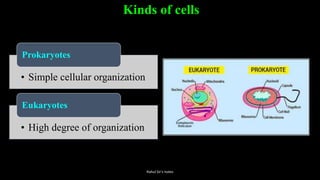
Kinds of cells
• Simple cellular organization
Prokaryotes
• High degree of organization
Eukaryotes
Rahul Sir's notes
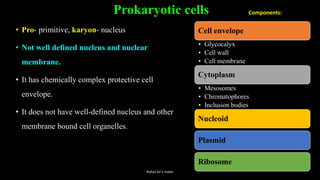
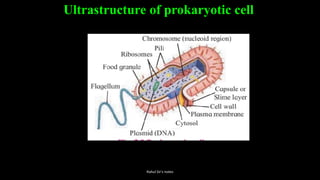
Prokaryotic cells
• Pro- primitive, karyon- nucleus
• Not well defined nucleus and nuclear
membrane.
• It has chemically complex protective cell
envelope.
• It does not have well-defined nucleus and other
membrane bound cell organelles.
Cell envelope
• Glycocalyx
• Cell wall
• Cell membrane
Cytoplasm
• Mesosomes
• Chromatophores
• Inclusion bodies
Nucleoid
Plasmid
Ribosome
Components:
Rahul Sir's notes
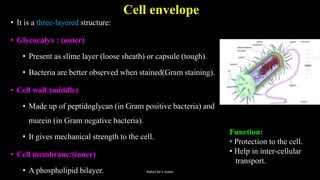
Cell envelope
• It is a three-layered structure:
• Glycocalyx : (outer)
• Present as slime layer (loose sheath) or capsule (tough).
• Bacteria are better observed when stained(Gram staining).
• Cell wall:(middle)
• Made up of peptidoglycan (in Gram positive bacteria) and
murein (in Gram negative bacteria).
• It gives mechanical strength to the cell.
• Cell membrane:(inner)
• A phospholipid bilayer.
Function:
• Protection to the cell.
• Help in inter-cellular
transport.
Rahul Sir's notes
• In motile bacteria either cilia or flagella are found. Both are driven by rotatory
movement produced by basal body (which works as motor).
• Other parts are filament and hook.
• Some other surface projections:
• Tubular pili: Help in inter-cellular communication.
• Fimbriae: For clinging to support.
Rahul Sir's notes
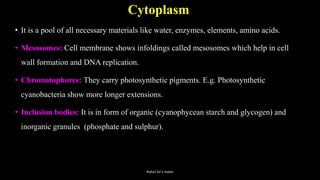
Cytoplasm
• It is a pool of all necessary materials like water, enzymes, elements, amino acids.
• Mesosomes: Cell membrane shows infoldings called mesosomes which help in cell
wall formation and DNA replication.
• Chromatophores: They carry photosynthetic pigments. E.g. Photosynthetic
cyanobacteria show more longer extensions.
• Inclusion bodies: It is in form of organic (cyanophycean starch and glycogen) and
inorganic granules (phosphate and sulphur).
Rahul Sir's notes
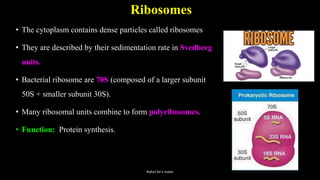
Ribosomes
• The cytoplasm contains dense particles called ribosomes
• They are described by their sedimentation rate in Svedberg
units.
• Bacterial ribosome are 70S (composed of a larger subunit
50S + smaller subunit 30S).
• Many ribosomal units combine to form polyribosomes.
• Function: Protein synthesis.
Rahul Sir's notes
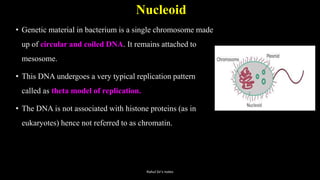
Nucleoid
• Genetic material in bacterium is a single chromosome made
up of circular and coiled DNA. It remains attached to
mesosome.
• This DNA undergoes a very typical replication pattern
called as theta model of replication.
• The DNA is not associated with histone proteins (as in
eukaryotes) hence not referred to as chromatin.
Rahul Sir's notes
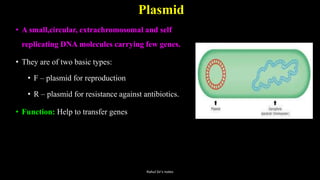
Plasmid
• A small,circular, extrachromosomal and self
replicating DNA molecules carrying few genes.
• They are of two basic types:
• F – plasmid for reproduction
• R – plasmid for resistance against antibiotics.
• Function: Help to transfer genes
Rahul Sir's notes
Ultrastructure of prokaryotic cell
Rahul Sir's notes
History of scientist
• Robert Hooke (1665): The term cell was first used (book ‘‘Micrographic’’).
• Purkinje and Mohl (1835-37) : Protoplasm.
• Camillo Golgi (1838) : Golgi apparatus.
• Robert Brown (1881) : Nucleus.
• Balbiani (1881) : Chromosomes in salivary glands of Chironomus larva.
• Flemming (1882) : Studied cell division in detail and coined the term Mitosis.
• Porter (1945) : Endoplasmic Reticulum.
• C. Benda : Mitochondria.
• C. de Duve (1955) : Lysosomes.
Rahul Sir's notes
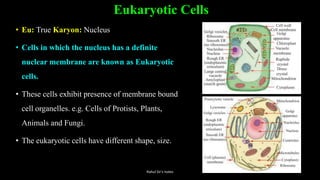
Eukaryotic Cells
• Eu: True Karyon: Nucleus
• Cells in which the nucleus has a definite
nuclear membrane are known as Eukaryotic
cells.
• These cells exhibit presence of membrane bound
cell organelles. e.g. Cells of Protists, Plants,
Animals and Fungi.
• The eukaryotic cells have different shape, size.
Rahul Sir's notes
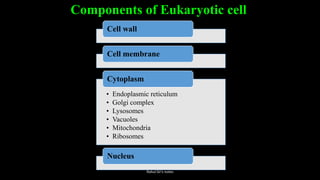
Components of Eukaryotic cell
Cell wall
Cell membrane
• Endoplasmic reticulum
• Golgi complex
• Lysosomes
• Vacuoles
• Mitochondria
• Ribosomes
Cytoplasm
Nucleus
Rahul Sir's notes
Cell wall
• It is outer covering of plasma membrane of plant cells, fungi and some protists.
• Absent in animal cell.
• Algae: Presence of cellulose, galactans, mannans and minerals like calcium
carbonate in cell wall.
• Plants: Made up of hemicelluloses, pectin, lipids and protein.
• Microfibrils of plant cell wall show presence of cellulose which is responsible for
rigidity. Some of the depositions of cell wall are silica (grass stem), cutin (epidermal
walls of land plants), suberin (endodermal cells of root), wax, lignin.
Rahul Sir's notes
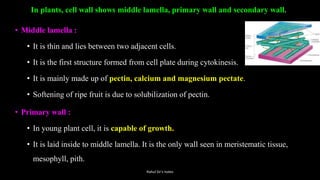
In plants, cell wall shows middle lamella, primary wall and secondary wall.
• Middle lamella :
• It is thin and lies between two adjacent cells.
• It is the first structure formed from cell plate during cytokinesis.
• It is mainly made up of pectin, calcium and magnesium pectate.
• Softening of ripe fruit is due to solubilization of pectin.
• Primary wall :
• In young plant cell, it is capable of growth.
• It is laid inside to middle lamella. It is the only wall seen in meristematic tissue,
mesophyll, pith.
Rahul Sir's notes
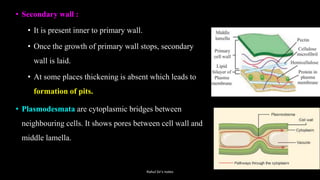
• Secondary wall :
• It is present inner to primary wall.
• Once the growth of primary wall stops, secondary
wall is laid.
• At some places thickening is absent which leads to
formation of pits.
• Plasmodesmata are cytoplasmic bridges between
neighbouring cells. It shows pores between cell wall and
middle lamella.
Rahul Sir's notes
Function
• Protection from mechanical injury and infections.
• Rigidity
• Support
• Shape to the cell.
• Exchange of nutrient
Rahul Sir's notes
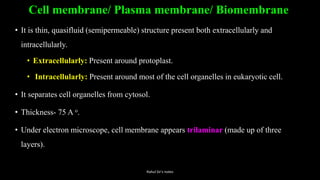
Cell membrane/ Plasma membrane/ Biomembrane
• It is thin, quasifluid (semipermeable) structure present both extracellularly and
intracellularly.
• Extracellularly: Present around protoplast.
• Intracellularly: Present around most of the cell organelles in eukaryotic cell.
• It separates cell organelles from cytosol.
• Thickness- 75 A o.
• Under electron microscope, cell membrane appears trilaminar (made up of three
layers).
Rahul Sir's notes
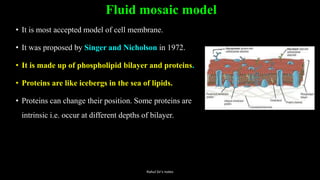
Fluid mosaic model
• It is most accepted model of cell membrane.
• It was proposed by Singer and Nicholson in 1972.
• It is made up of phospholipid bilayer and proteins.
• Proteins are like icebergs in the sea of lipids.
• Proteins can change their position. Some proteins are
intrinsic i.e. occur at different depths of bilayer.
Rahul Sir's notes
Fluid mosaic model
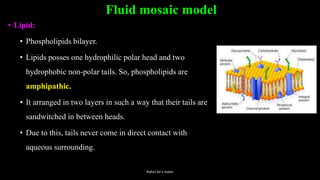
• Lipid:
• Phospholipids bilayer.
• Lipids posses one hydrophilic polar head and two
hydrophobic non-polar tails. So, phospholipids are
amphipathic.
• It arranged in two layers in such a way that their tails are
sandwitched in between heads.
• Due to this, tails never come in direct contact with
aqueous surrounding.
Rahul Sir's notes
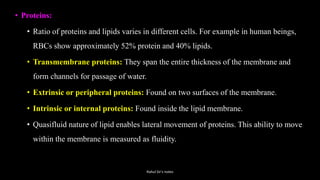
• Proteins:
• Ratio of proteins and lipids varies in different cells. For example in human beings,
RBCs show approximately 52% protein and 40% lipids.
• Transmembrane proteins: They span the entire thickness of the membrane and
form channels for passage of water.
• Extrinsic or peripheral proteins: Found on two surfaces of the membrane.
• Intrinsic or internal proteins: Found inside the lipid membrane.
• Quasifluid nature of lipid enables lateral movement of proteins. This ability to move
within the membrane is measured as fluidity.
Rahul Sir's notes
Function
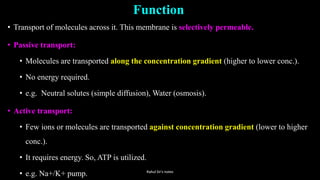
• Transport of molecules across it. This membrane is selectively permeable.
• Passive transport:
• Molecules are transported along the concentration gradient (higher to lower conc.).
• No energy required.
• e.g. Neutral solutes (simple diffusion), Water (osmosis).
• Active transport:
• Few ions or molecules are transported against concentration gradient (lower to higher
conc.).
• It requires energy. So, ATP is utilized.
• e.g. Na+/K+ pump. Rahul Sir's notes
Rahul Sir's notes
Cytoplasm
• The cell contains ground substance called cytoplasmic matrix or cytosol.
• This colloidal jelly like material is not static.
• It shows streaming movements called cyclosis.
• It contains water as major component along with organic and inorganic molecules like
sugars, amino acids, vitamins, enzymes, nucleotides, minerals and waste products.
• It also contains various cell organelles like endoplasmic reticulum, Golgi complex,
mitochondria, plastids, nucleus, microbodies and cytoskeletal elements like
microtubules.
• Cytoplasm acts as a source of raw materials as well as seat for various metabolic
activities taking place in the cell. Rahul Sir's notes
• It helps in distribution and exchange of materials between various cell organelles.
• Cell organelles carry out specific functions. Some of them coordinate with each other
and complete specific tasks for the cell.
• Endomembrane system of the cell:
• A group of Nuclear membrane, endoplasmic reticulum, Golgi complex, lysosomes
and various types of vesicles and vacuoles. (Except Organelles having distinct
functions e.g. mitochondria or chloroplast)
Rahul Sir's notes
Endoplasmic Reticulum (ER)
• This little network within the cytosol is present in all eukaryotic cells except ova and
mature red blood corpuscles.
• Membrane of Endoplasmic reticulum is continuous with nuclear envelope at one end
and extends till cell membrane.
• Under the electron microscope, it appears like network of membranous tubules and
sacs called cisternae.
• It forms more than 50% of the total membrane of a eukaryotic cell.
• This divides the cytoplasm in two parts viz;
• Laminal cytoplasm: lumen of ER
• Non-laminal cytoplasm: lies outside ER.
Rahul Sir's notes
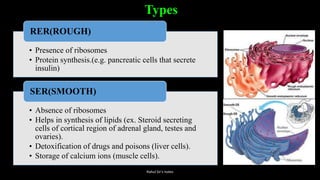
Types
• Presence of ribosomes
• Protein synthesis.(e.g. pancreatic cells that secrete
insulin)
RER(ROUGH)
• Absence of ribosomes
• Helps in synthesis of lipids (ex. Steroid secreting
cells of cortical region of adrenal gland, testes and
ovaries).
• Detoxification of drugs and poisons (liver cells).
• Storage of calcium ions (muscle cells).
SER(SMOOTH)
Rahul Sir's notes
Function
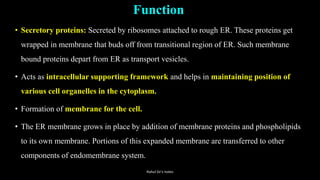
• Secretory proteins: Secreted by ribosomes attached to rough ER. These proteins get
wrapped in membrane that buds off from transitional region of ER. Such membrane
bound proteins depart from ER as transport vesicles.
• Acts as intracellular supporting framework and helps in maintaining position of
various cell organelles in the cytoplasm.
• Formation of membrane for the cell.
• The ER membrane grows in place by addition of membrane proteins and phospholipids
to its own membrane. Portions of this expanded membrane are transferred to other
components of endomembrane system.
Rahul Sir's notes
Golgi complex /Golgi apparatus /Golgi body
• Manufacturing cum packaging and transport unit of cell.
• Consists of stacks of membranous sacs called cisternae.
• Cisternae:
• Diameter- 0.5 to 1 μm, Few or many.
• The thickness and molecular composition of two membranes of a Golgi sac differ
from each other.
• Cisternae contain specific enzymes for specific functions.
• They are not physically connected to each other as that are in ER.
Rahul Sir's notes
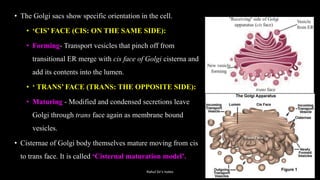
• The Golgi sacs show specific orientation in the cell.
• ‘CIS’ FACE (CIS: ON THE SAME SIDE):
• Forming- Transport vesicles that pinch off from
transitional ER merge with cis face of Golgi cisterna and
add its contents into the lumen.
• ‘ TRANS’ FACE (TRANS: THE OPPOSITE SIDE):
• Maturing - Modified and condensed secretions leave
Golgi through trans face again as membrane bound
vesicles.
• Cisternae of Golgi body themselves mature moving from cis
to trans face. It is called ‘Cisternal maturation model’.
Rahul Sir's notes
Function
• Modification of secretions of ER and production of its own secretions.
• Refining of product takes place in an orderly manner. For example, glycolipids and
glycoproteins that are brought from ER loose certain sugars and regain other, thus
forming a variety of products.
• Golgi bodies in many plant cells produce non-cellulose polysaccharides like pectin.
• Manufactured or modified, all products of Golgi complex leave cisternae from trans
face as transport vesicles. While they are leaving from the Golgi, certain markers may
get impregnated on their membrane so that they can identify their specific target cell or
cell organelle.
Rahul Sir's notes
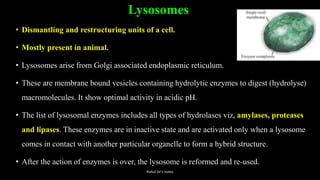
Lysosomes
• Dismantling and restructuring units of a cell.
• Mostly present in animal.
• Lysosomes arise from Golgi associated endoplasmic reticulum.
• These are membrane bound vesicles containing hydrolytic enzymes to digest (hydrolyse)
macromolecules. It show optimal activity in acidic pH.
• The list of lysosomal enzymes includes all types of hydrolases viz, amylases, proteases
and lipases. These enzymes are in inactive state and are activated only when a lysosome
comes in contact with another particular organelle to form a hybrid structure.
• After the action of enzymes is over, the lysosome is reformed and re-used.
Rahul Sir's notes
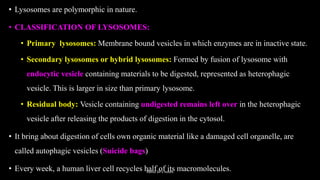
• Lysosomes are polymorphic in nature.
• CLASSIFICATION OF LYSOSOMES:
• Primary lysosomes: Membrane bound vesicles in which enzymes are in inactive state.
• Secondary lysosomes or hybrid lysosomes: Formed by fusion of lysosome with
endocytic vesicle containing materials to be digested, represented as heterophagic
vesicle. This is larger in size than primary lysosome.
• Residual body: Vesicle containing undigested remains left over in the heterophagic
vesicle after releasing the products of digestion in the cytosol.
• It bring about digestion of cells own organic material like a damaged cell organelle, are
called autophagic vesicles (Suicide bags)
• Every week, a human liver cell recycles half of its macromolecules.
Rahul Sir's notes
Type of digestion
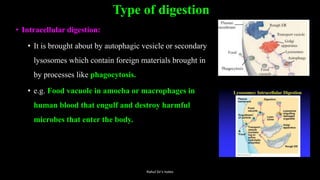
• Intracellular digestion:
• It is brought about by autophagic vesicle or secondary
lysosomes which contain foreign materials brought in
by processes like phagocytosis.
• e.g. Food vacuole in amoeba or macrophages in
human blood that engulf and destroy harmful
microbes that enter the body.
Rahul Sir's notes
• Extracellular digestion:
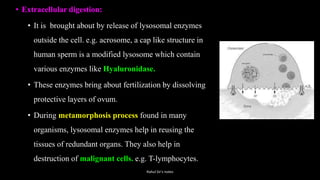
• It is brought about by release of lysosomal enzymes
outside the cell. e.g. acrosome, a cap like structure in
human sperm is a modified lysosome which contain
various enzymes like Hyaluronidase.
• These enzymes bring about fertilization by dissolving
protective layers of ovum.
• During metamorphosis process found in many
organisms, lysosomal enzymes help in reusing the
tissues of redundant organs. They also help in
destruction of malignant cells. e.g. T-lymphocytes.
Rahul Sir's notes
• Lysosomal enzymes do not digest their own membrane proteins. Three-dimensional
shape of these proteins probably protects the membrane.
• Accidental release of lysosomal enzymes in limited amount does not harm the cell
because pH of cytosol is near neutral.
• Any insufficiency in secretion of lysosomal enzymes leads to disorders e.g. in genetic
disorder, Tay Sach’s disease, due to insufficiency of lipase, brain gets impaired due to
accumulation of fats.
Rahul Sir's notes
Vacuoles
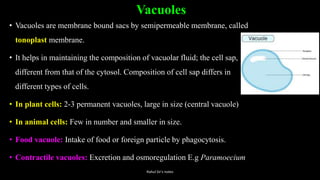
• Vacuoles are membrane bound sacs by semipermeable membrane, called
tonoplast membrane.
• It helps in maintaining the composition of vacuolar fluid; the cell sap,
different from that of the cytosol. Composition of cell sap differs in
different types of cells.
• In plant cells: 2-3 permanent vacuoles, large in size (central vacuole)
• In animal cells: Few in number and smaller in size.
• Food vacuole: Intake of food or foreign particle by phagocytosis.
• Contractile vacuoles: Excretion and osmoregulation E.g Paramoecium
Rahul Sir's notes
Function
• Store house of various ions and thus is hypertonic to cytosol.
• Small vacuoles in seeds of certain plants store organic materials like proteins.
• Vacuoles store excretory products or even compounds that are harmful or unpalatable
to herbivores, thereby protecting the plants.
• Attractive colours of the petals are due to storage of such pigments in vacuoles.
• Maintain turgidity of the cell.
Rahul Sir's notes
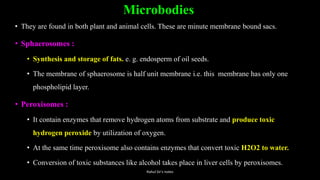
Microbodies
• They are found in both plant and animal cells. These are minute membrane bound sacs.
• Sphaerosomes :
• Synthesis and storage of fats. e. g. endosperm of oil seeds.
• The membrane of sphaerosome is half unit membrane i.e. this membrane has only one
phospholipid layer.
• Peroxisomes :
• It contain enzymes that remove hydrogen atoms from substrate and produce toxic
hydrogen peroxide by utilization of oxygen.
• At the same time peroxisome also contains enzymes that convert toxic H2O2 to water.
• Conversion of toxic substances like alcohol takes place in liver cells by peroxisomes.
Rahul Sir's notes
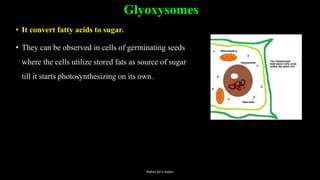
Glyoxysomes
• It convert fatty acids to sugar.
• They can be observed in cells of germinating seeds
where the cells utilize stored fats as source of sugar
till it starts photosynthesizing on its own.
Rahul Sir's notes
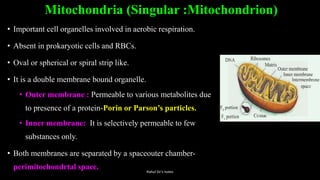
Mitochondria (Singular :Mitochondrion)
• Important cell organelles involved in aerobic respiration.
• Absent in prokaryotic cells and RBCs.
• Oval or spherical or spiral strip like.
• It is a double membrane bound organelle.
• Outer membrane : Permeable to various metabolites due
to presence of a protein-Porin or Parson’s particles.
• Inner membrane: It is selectively permeable to few
substances only.
• Both membranes are separated by a spaceouter chamber-
perimitochondrtal space. Rahul Sir's notes
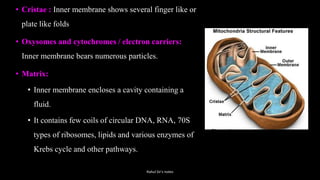
• Cristae : Inner membrane shows several finger like or
plate like folds
• Oxysomes and cytochromes / electron carriers:
Inner membrane bears numerous particles.
• Matrix:
• Inner membrane encloses a cavity containing a
fluid.
• It contains few coils of circular DNA, RNA, 70S
types of ribosomes, lipids and various enzymes of
Krebs cycle and other pathways.
Rahul Sir's notes
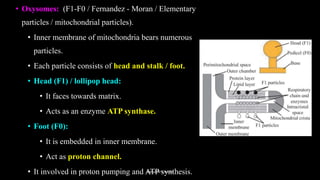
• Oxysomes: (F1-F0 / Fernandez - Moran / Elementary
particles / mitochondrial particles).
• Inner membrane of mitochondria bears numerous
particles.
• Each particle consists of head and stalk / foot.
• Head (F1) / lollipop head:
• It faces towards matrix.
• Acts as an enzyme ATP synthase.
• Foot (F0):
• It is embedded in inner membrane.
• Act as proton channel.
• It involved in proton pumping and ATP synthesis.
Rahul Sir's notes
Plastids
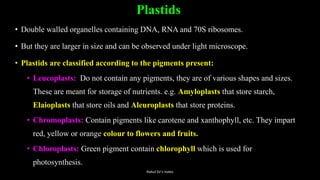
• Double walled organelles containing DNA, RNA and 70S ribosomes.
• But they are larger in size and can be observed under light microscope.
• Plastids are classified according to the pigments present:
• Leucoplasts: Do not contain any pigments, they are of various shapes and sizes.
These are meant for storage of nutrients. e.g. Amyloplasts that store starch,
Elaioplasts that store oils and Aleuroplasts that store proteins.
• Chromoplasts: Contain pigments like carotene and xanthophyll, etc. They impart
red, yellow or orange colour to flowers and fruits.
• Chloroplasts: Green pigment contain chlorophyll which is used for
photosynthesis.
Rahul Sir's notes
Chloroplast
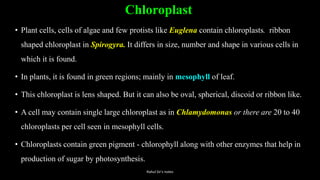
• Plant cells, cells of algae and few protists like Euglena contain chloroplasts. ribbon
shaped chloroplast in Spirogyra. It differs in size, number and shape in various cells in
which it is found.
• In plants, it is found in green regions; mainly in mesophyll of leaf.
• This chloroplast is lens shaped. But it can also be oval, spherical, discoid or ribbon like.
• A cell may contain single large chloroplast as in Chlamydomonas or there are 20 to 40
chloroplasts per cell seen in mesophyll cells.
• Chloroplasts contain green pigment - chlorophyll along with other enzymes that help in
production of sugar by photosynthesis.
Rahul Sir's notes
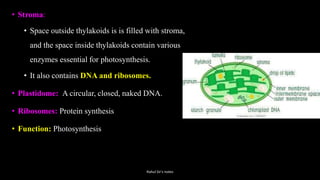
Structure
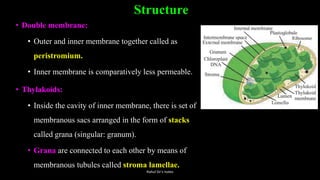
• Double membrane:
• Outer and inner membrane together called as
peristromium.
• Inner membrane is comparatively less permeable.
• Thylakoids:
• Inside the cavity of inner membrane, there is set of
membranous sacs arranged in the form of stacks
called grana (singular: granum).
• Grana are connected to each other by means of
membranous tubules called stroma lamellae.
Rahul Sir's notes
• Stroma:
• Space outside thylakoids is is filled with stroma,
and the space inside thylakoids contain various
enzymes essential for photosynthesis.
• It also contains DNA and ribosomes.
• Plastidome: A circular, closed, naked DNA.
• Ribosomes: Protein synthesis
• Function: Photosynthesis
Rahul Sir's notes
Something interesting
• Both mitochondria and chloroplast are double walled organelles, they have DNA and
ribosomes and can duplicate within the cell on their own!
• It is considered that primitive eukaryotic cell engulfed an aerobic nonphotosynthetic
prokaryotic cell.
• This guest cell developed symbiotic relationship with the host cell. In course of
evolution, both merged as a single cell with a mitochondrion.
• One of these cells might have engulfed photosynthetic prokaryote and evolved into
photosynthetic eukaryotic cells. This is called ‘Endosymbiont theory’ i.e. coexistence
of cell within cell!
Rahul Sir's notes
Ribosomes
• Ribosomes were first observed as dense particles in electron
micrograph of a cell by scientist Pallade in 1953.
• Ribosomes are made up of Ribosomal RNA and proteins.
• They do not have any membranous covering around them.
• In a eukaryotic cell, ribosomes are present in mitochondria,
plastids and in cytosol found attached to outer surface of
RER and nuclear membrane.
• Both are similar in structure and are 80S type.
Rahul Sir's notes
• Bound ribosomes: Produce proteins that are transported outside the cell after
processing in ER and Golgi body. e.g. Bound ribosomes of acinar cells of pancreas
produce pancreatic digestive enzymes.
• Free ribosomes: It come together and form chains called polyribosomes for protein
synthesis. Free ribosomes generally produce enzymatic proteins that are used up in
cytoplasm like enzymes required for breakdown of sugar.
• Both types of ribosomes can interchange position and function.
• Number of ribosome's is high in cells actively engaged in protein synthesis.
Rahul Sir's notes
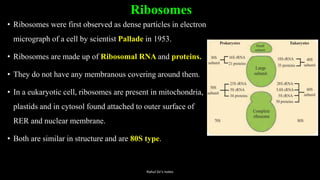
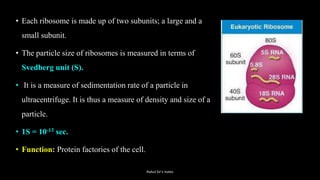
• Each ribosome is made up of two subunits; a large and a
small subunit.
• The particle size of ribosomes is measured in terms of
Svedberg unit (S).
• It is a measure of sedimentation rate of a particle in
ultracentrifuge. It is thus a measure of density and size of a
particle.
• 1S = 10-13 sec.
• Function: Protein factories of the cell.
Rahul Sir's notes
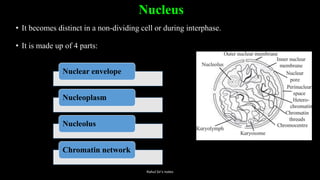
Nucleus
• It becomes distinct in a non-dividing cell or during interphase.
• It is made up of 4 parts:
Nuclear envelope
Nucleoplasm
Nucleolus
Chromatin network
Rahul Sir's notes
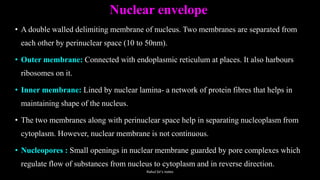
Nuclear envelope
• A double walled delimiting membrane of nucleus. Two membranes are separated from
each other by perinuclear space (10 to 50nm).
• Outer membrane: Connected with endoplasmic reticulum at places. It also harbours
ribosomes on it.
• Inner membrane: Lined by nuclear lamina- a network of protein fibres that helps in
maintaining shape of the nucleus.
• The two membranes along with perinuclear space help in separating nucleoplasm from
cytoplasm. However, nuclear membrane is not continuous.
• Nucleopores : Small openings in nuclear membrane guarded by pore complexes which
regulate flow of substances from nucleus to cytoplasm and in reverse direction.
Rahul Sir's notes
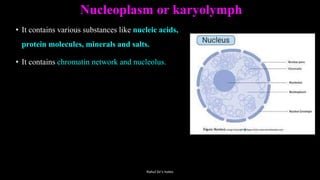
Nucleoplasm or karyolymph
• It contains various substances like nucleic acids,
protein molecules, minerals and salts.
• It contains chromatin network and nucleolus.
Rahul Sir's notes
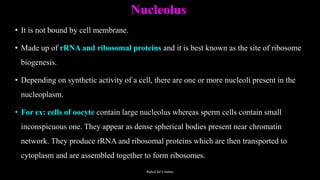
Nucleolus
• It is not bound by cell membrane.
• Made up of rRNA and ribosomal proteins and it is best known as the site of ribosome
biogenesis.
• Depending on synthetic activity of a cell, there are one or more nucleoli present in the
nucleoplasm.
• For ex: cells of oocyte contain large nucleolus whereas sperm cells contain small
inconspicuous one. They appear as dense spherical bodies present near chromatin
network. They produce rRNA and ribosomal proteins which are then transported to
cytoplasm and are assembled together to form ribosomes.
Rahul Sir's notes
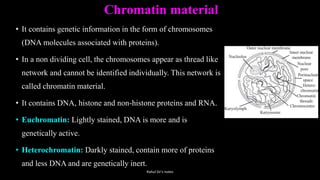
Chromatin material
• It contains genetic information in the form of chromosomes
(DNA molecules associated with proteins).
• In a non dividing cell, the chromosomes appear as thread like
network and cannot be identified individually. This network is
called chromatin material.
• It contains DNA, histone and non-histone proteins and RNA.
• Euchromatin: Lightly stained, DNA is more and is
genetically active.
• Heterochromatin: Darkly stained, contain more of proteins
and less DNA and are genetically inert.
Rahul Sir's notes
• When the cell prepares to divide, the chromosomes coil and get condensed. At
metaphase stage, they become distinct and can be clearly identified.
• Every species of living organism has specific number of chromosomes like normal
human cell has 46.
• Chromosome number being constant for a species, it is important in phylogenetic
studies.
Rahul Sir's notes
Role of nucleus
• It contains entire genetic information, hence play important role in heredity and
variation.
• It is the site for synthesis of DNA, RNA and ribosomes.
• It plays important role in protein synthesis.
• Nucleus thus is the master cell organelle.
Rahul Sir's notes
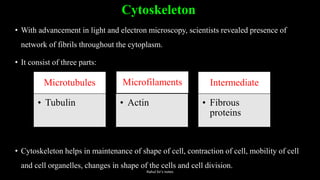
Cytoskeleton
• With advancement in light and electron microscopy, scientists revealed presence of
network of fibrils throughout the cytoplasm.
• It consist of three parts:
• Cytoskeleton helps in maintenance of shape of cell, contraction of cell, mobility of cell
and cell organelles, changes in shape of the cells and cell division.
Microtubules
• Tubulin
Microfilaments
• Actin
Intermediate
• Fibrous
proteins
Rahul Sir's notes
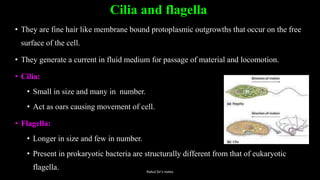
Cilia and flagella
• They are fine hair like membrane bound protoplasmic outgrowths that occur on the free
surface of the cell.
• They generate a current in fluid medium for passage of material and locomotion.
• Cilia:
• Small in size and many in number.
• Act as oars causing movement of cell.
• Flagella:
• Longer in size and few in number.
• Present in prokaryotic bacteria are structurally different from that of eukaryotic
flagella. Rahul Sir's notes
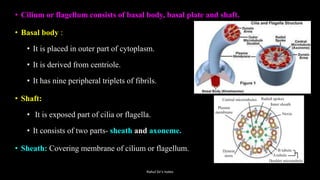
• Cilium or flagellum consists of basal body, basal plate and shaft.
• Basal body :
• It is placed in outer part of cytoplasm.
• It is derived from centriole.
• It has nine peripheral triplets of fibrils.
• Shaft:
• It is exposed part of cilia or flagella.
• It consists of two parts- sheath and axoneme.
• Sheath: Covering membrane of cilium or flagellum.
Rahul Sir's notes
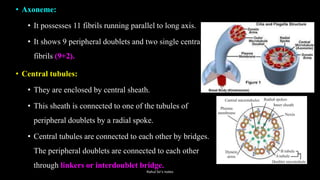
• Axoneme:
• It possesses 11 fibrils running parallel to long axis.
• It shows 9 peripheral doublets and two single central
fibrils (9+2).
• Central tubules:
• They are enclosed by central sheath.
• This sheath is connected to one of the tubules of
peripheral doublets by a radial spoke.
• Central tubules are connected to each other by bridges.
The peripheral doublets are connected to each other
through linkers or interdoublet bridge.
Rahul Sir's notes
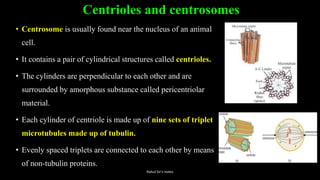
Centrioles and centrosomes
• Centrosome is usually found near the nucleus of an animal
cell.
• It contains a pair of cylindrical structures called centrioles.
• The cylinders are perpendicular to each other and are
surrounded by amorphous substance called pericentriolar
material.
• Each cylinder of centriole is made up of nine sets of triplet
microtubules made up of tubulin.
• Evenly spaced triplets are connected to each other by means
of non-tubulin proteins.
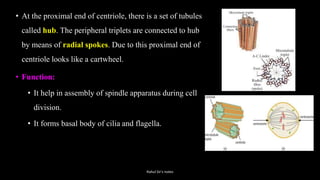
Rahul Sir's notes
• At the proximal end of centriole, there is a set of tubules
called hub. The peripheral triplets are connected to hub
by means of radial spokes. Due to this proximal end of
centriole looks like a cartwheel.
• Function:
• It help in assembly of spindle apparatus during cell
division.
• It forms basal body of cilia and flagella.
Rahul Sir's notes
Rahul Sir's notes

Chp5.cell structure and organization

  • 1.
    CHAPTER 5. CELL STRUCTUREAND ORGANIZATION Prof. RAHUL MORE XI BIOLOGY
  • 2.
    Cell • Cell iscalled a structural and functional unit of life of all living organisms capable of independent existence and can perform all functions of life. • To see cells clearly we need microscope. • Simple microscope: To see Larger cells - (magnify image 50 to 100 times) • Compound microscope: To see Smaller cells- (magnify image 1000 or more times) Rahul Sir's notes
  • 3.
    • Light microscope: a beam of light is used to make things visible (use in the laboratory) • Electron microscope: To see interior of cell. It can magnify image 500000 times. Rahul Sir's notes
  • 4.
    Shape and Size •Shape: • No typical shape of a cell. It can be varies. • Spherical, rectangular, flattened, polygonal, oval, triangular, conical, columnar, etc. • Cell Size: • It varies greatly in various plants and animals. • Some of them are not visible to naked eye. Some are barely visible while some are microscopic. • Smallest cell size: Mycoplasma (0.3 μm in length), bacterial cell size is 3 to 5 μm. • Largest cell size: Ostrich egg (nearly 15cms). • Longest cells: Nerve cells. Rahul Sir's notes
  • 5.
    Cell size andshape Rahul Sir's notes
  • 6.
    Totipotency • It isthe capacity or the potential of living nucleated cell to differentiate and divide to form any other type of cell and thereby a complete new organism. • A cell is totipotent because it has the entire genetic information of the organism in its nucleus. • Embryonic animal cells are totipotent and termed as stem cells. • Stem cells have great medical applications including cure for diseases. Rahul Sir's notes
  • 7.
  • 8.
    Postulates of moderncell theory • Proposed by Schwann and Schleiden. • Postulates: • All living organisms are made up of cells. • Living cells arise from pre-existing cells. (Rudolf Virchow (1855) • A cell is the structural and functional unit of life. • Total activities of cells are responsible for activity of an organism. • Cells show transformation of energy. • Cells contain nucleic acids; DNA and RNA in the nucleus and cytoplasm. Rahul Sir's notes
  • 9.
    Kinds of cells •Simple cellular organization Prokaryotes • High degree of organization Eukaryotes Rahul Sir's notes
  • 10.
    Prokaryotic cells • Pro-primitive, karyon- nucleus • Not well defined nucleus and nuclear membrane. • It has chemically complex protective cell envelope. • It does not have well-defined nucleus and other membrane bound cell organelles. Cell envelope • Glycocalyx • Cell wall • Cell membrane Cytoplasm • Mesosomes • Chromatophores • Inclusion bodies Nucleoid Plasmid Ribosome Components: Rahul Sir's notes
  • 11.
    Cell envelope • Itis a three-layered structure: • Glycocalyx : (outer) • Present as slime layer (loose sheath) or capsule (tough). • Bacteria are better observed when stained(Gram staining). • Cell wall:(middle) • Made up of peptidoglycan (in Gram positive bacteria) and murein (in Gram negative bacteria). • It gives mechanical strength to the cell. • Cell membrane:(inner) • A phospholipid bilayer. Function: • Protection to the cell. • Help in inter-cellular transport. Rahul Sir's notes
  • 12.
    • In motilebacteria either cilia or flagella are found. Both are driven by rotatory movement produced by basal body (which works as motor). • Other parts are filament and hook. • Some other surface projections: • Tubular pili: Help in inter-cellular communication. • Fimbriae: For clinging to support. Rahul Sir's notes
  • 13.
    Cytoplasm • It isa pool of all necessary materials like water, enzymes, elements, amino acids. • Mesosomes: Cell membrane shows infoldings called mesosomes which help in cell wall formation and DNA replication. • Chromatophores: They carry photosynthetic pigments. E.g. Photosynthetic cyanobacteria show more longer extensions. • Inclusion bodies: It is in form of organic (cyanophycean starch and glycogen) and inorganic granules (phosphate and sulphur). Rahul Sir's notes
  • 14.
    Ribosomes • The cytoplasmcontains dense particles called ribosomes • They are described by their sedimentation rate in Svedberg units. • Bacterial ribosome are 70S (composed of a larger subunit 50S + smaller subunit 30S). • Many ribosomal units combine to form polyribosomes. • Function: Protein synthesis. Rahul Sir's notes
  • 15.
    Nucleoid • Genetic materialin bacterium is a single chromosome made up of circular and coiled DNA. It remains attached to mesosome. • This DNA undergoes a very typical replication pattern called as theta model of replication. • The DNA is not associated with histone proteins (as in eukaryotes) hence not referred to as chromatin. Rahul Sir's notes
  • 16.
    Plasmid • A small,circular,extrachromosomal and self replicating DNA molecules carrying few genes. • They are of two basic types: • F – plasmid for reproduction • R – plasmid for resistance against antibiotics. • Function: Help to transfer genes Rahul Sir's notes
  • 17.
    Ultrastructure of prokaryoticcell Rahul Sir's notes
  • 18.
    History of scientist •Robert Hooke (1665): The term cell was first used (book ‘‘Micrographic’’). • Purkinje and Mohl (1835-37) : Protoplasm. • Camillo Golgi (1838) : Golgi apparatus. • Robert Brown (1881) : Nucleus. • Balbiani (1881) : Chromosomes in salivary glands of Chironomus larva. • Flemming (1882) : Studied cell division in detail and coined the term Mitosis. • Porter (1945) : Endoplasmic Reticulum. • C. Benda : Mitochondria. • C. de Duve (1955) : Lysosomes. Rahul Sir's notes
  • 19.
    Eukaryotic Cells • Eu:True Karyon: Nucleus • Cells in which the nucleus has a definite nuclear membrane are known as Eukaryotic cells. • These cells exhibit presence of membrane bound cell organelles. e.g. Cells of Protists, Plants, Animals and Fungi. • The eukaryotic cells have different shape, size. Rahul Sir's notes
  • 20.
    Components of Eukaryoticcell Cell wall Cell membrane • Endoplasmic reticulum • Golgi complex • Lysosomes • Vacuoles • Mitochondria • Ribosomes Cytoplasm Nucleus Rahul Sir's notes
  • 21.
    Cell wall • Itis outer covering of plasma membrane of plant cells, fungi and some protists. • Absent in animal cell. • Algae: Presence of cellulose, galactans, mannans and minerals like calcium carbonate in cell wall. • Plants: Made up of hemicelluloses, pectin, lipids and protein. • Microfibrils of plant cell wall show presence of cellulose which is responsible for rigidity. Some of the depositions of cell wall are silica (grass stem), cutin (epidermal walls of land plants), suberin (endodermal cells of root), wax, lignin. Rahul Sir's notes
  • 22.
    In plants, cellwall shows middle lamella, primary wall and secondary wall. • Middle lamella : • It is thin and lies between two adjacent cells. • It is the first structure formed from cell plate during cytokinesis. • It is mainly made up of pectin, calcium and magnesium pectate. • Softening of ripe fruit is due to solubilization of pectin. • Primary wall : • In young plant cell, it is capable of growth. • It is laid inside to middle lamella. It is the only wall seen in meristematic tissue, mesophyll, pith. Rahul Sir's notes
  • 23.
    • Secondary wall: • It is present inner to primary wall. • Once the growth of primary wall stops, secondary wall is laid. • At some places thickening is absent which leads to formation of pits. • Plasmodesmata are cytoplasmic bridges between neighbouring cells. It shows pores between cell wall and middle lamella. Rahul Sir's notes
  • 24.
    Function • Protection frommechanical injury and infections. • Rigidity • Support • Shape to the cell. • Exchange of nutrient Rahul Sir's notes
  • 25.
    Cell membrane/ Plasmamembrane/ Biomembrane • It is thin, quasifluid (semipermeable) structure present both extracellularly and intracellularly. • Extracellularly: Present around protoplast. • Intracellularly: Present around most of the cell organelles in eukaryotic cell. • It separates cell organelles from cytosol. • Thickness- 75 A o. • Under electron microscope, cell membrane appears trilaminar (made up of three layers). Rahul Sir's notes
  • 26.
    Fluid mosaic model •It is most accepted model of cell membrane. • It was proposed by Singer and Nicholson in 1972. • It is made up of phospholipid bilayer and proteins. • Proteins are like icebergs in the sea of lipids. • Proteins can change their position. Some proteins are intrinsic i.e. occur at different depths of bilayer. Rahul Sir's notes
  • 27.
    Fluid mosaic model •Lipid: • Phospholipids bilayer. • Lipids posses one hydrophilic polar head and two hydrophobic non-polar tails. So, phospholipids are amphipathic. • It arranged in two layers in such a way that their tails are sandwitched in between heads. • Due to this, tails never come in direct contact with aqueous surrounding. Rahul Sir's notes
  • 28.
    • Proteins: • Ratioof proteins and lipids varies in different cells. For example in human beings, RBCs show approximately 52% protein and 40% lipids. • Transmembrane proteins: They span the entire thickness of the membrane and form channels for passage of water. • Extrinsic or peripheral proteins: Found on two surfaces of the membrane. • Intrinsic or internal proteins: Found inside the lipid membrane. • Quasifluid nature of lipid enables lateral movement of proteins. This ability to move within the membrane is measured as fluidity. Rahul Sir's notes
  • 29.
    Function • Transport ofmolecules across it. This membrane is selectively permeable. • Passive transport: • Molecules are transported along the concentration gradient (higher to lower conc.). • No energy required. • e.g. Neutral solutes (simple diffusion), Water (osmosis). • Active transport: • Few ions or molecules are transported against concentration gradient (lower to higher conc.). • It requires energy. So, ATP is utilized. • e.g. Na+/K+ pump. Rahul Sir's notes Rahul Sir's notes
  • 30.
    Cytoplasm • The cellcontains ground substance called cytoplasmic matrix or cytosol. • This colloidal jelly like material is not static. • It shows streaming movements called cyclosis. • It contains water as major component along with organic and inorganic molecules like sugars, amino acids, vitamins, enzymes, nucleotides, minerals and waste products. • It also contains various cell organelles like endoplasmic reticulum, Golgi complex, mitochondria, plastids, nucleus, microbodies and cytoskeletal elements like microtubules. • Cytoplasm acts as a source of raw materials as well as seat for various metabolic activities taking place in the cell. Rahul Sir's notes
  • 31.
    • It helpsin distribution and exchange of materials between various cell organelles. • Cell organelles carry out specific functions. Some of them coordinate with each other and complete specific tasks for the cell. • Endomembrane system of the cell: • A group of Nuclear membrane, endoplasmic reticulum, Golgi complex, lysosomes and various types of vesicles and vacuoles. (Except Organelles having distinct functions e.g. mitochondria or chloroplast) Rahul Sir's notes
  • 32.
    Endoplasmic Reticulum (ER) •This little network within the cytosol is present in all eukaryotic cells except ova and mature red blood corpuscles. • Membrane of Endoplasmic reticulum is continuous with nuclear envelope at one end and extends till cell membrane. • Under the electron microscope, it appears like network of membranous tubules and sacs called cisternae. • It forms more than 50% of the total membrane of a eukaryotic cell. • This divides the cytoplasm in two parts viz; • Laminal cytoplasm: lumen of ER • Non-laminal cytoplasm: lies outside ER. Rahul Sir's notes
  • 33.
    Types • Presence ofribosomes • Protein synthesis.(e.g. pancreatic cells that secrete insulin) RER(ROUGH) • Absence of ribosomes • Helps in synthesis of lipids (ex. Steroid secreting cells of cortical region of adrenal gland, testes and ovaries). • Detoxification of drugs and poisons (liver cells). • Storage of calcium ions (muscle cells). SER(SMOOTH) Rahul Sir's notes
  • 34.
    Function • Secretory proteins:Secreted by ribosomes attached to rough ER. These proteins get wrapped in membrane that buds off from transitional region of ER. Such membrane bound proteins depart from ER as transport vesicles. • Acts as intracellular supporting framework and helps in maintaining position of various cell organelles in the cytoplasm. • Formation of membrane for the cell. • The ER membrane grows in place by addition of membrane proteins and phospholipids to its own membrane. Portions of this expanded membrane are transferred to other components of endomembrane system. Rahul Sir's notes
  • 35.
    Golgi complex /Golgiapparatus /Golgi body • Manufacturing cum packaging and transport unit of cell. • Consists of stacks of membranous sacs called cisternae. • Cisternae: • Diameter- 0.5 to 1 μm, Few or many. • The thickness and molecular composition of two membranes of a Golgi sac differ from each other. • Cisternae contain specific enzymes for specific functions. • They are not physically connected to each other as that are in ER. Rahul Sir's notes
  • 36.
    • The Golgisacs show specific orientation in the cell. • ‘CIS’ FACE (CIS: ON THE SAME SIDE): • Forming- Transport vesicles that pinch off from transitional ER merge with cis face of Golgi cisterna and add its contents into the lumen. • ‘ TRANS’ FACE (TRANS: THE OPPOSITE SIDE): • Maturing - Modified and condensed secretions leave Golgi through trans face again as membrane bound vesicles. • Cisternae of Golgi body themselves mature moving from cis to trans face. It is called ‘Cisternal maturation model’. Rahul Sir's notes
  • 37.
    Function • Modification ofsecretions of ER and production of its own secretions. • Refining of product takes place in an orderly manner. For example, glycolipids and glycoproteins that are brought from ER loose certain sugars and regain other, thus forming a variety of products. • Golgi bodies in many plant cells produce non-cellulose polysaccharides like pectin. • Manufactured or modified, all products of Golgi complex leave cisternae from trans face as transport vesicles. While they are leaving from the Golgi, certain markers may get impregnated on their membrane so that they can identify their specific target cell or cell organelle. Rahul Sir's notes
  • 38.
    Lysosomes • Dismantling andrestructuring units of a cell. • Mostly present in animal. • Lysosomes arise from Golgi associated endoplasmic reticulum. • These are membrane bound vesicles containing hydrolytic enzymes to digest (hydrolyse) macromolecules. It show optimal activity in acidic pH. • The list of lysosomal enzymes includes all types of hydrolases viz, amylases, proteases and lipases. These enzymes are in inactive state and are activated only when a lysosome comes in contact with another particular organelle to form a hybrid structure. • After the action of enzymes is over, the lysosome is reformed and re-used. Rahul Sir's notes
  • 39.
    • Lysosomes arepolymorphic in nature. • CLASSIFICATION OF LYSOSOMES: • Primary lysosomes: Membrane bound vesicles in which enzymes are in inactive state. • Secondary lysosomes or hybrid lysosomes: Formed by fusion of lysosome with endocytic vesicle containing materials to be digested, represented as heterophagic vesicle. This is larger in size than primary lysosome. • Residual body: Vesicle containing undigested remains left over in the heterophagic vesicle after releasing the products of digestion in the cytosol. • It bring about digestion of cells own organic material like a damaged cell organelle, are called autophagic vesicles (Suicide bags) • Every week, a human liver cell recycles half of its macromolecules. Rahul Sir's notes
  • 40.
    Type of digestion •Intracellular digestion: • It is brought about by autophagic vesicle or secondary lysosomes which contain foreign materials brought in by processes like phagocytosis. • e.g. Food vacuole in amoeba or macrophages in human blood that engulf and destroy harmful microbes that enter the body. Rahul Sir's notes
  • 41.
    • Extracellular digestion: •It is brought about by release of lysosomal enzymes outside the cell. e.g. acrosome, a cap like structure in human sperm is a modified lysosome which contain various enzymes like Hyaluronidase. • These enzymes bring about fertilization by dissolving protective layers of ovum. • During metamorphosis process found in many organisms, lysosomal enzymes help in reusing the tissues of redundant organs. They also help in destruction of malignant cells. e.g. T-lymphocytes. Rahul Sir's notes
  • 42.
    • Lysosomal enzymesdo not digest their own membrane proteins. Three-dimensional shape of these proteins probably protects the membrane. • Accidental release of lysosomal enzymes in limited amount does not harm the cell because pH of cytosol is near neutral. • Any insufficiency in secretion of lysosomal enzymes leads to disorders e.g. in genetic disorder, Tay Sach’s disease, due to insufficiency of lipase, brain gets impaired due to accumulation of fats. Rahul Sir's notes
  • 43.
    Vacuoles • Vacuoles aremembrane bound sacs by semipermeable membrane, called tonoplast membrane. • It helps in maintaining the composition of vacuolar fluid; the cell sap, different from that of the cytosol. Composition of cell sap differs in different types of cells. • In plant cells: 2-3 permanent vacuoles, large in size (central vacuole) • In animal cells: Few in number and smaller in size. • Food vacuole: Intake of food or foreign particle by phagocytosis. • Contractile vacuoles: Excretion and osmoregulation E.g Paramoecium Rahul Sir's notes
  • 44.
    Function • Store houseof various ions and thus is hypertonic to cytosol. • Small vacuoles in seeds of certain plants store organic materials like proteins. • Vacuoles store excretory products or even compounds that are harmful or unpalatable to herbivores, thereby protecting the plants. • Attractive colours of the petals are due to storage of such pigments in vacuoles. • Maintain turgidity of the cell. Rahul Sir's notes
  • 45.
    Microbodies • They arefound in both plant and animal cells. These are minute membrane bound sacs. • Sphaerosomes : • Synthesis and storage of fats. e. g. endosperm of oil seeds. • The membrane of sphaerosome is half unit membrane i.e. this membrane has only one phospholipid layer. • Peroxisomes : • It contain enzymes that remove hydrogen atoms from substrate and produce toxic hydrogen peroxide by utilization of oxygen. • At the same time peroxisome also contains enzymes that convert toxic H2O2 to water. • Conversion of toxic substances like alcohol takes place in liver cells by peroxisomes. Rahul Sir's notes
  • 46.
    Glyoxysomes • It convertfatty acids to sugar. • They can be observed in cells of germinating seeds where the cells utilize stored fats as source of sugar till it starts photosynthesizing on its own. Rahul Sir's notes
  • 47.
    Mitochondria (Singular :Mitochondrion) •Important cell organelles involved in aerobic respiration. • Absent in prokaryotic cells and RBCs. • Oval or spherical or spiral strip like. • It is a double membrane bound organelle. • Outer membrane : Permeable to various metabolites due to presence of a protein-Porin or Parson’s particles. • Inner membrane: It is selectively permeable to few substances only. • Both membranes are separated by a spaceouter chamber- perimitochondrtal space. Rahul Sir's notes
  • 48.
    • Cristae :Inner membrane shows several finger like or plate like folds • Oxysomes and cytochromes / electron carriers: Inner membrane bears numerous particles. • Matrix: • Inner membrane encloses a cavity containing a fluid. • It contains few coils of circular DNA, RNA, 70S types of ribosomes, lipids and various enzymes of Krebs cycle and other pathways. Rahul Sir's notes
  • 49.
    • Oxysomes: (F1-F0/ Fernandez - Moran / Elementary particles / mitochondrial particles). • Inner membrane of mitochondria bears numerous particles. • Each particle consists of head and stalk / foot. • Head (F1) / lollipop head: • It faces towards matrix. • Acts as an enzyme ATP synthase. • Foot (F0): • It is embedded in inner membrane. • Act as proton channel. • It involved in proton pumping and ATP synthesis. Rahul Sir's notes
  • 50.
    Plastids • Double walledorganelles containing DNA, RNA and 70S ribosomes. • But they are larger in size and can be observed under light microscope. • Plastids are classified according to the pigments present: • Leucoplasts: Do not contain any pigments, they are of various shapes and sizes. These are meant for storage of nutrients. e.g. Amyloplasts that store starch, Elaioplasts that store oils and Aleuroplasts that store proteins. • Chromoplasts: Contain pigments like carotene and xanthophyll, etc. They impart red, yellow or orange colour to flowers and fruits. • Chloroplasts: Green pigment contain chlorophyll which is used for photosynthesis. Rahul Sir's notes
  • 51.
    Chloroplast • Plant cells,cells of algae and few protists like Euglena contain chloroplasts. ribbon shaped chloroplast in Spirogyra. It differs in size, number and shape in various cells in which it is found. • In plants, it is found in green regions; mainly in mesophyll of leaf. • This chloroplast is lens shaped. But it can also be oval, spherical, discoid or ribbon like. • A cell may contain single large chloroplast as in Chlamydomonas or there are 20 to 40 chloroplasts per cell seen in mesophyll cells. • Chloroplasts contain green pigment - chlorophyll along with other enzymes that help in production of sugar by photosynthesis. Rahul Sir's notes
  • 52.
    Structure • Double membrane: •Outer and inner membrane together called as peristromium. • Inner membrane is comparatively less permeable. • Thylakoids: • Inside the cavity of inner membrane, there is set of membranous sacs arranged in the form of stacks called grana (singular: granum). • Grana are connected to each other by means of membranous tubules called stroma lamellae. Rahul Sir's notes
  • 53.
    • Stroma: • Spaceoutside thylakoids is is filled with stroma, and the space inside thylakoids contain various enzymes essential for photosynthesis. • It also contains DNA and ribosomes. • Plastidome: A circular, closed, naked DNA. • Ribosomes: Protein synthesis • Function: Photosynthesis Rahul Sir's notes
  • 54.
    Something interesting • Bothmitochondria and chloroplast are double walled organelles, they have DNA and ribosomes and can duplicate within the cell on their own! • It is considered that primitive eukaryotic cell engulfed an aerobic nonphotosynthetic prokaryotic cell. • This guest cell developed symbiotic relationship with the host cell. In course of evolution, both merged as a single cell with a mitochondrion. • One of these cells might have engulfed photosynthetic prokaryote and evolved into photosynthetic eukaryotic cells. This is called ‘Endosymbiont theory’ i.e. coexistence of cell within cell! Rahul Sir's notes
  • 55.
    Ribosomes • Ribosomes werefirst observed as dense particles in electron micrograph of a cell by scientist Pallade in 1953. • Ribosomes are made up of Ribosomal RNA and proteins. • They do not have any membranous covering around them. • In a eukaryotic cell, ribosomes are present in mitochondria, plastids and in cytosol found attached to outer surface of RER and nuclear membrane. • Both are similar in structure and are 80S type. Rahul Sir's notes
  • 56.
    • Bound ribosomes:Produce proteins that are transported outside the cell after processing in ER and Golgi body. e.g. Bound ribosomes of acinar cells of pancreas produce pancreatic digestive enzymes. • Free ribosomes: It come together and form chains called polyribosomes for protein synthesis. Free ribosomes generally produce enzymatic proteins that are used up in cytoplasm like enzymes required for breakdown of sugar. • Both types of ribosomes can interchange position and function. • Number of ribosome's is high in cells actively engaged in protein synthesis. Rahul Sir's notes
  • 57.
    • Each ribosomeis made up of two subunits; a large and a small subunit. • The particle size of ribosomes is measured in terms of Svedberg unit (S). • It is a measure of sedimentation rate of a particle in ultracentrifuge. It is thus a measure of density and size of a particle. • 1S = 10-13 sec. • Function: Protein factories of the cell. Rahul Sir's notes
  • 58.
    Nucleus • It becomesdistinct in a non-dividing cell or during interphase. • It is made up of 4 parts: Nuclear envelope Nucleoplasm Nucleolus Chromatin network Rahul Sir's notes
  • 59.
    Nuclear envelope • Adouble walled delimiting membrane of nucleus. Two membranes are separated from each other by perinuclear space (10 to 50nm). • Outer membrane: Connected with endoplasmic reticulum at places. It also harbours ribosomes on it. • Inner membrane: Lined by nuclear lamina- a network of protein fibres that helps in maintaining shape of the nucleus. • The two membranes along with perinuclear space help in separating nucleoplasm from cytoplasm. However, nuclear membrane is not continuous. • Nucleopores : Small openings in nuclear membrane guarded by pore complexes which regulate flow of substances from nucleus to cytoplasm and in reverse direction. Rahul Sir's notes
  • 60.
    Nucleoplasm or karyolymph •It contains various substances like nucleic acids, protein molecules, minerals and salts. • It contains chromatin network and nucleolus. Rahul Sir's notes
  • 61.
    Nucleolus • It isnot bound by cell membrane. • Made up of rRNA and ribosomal proteins and it is best known as the site of ribosome biogenesis. • Depending on synthetic activity of a cell, there are one or more nucleoli present in the nucleoplasm. • For ex: cells of oocyte contain large nucleolus whereas sperm cells contain small inconspicuous one. They appear as dense spherical bodies present near chromatin network. They produce rRNA and ribosomal proteins which are then transported to cytoplasm and are assembled together to form ribosomes. Rahul Sir's notes
  • 62.
    Chromatin material • Itcontains genetic information in the form of chromosomes (DNA molecules associated with proteins). • In a non dividing cell, the chromosomes appear as thread like network and cannot be identified individually. This network is called chromatin material. • It contains DNA, histone and non-histone proteins and RNA. • Euchromatin: Lightly stained, DNA is more and is genetically active. • Heterochromatin: Darkly stained, contain more of proteins and less DNA and are genetically inert. Rahul Sir's notes
  • 63.
    • When thecell prepares to divide, the chromosomes coil and get condensed. At metaphase stage, they become distinct and can be clearly identified. • Every species of living organism has specific number of chromosomes like normal human cell has 46. • Chromosome number being constant for a species, it is important in phylogenetic studies. Rahul Sir's notes
  • 64.
    Role of nucleus •It contains entire genetic information, hence play important role in heredity and variation. • It is the site for synthesis of DNA, RNA and ribosomes. • It plays important role in protein synthesis. • Nucleus thus is the master cell organelle. Rahul Sir's notes
  • 65.
    Cytoskeleton • With advancementin light and electron microscopy, scientists revealed presence of network of fibrils throughout the cytoplasm. • It consist of three parts: • Cytoskeleton helps in maintenance of shape of cell, contraction of cell, mobility of cell and cell organelles, changes in shape of the cells and cell division. Microtubules • Tubulin Microfilaments • Actin Intermediate • Fibrous proteins Rahul Sir's notes
  • 66.
    Cilia and flagella •They are fine hair like membrane bound protoplasmic outgrowths that occur on the free surface of the cell. • They generate a current in fluid medium for passage of material and locomotion. • Cilia: • Small in size and many in number. • Act as oars causing movement of cell. • Flagella: • Longer in size and few in number. • Present in prokaryotic bacteria are structurally different from that of eukaryotic flagella. Rahul Sir's notes
  • 67.
    • Cilium orflagellum consists of basal body, basal plate and shaft. • Basal body : • It is placed in outer part of cytoplasm. • It is derived from centriole. • It has nine peripheral triplets of fibrils. • Shaft: • It is exposed part of cilia or flagella. • It consists of two parts- sheath and axoneme. • Sheath: Covering membrane of cilium or flagellum. Rahul Sir's notes
  • 68.
    • Axoneme: • Itpossesses 11 fibrils running parallel to long axis. • It shows 9 peripheral doublets and two single central fibrils (9+2). • Central tubules: • They are enclosed by central sheath. • This sheath is connected to one of the tubules of peripheral doublets by a radial spoke. • Central tubules are connected to each other by bridges. The peripheral doublets are connected to each other through linkers or interdoublet bridge. Rahul Sir's notes
  • 69.
    Centrioles and centrosomes •Centrosome is usually found near the nucleus of an animal cell. • It contains a pair of cylindrical structures called centrioles. • The cylinders are perpendicular to each other and are surrounded by amorphous substance called pericentriolar material. • Each cylinder of centriole is made up of nine sets of triplet microtubules made up of tubulin. • Evenly spaced triplets are connected to each other by means of non-tubulin proteins. Rahul Sir's notes
  • 70.
    • At theproximal end of centriole, there is a set of tubules called hub. The peripheral triplets are connected to hub by means of radial spokes. Due to this proximal end of centriole looks like a cartwheel. • Function: • It help in assembly of spindle apparatus during cell division. • It forms basal body of cilia and flagella. Rahul Sir's notes
  • 71.