Chapter 3 Cell Structure and Function
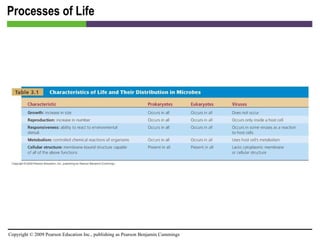
Processes of Life Growth Reproduction Responsiveness Metabolism
Processes of Life
Prokaryotic & Eukaryotic Cells: An Overview [INSERT FIGURE 3.1]
Prokaryotic & Eukaryotic Cells: An Overview Prokaryotes Do not have membrane surrounding their DNA; lack a nucleus Lack various internal structures bound with phospholipid membranes Are small, ~1.0 µm in diameter Have a simple structure Composed of bacteria and archaea
Prokaryotic & Eukaryotic Cells: An Overview [INSERT FIGURE 3.2]
Prokaryotic & Eukaryotic Cells: An Overview Eukaryotes Have membrane surrounding their DNA; have a nucleus Have internal membrane-bound organelles Are larger, 10-100 µm in diameter Have more complex structure Composed of algae, protozoa, fungi, animals, and plants
Prokaryotic & Eukaryotic Cells: An Overview [INSERT FIGURE 3.3]
Prokaryotic & Eukaryotic Cells: An Overview [INSERT FIGURE 3.4]
External Structures of Prokaryotic Cells Glycocalyces Gelatinous, sticky substance surrounding the outside of the cell Composed of polysaccharides, polypeptides, or both
External Structures of Prokaryotic Cells Two Types of Glycocalyces Capsule Composed of organized repeating units of organic chemicals Firmly attached to cell surface Protects cells from drying out May prevent bacteria from being recognized and destroyed by host Slime layer Loosely attached to cell surface Water soluble Protects cells from drying out Sticky layer that allows prokaryotes to attach to surfaces
External Structures of Prokaryotic Cells [INSERT FIGURE 3.5]
External Structures of Prokaryotic Cells Animation: Motility
External Structures of Prokaryotic Cells Flagella Are responsible for movement Have long structures that extend beyond cell surface Are not present on all prokaryotes
External Structures of Prokaryotic Cells Flagella Structure Composed of filament, hook, and basal body Flagellin protein (filament) deposited in a helix at the lengthening tip Base of filament inserts into hook Basal body anchors filament and hook to cell wall by a rod and a series of either two or four rings of integral proteins Filament capable of rotating 360º
External Structures of Prokaryotic Cells Animation: Flagella Structure
External Structures of Prokaryotic Cells [INSERT FIGURE 3.6]
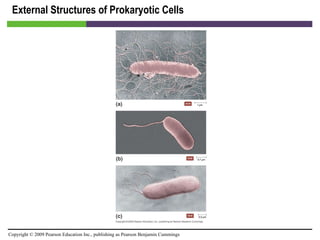
External Structures of Prokaryotic Cells
External Structures of Prokaryotic Cells Animation: Flagella Arrangement
External Structures of Prokaryotic Cells [INSERT FIGURE 3.8]
External Structures of Prokaryotic Cells Flagella Function Rotation propels bacterium through environment Rotation reversible, can be clockwise or counterclockwise Bacteria move in response to stimuli (taxis) Runs  Tumbles
External Structures of Prokaryotic Cells [INSERT FIGURE 3.9]
External Structures of Prokaryotic Cells Animation: Flagella Movement
External Structures of Prokaryotic Cells Fimbriae and Pili Rod-like proteinaceous extensions
External Structures of Prokaryotic Cells Fimbriae   Sticky, bristlelike projections Used by bacteria to adhere to one another, to hosts, and to substances in environment Shorter than flagella May be hundreds per cell Serve an important function in biofilms
External Structures of Prokaryotic Cells [INSERT FIGURE 3.10]
External Structures of Prokaryotic Cells Pili Tubules composed of pilin Also known as conjugation pili  Longer than fimbriae but shorter than flagella Bacteria typically only have one or two per cell Mediate the transfer of DNA from one cell to another (conjugation)
External Structures of Prokaryotic Cells [INSERT FIGURE 3.11]
Prokaryotic Cell Walls Provide structure and shape and protect cell from osmotic forces Assist some cells in attaching to other cells or in eluding antimicrobial drugs Not present in animal cells, so can target cell wall of bacteria with antibiotics Bacteria and archaea have different cell wall chemistry
Prokaryotic Cell Wall Bacterial Cell Walls Most have cell wall composed of peptidoglycan Peptidoglycan is composed of sugars, NAG, and NAM Chains of NAG and NAM attached to other chains by tetrapeptide crossbridges Bridges may be covalently bonded to one another Bridges may be held together by short connecting chains of amino acids Scientists describe two basic types of bacterial cell walls: Gram-positive and Gram-negative
External Structures of Prokaryotic Cells [INSERT FIGURE 3.12]
External Structures of Prokaryotic Cells [INSERT FIGURE 3.13]
Prokaryotic Cell Walls Bacterial Cell Walls Gram-positive cell walls Relatively thick layer of peptidoglycan Contain unique polyalcohols called teichoic acids Some covalently linked to lipids, forming lipoteichoic acids that anchor peptidoglycan to cell membrane Retain crystal violet dye in Gram staining procedure; so appear purple Up to 60% mycolic acid in acid-fast bacteria helps cells survive desiccation
Prokaryotic Cell Walls [INSERT FIGURE 3.14a]
Prokaryotic Cell Walls Bacterial Cell Walls Gram-negative cell walls Have only a thin layer of peptidoglycan Bilayer membrane outside the peptidoglycan contains phospholipids, proteins, and lipopolysaccharide (LPS)  May be impediment to the treatment of disease Appear pink following Gram staining procedure
Prokaryotic Cell Walls [INSERT FIGURE 3.14b]
Prokaryotic Cell Walls Archaeal Cell Walls Do not have peptidoglycan  Contains variety of specialized polysaccharides and proteins Gram-positive archaea stain purple  Gram-negative archaea stain pink
Prokaryotic Cytoplasmic Membranes Structure Referred to as phospholipid bilayer; composed of lipids and associated proteins Approximately half composed of proteins that act as recognition proteins, enzymes, receptors, carriers, or channels Integral proteins  Peripheral proteins  Glycoproteins  Fluid mosaic model describes current understanding of membrane structure
Prokaryotic Cytoplasmic Membranes [INSERT FIGURE 3.15]
Prokaryotic Cytoplasmic Membranes Function Energy storage Harvest light energy in photosynthetic prokaryotes Selectively permeable Naturally impermeable to most substances Proteins allow substances to cross membrane Occurs by passive or active processes Maintain concentration and electrical gradient Chemicals concentrated on one side of the membrane or the other Voltage exists across the membrane
Prokaryotic Cytoplasmic Membranes [INSERT FIGURE 3.16]
Prokaryotic Cytoplasmic Membranes Function Passive processes Diffusion Facilitated diffusion  Osmosis  Isotonic solution  Hypertonic solution  Hypotonic solution
Prokaryotic Cytoplasmic Membranes [INSERT FIGURE 3.17]
Prokaryotic Cytoplasmic Membranes [INSERT FIGURE 3.18]
Prokaryotic Cytoplasmic Membranes [INSERT FIGURE 3.19]
Prokaryotic Cytoplasmic Membranes Function Active processes Active transport Utilize permease proteins and expend ATP Uniport  Antiport  Symport  Group translocation Substance chemically modified during transport
Prokaryotic Cytoplasmic Membranes [INSERT FIGURE 3.20]
Prokaryotic Cytoplasmic Membranes Animation: Active Transport Overview
Prokaryotic Cytoplasmic Membranes Animation: Active Transport Types
Prokaryotic Cytoplasmic Membranes [INSERT FIGURE 3.21]
Prokaryotic Cytoplasmic Membranes [INSERT TABLE 3.2]
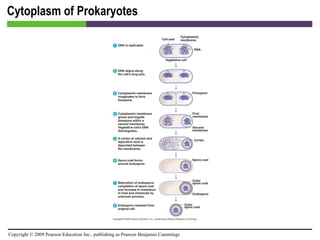
Cytoplasm of Prokaryotes Cytosol  – liquid portion of cytoplasm Inclusions  – may include reserve deposits of chemicals Endospores  – unique structures produced by some bacteria that are a defensive strategy against unfavorable conditions
Cytoplasm of Prokaryotes
Cytoplasm of Prokaryotes Nonmembranous Organelles Ribosomes – sites of protein synthesis Cytoskeleton – plays a role in forming the cell’s basic shape
Cytoplasm of Prokaryotes [INSERT FIGURE 3.23]
External Structure of Eukaryotic Cells Glycocalyces Never as organized as prokaryotic capsules Help anchor animal cells to each other Strengthen cell surface Provide protection against dehydration Function in cell-to-cell recognition and communication
Eukaryotic Cell Walls & Cytoplasmic Membranes Fungi, algae, plants, and some protozoa have cell walls but no glycocalyx Composed of various polysaccharides Cellulose found in plant cell walls Fungal cell walls composed of cellulose, chitin, and/or glucomannan Algal cell walls composed of cellulose, proteins, agar, carrageenan, silicates, algin, calcium carbonate, or a combination of these
Eukaryotic Cell Walls & Cytoplasmic Membranes [INSERT FIGURE 3.24]
Eukaryotic Cell Walls & Cytoplasmic Membranes All eukaryotic cells have cytoplasmic membrane Are a fluid mosaic of phospholipids and proteins Contain steroid lipids to help maintain fluidity Contain regions of lipids and proteins called membrane rafts Control movement into and out of cell Use diffusion, facilitated diffusion, osmosis, and active transport Perform endocytosis; phagocytosis if solid substance and pinocytosis if liquid substance Exocytosis enables substances to be exported from cell
Eukaryotic Cell Walls & Cytoplasmic Membranes [INSERT FIGURE 3.25]
Eukaryotic Cell Walls & Cytoplasmic Membranes [INSERT TABLE 3.3]
Eukaryotic Cell Walls & Cytoplasmic Membranes [INSERT FIGURE 3.26]
Cytoplasm of Eukaryotes
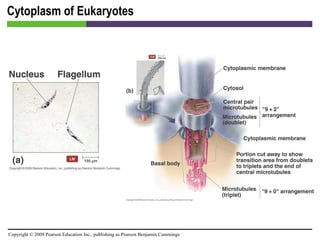
Cytoplasm of Eukaryotes Flagella Structure and arrangement Shaft composed of tubulin arranged to form microtubules “ 9 + 2” arrangement of microtubules in all flagellated eukaryotes Filaments anchored to cell by basal body; no hook Basal body has “9 + 0” arrangement of microtubules May be single or multiple; generally found at one pole of cell
Cytoplasm of Eukaryotes Flagella Function Do not rotate, but undulate rhythmically
Cytoplasm of Eukaryotes [INSERT FIGURE 3.28a & b]
Cytoplasm of Eukaryotes Cilia Shorter and more numerous than flagella Composed of tubulin in “9 + 2” and “9 + 0” arrangements Coordinated beating propels cells through their environment Also used to move substances past the surface of the cell
Cytoplasm of Eukaryotes [INSERT FIGURE 3.27c]
Cytoplasm of Eukaryotes Other Nonmembranous Organelles Ribosomes Larger than prokaryotic ribosomes (80S versus 70S) Composed of 60S and 40S subunits Cytoskeleton Extensive  Functions Anchors organelles Cytoplasmic streaming and movement of organelles Movement during endocytosis and amoeboid action Produces basic shape of the cell Made up of tubulin microtubules, actin microfilaments, and intermediate filaments
Cytoplasm of Eukaryotes [INSERT FIGURE 3.29]
Cytoplasm of Eukaryotes Other Nonmembranous Organelles Centrioles and centrosome Centrioles play a role in mitosis, cytokinesis, and in formation of flagella and cilia Centrioles composed of “9 + 0” arrangement of microtubules Centrosome is region of cytoplasm where centrioles are found
Cytoplasm of Eukaryotes [INSERT FIGURE 3.30]
Cytoplasm of Eukaryotes Membranous Organelles Nucleus Often largest organelle in cell Contains most of the cell’s DNA Semi-liquid portion called nucleoplasm One or more nucleoli present in nucleoplasm; RNA synthesized in nucleoli Nucleoplasm contains chromatin – masses of DNA associated with histones Surrounded by nuclear envelope – double membrane composed of two phospholipid bilayers Nuclear envelope contains nuclear pores
Cytoplasm of Eukaryotes [INSERT FIGURE 3.31]
Cytoplasm of Eukaryotes Membranous Organelles Endoplasmic reticulum Netlike arrangement of flattened, hollow tubules continuous with nuclear envelope Functions as transport system Two forms Smooth endoplasmic reticulum (SER) – plays role in lipid synthesis Rough endoplasmic reticulum (RER) – ribosomes attached to its outer surface; transports proteins produced by ribosomes
Cytoplasm of Eukaryotes [INSERT FIGURE 3.32]
Cytoplasm of Eukaryotes Membranous Organelles Golgi body Receives, processes, and packages large molecules for export from cell Packages molecules in secretory vesicles that fuse with cytoplasmic membrane Composed of flattened hollow sacs surrounded by phospholipid bilayer Not in all eukaryotic cells
Cytoplasm of Eukaryotes [INSERT FIGURE 3.33]
Cytoplasm of Eukaryotes Membranous Organelles Lysosomes, peroxisomes,vacuoles, and vesicles Store and transfer chemicals within cells May store nutrients in cell Lysosomes contain catabolic enzymes  Peroxisomes contain enzymes that degrade poisonous wastes
Cytoplasm of Eukaryotes [INSERT FIGURE 3.34]
Cytoplasm of Eukaryotes [INSERT FIGURE 3.35]
Cytoplasm of Eukaryotes Membranous Organelles Mitochondria Have two membranes composed of phospholipid bilayer Produce most of cell’s ATP Interior matrix contains 70S ribosomes and circular molecule of DNA
Cytoplasm of Eukaryotes [INSERT FIGURE 3.36]
Cytoplasm of Eukaryotes Membranous Organelles Chloroplasts Light-harvesting structures found in photosynthetic eukaryotes Have two phospholipid bilayer membranes and DNA Have 70S ribosomes
Cytoplasm of Eukaryotes [INSERT FIGURE 3.37]
Cytoplasm of Eukaryotes [INSERT TABLE 3.4]
Cytoplasm of Eukaryotes Endosymbiotic Theory Eukaryotes formed from union of small aerobic prokaryotes with larger anaerobic prokaryotes smaller prokaryotes became internal parasites Parasites lost ability to exist independently; retained portion of DNA, ribosomes, and cytoplasmic membranes Larger cell became dependent on parasites for aerobic ATP production Aerobic prokaryotes evolved into mitochondria Similar scenario for origin of chloroplasts Not universally accepted
Cytoplasm of Eukaryotes [INSERT TABLE 3.5]

Start here_ch03_lecture

  • 1.
    Chapter 3 CellStructure and Function
  • 2.
    Processes of LifeGrowth Reproduction Responsiveness Metabolism
  • 3.
  • 4.
    Prokaryotic & EukaryoticCells: An Overview [INSERT FIGURE 3.1]
  • 5.
    Prokaryotic & EukaryoticCells: An Overview Prokaryotes Do not have membrane surrounding their DNA; lack a nucleus Lack various internal structures bound with phospholipid membranes Are small, ~1.0 µm in diameter Have a simple structure Composed of bacteria and archaea
  • 6.
    Prokaryotic & EukaryoticCells: An Overview [INSERT FIGURE 3.2]
  • 7.
    Prokaryotic & EukaryoticCells: An Overview Eukaryotes Have membrane surrounding their DNA; have a nucleus Have internal membrane-bound organelles Are larger, 10-100 µm in diameter Have more complex structure Composed of algae, protozoa, fungi, animals, and plants
  • 8.
    Prokaryotic & EukaryoticCells: An Overview [INSERT FIGURE 3.3]
  • 9.
    Prokaryotic & EukaryoticCells: An Overview [INSERT FIGURE 3.4]
  • 10.
    External Structures ofProkaryotic Cells Glycocalyces Gelatinous, sticky substance surrounding the outside of the cell Composed of polysaccharides, polypeptides, or both
  • 11.
    External Structures ofProkaryotic Cells Two Types of Glycocalyces Capsule Composed of organized repeating units of organic chemicals Firmly attached to cell surface Protects cells from drying out May prevent bacteria from being recognized and destroyed by host Slime layer Loosely attached to cell surface Water soluble Protects cells from drying out Sticky layer that allows prokaryotes to attach to surfaces
  • 12.
    External Structures ofProkaryotic Cells [INSERT FIGURE 3.5]
  • 13.
    External Structures ofProkaryotic Cells Animation: Motility
  • 14.
    External Structures ofProkaryotic Cells Flagella Are responsible for movement Have long structures that extend beyond cell surface Are not present on all prokaryotes
  • 15.
    External Structures ofProkaryotic Cells Flagella Structure Composed of filament, hook, and basal body Flagellin protein (filament) deposited in a helix at the lengthening tip Base of filament inserts into hook Basal body anchors filament and hook to cell wall by a rod and a series of either two or four rings of integral proteins Filament capable of rotating 360º
  • 16.
    External Structures ofProkaryotic Cells Animation: Flagella Structure
  • 17.
    External Structures ofProkaryotic Cells [INSERT FIGURE 3.6]
  • 18.
    External Structures ofProkaryotic Cells
  • 19.
    External Structures ofProkaryotic Cells Animation: Flagella Arrangement
  • 20.
    External Structures ofProkaryotic Cells [INSERT FIGURE 3.8]
  • 21.
    External Structures ofProkaryotic Cells Flagella Function Rotation propels bacterium through environment Rotation reversible, can be clockwise or counterclockwise Bacteria move in response to stimuli (taxis) Runs Tumbles
  • 22.
    External Structures ofProkaryotic Cells [INSERT FIGURE 3.9]
  • 23.
    External Structures ofProkaryotic Cells Animation: Flagella Movement
  • 24.
    External Structures ofProkaryotic Cells Fimbriae and Pili Rod-like proteinaceous extensions
  • 25.
    External Structures ofProkaryotic Cells Fimbriae Sticky, bristlelike projections Used by bacteria to adhere to one another, to hosts, and to substances in environment Shorter than flagella May be hundreds per cell Serve an important function in biofilms
  • 26.
    External Structures ofProkaryotic Cells [INSERT FIGURE 3.10]
  • 27.
    External Structures ofProkaryotic Cells Pili Tubules composed of pilin Also known as conjugation pili Longer than fimbriae but shorter than flagella Bacteria typically only have one or two per cell Mediate the transfer of DNA from one cell to another (conjugation)
  • 28.
    External Structures ofProkaryotic Cells [INSERT FIGURE 3.11]
  • 29.
    Prokaryotic Cell WallsProvide structure and shape and protect cell from osmotic forces Assist some cells in attaching to other cells or in eluding antimicrobial drugs Not present in animal cells, so can target cell wall of bacteria with antibiotics Bacteria and archaea have different cell wall chemistry
  • 30.
    Prokaryotic Cell WallBacterial Cell Walls Most have cell wall composed of peptidoglycan Peptidoglycan is composed of sugars, NAG, and NAM Chains of NAG and NAM attached to other chains by tetrapeptide crossbridges Bridges may be covalently bonded to one another Bridges may be held together by short connecting chains of amino acids Scientists describe two basic types of bacterial cell walls: Gram-positive and Gram-negative
  • 31.
    External Structures ofProkaryotic Cells [INSERT FIGURE 3.12]
  • 32.
    External Structures ofProkaryotic Cells [INSERT FIGURE 3.13]
  • 33.
    Prokaryotic Cell WallsBacterial Cell Walls Gram-positive cell walls Relatively thick layer of peptidoglycan Contain unique polyalcohols called teichoic acids Some covalently linked to lipids, forming lipoteichoic acids that anchor peptidoglycan to cell membrane Retain crystal violet dye in Gram staining procedure; so appear purple Up to 60% mycolic acid in acid-fast bacteria helps cells survive desiccation
  • 34.
    Prokaryotic Cell Walls[INSERT FIGURE 3.14a]
  • 35.
    Prokaryotic Cell WallsBacterial Cell Walls Gram-negative cell walls Have only a thin layer of peptidoglycan Bilayer membrane outside the peptidoglycan contains phospholipids, proteins, and lipopolysaccharide (LPS) May be impediment to the treatment of disease Appear pink following Gram staining procedure
  • 36.
    Prokaryotic Cell Walls[INSERT FIGURE 3.14b]
  • 37.
    Prokaryotic Cell WallsArchaeal Cell Walls Do not have peptidoglycan Contains variety of specialized polysaccharides and proteins Gram-positive archaea stain purple Gram-negative archaea stain pink
  • 38.
    Prokaryotic Cytoplasmic MembranesStructure Referred to as phospholipid bilayer; composed of lipids and associated proteins Approximately half composed of proteins that act as recognition proteins, enzymes, receptors, carriers, or channels Integral proteins Peripheral proteins Glycoproteins Fluid mosaic model describes current understanding of membrane structure
  • 39.
  • 40.
    Prokaryotic Cytoplasmic MembranesFunction Energy storage Harvest light energy in photosynthetic prokaryotes Selectively permeable Naturally impermeable to most substances Proteins allow substances to cross membrane Occurs by passive or active processes Maintain concentration and electrical gradient Chemicals concentrated on one side of the membrane or the other Voltage exists across the membrane
  • 41.
  • 42.
    Prokaryotic Cytoplasmic MembranesFunction Passive processes Diffusion Facilitated diffusion Osmosis Isotonic solution Hypertonic solution Hypotonic solution
  • 43.
  • 44.
  • 45.
  • 46.
    Prokaryotic Cytoplasmic MembranesFunction Active processes Active transport Utilize permease proteins and expend ATP Uniport Antiport Symport Group translocation Substance chemically modified during transport
  • 47.
  • 48.
    Prokaryotic Cytoplasmic MembranesAnimation: Active Transport Overview
  • 49.
    Prokaryotic Cytoplasmic MembranesAnimation: Active Transport Types
  • 50.
  • 51.
  • 52.
    Cytoplasm of ProkaryotesCytosol – liquid portion of cytoplasm Inclusions – may include reserve deposits of chemicals Endospores – unique structures produced by some bacteria that are a defensive strategy against unfavorable conditions
  • 53.
  • 54.
    Cytoplasm of ProkaryotesNonmembranous Organelles Ribosomes – sites of protein synthesis Cytoskeleton – plays a role in forming the cell’s basic shape
  • 55.
    Cytoplasm of Prokaryotes[INSERT FIGURE 3.23]
  • 56.
    External Structure ofEukaryotic Cells Glycocalyces Never as organized as prokaryotic capsules Help anchor animal cells to each other Strengthen cell surface Provide protection against dehydration Function in cell-to-cell recognition and communication
  • 57.
    Eukaryotic Cell Walls& Cytoplasmic Membranes Fungi, algae, plants, and some protozoa have cell walls but no glycocalyx Composed of various polysaccharides Cellulose found in plant cell walls Fungal cell walls composed of cellulose, chitin, and/or glucomannan Algal cell walls composed of cellulose, proteins, agar, carrageenan, silicates, algin, calcium carbonate, or a combination of these
  • 58.
    Eukaryotic Cell Walls& Cytoplasmic Membranes [INSERT FIGURE 3.24]
  • 59.
    Eukaryotic Cell Walls& Cytoplasmic Membranes All eukaryotic cells have cytoplasmic membrane Are a fluid mosaic of phospholipids and proteins Contain steroid lipids to help maintain fluidity Contain regions of lipids and proteins called membrane rafts Control movement into and out of cell Use diffusion, facilitated diffusion, osmosis, and active transport Perform endocytosis; phagocytosis if solid substance and pinocytosis if liquid substance Exocytosis enables substances to be exported from cell
  • 60.
    Eukaryotic Cell Walls& Cytoplasmic Membranes [INSERT FIGURE 3.25]
  • 61.
    Eukaryotic Cell Walls& Cytoplasmic Membranes [INSERT TABLE 3.3]
  • 62.
    Eukaryotic Cell Walls& Cytoplasmic Membranes [INSERT FIGURE 3.26]
  • 63.
  • 64.
    Cytoplasm of EukaryotesFlagella Structure and arrangement Shaft composed of tubulin arranged to form microtubules “ 9 + 2” arrangement of microtubules in all flagellated eukaryotes Filaments anchored to cell by basal body; no hook Basal body has “9 + 0” arrangement of microtubules May be single or multiple; generally found at one pole of cell
  • 65.
    Cytoplasm of EukaryotesFlagella Function Do not rotate, but undulate rhythmically
  • 66.
    Cytoplasm of Eukaryotes[INSERT FIGURE 3.28a & b]
  • 67.
    Cytoplasm of EukaryotesCilia Shorter and more numerous than flagella Composed of tubulin in “9 + 2” and “9 + 0” arrangements Coordinated beating propels cells through their environment Also used to move substances past the surface of the cell
  • 68.
    Cytoplasm of Eukaryotes[INSERT FIGURE 3.27c]
  • 69.
    Cytoplasm of EukaryotesOther Nonmembranous Organelles Ribosomes Larger than prokaryotic ribosomes (80S versus 70S) Composed of 60S and 40S subunits Cytoskeleton Extensive Functions Anchors organelles Cytoplasmic streaming and movement of organelles Movement during endocytosis and amoeboid action Produces basic shape of the cell Made up of tubulin microtubules, actin microfilaments, and intermediate filaments
  • 70.
    Cytoplasm of Eukaryotes[INSERT FIGURE 3.29]
  • 71.
    Cytoplasm of EukaryotesOther Nonmembranous Organelles Centrioles and centrosome Centrioles play a role in mitosis, cytokinesis, and in formation of flagella and cilia Centrioles composed of “9 + 0” arrangement of microtubules Centrosome is region of cytoplasm where centrioles are found
  • 72.
    Cytoplasm of Eukaryotes[INSERT FIGURE 3.30]
  • 73.
    Cytoplasm of EukaryotesMembranous Organelles Nucleus Often largest organelle in cell Contains most of the cell’s DNA Semi-liquid portion called nucleoplasm One or more nucleoli present in nucleoplasm; RNA synthesized in nucleoli Nucleoplasm contains chromatin – masses of DNA associated with histones Surrounded by nuclear envelope – double membrane composed of two phospholipid bilayers Nuclear envelope contains nuclear pores
  • 74.
    Cytoplasm of Eukaryotes[INSERT FIGURE 3.31]
  • 75.
    Cytoplasm of EukaryotesMembranous Organelles Endoplasmic reticulum Netlike arrangement of flattened, hollow tubules continuous with nuclear envelope Functions as transport system Two forms Smooth endoplasmic reticulum (SER) – plays role in lipid synthesis Rough endoplasmic reticulum (RER) – ribosomes attached to its outer surface; transports proteins produced by ribosomes
  • 76.
    Cytoplasm of Eukaryotes[INSERT FIGURE 3.32]
  • 77.
    Cytoplasm of EukaryotesMembranous Organelles Golgi body Receives, processes, and packages large molecules for export from cell Packages molecules in secretory vesicles that fuse with cytoplasmic membrane Composed of flattened hollow sacs surrounded by phospholipid bilayer Not in all eukaryotic cells
  • 78.
    Cytoplasm of Eukaryotes[INSERT FIGURE 3.33]
  • 79.
    Cytoplasm of EukaryotesMembranous Organelles Lysosomes, peroxisomes,vacuoles, and vesicles Store and transfer chemicals within cells May store nutrients in cell Lysosomes contain catabolic enzymes Peroxisomes contain enzymes that degrade poisonous wastes
  • 80.
    Cytoplasm of Eukaryotes[INSERT FIGURE 3.34]
  • 81.
    Cytoplasm of Eukaryotes[INSERT FIGURE 3.35]
  • 82.
    Cytoplasm of EukaryotesMembranous Organelles Mitochondria Have two membranes composed of phospholipid bilayer Produce most of cell’s ATP Interior matrix contains 70S ribosomes and circular molecule of DNA
  • 83.
    Cytoplasm of Eukaryotes[INSERT FIGURE 3.36]
  • 84.
    Cytoplasm of EukaryotesMembranous Organelles Chloroplasts Light-harvesting structures found in photosynthetic eukaryotes Have two phospholipid bilayer membranes and DNA Have 70S ribosomes
  • 85.
    Cytoplasm of Eukaryotes[INSERT FIGURE 3.37]
  • 86.
    Cytoplasm of Eukaryotes[INSERT TABLE 3.4]
  • 87.
    Cytoplasm of EukaryotesEndosymbiotic Theory Eukaryotes formed from union of small aerobic prokaryotes with larger anaerobic prokaryotes smaller prokaryotes became internal parasites Parasites lost ability to exist independently; retained portion of DNA, ribosomes, and cytoplasmic membranes Larger cell became dependent on parasites for aerobic ATP production Aerobic prokaryotes evolved into mitochondria Similar scenario for origin of chloroplasts Not universally accepted
  • 88.
    Cytoplasm of Eukaryotes[INSERT TABLE 3.5]