TERM PAPER PRESENTATION
BTY 105: PRINCIPLES OF BIOCHEMISTRY
TOPIC: PLANT PIGMENTS AND THEIR ROLE

Submitted to:
Dr. Kuldip Chandra Verma
Deptt. Of Biotechnology
Lovely Professional University

Submitted by:
Vir Sapan Pratap Anand

11202530
Section : B1205
Roll No. : A07
INTRODUCTION: WHAT ARE PIGMENTS ?
Pigments are “molecules that absorb specific
wavelength (energies) of light and reflect all others.”
 Pigments are coloured.
 The colour we see is the net effect of all the light
reflecting back at us…!
 They are the substances produced by living
organisms that have a colour resulting from
selective colour absorption.

WHAT DO I MEAN BY “ABSORB” ?
Electrons exist at specific levels
 Normally exist at lowest specific levels
 However, if enough energy comes to boost them
into the next level, they can ABSORB that
energy…!!! And occupy that higher level.

WHAT DO I MEAN BY “ABSORB” ?
(CONT…)








The light they absorb contains just the right amount of energy
to push them into the next level.
Light not having enough energy or having too much energy is
reflected back…!!!
Electron does not want to stay at higher level
It wants to return because it is unstable there.
Inorder to do this it has to release energy that has put it into
higher level.
WAYS TO RELEASE ENERGY ??
By heat: Conversion in molecular motion
 By fluorescence: Losing e- by light
 By Resonance: The energy but not the e- itself can
be passed on to another molecule.
 By transferring the electron to another molecule
-------------------- Plant pigments usually utilize the last two of these
reactions to convert the sun’s energy into their own.

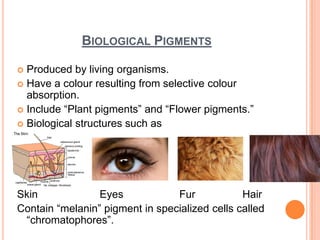
BIOLOGICAL PIGMENTS
Produced by living organisms.
 Have a colour resulting from selective colour
absorption.
 Include “Plant pigments” and “Flower pigments.”
 Biological structures such as


Skin
Eyes
Fur
Hair
Contain “melanin” pigment in specialized cells called
“chromatophores”.
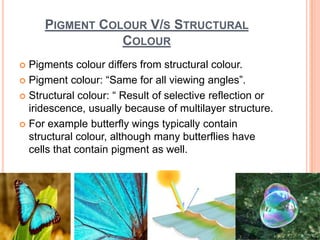
PIGMENT COLOUR V/S STRUCTURAL
COLOUR
Pigments colour differs from structural colour.
 Pigment colour: “Same for all viewing angles”.
 Structural colour: “ Result of selective reflection or
iridescence, usually because of multilayer structure.
 For example butterfly wings typically contain
structural colour, although many butterflies have
cells that contain pigment as well.

TYPES OF BIOLOGICAL PIGMENTS
1. Heme/Porphyrin based: Chlorophyll, bilirubin,
hemoglobin, myoglobin.
2. Light Emitting: Luciferin
3. Carotenoids:
i)
Hematochromes : Algal pigments, mixes of
carotenoids and their derivatives.
ii)
Carotenes: alpha and beta Carotene
iii)
Xanthophylls: Oxidised Carotenes (Eg.
Canthaxanthin)
4. Proteinaceous : Phytochrome
5. Polyene enolates: A class of red pigments unique to
parrots
6. Other: Melanin, Urochrome, flavanoids
PIGMENTS IN PLANTS-:
The Principal pigments in plants are-:
1. Chlorophyll
2. Carotenoids
3. Xanthophylls
4. Anthocyanins
5. Betalins
PRIMARY FUNCTION OF PIGMENTS IN
PLANTS:Primary Function : Photosynthesis
 Uses green pigment chlorophyll along with several
red and yellow pigments.
 Help to capture as much light as possible.
 Other functions include attracting insects to flowers
to encourage pollination.

CHLOROPHYLL
Primary pigment in plant.
 Chlorin absorbs yellow and blue wavelengths.
 Reflecting green.
 All land plants and green algae have two types of
chlorophyll.
 Chlorophyll a and Chlorophyll b.
 Kelps and photosynthetic heterokonts contain
Chlorophyll c.
 Chlorophyll serve as fuel to photosynthesis.

STRUCTURE OF CHLOROPHYLL
MORE ABOUT CHLOROPHYLL-:
Name derived from greek words
 Chloros means “green” and phyllon means “leaf”.
 Synthesized from succinyl-CoA and Glycine.
 Immediate precursor to Chlorophyll A and B is
protochlorophyllide.
 Contains hydrophobic phytol chain embedded in
lipid membrane.
 Rest structure is tetrapyrrolic ring.
 It is the part of pigment that absorbs the energy
from light.

CHLOROPHYLL AND PHOTOSYNTHESIS










Autotrophic Process: Plants and plant-like organisms make
their energy (glucose) from sunlight.
Stored as carbohydrate in their bodies.
6CO2 + 6H2O + sunlight  C6H12O6 + 6O2
Makes organic molecules (glucose) out of inorganic materials
(carbon dioxide and water).
It begins all food chains/webs. Thus all life is supported by
this process.
It also makes oxygen gas!!
WHY ONLY GREEN AND NOT BLACK ??
Black Colour is the best absorber of light.
 Then why couldn’t plants evolve this change ?
 Plants except some red algae appear brown or
green but not black. Why ?
 If plants had pigments that absorbed UV and XRays, this would mean that electrons could be
knocked off their orbitals and the molecule
destroyed.
 If plants absorbed IR and Radio waves, there would
not be enough energy for electron transfer, just
enough to warm up the molecule.

CAROTENOIDS:
Red, orange or yellow pigments.
 Function as accessory pigments in plants.
 Absorb wavelength not readily absorbed by
chlotophyll.
 Ex: Carotene ( Found in Carrots)
 Lutein ( Yellow pigment found in fruits and
vegetables).
 Lycopene ( Red pigment in tomatoes)

ROLE OF CAROTENOIDS
Attract pollinators and seed dispersers
 Accessory photosynthetic Pigment in periods of
low light,
 Absorbs excess light energy,
 Anti oxidant roles,
 Substrate for hormones

CAROTENOIDS:
Carotenoids are Present in:

Carrot,
 Sweet potato,
 Winter squash,
 Pumpkin,
 Green leafy vegetables,
 Cantaloupe,
 Apricot

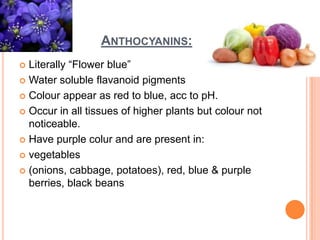
ANTHOCYANINS:
Literally “Flower blue”
 Water soluble flavanoid pigments
 Colour appear as red to blue, acc to pH.
 Occur in all tissues of higher plants but colour not
noticeable.
 Have purple colur and are present in:
 vegetables
 (onions, cabbage, potatoes), red, blue & purple
berries, black beans

ROLE OF ANTHOCYANINS:
 attract

pollinators and seed dispersers
 repel predators, protect cells from damage
by excess light,
 improve plant tolerance to stress such as
drought, U V-B,
 improve night vision and other vision
 disorders, protect against heart disease,
BETALINS
Red or yellow pigments.
 Water soluble.
 Synthesized from tyrosine.
 Never co-occur in plants having anthocyanins.
 Occur in:
 beets (red and yellow ), chard, spinach, fruit of
prickly-pear cactus.

ROLE OF BETALINS
Anti oxidant,
 May protect against heart disease,
 various cancers,
 ulcers,
 liver damage

XANTHOPHYLLS
 Fourth

common class of pigments
 Essentially oxidized carotenes
 Usually red and yellow
 Do not absorb energy as well as
carotenoids.
CONCLUSION:
Life would be nothing without Plants…
 And Plants would be nothing without colours…
 Green plants having chlorophyll have a vital role in
photosynthesis, a process neccessary for life on
earth.
 Red and yellow plants and flowers having
carotenoids or Betalins provide fresh fruits, and
help in pollination.
 Blue plants and flowers having Anthocyanins are
strong anti-oxidants.

ANY QUERIES ??
Plant Pigments and their role

Plant Pigments and their role

  • 1.
    TERM PAPER PRESENTATION BTY105: PRINCIPLES OF BIOCHEMISTRY TOPIC: PLANT PIGMENTS AND THEIR ROLE Submitted to: Dr. Kuldip Chandra Verma Deptt. Of Biotechnology Lovely Professional University Submitted by: Vir Sapan Pratap Anand 11202530 Section : B1205 Roll No. : A07
  • 2.
    INTRODUCTION: WHAT AREPIGMENTS ? Pigments are “molecules that absorb specific wavelength (energies) of light and reflect all others.”  Pigments are coloured.  The colour we see is the net effect of all the light reflecting back at us…!  They are the substances produced by living organisms that have a colour resulting from selective colour absorption. 
  • 3.
    WHAT DO IMEAN BY “ABSORB” ? Electrons exist at specific levels  Normally exist at lowest specific levels  However, if enough energy comes to boost them into the next level, they can ABSORB that energy…!!! And occupy that higher level. 
  • 4.
    WHAT DO IMEAN BY “ABSORB” ? (CONT…)      The light they absorb contains just the right amount of energy to push them into the next level. Light not having enough energy or having too much energy is reflected back…!!! Electron does not want to stay at higher level It wants to return because it is unstable there. Inorder to do this it has to release energy that has put it into higher level.
  • 5.
    WAYS TO RELEASEENERGY ?? By heat: Conversion in molecular motion  By fluorescence: Losing e- by light  By Resonance: The energy but not the e- itself can be passed on to another molecule.  By transferring the electron to another molecule -------------------- Plant pigments usually utilize the last two of these reactions to convert the sun’s energy into their own. 
  • 6.
    BIOLOGICAL PIGMENTS Produced byliving organisms.  Have a colour resulting from selective colour absorption.  Include “Plant pigments” and “Flower pigments.”  Biological structures such as  Skin Eyes Fur Hair Contain “melanin” pigment in specialized cells called “chromatophores”.
  • 7.
    PIGMENT COLOUR V/SSTRUCTURAL COLOUR Pigments colour differs from structural colour.  Pigment colour: “Same for all viewing angles”.  Structural colour: “ Result of selective reflection or iridescence, usually because of multilayer structure.  For example butterfly wings typically contain structural colour, although many butterflies have cells that contain pigment as well. 
  • 8.
    TYPES OF BIOLOGICALPIGMENTS 1. Heme/Porphyrin based: Chlorophyll, bilirubin, hemoglobin, myoglobin. 2. Light Emitting: Luciferin 3. Carotenoids: i) Hematochromes : Algal pigments, mixes of carotenoids and their derivatives. ii) Carotenes: alpha and beta Carotene iii) Xanthophylls: Oxidised Carotenes (Eg. Canthaxanthin) 4. Proteinaceous : Phytochrome 5. Polyene enolates: A class of red pigments unique to parrots 6. Other: Melanin, Urochrome, flavanoids
  • 9.
    PIGMENTS IN PLANTS-: ThePrincipal pigments in plants are-: 1. Chlorophyll 2. Carotenoids 3. Xanthophylls 4. Anthocyanins 5. Betalins
  • 10.
    PRIMARY FUNCTION OFPIGMENTS IN PLANTS:Primary Function : Photosynthesis  Uses green pigment chlorophyll along with several red and yellow pigments.  Help to capture as much light as possible.  Other functions include attracting insects to flowers to encourage pollination. 
  • 11.
    CHLOROPHYLL Primary pigment inplant.  Chlorin absorbs yellow and blue wavelengths.  Reflecting green.  All land plants and green algae have two types of chlorophyll.  Chlorophyll a and Chlorophyll b.  Kelps and photosynthetic heterokonts contain Chlorophyll c.  Chlorophyll serve as fuel to photosynthesis. 
  • 12.
  • 13.
    MORE ABOUT CHLOROPHYLL-: Namederived from greek words  Chloros means “green” and phyllon means “leaf”.  Synthesized from succinyl-CoA and Glycine.  Immediate precursor to Chlorophyll A and B is protochlorophyllide.  Contains hydrophobic phytol chain embedded in lipid membrane.  Rest structure is tetrapyrrolic ring.  It is the part of pigment that absorbs the energy from light. 
  • 14.
    CHLOROPHYLL AND PHOTOSYNTHESIS       AutotrophicProcess: Plants and plant-like organisms make their energy (glucose) from sunlight. Stored as carbohydrate in their bodies. 6CO2 + 6H2O + sunlight  C6H12O6 + 6O2 Makes organic molecules (glucose) out of inorganic materials (carbon dioxide and water). It begins all food chains/webs. Thus all life is supported by this process. It also makes oxygen gas!!
  • 15.
    WHY ONLY GREENAND NOT BLACK ?? Black Colour is the best absorber of light.  Then why couldn’t plants evolve this change ?  Plants except some red algae appear brown or green but not black. Why ?  If plants had pigments that absorbed UV and XRays, this would mean that electrons could be knocked off their orbitals and the molecule destroyed.  If plants absorbed IR and Radio waves, there would not be enough energy for electron transfer, just enough to warm up the molecule. 
  • 16.
    CAROTENOIDS: Red, orange oryellow pigments.  Function as accessory pigments in plants.  Absorb wavelength not readily absorbed by chlotophyll.  Ex: Carotene ( Found in Carrots)  Lutein ( Yellow pigment found in fruits and vegetables).  Lycopene ( Red pigment in tomatoes) 
  • 17.
    ROLE OF CAROTENOIDS Attractpollinators and seed dispersers  Accessory photosynthetic Pigment in periods of low light,  Absorbs excess light energy,  Anti oxidant roles,  Substrate for hormones 
  • 18.
    CAROTENOIDS: Carotenoids are Presentin: Carrot,  Sweet potato,  Winter squash,  Pumpkin,  Green leafy vegetables,  Cantaloupe,  Apricot 
  • 19.
    ANTHOCYANINS: Literally “Flower blue” Water soluble flavanoid pigments  Colour appear as red to blue, acc to pH.  Occur in all tissues of higher plants but colour not noticeable.  Have purple colur and are present in:  vegetables  (onions, cabbage, potatoes), red, blue & purple berries, black beans 
  • 20.
    ROLE OF ANTHOCYANINS: attract pollinators and seed dispersers  repel predators, protect cells from damage by excess light,  improve plant tolerance to stress such as drought, U V-B,  improve night vision and other vision  disorders, protect against heart disease,
  • 21.
    BETALINS Red or yellowpigments.  Water soluble.  Synthesized from tyrosine.  Never co-occur in plants having anthocyanins.  Occur in:  beets (red and yellow ), chard, spinach, fruit of prickly-pear cactus. 
  • 22.
    ROLE OF BETALINS Antioxidant,  May protect against heart disease,  various cancers,  ulcers,  liver damage 
  • 23.
    XANTHOPHYLLS  Fourth common classof pigments  Essentially oxidized carotenes  Usually red and yellow  Do not absorb energy as well as carotenoids.
  • 24.
    CONCLUSION: Life would benothing without Plants…  And Plants would be nothing without colours…  Green plants having chlorophyll have a vital role in photosynthesis, a process neccessary for life on earth.  Red and yellow plants and flowers having carotenoids or Betalins provide fresh fruits, and help in pollination.  Blue plants and flowers having Anthocyanins are strong anti-oxidants. 
  • 25.