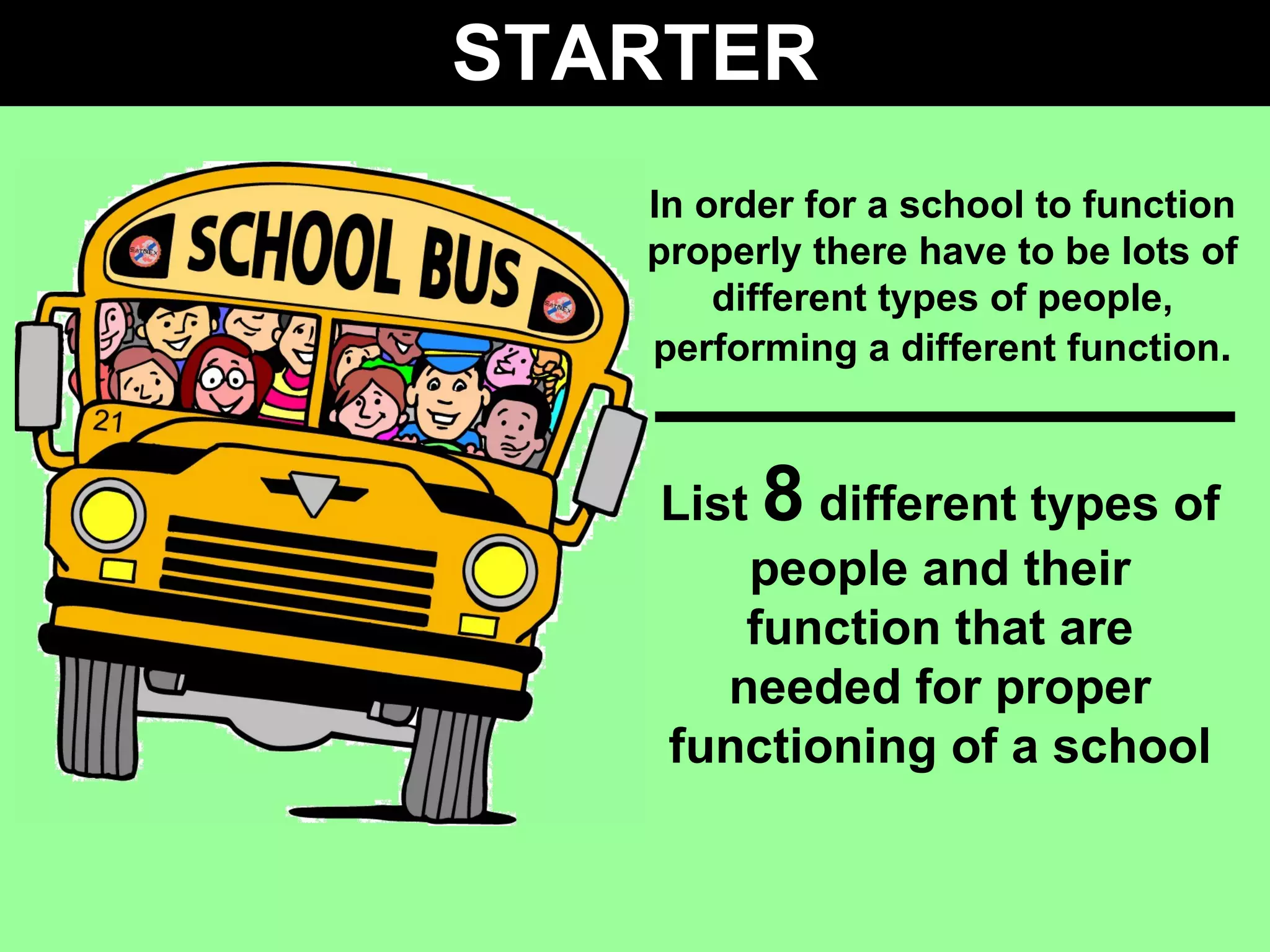
STARTER In order for a school to function properly there have to be lots of different types of people, performing a different function . List  8  different types of people and their function that are needed for proper functioning of a school
Specialised cells ALL Order the complexity of an  organism from cell to whole organism MOST Describe how cells are adapted SOME   Explain how these adaptations help  the cell to perform a specific function LEARNING OUTCOMES
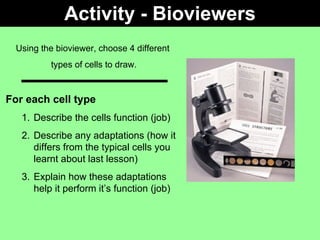
Activity - Bioviewers Using the bioviewer, choose 4 different  types of cells to draw. For each cell type   Describe the cells function (job) Describe any adaptations (how it differs from the typical cells you learnt about last lesson) Explain how these adaptations help it perform it’s function (job)
Specialised cells What does this mean? Particular shape Particular size Particular function For each of the plant and animal cells in section 2 of workbook 1 Identify  and  Explain each adaptation
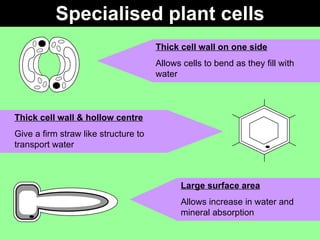
Specialised plant cells Thick cell wall on one side Allows cells to bend as they fill with water Large surface area Allows increase in water and mineral absorption Thick cell wall & hollow centre Give a firm straw like structure to transport water
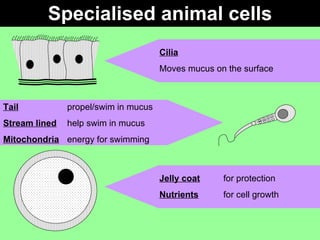
Specialised animal cells Cilia Moves mucus on the surface Tail propel/swim in mucus Stream lined help swim in mucus Mitochondria energy for swimming Jelly coat for protection  Nutrients for cell growth
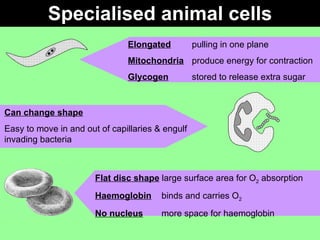
Specialised animal cells Elongated pulling in one plane Mitochondria produce energy for contraction Glycogen stored to release extra sugar Can change shape Easy to move in and out of capillaries & engulf invading bacteria Flat disc shape   large surface area for O 2  absorption Haemoglobin  binds and carries O 2 No nucleus  more space for haemoglobin
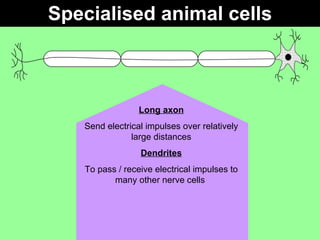
Specialised animal cells Long axon Send electrical impulses over relatively large distances Dendrites To pass / receive electrical impulses to many other nerve cells
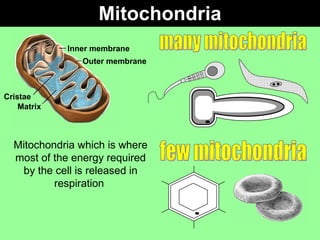
Mitochondria Mitochondria which is where most of the energy required by the cell is released in respiration  many mitochondria few mitochondria Inner membrane Outer membrane Cristae Matrix
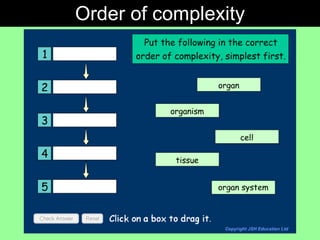
Order of complexity
Specialised cells ALL Order the complexity of an  organism from cell to whole organism MOST Describe how cells are adapted SOME   Explain how these adaptations help  the cell to perform a specific function LEARNING OUTCOMES
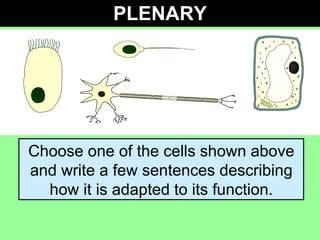
PLENARY Choose one of the cells shown above and write a few sentences describing how it is adapted to its function.

Specialised Cells

  • 1.
    STARTER In orderfor a school to function properly there have to be lots of different types of people, performing a different function . List 8 different types of people and their function that are needed for proper functioning of a school
  • 2.
    Specialised cells ALLOrder the complexity of an organism from cell to whole organism MOST Describe how cells are adapted SOME Explain how these adaptations help the cell to perform a specific function LEARNING OUTCOMES
  • 3.
    Activity - BioviewersUsing the bioviewer, choose 4 different types of cells to draw. For each cell type Describe the cells function (job) Describe any adaptations (how it differs from the typical cells you learnt about last lesson) Explain how these adaptations help it perform it’s function (job)
  • 4.
    Specialised cells Whatdoes this mean? Particular shape Particular size Particular function For each of the plant and animal cells in section 2 of workbook 1 Identify and Explain each adaptation
  • 5.
    Specialised plant cellsThick cell wall on one side Allows cells to bend as they fill with water Large surface area Allows increase in water and mineral absorption Thick cell wall & hollow centre Give a firm straw like structure to transport water
  • 6.
    Specialised animal cellsCilia Moves mucus on the surface Tail propel/swim in mucus Stream lined help swim in mucus Mitochondria energy for swimming Jelly coat for protection Nutrients for cell growth
  • 7.
    Specialised animal cellsElongated pulling in one plane Mitochondria produce energy for contraction Glycogen stored to release extra sugar Can change shape Easy to move in and out of capillaries & engulf invading bacteria Flat disc shape large surface area for O 2 absorption Haemoglobin binds and carries O 2 No nucleus more space for haemoglobin
  • 8.
    Specialised animal cellsLong axon Send electrical impulses over relatively large distances Dendrites To pass / receive electrical impulses to many other nerve cells
  • 9.
    Mitochondria Mitochondria whichis where most of the energy required by the cell is released in respiration many mitochondria few mitochondria Inner membrane Outer membrane Cristae Matrix
  • 10.
  • 11.
    Specialised cells ALLOrder the complexity of an organism from cell to whole organism MOST Describe how cells are adapted SOME Explain how these adaptations help the cell to perform a specific function LEARNING OUTCOMES
  • 12.
    PLENARY Choose oneof the cells shown above and write a few sentences describing how it is adapted to its function.