Cell AnAtomy 
by 
Dr.Arun nArAgunD 
Asst.prof. 
shri.j g c h s A m c 
ghAtAprAbhA
The Cell Theory 
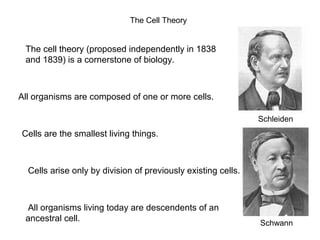
The cell theory (proposed independently in 1838 
and 1839) is a cornerstone of biology. 
All organisms are composed of one or more cells. 
Cells are the smallest living things. 
Cells arise only by division of previously existing cells. 
All organisms living today are descendents of an 
ancestral cell. 
Schleiden 
Schwann
Cells are Us 
A person contains about 100 billion 
cells. That’s 100,000,000,000 or 1 x 10¹¹ 
cells. 
There are about 200 different cell types 
in mammals (one of us). 
Cells are tiny, measuring on average 
about 0.002 cm (20 um) across. That’s 
about 1250 cells, “shoulder-to-shoulder” 
per inch. 
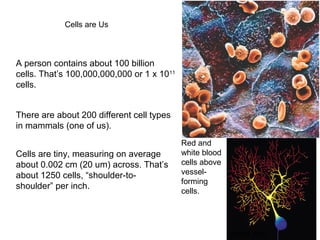
nerve cell 
Red and 
white blood 
cells above 
vessel-forming 
cells.
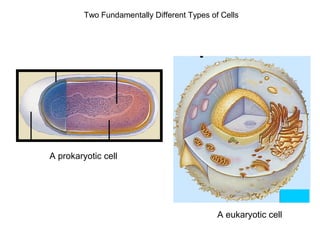
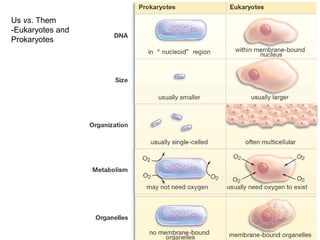
Two Fundamentally Different Types of Cells 
A prokaryotic cell 
A eukaryotic cell
Us vs. Them 
-Eukaryotes and 
Prokaryotes
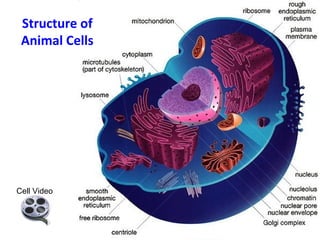
Structure of 
Animal Cells 
Cell Video
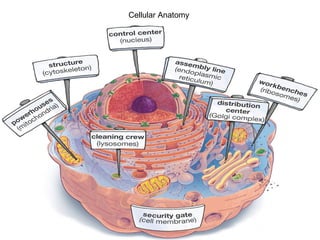
Cellular Anatomy
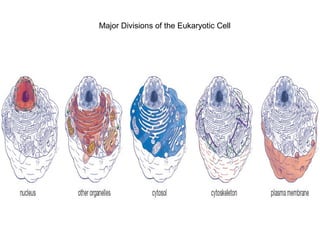
Major Divisions of the Eukaryotic Cell
9 
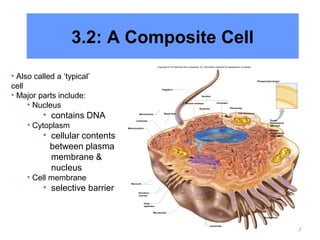
3.2: A Composite Cell 
• Also called a ‘typical’ 
cell 
• Major parts include: 
• Nucleus 
• contains DNA 
• Cytoplasm 
• cellular contents 
between plasma 
membrane & 
nucleus 
• Cell membrane 
• selective barrier 
Microtubules 
Flagellum 
Nucleus 
Nuclear envelope 
Basal body 
Chromatin 
Ribosomes 
Cell membrane 
Mitochondrion 
Rough 
Endoplasmic 
reticulum 
Cilia 
Microtubules 
Microtubule 
Centrioles 
Microvilli 
Nucleolus 
Lysosomes 
Phospholipid bilayer 
Smooth 
Endoplasmic 
reticulum 
Copyright © The McGraw-Hill Companies, Inc. Permission required for reproduction or display. 
Secretory 
vesicles 
Golgi 
apparatus
10 
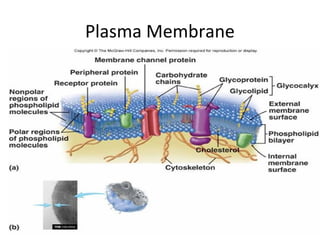
Cell Membrane 
• Outer limit of the cell 
• Controls what moves in and out of the cell 
• Selectively permeable 
• Phospholipid bilayer 
• Water-soluble “heads” form surfaces (hydrophilic) 
• Water-insoluble “tails” form interior (hydrophobic) 
• Permeable to lipid-soluble substances 
• Cholesterol stabilizes the membrane 
• Proteins: 
• Receptors 
• Pores, channels and carriers 
• Enzymes 
• CAMS 
• Self-markers
Plasma Membrane
12 
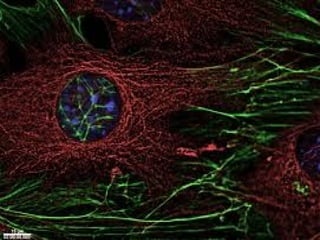
The Cytoskeleton 
• Maintains cell shape 
• Assists in movement of cell and organelles 
• Three types of macromolecular fibers 
– Actin Filaments 
– Intermediate Filaments 
– Microtubules 
• Assemble and disassemble as needed
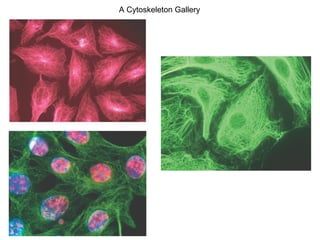
A Cytoskeleton Gallery
15 
The Cytoskeleton: 
Actin Filaments 
• Extremely thin filaments like twisted pearl necklace 
• Dense web just under plasma membrane maintains 
cell shape 
• Support for microvilli in intestinal cells 
• Intracellular traffic control 
– For moving stuff around within cell 
– Cytoplasmic streaming 
• Function in pseudopods of amoeboid cells 
• Pinch mother cell in two after animal mitosis 
• Important component in muscle contraction (other is 
myosin)
16 
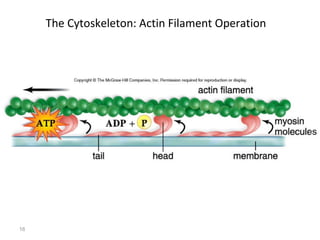
The Cytoskeleton: Actin Filament Operation
17 
The Cytoskeleton: 
Intermediate Filaments 
• Intermediate in size between actin filaments and 
microtubules 
• Rope-like assembly of fibrous polypeptides 
• Vary in nature 
– From tissue to tissue 
– From time to time 
• Functions: 
– Support nuclear envelope 
– Cell-cell junctions, like those holding skin cells tightly 
together
18 
The Cytoskeleton: 
Microtubules 
• Hollow cylinders made of two globular proteins 
called a and b tubulin 
• Spontaneous pairing of a and b tubulin 
molecules form structures called dimers 
• Dimers then arrange themselves into tubular 
spirals of 13 dimers around 
• Assembly: 
– Under control of Microtubule Organizing Center 
(MTOC) 
– Most important MTOC is centrosome 
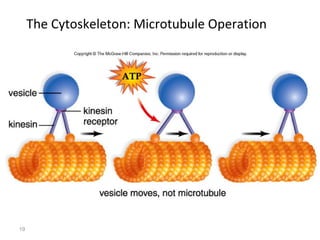
• Interacts with proteins kinesin and dynein to 
cause movement of organelles
19 
The Cytoskeleton: Microtubule Operation
20 
Microtubular Arrays: 
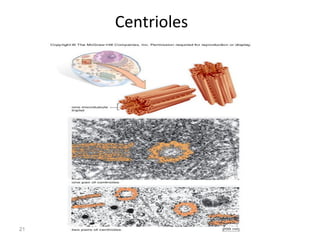
Centrioles 
• Short, hollow cylinders 
– Composed of 27 microtubules 
– Microtubules arranged into 9 overlapping triplets 
• One pair per animal cell 
– Located in centrosome of animal cells 
– Oriented at right angles to each other 
– Separate during mitosis to determine plane of division 
• May give rise to basal bodies of cilia and flagella
21 
Centrioles
22 
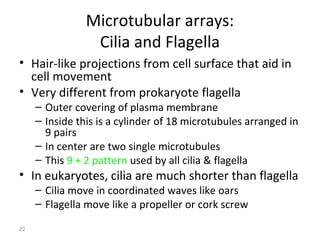
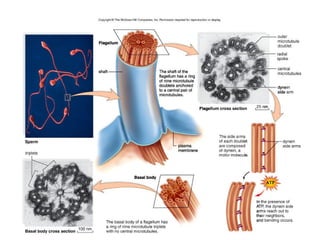
Microtubular arrays: 
Cilia and Flagella 
• Hair-like projections from cell surface that aid in 
cell movement 
• Very different from prokaryote flagella 
– Outer covering of plasma membrane 
– Inside this is a cylinder of 18 microtubules arranged in 
9 pairs 
– In center are two single microtubules 
– This 9 + 2 pattern used by all cilia & flagella 
• In eukaryotes, cilia are much shorter than flagella 
– Cilia move in coordinated waves like oars 
– Flagella move like a propeller or cork screw
23
24 
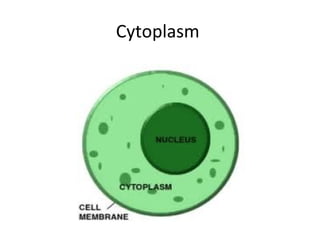
Cytoplasm 
• Cytosol = water 
• Organelles = solids 
Cytoplasm is really like a Jello fruit 
salad where the Jello is the cytosol and 
the fruits (oranges, grapes, bananas, 
maybe walnuts, etc.) are the 
organelles.
Cytoplasm
26 
Organelles 
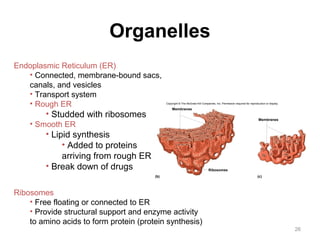
Endoplasmic Reticulum (ER) 
• Connected, membrane-bound sacs, 
canals, and vesicles 
• Transport system 
• Rough ER 
• Studded with ribosomes 
• Smooth ER 
• Lipid synthesis 
• Added to proteins 
arriving from rough ER 
• Break down of drugs 
Ribosomes 
Copyright © The McGraw-Hill Companies, Inc. Permission required for reproduction or display. 
Membranes 
• Free floating or connected to ER 
• Provide structural support and enzyme activity 
to amino acids to form protein (protein synthesis) 
Ribosomes 
Membranes 
(b) (c)
27 
Organelles 
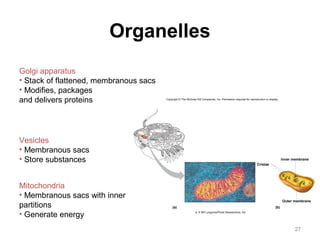
Golgi apparatus 
• Stack of flattened, membranous sacs 
• Modifies, packages 
and delivers proteins 
Copyright © The McGraw-Hill Companies, Inc. Permission required for reproduction or display. 
Vesicles 
• Membranous sacs 
• Store substances Inner membrane 
Outer membrane 
Cristae 
(a) (b) 
a: © Bill Longcore/Photo Researchers, Inc. 
Mitochondria 
• Membranous sacs with inner 
partitions 
• Generate energy
28 
Organelles 
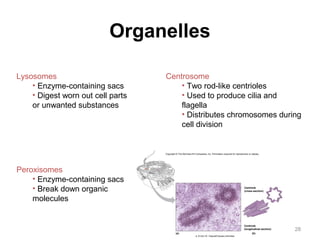
Lysosomes 
• Enzyme-containing sacs 
• Digest worn out cell parts 
or unwanted substances 
Peroxisomes 
• Enzyme-containing sacs 
• Break down organic 
molecules 
Centrosome 
• Two rod-like centrioles 
• Used to produce cilia and 
flagella 
• Distributes chromosomes during 
cell division 
Copyright © The McGraw-Hill Companies, Inc. Permission required for reproduction or display. 
Centriole 
(cross-section) 
Centriole 
(longitudinal section) 
(a) (b) 
a: © Don W. Fawcett/Visuals Unlimited
29 
Organelles 
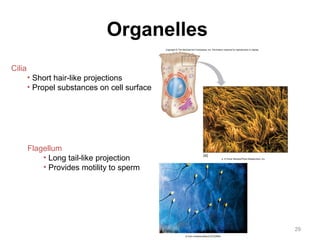
Cilia 
• Short hair-like projections 
• Propel substances on cell surface 
Flagellum 
• Long tail-like projection 
• Provides motility to sperm 
Copyright © The McGraw-Hill Companies, Inc. Permission required for reproduction or display. 
(a) 
a: © Oliver Meckes/Photo Researchers, Inc. 
© Colin Anderson/Brand X/CORBIS
30 
Organelles 
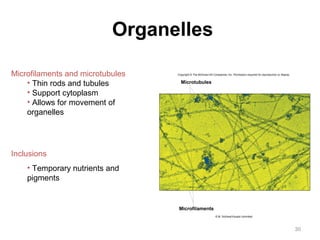
Microfilaments and microtubules 
• Thin rods and tubules 
• Support cytoplasm 
• Allows for movement of 
organelles 
Inclusions 
• Temporary nutrients and 
pigments 
Copyright © The McGraw-Hill Companies, Inc. Permission required for reproduction or display. 
Microtubules 
Microfilaments 
© M. Schliwa/Visuals Unlimited
31 
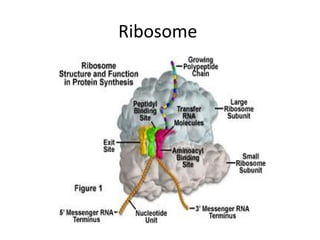
Ribosomes 
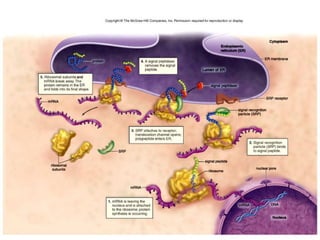
• Serve in protein synthesis 
• Composed of rRNA 
– Consists of a large subunit and a small subunit 
– Subunits made in nucleolus 
• May be located: 
– On the endoplasmic reticulum (thereby making it 
“rough”), or 
– Free in the cytoplasm, either singly or in groups called 
polyribosomes
32 
Figure 4.9
Ribosome
34 
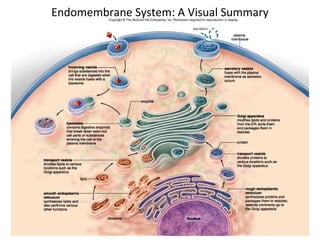
Endomembrane System 
• Restrict enzymatic reactions to specific 
compartments within cell 
• Consists of: 
– Nuclear envelope 
– Membranes of endoplasmic reticulum 
– Golgi apparatus 
– Vesicles 
• Several types 
• Transport materials between organelles of system
35 
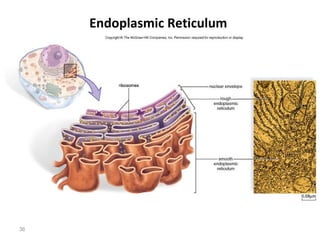
The Endoplasmic Reticulum 
• Rough ER 
– Studded with ribosomes on cytoplasmic side 
– Protein anabolism 
• Synthesizes proteins 
• Modifies proteins 
– Adds sugar to protein 
– Results in glycoproteins 
• Smooth ER 
– No ribosomes 
– Synthesis of lipids
36 
Endoplasmic Reticulum
38 
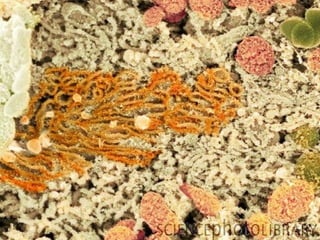
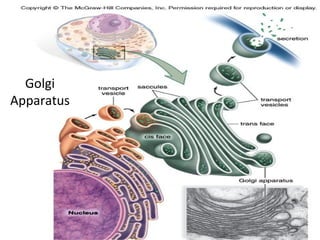
The Golgi Apparatus 
• Golgi Apparatus 
– Consists of 3-20 flattened, curved saccules 
– Resembles stack of hollow pancakes 
– Modifies proteins and lipids 
• Packages them in vesicles 
• Receives vesicles from ER on cis face 
• Prepares for “shipment” in vesicles from trans face 
– Within cell 
– Export from cell (secretion, exocytosis)
Golgi 
Apparatus 
39
40 
Endomembrane System: A Visual Summary
41 
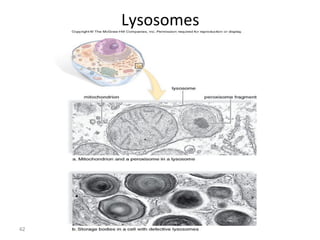
Lysosomes 
• Membrane-bound vesicles (not in plants) 
– Produced by the Golgi apparatus 
– Low pH 
– Contain lytic enzymes 
• Digestion of large molecules 
• Recycling of cellular resources 
• Apoptosis (programmed cell death, like tadpole losing tail) 
• Some genetic diseases 
– Caused by defect in lysosomal enzyme 
– Lysosomal storage diseases (Tay-Sachs)
42 
Lysosomes
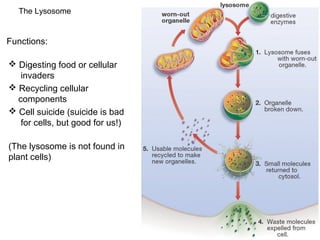
The Lysosome 
Functions: 
 Digesting food or cellular 
invaders 
 Recycling cellular 
components 
 Cell suicide (suicide is bad 
for cells, but good for us!) 
(The lysosome is not found in 
plant cells)
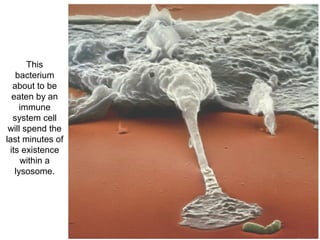
This 
bacterium 
about to be 
eaten by an 
immune 
system cell 
will spend the 
last minutes of 
its existence 
within a 
lysosome.
Mitochondrion 
• A cellular organelle probably of endosymbiotic 
origin that resides in the cytosol of most 
nucleated (eurkaryotic) cells. 
• This organelle produces energy by oxidising 
organic acids and fats with oxygen by the 
process of oxidative phosphorylation and 
generates oxygen radicals (reactive oxygen 
species ROS )as a toxic by-product
46 
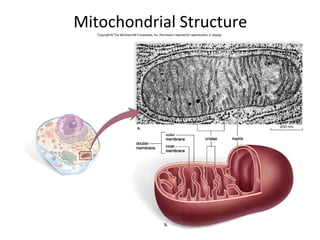
Mitochondrial Structure
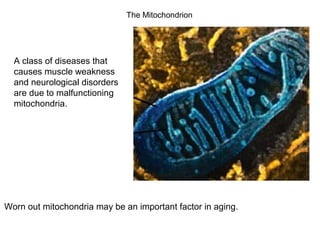
The Mitochondrion 
A class of diseases that 
causes muscle weakness 
and neurological disorders 
are due to malfunctioning 
mitochondria. 
Worn out mitochondria may be an important factor in aging.
48 
Energy-Power House: 
Mitochondria 
• Bounded by double membrane 
– Cristae – Infoldings of inner membrane that encloses 
matrix 
– Matrix – Inner semifluid containing respiratory 
enzymes 
• Involved in cellular respiration 
• Produce most of ATP utilized by the cell
Mitochondrial Genetics 
• Each cell contains many mitochondria, 
each of which contains multiple copies 
of 16.5-k-b circular DNA molecule 
• The mitochondrial genome is subject to 
a number of peculiarities of inheritance
Mitochondrial Genetics 
• Interest in mitochondrial genetics 
comes mostly from: 
• interest in diseases caused by 
mutations in mDNA 
• interest in human history 
• Doug Wallace.(mitochondrial 
enthusiast)
51 
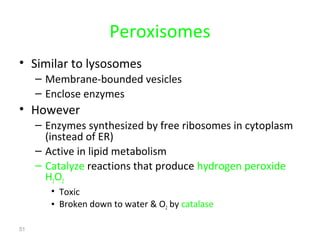
Peroxisomes 
• Similar to lysosomes 
– Membrane-bounded vesicles 
– Enclose enzymes 
• However 
– Enzymes synthesized by free ribosomes in cytoplasm 
(instead of ER) 
– Active in lipid metabolism 
– Catalyze reactions that produce hydrogen peroxide 
H2O2 
• Toxic 
• Broken down to water & O2 by catalase
52 
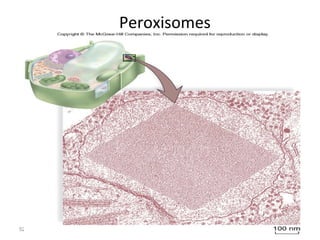
Peroxisomes
Nuclear 
envelope 
54 
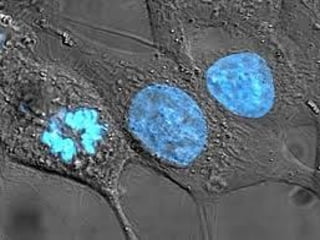
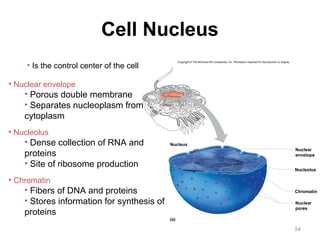
Cell Nucleus 
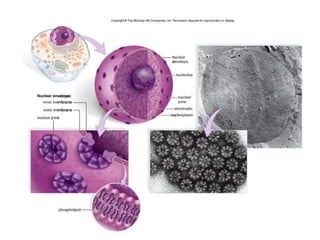
• Is the control center of the cell 
• Nuclear envelope 
• Porous double membrane 
• Separates nucleoplasm from 
cytoplasm 
• Nucleolus 
• Dense collection of RNA and 
proteins 
• Site of ribosome production 
• Chromatin 
• Fibers of DNA and proteins 
• Stores information for synthesis of 
proteins 
Copyright © The McGraw-Hill Companies, Inc. Permission required for reproduction or display. 
Nucleus 
Nucleolus 
Chromatin 
(a) 
Nuclear 
pores
55 
Nucleus 
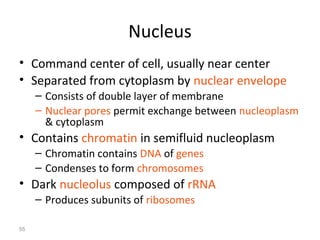
• Command center of cell, usually near center 
• Separated from cytoplasm by nuclear envelope 
– Consists of double layer of membrane 
– Nuclear pores permit exchange between nucleoplasm 
& cytoplasm 
• Contains chromatin in semifluid nucleoplasm 
– Chromatin contains DNA of genes 
– Condenses to form chromosomes 
• Dark nucleolus composed of rRNA 
– Produces subunits of ribosomes
56
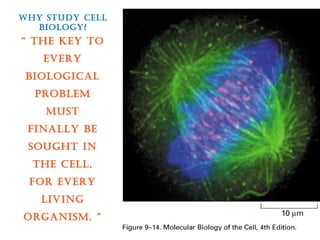
Why Study Cell 
Biology? 
“ the key to 
every 
BiologiCal 
proBlem 
muSt 
finally Be 
Sought in 
the Cell, 
for every 
living 
organiSm. ”
thank 
you

CELL ANATOMY

  • 1.
    Cell AnAtomy by Dr.Arun nArAgunD Asst.prof. shri.j g c h s A m c ghAtAprAbhA
  • 2.
    The Cell Theory The cell theory (proposed independently in 1838 and 1839) is a cornerstone of biology. All organisms are composed of one or more cells. Cells are the smallest living things. Cells arise only by division of previously existing cells. All organisms living today are descendents of an ancestral cell. Schleiden Schwann
  • 3.
    Cells are Us A person contains about 100 billion cells. That’s 100,000,000,000 or 1 x 10¹¹ cells. There are about 200 different cell types in mammals (one of us). Cells are tiny, measuring on average about 0.002 cm (20 um) across. That’s about 1250 cells, “shoulder-to-shoulder” per inch. nerve cell Red and white blood cells above vessel-forming cells.
  • 4.
    Two Fundamentally DifferentTypes of Cells A prokaryotic cell A eukaryotic cell
  • 5.
    Us vs. Them -Eukaryotes and Prokaryotes
  • 6.
    Structure of AnimalCells Cell Video
  • 7.
  • 8.
    Major Divisions ofthe Eukaryotic Cell
  • 9.
    9 3.2: AComposite Cell • Also called a ‘typical’ cell • Major parts include: • Nucleus • contains DNA • Cytoplasm • cellular contents between plasma membrane & nucleus • Cell membrane • selective barrier Microtubules Flagellum Nucleus Nuclear envelope Basal body Chromatin Ribosomes Cell membrane Mitochondrion Rough Endoplasmic reticulum Cilia Microtubules Microtubule Centrioles Microvilli Nucleolus Lysosomes Phospholipid bilayer Smooth Endoplasmic reticulum Copyright © The McGraw-Hill Companies, Inc. Permission required for reproduction or display. Secretory vesicles Golgi apparatus
  • 10.
    10 Cell Membrane • Outer limit of the cell • Controls what moves in and out of the cell • Selectively permeable • Phospholipid bilayer • Water-soluble “heads” form surfaces (hydrophilic) • Water-insoluble “tails” form interior (hydrophobic) • Permeable to lipid-soluble substances • Cholesterol stabilizes the membrane • Proteins: • Receptors • Pores, channels and carriers • Enzymes • CAMS • Self-markers
  • 11.
  • 12.
    12 The Cytoskeleton • Maintains cell shape • Assists in movement of cell and organelles • Three types of macromolecular fibers – Actin Filaments – Intermediate Filaments – Microtubules • Assemble and disassemble as needed
  • 14.
  • 15.
    15 The Cytoskeleton: Actin Filaments • Extremely thin filaments like twisted pearl necklace • Dense web just under plasma membrane maintains cell shape • Support for microvilli in intestinal cells • Intracellular traffic control – For moving stuff around within cell – Cytoplasmic streaming • Function in pseudopods of amoeboid cells • Pinch mother cell in two after animal mitosis • Important component in muscle contraction (other is myosin)
  • 16.
    16 The Cytoskeleton:Actin Filament Operation
  • 17.
    17 The Cytoskeleton: Intermediate Filaments • Intermediate in size between actin filaments and microtubules • Rope-like assembly of fibrous polypeptides • Vary in nature – From tissue to tissue – From time to time • Functions: – Support nuclear envelope – Cell-cell junctions, like those holding skin cells tightly together
  • 18.
    18 The Cytoskeleton: Microtubules • Hollow cylinders made of two globular proteins called a and b tubulin • Spontaneous pairing of a and b tubulin molecules form structures called dimers • Dimers then arrange themselves into tubular spirals of 13 dimers around • Assembly: – Under control of Microtubule Organizing Center (MTOC) – Most important MTOC is centrosome • Interacts with proteins kinesin and dynein to cause movement of organelles
  • 19.
    19 The Cytoskeleton:Microtubule Operation
  • 20.
    20 Microtubular Arrays: Centrioles • Short, hollow cylinders – Composed of 27 microtubules – Microtubules arranged into 9 overlapping triplets • One pair per animal cell – Located in centrosome of animal cells – Oriented at right angles to each other – Separate during mitosis to determine plane of division • May give rise to basal bodies of cilia and flagella
  • 21.
  • 22.
    22 Microtubular arrays: Cilia and Flagella • Hair-like projections from cell surface that aid in cell movement • Very different from prokaryote flagella – Outer covering of plasma membrane – Inside this is a cylinder of 18 microtubules arranged in 9 pairs – In center are two single microtubules – This 9 + 2 pattern used by all cilia & flagella • In eukaryotes, cilia are much shorter than flagella – Cilia move in coordinated waves like oars – Flagella move like a propeller or cork screw
  • 23.
  • 24.
    24 Cytoplasm •Cytosol = water • Organelles = solids Cytoplasm is really like a Jello fruit salad where the Jello is the cytosol and the fruits (oranges, grapes, bananas, maybe walnuts, etc.) are the organelles.
  • 25.
  • 26.
    26 Organelles EndoplasmicReticulum (ER) • Connected, membrane-bound sacs, canals, and vesicles • Transport system • Rough ER • Studded with ribosomes • Smooth ER • Lipid synthesis • Added to proteins arriving from rough ER • Break down of drugs Ribosomes Copyright © The McGraw-Hill Companies, Inc. Permission required for reproduction or display. Membranes • Free floating or connected to ER • Provide structural support and enzyme activity to amino acids to form protein (protein synthesis) Ribosomes Membranes (b) (c)
  • 27.
    27 Organelles Golgiapparatus • Stack of flattened, membranous sacs • Modifies, packages and delivers proteins Copyright © The McGraw-Hill Companies, Inc. Permission required for reproduction or display. Vesicles • Membranous sacs • Store substances Inner membrane Outer membrane Cristae (a) (b) a: © Bill Longcore/Photo Researchers, Inc. Mitochondria • Membranous sacs with inner partitions • Generate energy
  • 28.
    28 Organelles Lysosomes • Enzyme-containing sacs • Digest worn out cell parts or unwanted substances Peroxisomes • Enzyme-containing sacs • Break down organic molecules Centrosome • Two rod-like centrioles • Used to produce cilia and flagella • Distributes chromosomes during cell division Copyright © The McGraw-Hill Companies, Inc. Permission required for reproduction or display. Centriole (cross-section) Centriole (longitudinal section) (a) (b) a: © Don W. Fawcett/Visuals Unlimited
  • 29.
    29 Organelles Cilia • Short hair-like projections • Propel substances on cell surface Flagellum • Long tail-like projection • Provides motility to sperm Copyright © The McGraw-Hill Companies, Inc. Permission required for reproduction or display. (a) a: © Oliver Meckes/Photo Researchers, Inc. © Colin Anderson/Brand X/CORBIS
  • 30.
    30 Organelles Microfilamentsand microtubules • Thin rods and tubules • Support cytoplasm • Allows for movement of organelles Inclusions • Temporary nutrients and pigments Copyright © The McGraw-Hill Companies, Inc. Permission required for reproduction or display. Microtubules Microfilaments © M. Schliwa/Visuals Unlimited
  • 31.
    31 Ribosomes •Serve in protein synthesis • Composed of rRNA – Consists of a large subunit and a small subunit – Subunits made in nucleolus • May be located: – On the endoplasmic reticulum (thereby making it “rough”), or – Free in the cytoplasm, either singly or in groups called polyribosomes
  • 32.
  • 33.
  • 34.
    34 Endomembrane System • Restrict enzymatic reactions to specific compartments within cell • Consists of: – Nuclear envelope – Membranes of endoplasmic reticulum – Golgi apparatus – Vesicles • Several types • Transport materials between organelles of system
  • 35.
    35 The EndoplasmicReticulum • Rough ER – Studded with ribosomes on cytoplasmic side – Protein anabolism • Synthesizes proteins • Modifies proteins – Adds sugar to protein – Results in glycoproteins • Smooth ER – No ribosomes – Synthesis of lipids
  • 36.
  • 38.
    38 The GolgiApparatus • Golgi Apparatus – Consists of 3-20 flattened, curved saccules – Resembles stack of hollow pancakes – Modifies proteins and lipids • Packages them in vesicles • Receives vesicles from ER on cis face • Prepares for “shipment” in vesicles from trans face – Within cell – Export from cell (secretion, exocytosis)
  • 39.
  • 40.
    40 Endomembrane System:A Visual Summary
  • 41.
    41 Lysosomes •Membrane-bound vesicles (not in plants) – Produced by the Golgi apparatus – Low pH – Contain lytic enzymes • Digestion of large molecules • Recycling of cellular resources • Apoptosis (programmed cell death, like tadpole losing tail) • Some genetic diseases – Caused by defect in lysosomal enzyme – Lysosomal storage diseases (Tay-Sachs)
  • 42.
  • 43.
    The Lysosome Functions:  Digesting food or cellular invaders  Recycling cellular components  Cell suicide (suicide is bad for cells, but good for us!) (The lysosome is not found in plant cells)
  • 44.
    This bacterium aboutto be eaten by an immune system cell will spend the last minutes of its existence within a lysosome.
  • 45.
    Mitochondrion • Acellular organelle probably of endosymbiotic origin that resides in the cytosol of most nucleated (eurkaryotic) cells. • This organelle produces energy by oxidising organic acids and fats with oxygen by the process of oxidative phosphorylation and generates oxygen radicals (reactive oxygen species ROS )as a toxic by-product
  • 46.
  • 47.
    The Mitochondrion Aclass of diseases that causes muscle weakness and neurological disorders are due to malfunctioning mitochondria. Worn out mitochondria may be an important factor in aging.
  • 48.
    48 Energy-Power House: Mitochondria • Bounded by double membrane – Cristae – Infoldings of inner membrane that encloses matrix – Matrix – Inner semifluid containing respiratory enzymes • Involved in cellular respiration • Produce most of ATP utilized by the cell
  • 49.
    Mitochondrial Genetics •Each cell contains many mitochondria, each of which contains multiple copies of 16.5-k-b circular DNA molecule • The mitochondrial genome is subject to a number of peculiarities of inheritance
  • 50.
    Mitochondrial Genetics •Interest in mitochondrial genetics comes mostly from: • interest in diseases caused by mutations in mDNA • interest in human history • Doug Wallace.(mitochondrial enthusiast)
  • 51.
    51 Peroxisomes •Similar to lysosomes – Membrane-bounded vesicles – Enclose enzymes • However – Enzymes synthesized by free ribosomes in cytoplasm (instead of ER) – Active in lipid metabolism – Catalyze reactions that produce hydrogen peroxide H2O2 • Toxic • Broken down to water & O2 by catalase
  • 52.
  • 54.
    Nuclear envelope 54 Cell Nucleus • Is the control center of the cell • Nuclear envelope • Porous double membrane • Separates nucleoplasm from cytoplasm • Nucleolus • Dense collection of RNA and proteins • Site of ribosome production • Chromatin • Fibers of DNA and proteins • Stores information for synthesis of proteins Copyright © The McGraw-Hill Companies, Inc. Permission required for reproduction or display. Nucleus Nucleolus Chromatin (a) Nuclear pores
  • 55.
    55 Nucleus •Command center of cell, usually near center • Separated from cytoplasm by nuclear envelope – Consists of double layer of membrane – Nuclear pores permit exchange between nucleoplasm & cytoplasm • Contains chromatin in semifluid nucleoplasm – Chromatin contains DNA of genes – Condenses to form chromosomes • Dark nucleolus composed of rRNA – Produces subunits of ribosomes
  • 56.
  • 57.
    Why Study Cell Biology? “ the key to every BiologiCal proBlem muSt finally Be Sought in the Cell, for every living organiSm. ”
  • 58.