Cytosol

Cytoplasm refers to the jelly-like material with organelles in
it.
If the organelles were removed, the soluble part that would
be left is called the cytosol. It consists mainly of water with
dissolved substances such as amino acids in it.
Nucleus- The nucleus is the control center of the cell. It is the largest
organelle in the cell and it contains the DNA of the cell. The DNA of all
cells is made up of chromosomes.

DNA (Deoxyribonucleic Acid) contains all the information for cells to
live, perform their functions and reproduce.

Inside the nucleus is another organelle called the nucleolus. The
nucleolus is responsible for making ribosomes.

The circles on the surface of the nucleus are the nuclear pores. These are
where ribosomes, and other materials move in and out of the cell.
Mitochondria
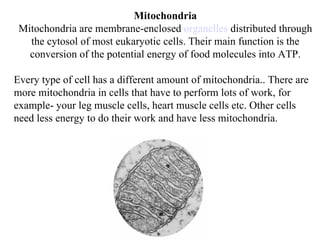
 Mitochondria are membrane-enclosed organelles distributed through
   the cytosol of most eukaryotic cells. Their main function is the
   conversion of the potential energy of food molecules into ATP.

Every type of cell has a different amount of mitochondria.. There are
more mitochondria in cells that have to perform lots of work, for
example- your leg muscle cells, heart muscle cells etc. Other cells
need less energy to do their work and have less mitochondria.
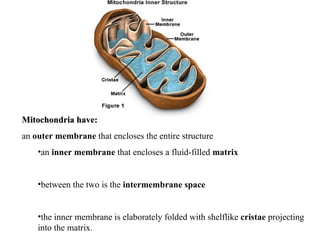
Mitochondria have:
an outer membrane that encloses the entire structure
    •an inner membrane that encloses a fluid-filled matrix


    •between the two is the intermembrane space


    •the inner membrane is elaborately folded with shelflike cristae projecting
    into the matrix.
Endoplasmic reticulum (ER)- It is a network of membranes
throughout the cytoplasm of the cell. There are two types of ER.
When ribosomes are attached it is called rough ER and smooth ER
when there are no ribosomes attached.
The rough endoplasmic reticulum is where most protein synthesis
occurs in the cell. The function of the smooth endoplasmic reticulum is
to synthesize lipids in the cell. The smooth ER is also helps in the
detoxification of harmful substances in the cell.
Golgi complex- It is organelle in the cell that is
responsible for sorting and correctly shipping the
proteins produced in the ER.

Just like our postal packages which should have a
correct shipping address, the proteins produced in
the ER, should be correctly sent to their respective
address.

In the cell, shipping and sorting done by the Golgi
complex. It is a very important step in protein
synthesis.

If the Golgi complex makes a mistake in shipping
the proteins to the right address, certain functions in
the cell may stop.
Ribosomes- Organelles that help in the synthesis of proteins. Ribosomes
are made up of two parts, called subunits.
 They get their names from their size. One unit is larger than than the
other so they are called large and small subunits.

Both these subunits are necessary for protein synthesis in the cell. When
the two units are docked together with a special information unit called
messenger RNA, they make proteins.

Some ribosomes are found in the cytoplasm, but most are attached to the
endoplasmic reticulum. While attached to the ER, ribosomes make
proteins that the cell needs and also ones to be exported from the cell for
work elsewhere in the body.
The f l u i d m o s a i c m o d e l describes the structure of the
plasma membrane.Different kinds of cell membrane models have
 been proposed, and one of the most useful is the Fluid-mosaic
    model. In this model the membrane is seen as a bilayer of
    phospholipids in which protein molecules are embedded.


                                             An illustration of the Fluid
                                                   mosaic model
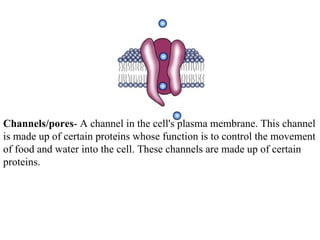
Channels/pores- A channel in the cell's plasma membrane. This channel
is made up of certain proteins whose function is to control the movement
of food and water into the cell. These channels are made up of certain
proteins.
Vesicles- This term literally means "small vessel". This organelle helps
store and transport products produced by the cell.
The vesicles are the transport and delivery vehicles like our mail and
Federal Express trucks. Some vesicles deliver materials to parts of the
cell and others transport materials outside the cell in a process called
exocytosis
Lysosomes function as the cell's recycling compartment.


Lysosomes receive cellular and endocytosed proteins and
lipids that need digesting. The metabolites that result are
    transported either by vesicles or directly across the
                        membrane.
Steps in lysomal formation

•   The ER and Golgi apparatus make a lysosome

•   (2) The lysosome fuses with a digestive vacuole
    (3) Activated acid

•   hydrolases digest the contents
The centrosome, also called the "microtubule organizing center", is an
area in the cell where microtubles are produced.

Within an animal cell centrosome there is a pair of small organelles, the
centrioles, each made up of a ring of nine groups of microtubules. There
are three fused microtubules in each group.

The two centrioles are arranged such that one is perpendicular to the
other.


During animal cell division, the centrosome divides and the centrioles
replicate (make new copies). The result is two centrosomes, each with its
own pair of centrioles. The two centrosomes move to opposite ends of
the nucleus, and from each centrosome, microtubules grow into a
"spindle" which is responsible for separating replicated chromosomes
into the two daughter cells.
•c i l i a are thread-like projections of certain cells that beat in a
regular fashion to create currents that sweep materials along;
Flagella may extend to the rear of a cell and push it forward by snakelike
           wriggling, or stick out in front and draw it along.


We humans possess both flagella and cilia. Each sperm cell is propelled
by a trailing flagellum that accelerates the little torpedo forward in its
quest to fertilize an egg.
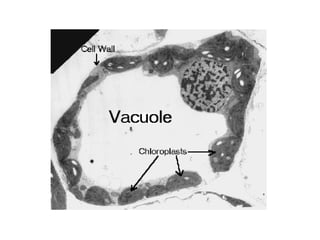
Chloroplast- The cell organelle in which photosynthesis takes place. In
this organelle the light energy of the sun is converted into chemical
energy.
 Chloroplasts are found only in plant cells not animal cells. The chemical
energy that is produced by chloroplasts is finally used to make
carbohydrates like starch, that get stored in the plant.
Chloroplasts contain tiny pigments called chlorophylls. Chlorophylls are
responsible for trapping the light energy from the sun.
        One of the most important distinguishing features of plant cells is the
           presence of a cell wall, a which serves a variety of functions.

  The cell wall protects the cellular contents; gives rigidity to the plant structure;
    provides a porous medium for the circulation  and distribution of water,
    minerals, and other small nutrient molecules; and contains specialized
molecules that regulate growth and protect  the plant from disease. A structure
    of great tensile strength, the cell wall is formed from fibrils of cellulose
   molecules, embedded in a  water-saturated matrix of polysaccharides and
                          structural glycoproteins.        .
Cell wall & Plasmodesmata- In addition to cell membranes, plants have
cell walls. Cell walls provide protection and support for plants.
Unlike cell membranes materials cannot get through cell walls. This
would be a problem for plant cells if not for special openings called
plasmodesmata.
These openings are used to communicate and transport materials
between plant cells because the cell membranes are able touch and
therefore exchange needed materials.
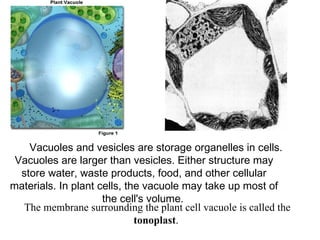
        Vacuoles and vesicles are storage organelles in cells.
   Vacuoles are larger than vesicles. Either structure may
     store water, waste products, food, and other cellular
 materials. In plant cells, the vacuole may take up most of
                      the cell's volume.
      The membrane surrounding the plant cell vacuole is called the
                              tonoplast.
Differences between Prokaryotic & Eukaryotic cells
Bacterial cells also contain flagellum, plasmid and capsule.

  Feature             Prokaryote                     Eukaryote

               Small about 0.5
    Size                                   Up to 40 micrometers
               micrometers

  Genetic      Circular DNA (in            DNA in form of linear
  material     cytoplasm)                  chromosomes ( in nucleus)

                                           Many organelles:
               Few present, none               •Double membranes e.g.:
Organelles                                     nucleus, mitochondria &
               membrane bound
                                               chloroplasts
                                               •Single membrane e.g.: GA,
                                               ER & lysosomes
                                               •Fungi: rigid, formed from
               Rigid formed from               polysaccharide, chitin.
 Cell walls    glycoproteins (mainly           •Plant: rigid, formed from
                                               polysaccharides. E.g.:
               murein)
                                               cellulose.
                                               •Animals no cell wall

Ribosome’s                70s                            80s
Epithelial Tissue

Epithelial tissues come in three basic types: squamous, cuboidal and columnar. These
three types of tissue are seen in either simple (only one cell layer thick) or stratified
                        (many cells in thickness) arrangements.


                     The Simple Epithelial Tissue Types
Simple Cuboidal Epithelium:   Simple Columnar Epithelium:
The Stratified Epithelial Tissue Type


  It is called pseudostratified due to the differing heights of the cells and the nuclei
 within the cells, making the epithelium look as if it is multilayered (stratified). The
prefix, "pseudo" means "fake" or "not real", so pseudostratified literally means, "not
                                  really multilayered."
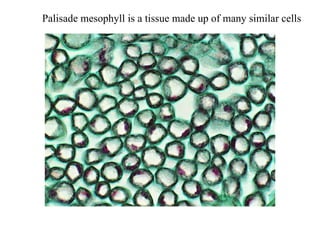
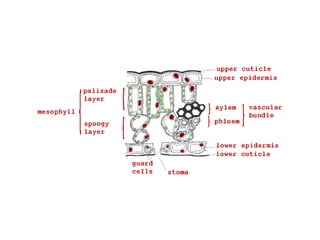
Palisade mesophyll is a tissue made up of many similar cells
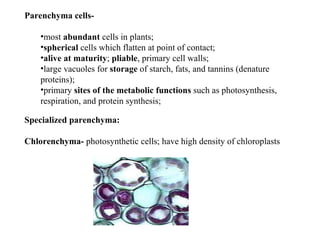
Parenchyma cells-

    •most abundant cells in plants;
    •spherical cells which flatten at point of contact;
    •alive at maturity; pliable, primary cell walls;
    •large vacuoles for storage of starch, fats, and tannins (denature
    proteins);
    •primary sites of the metabolic functions such as photosynthesis,
    respiration, and protein synthesis;

Specialized parenchyma:

Chlorenchyma- photosynthetic cells; have high density of chloroplasts
This powerpoint was kindly donated to
www.worldofteaching.com


http://www.worldofteaching.com is home to over a
thousand powerpoints submitted by teachers. This is a
completely free site and requires no registration. Please
visit and I hope it will help in your teaching.

Cells

  • 3.
    Cytosol Cytoplasm refers tothe jelly-like material with organelles in it. If the organelles were removed, the soluble part that would be left is called the cytosol. It consists mainly of water with dissolved substances such as amino acids in it.
  • 4.
    Nucleus- The nucleusis the control center of the cell. It is the largest organelle in the cell and it contains the DNA of the cell. The DNA of all cells is made up of chromosomes. DNA (Deoxyribonucleic Acid) contains all the information for cells to live, perform their functions and reproduce. Inside the nucleus is another organelle called the nucleolus. The nucleolus is responsible for making ribosomes. The circles on the surface of the nucleus are the nuclear pores. These are where ribosomes, and other materials move in and out of the cell.
  • 5.
    Mitochondria Mitochondria aremembrane-enclosed organelles distributed through the cytosol of most eukaryotic cells. Their main function is the conversion of the potential energy of food molecules into ATP. Every type of cell has a different amount of mitochondria.. There are more mitochondria in cells that have to perform lots of work, for example- your leg muscle cells, heart muscle cells etc. Other cells need less energy to do their work and have less mitochondria.
  • 6.
    Mitochondria have: an outermembrane that encloses the entire structure •an inner membrane that encloses a fluid-filled matrix •between the two is the intermembrane space •the inner membrane is elaborately folded with shelflike cristae projecting into the matrix.
  • 7.
    Endoplasmic reticulum (ER)-It is a network of membranes throughout the cytoplasm of the cell. There are two types of ER. When ribosomes are attached it is called rough ER and smooth ER when there are no ribosomes attached. The rough endoplasmic reticulum is where most protein synthesis occurs in the cell. The function of the smooth endoplasmic reticulum is to synthesize lipids in the cell. The smooth ER is also helps in the detoxification of harmful substances in the cell.
  • 8.
    Golgi complex- Itis organelle in the cell that is responsible for sorting and correctly shipping the proteins produced in the ER. Just like our postal packages which should have a correct shipping address, the proteins produced in the ER, should be correctly sent to their respective address. In the cell, shipping and sorting done by the Golgi complex. It is a very important step in protein synthesis. If the Golgi complex makes a mistake in shipping the proteins to the right address, certain functions in the cell may stop.
  • 9.
    Ribosomes- Organelles thathelp in the synthesis of proteins. Ribosomes are made up of two parts, called subunits. They get their names from their size. One unit is larger than than the other so they are called large and small subunits. Both these subunits are necessary for protein synthesis in the cell. When the two units are docked together with a special information unit called messenger RNA, they make proteins. Some ribosomes are found in the cytoplasm, but most are attached to the endoplasmic reticulum. While attached to the ER, ribosomes make proteins that the cell needs and also ones to be exported from the cell for work elsewhere in the body.
  • 10.
    The f lu i d m o s a i c m o d e l describes the structure of the plasma membrane.Different kinds of cell membrane models have been proposed, and one of the most useful is the Fluid-mosaic model. In this model the membrane is seen as a bilayer of phospholipids in which protein molecules are embedded. An illustration of the Fluid mosaic model
  • 11.
    Channels/pores- A channelin the cell's plasma membrane. This channel is made up of certain proteins whose function is to control the movement of food and water into the cell. These channels are made up of certain proteins.
  • 12.
    Vesicles- This termliterally means "small vessel". This organelle helps store and transport products produced by the cell. The vesicles are the transport and delivery vehicles like our mail and Federal Express trucks. Some vesicles deliver materials to parts of the cell and others transport materials outside the cell in a process called exocytosis
  • 13.
    Lysosomes function asthe cell's recycling compartment. Lysosomes receive cellular and endocytosed proteins and lipids that need digesting. The metabolites that result are transported either by vesicles or directly across the membrane.
  • 14.
    Steps in lysomalformation • The ER and Golgi apparatus make a lysosome • (2) The lysosome fuses with a digestive vacuole (3) Activated acid • hydrolases digest the contents
  • 16.
    The centrosome, alsocalled the "microtubule organizing center", is an area in the cell where microtubles are produced. Within an animal cell centrosome there is a pair of small organelles, the centrioles, each made up of a ring of nine groups of microtubules. There are three fused microtubules in each group. The two centrioles are arranged such that one is perpendicular to the other. During animal cell division, the centrosome divides and the centrioles replicate (make new copies). The result is two centrosomes, each with its own pair of centrioles. The two centrosomes move to opposite ends of the nucleus, and from each centrosome, microtubules grow into a "spindle" which is responsible for separating replicated chromosomes into the two daughter cells.
  • 17.
    •c i li a are thread-like projections of certain cells that beat in a regular fashion to create currents that sweep materials along;
  • 18.
    Flagella may extendto the rear of a cell and push it forward by snakelike wriggling, or stick out in front and draw it along. We humans possess both flagella and cilia. Each sperm cell is propelled by a trailing flagellum that accelerates the little torpedo forward in its quest to fertilize an egg.
  • 22.
    Chloroplast- The cellorganelle in which photosynthesis takes place. In this organelle the light energy of the sun is converted into chemical energy. Chloroplasts are found only in plant cells not animal cells. The chemical energy that is produced by chloroplasts is finally used to make carbohydrates like starch, that get stored in the plant. Chloroplasts contain tiny pigments called chlorophylls. Chlorophylls are responsible for trapping the light energy from the sun.
  • 23.
            One ofthe most important distinguishing features of plant cells is the presence of a cell wall, a which serves a variety of functions.   The cell wall protects the cellular contents; gives rigidity to the plant structure; provides a porous medium for the circulation  and distribution of water, minerals, and other small nutrient molecules; and contains specialized molecules that regulate growth and protect  the plant from disease. A structure of great tensile strength, the cell wall is formed from fibrils of cellulose molecules, embedded in a  water-saturated matrix of polysaccharides and structural glycoproteins.        .
  • 24.
    Cell wall &Plasmodesmata- In addition to cell membranes, plants have cell walls. Cell walls provide protection and support for plants. Unlike cell membranes materials cannot get through cell walls. This would be a problem for plant cells if not for special openings called plasmodesmata. These openings are used to communicate and transport materials between plant cells because the cell membranes are able touch and therefore exchange needed materials.
  • 25.
            Vacuoles andvesicles are storage organelles in cells. Vacuoles are larger than vesicles. Either structure may store water, waste products, food, and other cellular materials. In plant cells, the vacuole may take up most of the cell's volume. The membrane surrounding the plant cell vacuole is called the tonoplast.
  • 28.
    Differences between Prokaryotic& Eukaryotic cells Bacterial cells also contain flagellum, plasmid and capsule. Feature Prokaryote Eukaryote Small about 0.5 Size Up to 40 micrometers micrometers Genetic Circular DNA (in DNA in form of linear material cytoplasm) chromosomes ( in nucleus) Many organelles: Few present, none •Double membranes e.g.: Organelles nucleus, mitochondria & membrane bound chloroplasts •Single membrane e.g.: GA, ER & lysosomes •Fungi: rigid, formed from Rigid formed from polysaccharide, chitin. Cell walls glycoproteins (mainly •Plant: rigid, formed from polysaccharides. E.g.: murein) cellulose. •Animals no cell wall Ribosome’s 70s 80s
  • 29.
    Epithelial Tissue Epithelial tissuescome in three basic types: squamous, cuboidal and columnar. These three types of tissue are seen in either simple (only one cell layer thick) or stratified (many cells in thickness) arrangements. The Simple Epithelial Tissue Types
  • 30.
    Simple Cuboidal Epithelium: Simple Columnar Epithelium:
  • 31.
    The Stratified EpithelialTissue Type It is called pseudostratified due to the differing heights of the cells and the nuclei within the cells, making the epithelium look as if it is multilayered (stratified). The prefix, "pseudo" means "fake" or "not real", so pseudostratified literally means, "not really multilayered."
  • 32.
    Palisade mesophyll isa tissue made up of many similar cells
  • 35.
    Parenchyma cells- •most abundant cells in plants; •spherical cells which flatten at point of contact; •alive at maturity; pliable, primary cell walls; •large vacuoles for storage of starch, fats, and tannins (denature proteins); •primary sites of the metabolic functions such as photosynthesis, respiration, and protein synthesis; Specialized parenchyma: Chlorenchyma- photosynthetic cells; have high density of chloroplasts
  • 36.
    This powerpoint waskindly donated to www.worldofteaching.com http://www.worldofteaching.com is home to over a thousand powerpoints submitted by teachers. This is a completely free site and requires no registration. Please visit and I hope it will help in your teaching.