R eproductive cells in human Present by: m.nafly (HND in Biomedical scientist) * Nafly Hussain*
EGG CELL * Nafly Hussain*
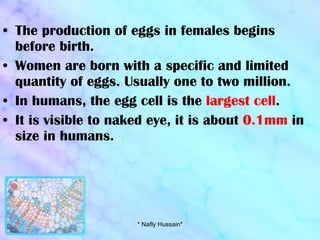
The production of eggs in females begins before birth. Women are born with a specific and limited quantity of eggs. Usually one to two million. In humans, the egg cell is the  largest cell . It is visible to naked eye, it is about  0.1mm  in size in humans. * Nafly Hussain*
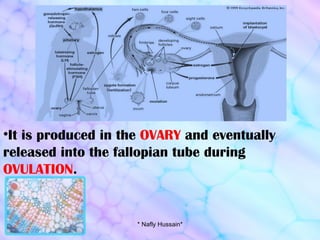
It is produced in the  OVARY  and eventually released into the fallopian tube during  OVULATION . * Nafly Hussain*
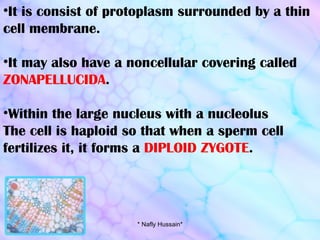
It is consist of protoplasm surrounded by a thin cell membrane. It may also have a noncellular covering called  ZONAPELLUCIDA . Within the large nucleus with a nucleolus The cell is haploid so that when a sperm cell fertilizes it, it forms a  DIPLOID ZYGOTE . * Nafly Hussain*
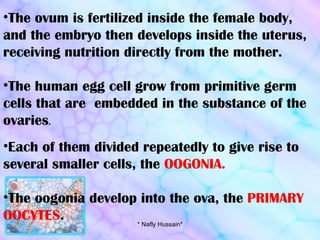
The ovum is fertilized inside the female body, and the embryo then develops inside the uterus, receiving nutrition directly from the mother. The human egg cell grow from primitive germ cells that are  embedded in the substance of the ovaries . Each of them divided repeatedly to give rise to several smaller cells, the  OOGONIA. The oogonia develop into the ova, the  PRIMARY OOCYTES . * Nafly Hussain*
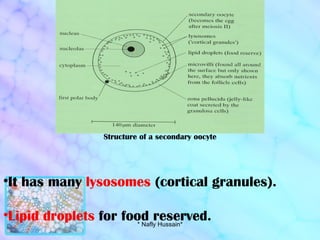
It has many  lysosomes  (cortical granules). Lipid droplets  for food reserved. Structure of a secondary oocyte * Nafly Hussain*
Microvilli  found all around the surface, they absorb nutrients from the follicle cells. Zona pellucida , jelly like coat secreted by the granulosa cells. It has  first polar body. Cytoplasm. Nucleolus. Nucleus. * Nafly Hussain*
Adaptation of egg cells to its function. It has lots of  cytoplasm , to support the many divisions that it undergoes and the second adaptation when a sperm cell interacts With it, the cell membrane changes immediately, to become impenetrable to any other sperm cells. Also it contains  cytoplasm  to survive on for the couple of hours it takes the egg cell to reach the womb. * Nafly Hussain*
Adaptation of egg cells to its function . The egg cell is much bigger than the sperm and has a  chemical around  the out side to stop more sperm getting in. Egg is  large  to contain food store for embryo. It is  haploid , has a single set of chromosomes. This ensures the uniqueness. * Nafly Hussain*
Adaptation of egg cells to its function.  Egg cell is  thin enough  to let the pointy headed sperm inside itself and with that it reproduces to create children. The egg can grown along with the baby and it can just  feed  the baby and look after the baby. The egg cell is also big round and it looks  like a big bird nest. * Nafly Hussain*
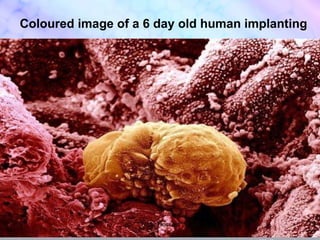
Coloured image of a 6 day old human implanting  * Nafly Hussain*
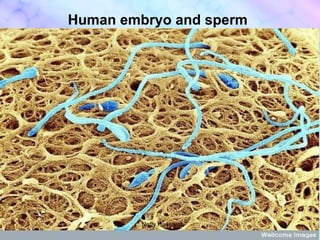
Human embryo and sperm * Nafly Hussain*
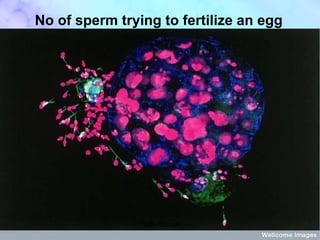
No of sperm trying to fertilize an egg * Nafly Hussain*
SPERM CELL * Nafly Hussain*
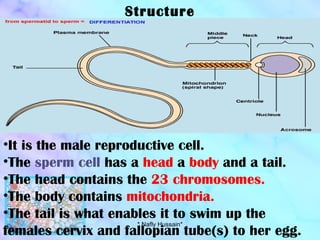
Structure It is the male reproductive cell.  The  sperm cell  has a  head  a  body  and a tail. The head contains the  23 chromosomes.   The body contains  mitochondria. The tail is what enables it to swim up the females cervix and fallopian tube(s) to her egg.   * Nafly Hussain*
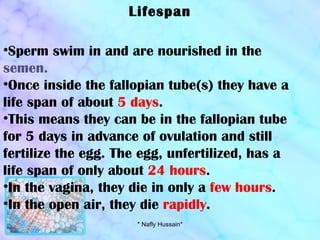
Lifespan Sperm swim in and are nourished in the  semen.  Once inside the fallopian tube(s) they have a life span of about  5 days . This means they can be in the fallopian tube for 5 days in advance of ovulation and still fertilize the egg. The egg, unfertilized, has a life span of only about  24 hours . In the vagina, they die in only a  few hours . In the open air, they die  rapidly . * Nafly Hussain*
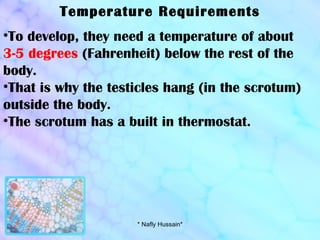
Temperature Requirements To develop, they need a temperature of about  3-5 degrees  (Fahrenheit) below the rest of the body.  That is why the testicles hang (in the scrotum) outside the body. The scrotum has a built in thermostat.   * Nafly Hussain*
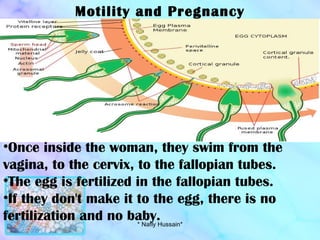
Motility and Pregnancy Once inside the woman, they swim from the vagina, to the cervix, to the fallopian tubes.  The egg is fertilized in the fallopian tubes. If they don't make it to the egg, there is no fertilization and no baby. * Nafly Hussain*
Chromosomes Unlike every cell of the male body, which has 46 chromosomes (in 23 pairs), these cells have only 23 (not in pairs).  The same is true for the female eggs. When a sperm and an egg combine they once again form a perfect cell with 46 chromosomes in 23 pairs.  This one cell now has all the information (DNA) necessary to produce a complete human being. The combined DNA now has all the information of the physical characteristics of both parents. * Nafly Hussain*
Adaptation of sperm cells to its function. A sperm cell has a  long tail  to help it swim to the egg. mid- piece which contains large amount of  mitochondria  to release energy needed to make  the tail move. The head of the sperm also contain  enzymes  to break down and digest the zona pellucida of the egg so that it can fertilize it.  * Nafly Hussain*
Adaptation of sperm cells to its function. They also have a  pointed front end  so they are able to penetrate the egg. The also have  half genetic  information  inside them so that they can swim to the egg and complete the full genetic information which makes the baby. * Nafly Hussain*
END * Nafly Hussain*

Reproduct cell in human

  • 1.
    R eproductive cellsin human Present by: m.nafly (HND in Biomedical scientist) * Nafly Hussain*
  • 2.
    EGG CELL *Nafly Hussain*
  • 3.
    The production ofeggs in females begins before birth. Women are born with a specific and limited quantity of eggs. Usually one to two million. In humans, the egg cell is the largest cell . It is visible to naked eye, it is about 0.1mm in size in humans. * Nafly Hussain*
  • 4.
    It is producedin the OVARY and eventually released into the fallopian tube during OVULATION . * Nafly Hussain*
  • 5.
    It is consistof protoplasm surrounded by a thin cell membrane. It may also have a noncellular covering called ZONAPELLUCIDA . Within the large nucleus with a nucleolus The cell is haploid so that when a sperm cell fertilizes it, it forms a DIPLOID ZYGOTE . * Nafly Hussain*
  • 6.
    The ovum isfertilized inside the female body, and the embryo then develops inside the uterus, receiving nutrition directly from the mother. The human egg cell grow from primitive germ cells that are embedded in the substance of the ovaries . Each of them divided repeatedly to give rise to several smaller cells, the OOGONIA. The oogonia develop into the ova, the PRIMARY OOCYTES . * Nafly Hussain*
  • 7.
    It has many lysosomes (cortical granules). Lipid droplets for food reserved. Structure of a secondary oocyte * Nafly Hussain*
  • 8.
    Microvilli foundall around the surface, they absorb nutrients from the follicle cells. Zona pellucida , jelly like coat secreted by the granulosa cells. It has first polar body. Cytoplasm. Nucleolus. Nucleus. * Nafly Hussain*
  • 9.
    Adaptation of eggcells to its function. It has lots of cytoplasm , to support the many divisions that it undergoes and the second adaptation when a sperm cell interacts With it, the cell membrane changes immediately, to become impenetrable to any other sperm cells. Also it contains cytoplasm to survive on for the couple of hours it takes the egg cell to reach the womb. * Nafly Hussain*
  • 10.
    Adaptation of eggcells to its function . The egg cell is much bigger than the sperm and has a chemical around the out side to stop more sperm getting in. Egg is large to contain food store for embryo. It is haploid , has a single set of chromosomes. This ensures the uniqueness. * Nafly Hussain*
  • 11.
    Adaptation of eggcells to its function. Egg cell is thin enough to let the pointy headed sperm inside itself and with that it reproduces to create children. The egg can grown along with the baby and it can just feed the baby and look after the baby. The egg cell is also big round and it looks like a big bird nest. * Nafly Hussain*
  • 12.
    Coloured image ofa 6 day old human implanting * Nafly Hussain*
  • 13.
    Human embryo andsperm * Nafly Hussain*
  • 14.
    No of spermtrying to fertilize an egg * Nafly Hussain*
  • 15.
    SPERM CELL *Nafly Hussain*
  • 16.
    Structure It isthe male reproductive cell. The  sperm cell  has a head a body and a tail. The head contains the 23 chromosomes. The body contains mitochondria. The tail is what enables it to swim up the females cervix and fallopian tube(s) to her egg. * Nafly Hussain*
  • 17.
    Lifespan Sperm swimin and are nourished in the  semen.  Once inside the fallopian tube(s) they have a life span of about 5 days . This means they can be in the fallopian tube for 5 days in advance of ovulation and still fertilize the egg. The egg, unfertilized, has a life span of only about 24 hours . In the vagina, they die in only a few hours . In the open air, they die rapidly . * Nafly Hussain*
  • 18.
    Temperature Requirements Todevelop, they need a temperature of about 3-5 degrees (Fahrenheit) below the rest of the body. That is why the testicles hang (in the scrotum) outside the body. The scrotum has a built in thermostat. * Nafly Hussain*
  • 19.
    Motility and PregnancyOnce inside the woman, they swim from the vagina, to the cervix, to the fallopian tubes. The egg is fertilized in the fallopian tubes. If they don't make it to the egg, there is no fertilization and no baby. * Nafly Hussain*
  • 20.
    Chromosomes Unlike everycell of the male body, which has 46 chromosomes (in 23 pairs), these cells have only 23 (not in pairs). The same is true for the female eggs. When a sperm and an egg combine they once again form a perfect cell with 46 chromosomes in 23 pairs. This one cell now has all the information (DNA) necessary to produce a complete human being. The combined DNA now has all the information of the physical characteristics of both parents. * Nafly Hussain*
  • 21.
    Adaptation of spermcells to its function. A sperm cell has a long tail to help it swim to the egg. mid- piece which contains large amount of mitochondria to release energy needed to make the tail move. The head of the sperm also contain enzymes to break down and digest the zona pellucida of the egg so that it can fertilize it. * Nafly Hussain*
  • 22.
    Adaptation of spermcells to its function. They also have a pointed front end so they are able to penetrate the egg. The also have half genetic information inside them so that they can swim to the egg and complete the full genetic information which makes the baby. * Nafly Hussain*
  • 23.
    END * NaflyHussain*