Cells
Biology
GCE Study Buddy
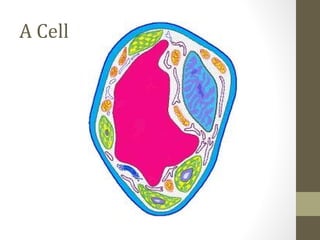
A Cell
What is a cell?
• A cell is a unit of life
• Why must life be organized in cells?
  • Life requires a structural compartment separate from the
    external environment in which macromolecules can perform
    unique functions in a relatively constant internal environment
• Cells onsists of living matter called protoplasm
  • A jelly-like substance in which chemical activities are carried out
  • Consists of 70-90% water, the rest consists of mineral salts and
    organic compounds (carbon compounds) such as carbohydrates,
    fats and proteins
  • Its composition varies from animal to animal and from plant to
    plant
  • Consists of 2 forms
     • Sol (liquid) state
     • Gel state (semi-solid)
Cell Theory
 • all organisms are made up of one or more cells
 • the smallest organisms are single cells
 • cells are the functional units of multicellular
   organisms
 • all cells arise from pre-existing cells.
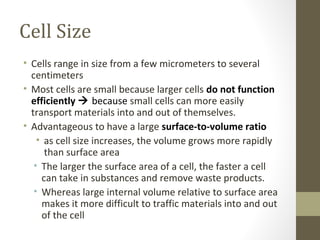
Cell Size
• Cells range in size from a few micrometers to several
  centimeters
• Most cells are small because larger cells do not function
  efficiently  because small cells can more easily
  transport materials into and out of themselves.
• Advantageous to have a large surface-to-volume ratio
    • as cell size increases, the volume grows more rapidly
      than surface area
   • The larger the surface area of a cell, the faster a cell
     can take in substances and remove waste products.
   • Whereas large internal volume relative to surface area
     makes it more difficult to traffic materials into and out
     of the cell
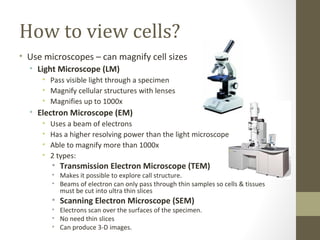
How to view cells?
• Use microscopes – can magnify cell sizes
  • Light Microscope (LM)
     • Pass visible light through a specimen
     • Magnify cellular structures with lenses
     • Magnifies up to 1000x
  • Electron Microscope (EM)
     •   Uses a beam of electrons
     •   Has a higher resolving power than the light microscope
     •   Able to magnify more than 1000x
     •   2 types:
         • Transmission Electron Microscope (TEM)
         • Makes it possible to explore call structure.
         • Beams of electron can only pass through thin samples so cells & tissues
           must be cut into ultra thin slices
         • Scanning Electron Microscope (SEM)
         • Electrons scan over the surfaces of the specimen.
         • No need thin slices
         • Can produce 3-D images.
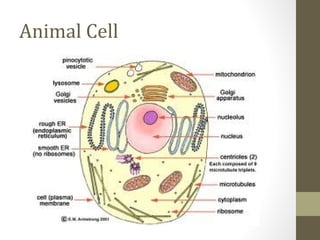
Animal Cell
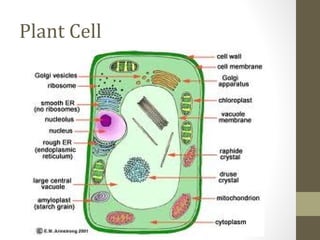
Plant Cell
Characteristics of Cells
 •   A surrounding membrane – Plasma membrane
 •   Protoplasm – cell contents in thick fluid
 •   Organelles – structures for cell function
 •   Control centre with DNA - Nucleus

Protoplasm of a cell consists of:
-Cell surface membrane
-Cytoplasm where most cell activities occur and contains enzymes and
organelles. It can exist in sol or get state
-Nucleus which consists of nucleoplasm, nuclear envelope, one or more
nucleoli and chromatin. It controls cell activities and is essential for cell
division
Nucleus
• Consists of a small spherical mass of denser protoplasm, the
  nucleoplasm, surrounded by a nuclear envelope
• Controls the normal cell activities
• Responsible for cell reproduction
• Needed for the continued life of the cell and repair of worn-out parts
• Within the nucleus are:
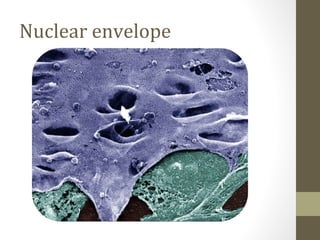
   • Nuclear envelope: double membrane surrounding nucleus
      • Separates the nuclear content from the surrounding cytoplasm
      • Perforated with thousands of nuclear pores to allow materials to move into
        and out of the nucleus to and from the rest of the cell
  • Nucleoli: spherical structures
      • Main function is the production of ribosomes
  • Chromatin: a network of long thread-like structures (DNA bound to
    proteins)
      • Contain hereditary materials
      • Control the activities of the cell
      • During cell division, chromatin threads condense and become highly coiled
        structures called chromosomes
Nuclear envelope
What’s in the cytoplasm?
• Cytoplasm: the place where most life processes occur
• Embedded in the cytoplasm are important organelles:
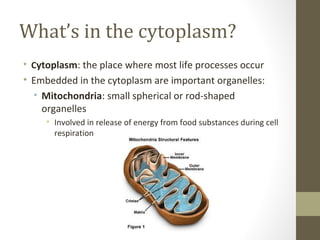
  • Mitochondria: small spherical or rod-shaped
    organelles
     • Involved in release of energy from food substances during cell
       respiration
What’s in the cytoplasm?
• Chloroplasts
  • In plant cells only
  • Sites where plants make food, combining carbon dioxide and
    water, using energy from sunlight, to make sugar
• Vacuoles
  • In both plant and animal cells
  • A fluid-filled space enclosed by a membrane
  • Animal cells may have many small vacuoles but are usually not
    permanent.
  • May contain water and food substances
  • A plant cell usually has a large central vacuole which contains a
    liquid called cell sap
      • Cell sap contains dissolved substances such as sugars, amino acids, and
        mineral salts
      • This large vacuole is enclosed by a membrane called tonoplast
What’s in the cytoplasm?
• Centrioles
  • Play a part in cell division
  • Absent in most plant cells
• Ribosomes (2 types)
     • Free floating ribosomes in cytoplasm
     • Attached to the Endoplasmic Reticulum
  • Ribosomes build all the cell’s proteins
  • Cells active in protein synthesis are often packed with ribosomes.
• Endoplasmic Reticulum (ER)
  – Composed of smooth and rough ER
  – Produces an enormous variety of molecules
• Golgi Apparatus
  – Works in partnership with the ER
  – Refines, stores, and distributes the products of cells
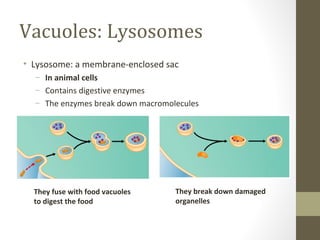
Vacuoles: Lysosomes
• Lysosome: a membrane-enclosed sac
  – In animal cells
  – Contains digestive enzymes
  – The enzymes break down macromolecules


  They fuse with food vacuoles     They break down damaged
  to digest the food               organelles
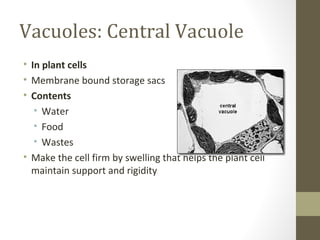
Vacuoles: Central Vacuole
• In plant cells
• Membrane bound storage sacs
• Contents
   • Water
   • Food
   • Wastes
• Make the cell firm by swelling that helps the plant cell
  maintain support and rigidity
Endoplasmic Reticulum
• Rough ER: The “roughness” is due to ribosomes attached
  to the outside of the ER membrane
• The functions of the rough ER include
     • Produce membrane proteins
     • Produce digestive enzymes
       • After the rough ER synthesizes a molecule it packages the
         molecule into transport vesicles
• The smooth ER lacks the surface ribosomes of rough ER
• Serves many functions:
     •   Producing proteins
     •   Fatty acids for new membrane synthesis
     •   Produce steroids
     •   Produce sex hormones
     •   Detoxification of drugs and poisons
Mitochondria
• Sites of cellular respiration, which involves the production
  of energy from food molecules
• The matrix contains enzymes which break down
  carbohydrates and other nutrients for energy.
• The breakdown of these molecules in the presence of
  oxygen to produce energy is called aerobic cellular
  respiration.
• Energy releases may be temporarily stored in small
  molecules called ATP (adenosine triphosphate) 
  batteries
• ATP can be transported from one part of the cell to
  another
• When needed, ATP break down to release energy
Cell Surface Membrane
• Also known as Plasma Membrane
• Separates the inside of the cell from the outside environment
• Partially permeable to control substances entering or leaving
  the cell
• Selective permeability
  • Allowing some substances to cross more easily than others
  • Block passage of some substances altogether
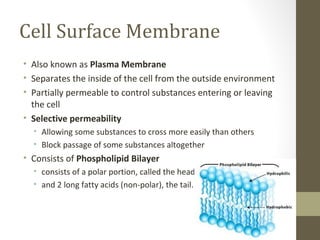
• Consists of Phospholipid Bilayer
  • consists of a polar portion, called the head,
  • and 2 long fatty acids (non-polar), the tail.
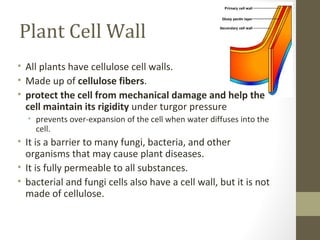
Plant Cell Wall
• All plants have cellulose cell walls.
• Made up of cellulose fibers.
• protect the cell from mechanical damage and help the
  cell maintain its rigidity under turgor pressure
  • prevents over-expansion of the cell when water diffuses into the
    cell.
• It is a barrier to many fungi, bacteria, and other
  organisms that may cause plant diseases.
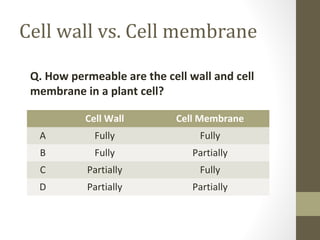
• It is fully permeable to all substances.
• bacterial and fungi cells also have a cell wall, but it is not
  made of cellulose.
Cell wall vs. Cell membrane

 Q. How permeable are the cell wall and cell
 membrane in a plant cell?

           Cell Wall         Cell Membrane
  A          Fully               Fully
  B          Fully              Partially
  C        Partially             Fully
  D        Partially            Partially
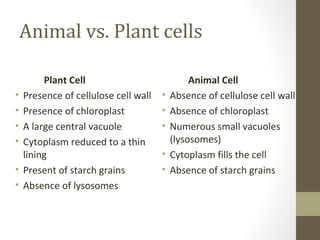
Animal vs. Plant cells

         Plant Cell                            Animal Cell
•   Presence of cellulose cell wall   •   Absence of cellulose cell wall
•   Presence of chloroplast           •   Absence of chloroplast
•   A large central vacuole           •   Numerous small vacuoles
•   Cytoplasm reduced to a thin           (lysosomes)
    lining                            •   Cytoplasm fills the cell
•   Present of starch grains          •   Absence of starch grains
•   Absence of lysosomes
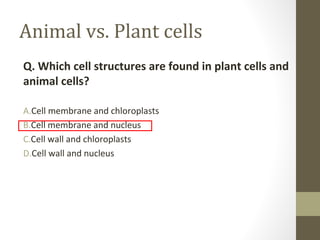
Animal vs. Plant cells
Q. Which cell structures are found in plant cells and
animal cells?

A.Cell membrane and chloroplasts
B.Cell membrane and nucleus
C.Cell wall and chloroplasts
D.Cell wall and nucleus
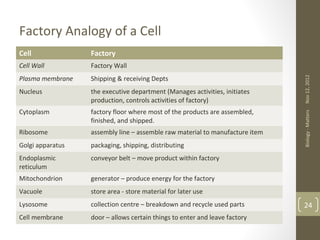
Factory Analogy of a Cell
Cell              Factory
Cell Wall         Factory Wall
Plasma membrane   Shipping & receiving Depts


                                                                              Nov 12, 2012
Nucleus           the executive department (Manages activities, initiates
                  production, controls activities of factory)
Cytoplasm         factory floor where most of the products are assembled,


                                                                              Biology - Matters
                  finished, and shipped.
Ribosome          assembly line – assemble raw material to manufacture item
Golgi apparatus   packaging, shipping, distributing
Endoplasmic       conveyor belt – move product within factory
reticulum
Mitochondrion     generator – produce energy for the factory
Vacuole           store area - store material for later use
Lysosome          collection centre – breakdown and recycle used parts        24
Cell membrane     door – allows certain things to enter and leave factory
Specialized cells, tissues,
 organs, and systems
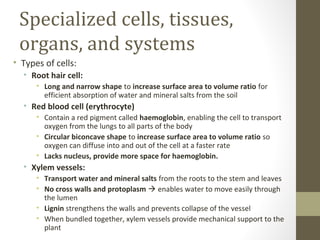
• Types of cells:
  • Root hair cell:
      • Long and narrow shape to increase surface area to volume ratio for
        efficient absorption of water and mineral salts from the soil
  • Red blood cell (erythrocyte)
      • Contain a red pigment called haemoglobin, enabling the cell to transport
        oxygen from the lungs to all parts of the body
      • Circular biconcave shape to increase surface area to volume ratio so
        oxygen can diffuse into and out of the cell at a faster rate
      • Lacks nucleus, provide more space for haemoglobin.
  • Xylem vessels:
      • Transport water and mineral salts from the roots to the stem and leaves
      • No cross walls and protoplasm  enables water to move easily through
        the lumen
      • Lignin strengthens the walls and prevents collapse of the vessel
      • When bundled together, xylem vessels provide mechanical support to the
        plant
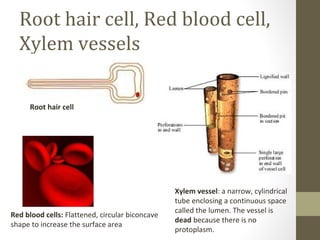
Root hair cell, Red blood cell,
  Xylem vessels

     Root hair cell


                                                 Xylem vessel: a narrow, cylindrical
                                                 tube enclosing a continuous space
                                                 called the lumen. The vessel is
Red blood cells: Flattened, circular biconcave
                                                 dead because there is no
shape to increase the surface area
                                                 protoplasm.
Form versus Function
• A sphere has the least surface area-to-volume ratio of any
  shape.
• Cells in multicellular organisms consist of many different types
  of cells that do different jobs.
• What does it mean for a cell to be specialized?
   • Specific types of cells performs specific functions
• As cells mature, they may change and differentiate
  • Differentiation: Process where a cell becomes specialised for a
    specific function
  • Differentiation could target any number of the following:
    1.   Shape of cell
    2.   Component proteins
    3.   Cell structures or organelles
    4.   Cell growth
    5.   Cell division
• The cell becomes adapted to perform a specific function.
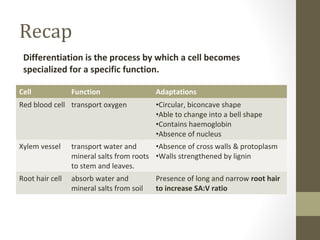
Recap
 Differentiation is the process by which a cell becomes
 specialized for a specific function.

Cell             Function                  Adaptations
Red blood cell transport oxygen            •Circular, biconcave shape
                                           •Able to change into a bell shape
                                           •Contains haemoglobin
                                           •Absence of nucleus
Xylem vessel     transport water and      •Absence of cross walls & protoplasm
                 mineral salts from roots •Walls strengthened by lignin
                 to stem and leaves.
Root hair cell   absorb water and          Presence of long and narrow root hair
                 mineral salts from soil   to increase SA:V ratio
Tissues, Organs, and Systems
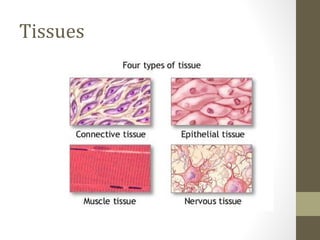
• Cells of the same type may be grouped together to
  carry out a special function  called simple tissue
  • Examples:
    • epithelial tissue: a sheet of cells covering both the
      internal and external surfaces of body
    • plants have similar covering tissues called the epidermis
    • muscle tissue: a collection of muscle cells which bring
      about movement in our body by their contraction and
      relaxation
  • Complex tissue: tissues containing several types
    of cells
    • Examples: Nervous tissue, glandular tissue etc
Tissues
Organs
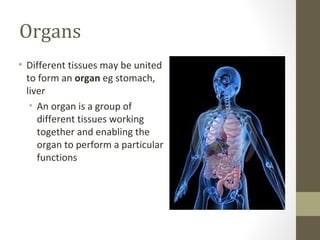
• Different tissues may be united
  to form an organ eg stomach,
  liver
   • An organ is a group of
     different tissues working
     together and enabling the
     organ to perform a particular
     functions
Organ System
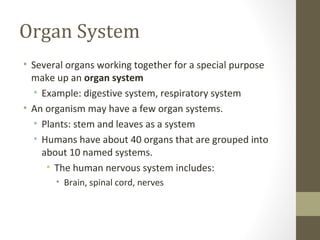
• Several organs working together for a special purpose
  make up an organ system
  • Example: digestive system, respiratory system
• An organism may have a few organ systems.
  • Plants: stem and leaves as a system
  • Humans have about 40 organs that are grouped into
    about 10 named systems.
     • The human nervous system includes:
       • Brain, spinal cord, nerves
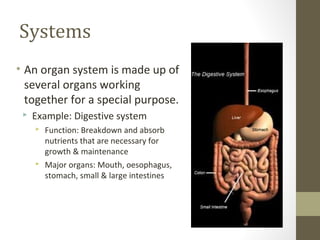
Systems
• An organ system is made up of
  several organs working
  together for a special purpose.
    Example: Digestive system
        Function: Breakdown and absorb
         nutrients that are necessary for
         growth & maintenance
        Major organs: Mouth, oesophagus,
         stomach, small & large intestines
Human Body Systems
• Respiratory System
   • Takes in oxygen from the surroundings. Removes carbon dioxide and
     water vapour into the surroundings


                                                                             Nov 12, 2012
• Digestive System
   • Breaks down the food we eat into simpler substances that can be
     absorbed by the blood.


                                                                             Biology - Matters
• Nervous System
   • Controls our actions, ensures all the parts of our body work smoothly
     together and enables us to respond to changes.
• Blood circulatory system
   • Carries food, oxygen and water to various parts of the body. Carries
     wastes away to be removed.
• Excretory System
  • Removes wastes from the body
• Immune System
  • Defends against infections                                               34
Human Body Systems
• Skeletal system
   • Supports our body, gives us shape, protects our organs and
     enables movement.


                                                                  Nov 12, 2012
• Muscular system
   • Enables movement
• Reproductive system
   • Female  Produces eggs for reproduction


                                                                  Biology - Matters
   • Male  Produces sperms for reproduction
• Integumentary system (skin)
   • Waterproof barrier
   • Regulate temperature
• Lymphatic system
   • Filters bacteria
   • Destroy bacteria
• Endocrine System
                                                                  35
   • Secret hormones
   • Produce response in the body
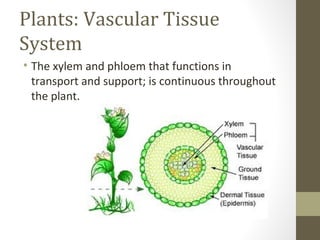
Plants: Vascular Tissue
System
• The xylem and phloem that functions in
  transport and support; is continuous throughout
  the plant.

Cells ( Olevel Biology)

  • 1.
  • 2.
  • 3.
    What is acell? • A cell is a unit of life • Why must life be organized in cells? • Life requires a structural compartment separate from the external environment in which macromolecules can perform unique functions in a relatively constant internal environment • Cells onsists of living matter called protoplasm • A jelly-like substance in which chemical activities are carried out • Consists of 70-90% water, the rest consists of mineral salts and organic compounds (carbon compounds) such as carbohydrates, fats and proteins • Its composition varies from animal to animal and from plant to plant • Consists of 2 forms • Sol (liquid) state • Gel state (semi-solid)
  • 4.
    Cell Theory •all organisms are made up of one or more cells • the smallest organisms are single cells • cells are the functional units of multicellular organisms • all cells arise from pre-existing cells.
  • 5.
    Cell Size • Cellsrange in size from a few micrometers to several centimeters • Most cells are small because larger cells do not function efficiently  because small cells can more easily transport materials into and out of themselves. • Advantageous to have a large surface-to-volume ratio • as cell size increases, the volume grows more rapidly than surface area • The larger the surface area of a cell, the faster a cell can take in substances and remove waste products. • Whereas large internal volume relative to surface area makes it more difficult to traffic materials into and out of the cell
  • 6.
    How to viewcells? • Use microscopes – can magnify cell sizes • Light Microscope (LM) • Pass visible light through a specimen • Magnify cellular structures with lenses • Magnifies up to 1000x • Electron Microscope (EM) • Uses a beam of electrons • Has a higher resolving power than the light microscope • Able to magnify more than 1000x • 2 types: • Transmission Electron Microscope (TEM) • Makes it possible to explore call structure. • Beams of electron can only pass through thin samples so cells & tissues must be cut into ultra thin slices • Scanning Electron Microscope (SEM) • Electrons scan over the surfaces of the specimen. • No need thin slices • Can produce 3-D images.
  • 7.
  • 8.
  • 9.
    Characteristics of Cells • A surrounding membrane – Plasma membrane • Protoplasm – cell contents in thick fluid • Organelles – structures for cell function • Control centre with DNA - Nucleus Protoplasm of a cell consists of: -Cell surface membrane -Cytoplasm where most cell activities occur and contains enzymes and organelles. It can exist in sol or get state -Nucleus which consists of nucleoplasm, nuclear envelope, one or more nucleoli and chromatin. It controls cell activities and is essential for cell division
  • 10.
    Nucleus • Consists ofa small spherical mass of denser protoplasm, the nucleoplasm, surrounded by a nuclear envelope • Controls the normal cell activities • Responsible for cell reproduction • Needed for the continued life of the cell and repair of worn-out parts • Within the nucleus are: • Nuclear envelope: double membrane surrounding nucleus • Separates the nuclear content from the surrounding cytoplasm • Perforated with thousands of nuclear pores to allow materials to move into and out of the nucleus to and from the rest of the cell • Nucleoli: spherical structures • Main function is the production of ribosomes • Chromatin: a network of long thread-like structures (DNA bound to proteins) • Contain hereditary materials • Control the activities of the cell • During cell division, chromatin threads condense and become highly coiled structures called chromosomes
  • 11.
  • 12.
    What’s in thecytoplasm? • Cytoplasm: the place where most life processes occur • Embedded in the cytoplasm are important organelles: • Mitochondria: small spherical or rod-shaped organelles • Involved in release of energy from food substances during cell respiration
  • 13.
    What’s in thecytoplasm? • Chloroplasts • In plant cells only • Sites where plants make food, combining carbon dioxide and water, using energy from sunlight, to make sugar • Vacuoles • In both plant and animal cells • A fluid-filled space enclosed by a membrane • Animal cells may have many small vacuoles but are usually not permanent. • May contain water and food substances • A plant cell usually has a large central vacuole which contains a liquid called cell sap • Cell sap contains dissolved substances such as sugars, amino acids, and mineral salts • This large vacuole is enclosed by a membrane called tonoplast
  • 14.
    What’s in thecytoplasm? • Centrioles • Play a part in cell division • Absent in most plant cells • Ribosomes (2 types) • Free floating ribosomes in cytoplasm • Attached to the Endoplasmic Reticulum • Ribosomes build all the cell’s proteins • Cells active in protein synthesis are often packed with ribosomes. • Endoplasmic Reticulum (ER) – Composed of smooth and rough ER – Produces an enormous variety of molecules • Golgi Apparatus – Works in partnership with the ER – Refines, stores, and distributes the products of cells
  • 15.
    Vacuoles: Lysosomes • Lysosome:a membrane-enclosed sac – In animal cells – Contains digestive enzymes – The enzymes break down macromolecules They fuse with food vacuoles They break down damaged to digest the food organelles
  • 16.
    Vacuoles: Central Vacuole •In plant cells • Membrane bound storage sacs • Contents • Water • Food • Wastes • Make the cell firm by swelling that helps the plant cell maintain support and rigidity
  • 17.
    Endoplasmic Reticulum • RoughER: The “roughness” is due to ribosomes attached to the outside of the ER membrane • The functions of the rough ER include • Produce membrane proteins • Produce digestive enzymes • After the rough ER synthesizes a molecule it packages the molecule into transport vesicles • The smooth ER lacks the surface ribosomes of rough ER • Serves many functions: • Producing proteins • Fatty acids for new membrane synthesis • Produce steroids • Produce sex hormones • Detoxification of drugs and poisons
  • 18.
    Mitochondria • Sites ofcellular respiration, which involves the production of energy from food molecules • The matrix contains enzymes which break down carbohydrates and other nutrients for energy. • The breakdown of these molecules in the presence of oxygen to produce energy is called aerobic cellular respiration. • Energy releases may be temporarily stored in small molecules called ATP (adenosine triphosphate)  batteries • ATP can be transported from one part of the cell to another • When needed, ATP break down to release energy
  • 19.
    Cell Surface Membrane •Also known as Plasma Membrane • Separates the inside of the cell from the outside environment • Partially permeable to control substances entering or leaving the cell • Selective permeability • Allowing some substances to cross more easily than others • Block passage of some substances altogether • Consists of Phospholipid Bilayer • consists of a polar portion, called the head, • and 2 long fatty acids (non-polar), the tail.
  • 20.
    Plant Cell Wall •All plants have cellulose cell walls. • Made up of cellulose fibers. • protect the cell from mechanical damage and help the cell maintain its rigidity under turgor pressure • prevents over-expansion of the cell when water diffuses into the cell. • It is a barrier to many fungi, bacteria, and other organisms that may cause plant diseases. • It is fully permeable to all substances. • bacterial and fungi cells also have a cell wall, but it is not made of cellulose.
  • 21.
    Cell wall vs.Cell membrane Q. How permeable are the cell wall and cell membrane in a plant cell? Cell Wall Cell Membrane A Fully Fully B Fully Partially C Partially Fully D Partially Partially
  • 22.
    Animal vs. Plantcells Plant Cell Animal Cell • Presence of cellulose cell wall • Absence of cellulose cell wall • Presence of chloroplast • Absence of chloroplast • A large central vacuole • Numerous small vacuoles • Cytoplasm reduced to a thin (lysosomes) lining • Cytoplasm fills the cell • Present of starch grains • Absence of starch grains • Absence of lysosomes
  • 23.
    Animal vs. Plantcells Q. Which cell structures are found in plant cells and animal cells? A.Cell membrane and chloroplasts B.Cell membrane and nucleus C.Cell wall and chloroplasts D.Cell wall and nucleus
  • 24.
    Factory Analogy ofa Cell Cell Factory Cell Wall Factory Wall Plasma membrane Shipping & receiving Depts Nov 12, 2012 Nucleus the executive department (Manages activities, initiates production, controls activities of factory) Cytoplasm factory floor where most of the products are assembled, Biology - Matters finished, and shipped. Ribosome assembly line – assemble raw material to manufacture item Golgi apparatus packaging, shipping, distributing Endoplasmic conveyor belt – move product within factory reticulum Mitochondrion generator – produce energy for the factory Vacuole store area - store material for later use Lysosome collection centre – breakdown and recycle used parts 24 Cell membrane door – allows certain things to enter and leave factory
  • 25.
    Specialized cells, tissues, organs, and systems • Types of cells: • Root hair cell: • Long and narrow shape to increase surface area to volume ratio for efficient absorption of water and mineral salts from the soil • Red blood cell (erythrocyte) • Contain a red pigment called haemoglobin, enabling the cell to transport oxygen from the lungs to all parts of the body • Circular biconcave shape to increase surface area to volume ratio so oxygen can diffuse into and out of the cell at a faster rate • Lacks nucleus, provide more space for haemoglobin. • Xylem vessels: • Transport water and mineral salts from the roots to the stem and leaves • No cross walls and protoplasm  enables water to move easily through the lumen • Lignin strengthens the walls and prevents collapse of the vessel • When bundled together, xylem vessels provide mechanical support to the plant
  • 26.
    Root hair cell,Red blood cell, Xylem vessels Root hair cell Xylem vessel: a narrow, cylindrical tube enclosing a continuous space called the lumen. The vessel is Red blood cells: Flattened, circular biconcave dead because there is no shape to increase the surface area protoplasm.
  • 27.
    Form versus Function •A sphere has the least surface area-to-volume ratio of any shape. • Cells in multicellular organisms consist of many different types of cells that do different jobs. • What does it mean for a cell to be specialized? • Specific types of cells performs specific functions • As cells mature, they may change and differentiate • Differentiation: Process where a cell becomes specialised for a specific function • Differentiation could target any number of the following: 1. Shape of cell 2. Component proteins 3. Cell structures or organelles 4. Cell growth 5. Cell division • The cell becomes adapted to perform a specific function.
  • 28.
    Recap Differentiation isthe process by which a cell becomes specialized for a specific function. Cell Function Adaptations Red blood cell transport oxygen •Circular, biconcave shape •Able to change into a bell shape •Contains haemoglobin •Absence of nucleus Xylem vessel transport water and •Absence of cross walls & protoplasm mineral salts from roots •Walls strengthened by lignin to stem and leaves. Root hair cell absorb water and Presence of long and narrow root hair mineral salts from soil to increase SA:V ratio
  • 29.
    Tissues, Organs, andSystems • Cells of the same type may be grouped together to carry out a special function  called simple tissue • Examples: • epithelial tissue: a sheet of cells covering both the internal and external surfaces of body • plants have similar covering tissues called the epidermis • muscle tissue: a collection of muscle cells which bring about movement in our body by their contraction and relaxation • Complex tissue: tissues containing several types of cells • Examples: Nervous tissue, glandular tissue etc
  • 30.
  • 31.
    Organs • Different tissuesmay be united to form an organ eg stomach, liver • An organ is a group of different tissues working together and enabling the organ to perform a particular functions
  • 32.
    Organ System • Severalorgans working together for a special purpose make up an organ system • Example: digestive system, respiratory system • An organism may have a few organ systems. • Plants: stem and leaves as a system • Humans have about 40 organs that are grouped into about 10 named systems. • The human nervous system includes: • Brain, spinal cord, nerves
  • 33.
    Systems • An organsystem is made up of several organs working together for a special purpose.  Example: Digestive system  Function: Breakdown and absorb nutrients that are necessary for growth & maintenance  Major organs: Mouth, oesophagus, stomach, small & large intestines
  • 34.
    Human Body Systems •Respiratory System • Takes in oxygen from the surroundings. Removes carbon dioxide and water vapour into the surroundings Nov 12, 2012 • Digestive System • Breaks down the food we eat into simpler substances that can be absorbed by the blood. Biology - Matters • Nervous System • Controls our actions, ensures all the parts of our body work smoothly together and enables us to respond to changes. • Blood circulatory system • Carries food, oxygen and water to various parts of the body. Carries wastes away to be removed. • Excretory System • Removes wastes from the body • Immune System • Defends against infections 34
  • 35.
    Human Body Systems •Skeletal system • Supports our body, gives us shape, protects our organs and enables movement. Nov 12, 2012 • Muscular system • Enables movement • Reproductive system • Female  Produces eggs for reproduction Biology - Matters • Male  Produces sperms for reproduction • Integumentary system (skin) • Waterproof barrier • Regulate temperature • Lymphatic system • Filters bacteria • Destroy bacteria • Endocrine System 35 • Secret hormones • Produce response in the body
  • 36.
    Plants: Vascular Tissue System •The xylem and phloem that functions in transport and support; is continuous throughout the plant.