OPERATION
THEATER
www.drjayeshpatidar.blogspot.com
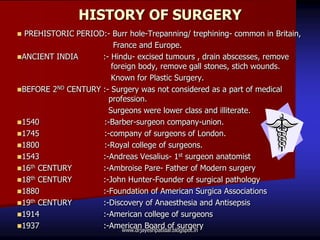
HISTORY OF SURGERY
 PREHISTORIC PERIOD:- Burr hole-Trepanning/ trephining- common in Britain,
France and Europe.
ANCIENT INDIA :- Hindu- excised tumours , drain abscesses, remove
foreign body, remove gall stones, stich wounds.
Known for Plastic Surgery.
BEFORE 2ND CENTURY :- Surgery was not considered as a part of medical
profession.
Surgeons were lower class and illiterate.
1540 :-Barber-surgeon company-union.
1745 :-company of surgeons of London.
1800 :-Royal college of surgeons.
1543 :-Andreas Vesalius- 1st surgeon anatomist
16th CENTURY :-Ambroise Pare- Father of Modern surgery
18th CENTURY :-John Hunter-Founder of surgical pathology
1880 :-Foundation of American Surgica Associations
19th CENTURY :-Discovery of Anaesthesia and Antisepsis
1914 :-American college of surgeons
1937 :-American Board of surgerywww.drjayeshpatidar.blogspot.in
PURPOSES OF SURGERY
 Diagnostic
 Exploratory
 Curative:-a) Ablative
b) Reconstructive
c) Constructive
 Palliative
 Restorative
www.drjayeshpatidar.blogspot.in
TYPES OF SURGERY
 Major surgery
 Minor surgery
TYPES ACCORDING TO URGENCY
 Optional
 Elective
 Planned
 Imperative or urgent
 Emergency
www.drjayeshpatidar.blogspot.in
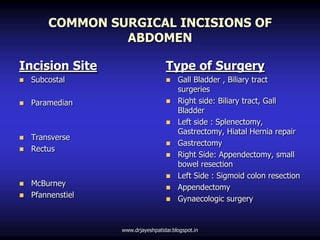
COMMON SURGICAL INCISIONS OF
ABDOMEN
Incision Site
 Subcostal
 Paramedian
 Transverse
 Rectus
 McBurney
 Pfannenstiel
Type of Surgery
 Gall Bladder , Biliary tract
surgeries
 Right side: Biliary tract, Gall
Bladder
 Left side : Splenectomy,
Gastrectomy, Hiatal Hernia repair
 Gastrectomy
 Right Side: Appendectomy, small
bowel resection
 Left Side : Sigmoid colon resection
 Appendectomy
 Gynaecologic surgery
www.drjayeshpatidar.blogspot.in
ORGANIZATION AND
PHYSICAL LAYOUT OF THE O.T.
Number of rooms required in the O.T. depends on:-
 Number and length of the surgical procedures to be
performed.
 Types and distribution by specialities of the surgical staff
and equipments for each
 Proportion of inpatient and emergency surgical
procedures to ambulatory patient and minimal invasive
procedures.
 Scheduling policies related to the number of hours/day
and days /week the suite will be in the use and staffing
needs.
 Systems and procedures established for the efficient flow
of patients, personnel, and supplies.
www.drjayeshpatidar.blogspot.in
PRINCIPLES IN PLANNING THE
PHYSICAL LAYOUT OF AN
OPERATION ROOM
 Exclusion of contamination from outside
the suite with sensible traffic pattern
within the suite.
 Separation of clean areas from
contaminated areas within the suite.
www.drjayeshpatidar.blogspot.in
OPERATION ROOM SIZE:-
Minimum:- 20 20 10 feet( 400sq feet or
approximately 37m² )floor space;
Maximum:-20 30 10 feet (600 sq feet or
approximately 60m²
If Portable equipments are required then
minimum floor space 22 22 10 feet(484 sq
feet approximately 45m²)
if cardiopulmonary bypass machine required then
600 sq feet or 60m² floor space
www.drjayeshpatidar.blogspot.in
PERIOPERATIVE PATIENT CARE
 PREOPERATIVE PHASE:
From the time the decision is made for surgical
intervention to the transference of the patient to
the operating room.
 INTRAOPERATIVE PHASE:
From the time the patient is received in the
operating room until he is admitted to the
recovery room.
 POST OPERATIVE PHASE:
From the time of admission to the recovery
room to the follow up in home/ clinic for
evaluation.
www.drjayeshpatidar.blogspot.in
Thank you
www.drjayeshpatidar.blogspot.in

Operation theater

  • 1.
  • 2.
    HISTORY OF SURGERY PREHISTORIC PERIOD:- Burr hole-Trepanning/ trephining- common in Britain, France and Europe. ANCIENT INDIA :- Hindu- excised tumours , drain abscesses, remove foreign body, remove gall stones, stich wounds. Known for Plastic Surgery. BEFORE 2ND CENTURY :- Surgery was not considered as a part of medical profession. Surgeons were lower class and illiterate. 1540 :-Barber-surgeon company-union. 1745 :-company of surgeons of London. 1800 :-Royal college of surgeons. 1543 :-Andreas Vesalius- 1st surgeon anatomist 16th CENTURY :-Ambroise Pare- Father of Modern surgery 18th CENTURY :-John Hunter-Founder of surgical pathology 1880 :-Foundation of American Surgica Associations 19th CENTURY :-Discovery of Anaesthesia and Antisepsis 1914 :-American college of surgeons 1937 :-American Board of surgerywww.drjayeshpatidar.blogspot.in
  • 3.
    PURPOSES OF SURGERY Diagnostic  Exploratory  Curative:-a) Ablative b) Reconstructive c) Constructive  Palliative  Restorative www.drjayeshpatidar.blogspot.in
  • 4.
    TYPES OF SURGERY Major surgery  Minor surgery TYPES ACCORDING TO URGENCY  Optional  Elective  Planned  Imperative or urgent  Emergency www.drjayeshpatidar.blogspot.in
  • 5.
    COMMON SURGICAL INCISIONSOF ABDOMEN Incision Site  Subcostal  Paramedian  Transverse  Rectus  McBurney  Pfannenstiel Type of Surgery  Gall Bladder , Biliary tract surgeries  Right side: Biliary tract, Gall Bladder  Left side : Splenectomy, Gastrectomy, Hiatal Hernia repair  Gastrectomy  Right Side: Appendectomy, small bowel resection  Left Side : Sigmoid colon resection  Appendectomy  Gynaecologic surgery www.drjayeshpatidar.blogspot.in
  • 6.
    ORGANIZATION AND PHYSICAL LAYOUTOF THE O.T. Number of rooms required in the O.T. depends on:-  Number and length of the surgical procedures to be performed.  Types and distribution by specialities of the surgical staff and equipments for each  Proportion of inpatient and emergency surgical procedures to ambulatory patient and minimal invasive procedures.  Scheduling policies related to the number of hours/day and days /week the suite will be in the use and staffing needs.  Systems and procedures established for the efficient flow of patients, personnel, and supplies. www.drjayeshpatidar.blogspot.in
  • 7.
    PRINCIPLES IN PLANNINGTHE PHYSICAL LAYOUT OF AN OPERATION ROOM  Exclusion of contamination from outside the suite with sensible traffic pattern within the suite.  Separation of clean areas from contaminated areas within the suite. www.drjayeshpatidar.blogspot.in
  • 8.
    OPERATION ROOM SIZE:- Minimum:-20 20 10 feet( 400sq feet or approximately 37m² )floor space; Maximum:-20 30 10 feet (600 sq feet or approximately 60m² If Portable equipments are required then minimum floor space 22 22 10 feet(484 sq feet approximately 45m²) if cardiopulmonary bypass machine required then 600 sq feet or 60m² floor space www.drjayeshpatidar.blogspot.in
  • 9.
    PERIOPERATIVE PATIENT CARE PREOPERATIVE PHASE: From the time the decision is made for surgical intervention to the transference of the patient to the operating room.  INTRAOPERATIVE PHASE: From the time the patient is received in the operating room until he is admitted to the recovery room.  POST OPERATIVE PHASE: From the time of admission to the recovery room to the follow up in home/ clinic for evaluation. www.drjayeshpatidar.blogspot.in
  • 10.