UNIT XI INFECTION CONTROL IN CLINICL SETTING
TOPIC:ISOLATION PRECAUTIONS [ BARRIER NURSING ]
Presented By:
Mrs Bemina JA
Assistant Professor
ESIC College of Nursing
Kalaburagi
 Isolation refers to techniques used to prevent or limit
the spread of infection.
 Some forms of isolation has been used for centuries,
whether to protect a high-risk person from exposure to
pathogens or to prevent the transmission of pathogens
from an infected person to others.
 Barrier nursing or isolation technique is intended to
confine the micro-organisms within a given and
recognized area.
 There are a number of isolation techniques and
precautions used to prevent the spread of infection.
 Barrier nursing is a largely archaic term for a set of
stringent infection control techniques used in nursing
 It is sometimes called "bedside isolation."
 The nursing technique by which a patient with an
infectious disease is prevented from infecting other
people is called barrier nursing
The aim of barrier nursing
 Is to protect medical staff against infection by patients
 To protect patients with highly infectious diseases from
spreading their pathogens to other non-infected people.
 Contact Precautions
 Airborne Precautions
 Droplet Precautions
 Protective Isolation
 Three more elements have been added to standard
precautions.
 Respiratory hygiene/cough etiquette
 Safe injection practices
 Use of masks for insertion of catheters or injection into
spinal or epidural areas
 Clean, non-sterile gloves are usually adequate for routine care of
the patients
 Use gloves before providing care to patient
 Change gloves after contact with infective material.
 After providing care, remove gloves and wash hands
 Follow proper use of protective gown in case of direct contact
with patient with potentially contaminated environmental
surfaces and observe hand hygiene
 Limit the movement or transport of the patient from the room.
 Make sure any infected or colonized areas are contained or
covered.
 Ensure that patient care items, bedside equipment and frequently
touched surfaces receive daily cleaning.
 Used to prevent or reduce the transmission of micro-
organisms that are airborne in small droplet nuclei (5 or
smaller in size) or dust particles containing the infectious
agent.
 Place the patient in private room that has negative air
pressure, with 6-12 air changes/per hour.
 If not available, cohort with patient with active infection
with same microorganism
 Use of respiratory protection
 Limit movement and transport of the patient.
 Use a mask on the patient if they need to be moved
 Keep patient room door closed.
 Used to reduce the risk of transmission of microorganisms
transmitted by large particle droplets (larger than 5 in size).
 Droplets usually travel 3 feet or less within the air and thus
special air handling is not required, however newer
recommendations suggest a distance of 6 feet be used for safety.
 Place the patient in a private room
 Use of respiratory protection such as a mask when entering the
room recommended and definitely if within 3 feet of patient
 Limit movement and transport of the patient
 Use a mask on the patient if they need to be moved and follow
respiratory hygiene/cough etiquette
 Keep patient at least 3 feet apart between infected patient and
visitors
 Room door may remain open
 Informing personnel if they have any symptoms of respiratory
infection•
 Health educate patients and visitors to cover their mouth/nose while
coughing and sneezing
 • Proper disposal of used materials, during coughing and sneezing
 • Use of surgical masks on coughing person when appropriate
 • Providing alcohol-based hand-rubbing dispensers and supplies for
hand hygiene and educating patients and staff in their use,
 • Encouraging hand hygiene after coughing or sneezing.
 • Separating coughing persons at least 3 feet away from others in a
waiting room or have separate locality.
 • Instructing patients and providers not to touch eyes, nose, or mouth.
 • Health care workers should use standard precautions with all patients.
 Correct disposal in appropriate container
 Avoid re-sheathing needle
 Avoid removing needle
 Discard syringes as single unit
 Avoid over-filling sharps container
 Use of masks for insertion of catheters or injection into
spinal or epidural areas
 1. Aseptic technique[Hand Washing]
 2. Isolation
 3.Personal protective equipments
 4. Decontamination of equipments and unit[Safer Handling
of Sharps, Linen handling and disposal]
 5. Waste disposal
 6. Transportation of infected patients [Handling Biological
Spills
 7. Standard safety precautions[Universal precautions]
 7. Environmental cleaning
 8. Risk assessment
 9. Staff health
 ASEPTIC TECHNIQUE
 • Sepsis - harmful infection by bacteria
 • Asepsis - prevention of sepsis
 • Minimise risk of introducing pathogenic micro- organisms into
susceptible sites
 • Prevent transfer of potential pathogens from contaminated site
to other sites, patients or staff
 • Follow local policy of your hospital
 • Disinfect clean skin with an appropriate antiseptic before
insertion and at the time of dressing changes.
 • A 2% chlorhexidine is preferred.
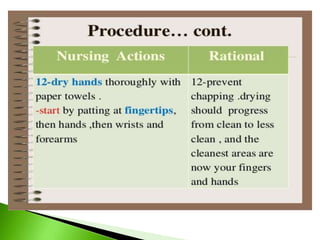
 Hand hygiene is the single most important measure for control of
nosocomial infections
Introduction
 Hand washing is the single most effective way to
prevent the spread of germs/micro-organism which
prevent communicable diseases.It’s easy to learn how
to wash your hands and how to stop the spread of
infection by washing the germs away. Good hand
washing can prevent diseases such as: Shigellosis,E.
Coli, Streptococcal Disease, Influenza and the
Common Cold. We can pick-up germs from doorknobs,
stair railings or anything that has been touched by
others who aren’t good hand washers
 Hand washing or hand hygiene is the act of cleaning
one's hands with or without the use of water or another
liquid, or with the use of soap for the purpose of
removing soil, dirt, and/or micro organisms.
Who should practice hand hygiene
 Hand hygiene practicing is not important only for
health care Providers, everyone needs to practicing
appropriate & effective hand hygiene to prevent spread
of micro organisms.
MANY PERSONNEL DON’T REALIZE WHEN THEY HAVE
MICROBES ON THEIR HANDS
 • Healthcare workers can get 100s to 1000s of bacteria on their
hands by doing simple tasks like:
 • pulling patients up in bed
 • taking a blood pressure or pulse
 • touching a patient’s hand
 • rolling patients over in bed
 • touching the patient’s gown or bed sheets
 • touching equipment like bedside rails, overbed tables, IV
pumps
WHY WE ARE NOT WASHING HANDS ???
 • Working in high-risk areas
 • Lack of hand hygiene promotion
 • Lack of role model
 • Lack of institutional priority •
 Lack of sanction of non-compliers
 1. Busy health care providers need access to hand
hygiene products where patient or patient environment
contact is taking place.
 2. Hand hygiene is important in all
work settings, including Acute Care, Long Term Care
Facilities, Community and Corporate sites.
 3. Providing alcohol-based hand rub at the point of care
(within arm’s reach) is an important system support to
improve hand hygiene
 Hand hygiene is essential :
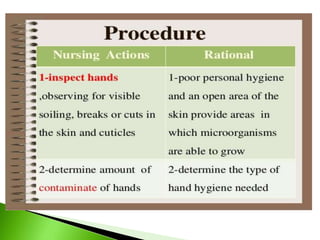
• 1-When hands are visible soiled
• 2-Before and after caring for a patient
• 3-After contact with organic material ,such as feces ,wound drainage
,and mucus
• 4-In preparation for an invasive procedure ,such as suction
catheterization ,or injections
• 5-Before changing a dressing or having contact with open wounds
• 6-Befor preparing and administrating medications
• 7-After removing disposable gloves
• 8-Before and after using the toilet
• 9-Before and after eating
• 10-At the beginning and end of the shift.
11-Before initial patient or patient environment contact
 1. Hand hygiene is the most important way to prevent
the spread of germs.
 2. Hand hygiene helps keep you healthy by reducing
the number of germs on your hands and helps reduce
the spread of germs to your family, friends, co-workers,
patients, residents or clients.
 3. Using appropriate hand hygiene prevents
contamination of the patient’s, client’s, or resident’s
environment.
 1- Routine Hand washing 10-15 seconds
• Washing hands with plain soap and water
 2- Antiseptic hand wash 1 minute
• Washing hands with water and soap or other antiseptic
agent
 3- Alcohol-based hand rub
• Rubbing hands with an alcohol-containing preparation
(used after hand washing)
 4- Surgical antisepsis 3-5 minutes
• Hand washing with antiseptic soap or alcohol- based hand
rub before operations by surgical personnel
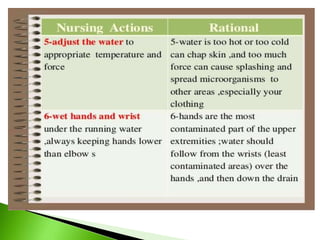
 Proper technique is important when it comes to effective
hand hygiene. Without proper hand hygiene technique, we
can still spread many micro-organisms with our hands. This
section will cover the proper techniques for the following
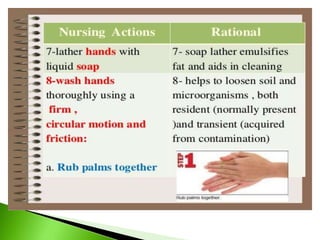
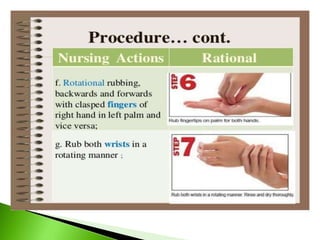
procedures 1. Wet hands under running water 2. Apply soap
and distribute over hands 3. Rub hands together vigorously
for 15 seconds to create a good lather: Palm to palm 4. Rub
fingertips of each hand in opposite palm
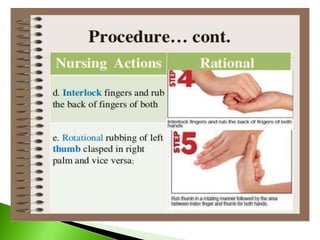
 5. Between and around fingers 6. Rub each thumb clasped
in opposite hand 7. Rub back of each hand with opposite
palm 8. Rinse hands thoroughly under running water.
 • Nails
 • Rings
 • Hand creams
 • Cuts & abrasions
 • “Chapping”
 • Skin Problems
 Rings and Jewelry Studies have demonstrated that skin
underneath rings is more heavily colonized than
comparable areas of skin on fingers without rings.
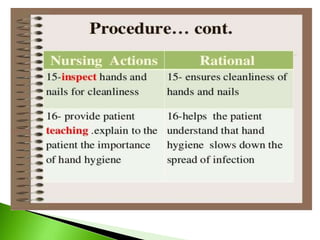
 Keep fingernails SHORT! Not excesses
• 1/4 inch – Avoid artificial nails – Avoid nail polish
Fingernails

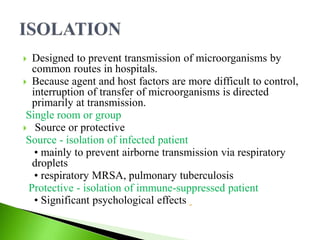
 Designed to prevent transmission of microorganisms by
common routes in hospitals.
 Because agent and host factors are more difficult to control,
interruption of transfer of microorganisms is directed
primarily at transmission.
Single room or group
 Source or protective
Source - isolation of infected patient
• mainly to prevent airborne transmission via respiratory
droplets
• respiratory MRSA, pulmonary tuberculosis
Protective - isolation of immune-suppressed patient
• Significant psychological effects
 PPE is a precautionary step to protect yourself and the people
around you.
 PPE is specialized clothing or equipment worn for protection
against dangerous or infectious materials.
 PPE prevents contact with an infectious agent by creating a
barrier between the potentially infectious material and the public
health practitioner.
Purpose of PPE
 Public health practitioners should wear PPE to:
Stop the spread of illness/infection
Protect their health
Protect their client's health
Protect their family's health
Protect the community's health
 PPE when contamination or splashing with blood or body
fluids is anticipated
 Disposable gloves
 Gowns, aprons, coveralls
 Respirators/Masks
 Goggles or Face shields
 Plastic aprons
 Face masks
 Safety glasses, goggles, visors
 Head protection / Hair covers
 Foot protection/ Shoe covers
 Masks
 There are several types of masks to prevent the spread
of infectious disease.
 They vary in shape (rectangular, round) and method of
securing (elastic, ties
 Note that masks are not respirators.
 They do not protect you from airborne transmitted
diseases, just droplet transmitted disease.
 Goggles
 Goggles or face shields protect the mucous membranes
of the eyes, nose and mouth during situations where
blood, body fluid, secretions, or excretions may splash
or spray.
 Eye glasses do not provide an adequate level of
protection.
 Goggles cover the top, front and sides of the eye area,
providing the proper protection from splashes and
sprays that eyeglasses do not.
 Some brands of goggles can be decontaminated and
reused
 GLOVES
 It is important to select the right size gloves to provide
proper protection from infectious agents.
 Remember to change gloves if they become torn or
heavily contaminated during use.
 Gloves are not a substitute for hand hygiene!
RESPIRATORS
 Several types of respirators can be worn to control the spread of
infectious disease.
 Respirators vary in size, shape (oval or round), and level of
respiratory protection offered (N95 versus N100).
 Unlike masks, respirators must be fit-tested before use to ensure
they fit properly.
 Respirators must have a mask-to-face seal and must be checked
annually to make sure they are providing adequate protection.
 Fit-testing is the procedure used to check for a correct mask-to-
face seal and involves testing to ensure there is no air leakage
between the mask and the face.
 Using a respirator that has not been fit-tested for your face
provides only droplet based transmission protection, which only
reduces the risk of transmission via large particle droplets
generated by coughing, sneezing or talking.
 It will not protect you from airborne transmitted diseases.
 Per CDC guidance, PPE should be donned in the
following order:
Gown (or apron/coverall)
Shoe and/or hair covers (if worn)
Mask/respirator
Goggles (or face shield in lieu of mask and goggles)
Gloves (if you are wearing a gown, tuck the gown
cuffs securely under each glove)
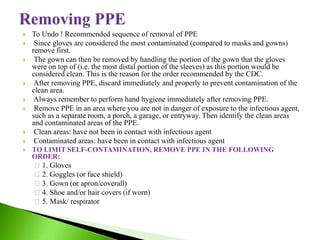
 To Undo ! Recommended sequence of removal of PPE
 Since gloves are considered the most contaminated (compared to masks and gowns)
remove first.
 The gown can then be removed by handling the portion of the gown that the gloves
were on top of (i.e. the most distal portion of the sleeves) as this portion would be
considered clean. This is the reason for the order recommended by the CDC.
 After removing PPE, discard immediately and properly to prevent contamination of the
clean area.
 Always remember to perform hand hygiene immediately after removing PPE.
 Remove PPE in an area where you are not in danger of exposure to the infectious agent,
such as a separate room, a porch, a garage, or entryway. Then identify the clean areas
and contaminated areas of the PPE.
 Clean areas: have not been in contact with infectious agent
 Contaminated areas: have been in contact with infectious agent
 TO LIMIT SELF-CONTAMINATION, REMOVE PPE IN THE FOLLOWING
ORDER:
1. Gloves
2. Goggles (or face shield)
3. Gown (or apron/coverall)
4. Shoe and/or hair covers (if worn)
5. Mask/ respirator
Provide supplies for hand hygiene.
 All rest rooms must have hot water, soap, and paper towels for proper hand
washing.
 Hand sanitizer should be available to all visitors and staff; placed at entrances,
desks, hallways, staff lounge and waiting areas.
Post visual alerts
 Place signs and posters at the entrances and in strategic places (e.g., restrooms,
elevators, cafeterias) to provide staff and visitors with instructions (in
appropriate languages) about respiratory hygiene and cough etiquette.
Provide PPE in the Workplace
 Inform staff of the types of PPE that are available in the workplace and where
they are located.
 PPE should be stored in a secure location, but should be easily accessible by
staff when needed.
 A policy should be devised to track PPE use, when to replace PPE supply, and
how to properly dispose of used PPE
 Psychological effects of being separated from healthcare
personnel, family, and friends may occur when isolation
precautions are used.
 Patients may mistakenly feel dirty or untouchable,
especially if they have diseases that are considered socially
unacceptable.
 Lack of social interaction can be psychologically injurious.
 Maintaining the patient’s social support before, during, and
after care by being present, listening to the patient’s
concerns and answering questions while adhering to
infection control practices is crucial for the patient’s well-
being and healing.
 Answering call lights promptly to alleviate feelings of
abandonment is also important.

barrier nsg.pptx

  • 1.
    UNIT XI INFECTIONCONTROL IN CLINICL SETTING TOPIC:ISOLATION PRECAUTIONS [ BARRIER NURSING ] Presented By: Mrs Bemina JA Assistant Professor ESIC College of Nursing Kalaburagi
  • 2.
     Isolation refersto techniques used to prevent or limit the spread of infection.  Some forms of isolation has been used for centuries, whether to protect a high-risk person from exposure to pathogens or to prevent the transmission of pathogens from an infected person to others.  Barrier nursing or isolation technique is intended to confine the micro-organisms within a given and recognized area.  There are a number of isolation techniques and precautions used to prevent the spread of infection.
  • 3.
     Barrier nursingis a largely archaic term for a set of stringent infection control techniques used in nursing  It is sometimes called "bedside isolation."  The nursing technique by which a patient with an infectious disease is prevented from infecting other people is called barrier nursing
  • 4.
    The aim ofbarrier nursing  Is to protect medical staff against infection by patients  To protect patients with highly infectious diseases from spreading their pathogens to other non-infected people.
  • 5.
     Contact Precautions Airborne Precautions  Droplet Precautions  Protective Isolation  Three more elements have been added to standard precautions.  Respiratory hygiene/cough etiquette  Safe injection practices  Use of masks for insertion of catheters or injection into spinal or epidural areas
  • 6.
     Clean, non-sterilegloves are usually adequate for routine care of the patients  Use gloves before providing care to patient  Change gloves after contact with infective material.  After providing care, remove gloves and wash hands  Follow proper use of protective gown in case of direct contact with patient with potentially contaminated environmental surfaces and observe hand hygiene  Limit the movement or transport of the patient from the room.  Make sure any infected or colonized areas are contained or covered.  Ensure that patient care items, bedside equipment and frequently touched surfaces receive daily cleaning.
  • 7.
     Used toprevent or reduce the transmission of micro- organisms that are airborne in small droplet nuclei (5 or smaller in size) or dust particles containing the infectious agent.  Place the patient in private room that has negative air pressure, with 6-12 air changes/per hour.  If not available, cohort with patient with active infection with same microorganism  Use of respiratory protection  Limit movement and transport of the patient.  Use a mask on the patient if they need to be moved  Keep patient room door closed.
  • 8.
     Used toreduce the risk of transmission of microorganisms transmitted by large particle droplets (larger than 5 in size).  Droplets usually travel 3 feet or less within the air and thus special air handling is not required, however newer recommendations suggest a distance of 6 feet be used for safety.  Place the patient in a private room  Use of respiratory protection such as a mask when entering the room recommended and definitely if within 3 feet of patient  Limit movement and transport of the patient  Use a mask on the patient if they need to be moved and follow respiratory hygiene/cough etiquette  Keep patient at least 3 feet apart between infected patient and visitors  Room door may remain open
  • 9.
     Informing personnelif they have any symptoms of respiratory infection•  Health educate patients and visitors to cover their mouth/nose while coughing and sneezing  • Proper disposal of used materials, during coughing and sneezing  • Use of surgical masks on coughing person when appropriate  • Providing alcohol-based hand-rubbing dispensers and supplies for hand hygiene and educating patients and staff in their use,  • Encouraging hand hygiene after coughing or sneezing.  • Separating coughing persons at least 3 feet away from others in a waiting room or have separate locality.  • Instructing patients and providers not to touch eyes, nose, or mouth.  • Health care workers should use standard precautions with all patients.
  • 10.
     Correct disposalin appropriate container  Avoid re-sheathing needle  Avoid removing needle  Discard syringes as single unit  Avoid over-filling sharps container  Use of masks for insertion of catheters or injection into spinal or epidural areas
  • 11.
     1. Aseptictechnique[Hand Washing]  2. Isolation  3.Personal protective equipments  4. Decontamination of equipments and unit[Safer Handling of Sharps, Linen handling and disposal]  5. Waste disposal  6. Transportation of infected patients [Handling Biological Spills  7. Standard safety precautions[Universal precautions]  7. Environmental cleaning  8. Risk assessment  9. Staff health
  • 12.
     ASEPTIC TECHNIQUE • Sepsis - harmful infection by bacteria  • Asepsis - prevention of sepsis  • Minimise risk of introducing pathogenic micro- organisms into susceptible sites  • Prevent transfer of potential pathogens from contaminated site to other sites, patients or staff  • Follow local policy of your hospital  • Disinfect clean skin with an appropriate antiseptic before insertion and at the time of dressing changes.  • A 2% chlorhexidine is preferred.  Hand hygiene is the single most important measure for control of nosocomial infections
  • 13.
    Introduction  Hand washingis the single most effective way to prevent the spread of germs/micro-organism which prevent communicable diseases.It’s easy to learn how to wash your hands and how to stop the spread of infection by washing the germs away. Good hand washing can prevent diseases such as: Shigellosis,E. Coli, Streptococcal Disease, Influenza and the Common Cold. We can pick-up germs from doorknobs, stair railings or anything that has been touched by others who aren’t good hand washers
  • 14.
     Hand washingor hand hygiene is the act of cleaning one's hands with or without the use of water or another liquid, or with the use of soap for the purpose of removing soil, dirt, and/or micro organisms. Who should practice hand hygiene  Hand hygiene practicing is not important only for health care Providers, everyone needs to practicing appropriate & effective hand hygiene to prevent spread of micro organisms.
  • 15.
    MANY PERSONNEL DON’TREALIZE WHEN THEY HAVE MICROBES ON THEIR HANDS  • Healthcare workers can get 100s to 1000s of bacteria on their hands by doing simple tasks like:  • pulling patients up in bed  • taking a blood pressure or pulse  • touching a patient’s hand  • rolling patients over in bed  • touching the patient’s gown or bed sheets  • touching equipment like bedside rails, overbed tables, IV pumps WHY WE ARE NOT WASHING HANDS ???  • Working in high-risk areas  • Lack of hand hygiene promotion  • Lack of role model  • Lack of institutional priority •  Lack of sanction of non-compliers
  • 16.
     1. Busyhealth care providers need access to hand hygiene products where patient or patient environment contact is taking place.  2. Hand hygiene is important in all work settings, including Acute Care, Long Term Care Facilities, Community and Corporate sites.  3. Providing alcohol-based hand rub at the point of care (within arm’s reach) is an important system support to improve hand hygiene
  • 17.
     Hand hygieneis essential : • 1-When hands are visible soiled • 2-Before and after caring for a patient • 3-After contact with organic material ,such as feces ,wound drainage ,and mucus • 4-In preparation for an invasive procedure ,such as suction catheterization ,or injections • 5-Before changing a dressing or having contact with open wounds • 6-Befor preparing and administrating medications • 7-After removing disposable gloves • 8-Before and after using the toilet • 9-Before and after eating • 10-At the beginning and end of the shift. 11-Before initial patient or patient environment contact
  • 20.
     1. Handhygiene is the most important way to prevent the spread of germs.  2. Hand hygiene helps keep you healthy by reducing the number of germs on your hands and helps reduce the spread of germs to your family, friends, co-workers, patients, residents or clients.  3. Using appropriate hand hygiene prevents contamination of the patient’s, client’s, or resident’s environment.
  • 21.
     1- RoutineHand washing 10-15 seconds • Washing hands with plain soap and water  2- Antiseptic hand wash 1 minute • Washing hands with water and soap or other antiseptic agent  3- Alcohol-based hand rub • Rubbing hands with an alcohol-containing preparation (used after hand washing)  4- Surgical antisepsis 3-5 minutes • Hand washing with antiseptic soap or alcohol- based hand rub before operations by surgical personnel
  • 22.
     Proper techniqueis important when it comes to effective hand hygiene. Without proper hand hygiene technique, we can still spread many micro-organisms with our hands. This section will cover the proper techniques for the following procedures 1. Wet hands under running water 2. Apply soap and distribute over hands 3. Rub hands together vigorously for 15 seconds to create a good lather: Palm to palm 4. Rub fingertips of each hand in opposite palm  5. Between and around fingers 6. Rub each thumb clasped in opposite hand 7. Rub back of each hand with opposite palm 8. Rinse hands thoroughly under running water.
  • 23.
     • Nails • Rings  • Hand creams  • Cuts & abrasions  • “Chapping”  • Skin Problems  Rings and Jewelry Studies have demonstrated that skin underneath rings is more heavily colonized than comparable areas of skin on fingers without rings.  Keep fingernails SHORT! Not excesses • 1/4 inch – Avoid artificial nails – Avoid nail polish Fingernails 
  • 35.
     Designed toprevent transmission of microorganisms by common routes in hospitals.  Because agent and host factors are more difficult to control, interruption of transfer of microorganisms is directed primarily at transmission. Single room or group  Source or protective Source - isolation of infected patient • mainly to prevent airborne transmission via respiratory droplets • respiratory MRSA, pulmonary tuberculosis Protective - isolation of immune-suppressed patient • Significant psychological effects
  • 36.
     PPE isa precautionary step to protect yourself and the people around you.  PPE is specialized clothing or equipment worn for protection against dangerous or infectious materials.  PPE prevents contact with an infectious agent by creating a barrier between the potentially infectious material and the public health practitioner. Purpose of PPE  Public health practitioners should wear PPE to: Stop the spread of illness/infection Protect their health Protect their client's health Protect their family's health Protect the community's health
  • 37.
     PPE whencontamination or splashing with blood or body fluids is anticipated  Disposable gloves  Gowns, aprons, coveralls  Respirators/Masks  Goggles or Face shields  Plastic aprons  Face masks  Safety glasses, goggles, visors  Head protection / Hair covers  Foot protection/ Shoe covers
  • 38.
     Masks  Thereare several types of masks to prevent the spread of infectious disease.  They vary in shape (rectangular, round) and method of securing (elastic, ties  Note that masks are not respirators.  They do not protect you from airborne transmitted diseases, just droplet transmitted disease.
  • 39.
     Goggles  Gogglesor face shields protect the mucous membranes of the eyes, nose and mouth during situations where blood, body fluid, secretions, or excretions may splash or spray.  Eye glasses do not provide an adequate level of protection.  Goggles cover the top, front and sides of the eye area, providing the proper protection from splashes and sprays that eyeglasses do not.  Some brands of goggles can be decontaminated and reused
  • 40.
     GLOVES  Itis important to select the right size gloves to provide proper protection from infectious agents.  Remember to change gloves if they become torn or heavily contaminated during use.  Gloves are not a substitute for hand hygiene!
  • 41.
    RESPIRATORS  Several typesof respirators can be worn to control the spread of infectious disease.  Respirators vary in size, shape (oval or round), and level of respiratory protection offered (N95 versus N100).  Unlike masks, respirators must be fit-tested before use to ensure they fit properly.  Respirators must have a mask-to-face seal and must be checked annually to make sure they are providing adequate protection.  Fit-testing is the procedure used to check for a correct mask-to- face seal and involves testing to ensure there is no air leakage between the mask and the face.  Using a respirator that has not been fit-tested for your face provides only droplet based transmission protection, which only reduces the risk of transmission via large particle droplets generated by coughing, sneezing or talking.  It will not protect you from airborne transmitted diseases.
  • 42.
     Per CDCguidance, PPE should be donned in the following order: Gown (or apron/coverall) Shoe and/or hair covers (if worn) Mask/respirator Goggles (or face shield in lieu of mask and goggles) Gloves (if you are wearing a gown, tuck the gown cuffs securely under each glove)
  • 43.
     To Undo! Recommended sequence of removal of PPE  Since gloves are considered the most contaminated (compared to masks and gowns) remove first.  The gown can then be removed by handling the portion of the gown that the gloves were on top of (i.e. the most distal portion of the sleeves) as this portion would be considered clean. This is the reason for the order recommended by the CDC.  After removing PPE, discard immediately and properly to prevent contamination of the clean area.  Always remember to perform hand hygiene immediately after removing PPE.  Remove PPE in an area where you are not in danger of exposure to the infectious agent, such as a separate room, a porch, a garage, or entryway. Then identify the clean areas and contaminated areas of the PPE.  Clean areas: have not been in contact with infectious agent  Contaminated areas: have been in contact with infectious agent  TO LIMIT SELF-CONTAMINATION, REMOVE PPE IN THE FOLLOWING ORDER: 1. Gloves 2. Goggles (or face shield) 3. Gown (or apron/coverall) 4. Shoe and/or hair covers (if worn) 5. Mask/ respirator
  • 44.
    Provide supplies forhand hygiene.  All rest rooms must have hot water, soap, and paper towels for proper hand washing.  Hand sanitizer should be available to all visitors and staff; placed at entrances, desks, hallways, staff lounge and waiting areas. Post visual alerts  Place signs and posters at the entrances and in strategic places (e.g., restrooms, elevators, cafeterias) to provide staff and visitors with instructions (in appropriate languages) about respiratory hygiene and cough etiquette. Provide PPE in the Workplace  Inform staff of the types of PPE that are available in the workplace and where they are located.  PPE should be stored in a secure location, but should be easily accessible by staff when needed.  A policy should be devised to track PPE use, when to replace PPE supply, and how to properly dispose of used PPE
  • 45.
     Psychological effectsof being separated from healthcare personnel, family, and friends may occur when isolation precautions are used.  Patients may mistakenly feel dirty or untouchable, especially if they have diseases that are considered socially unacceptable.  Lack of social interaction can be psychologically injurious.  Maintaining the patient’s social support before, during, and after care by being present, listening to the patient’s concerns and answering questions while adhering to infection control practices is crucial for the patient’s well- being and healing.  Answering call lights promptly to alleviate feelings of abandonment is also important.