Cleaning and
Decontamination in Hospitals
Ahmad Thanin
Introduction
The determination of environmental cleaning procedures for individual
patient care areas, including frequency, method, and process, should be
based on the risk of pathogen transmission.
This risk is a function of the:
• probability of contamination
• vulnerability of the patients to infection
• potential for exposure (i.e., high-touch vs low-touch surfaces)
WHAT IS
DECONTAMINATION?
A process which removes or destroys
contamination so that infectious agents do not
multiply at a susceptible site
There are 3 levels of decontamination:
• Cleaning
• Disinfection
• Sterilization
Definition of Detergent
• A cleansing substance that acts similarly to soap but is made from
chemical compounds rather than fats and lye.
Definition of Disinfectant
• A chemical agent which under defined conditions is capable of
disinfection.
Disinfection
• A process used to reduce the number of micro-organisms but not
usually bacterial spores.
• This process does not necessarily kill or remove all micro-organisms,
but reduces their number to a level which is not harmful to health
Cleaning
A process that physically removes infectious agents and the organic matter in which they thrive but does
not necessarily destroy infectious agents.
Any shared equipment should be cleaned patients i.e baths, commodes, beds,
Cleaning is an essential prerequisite to ensure effective disinfection or sterilization.
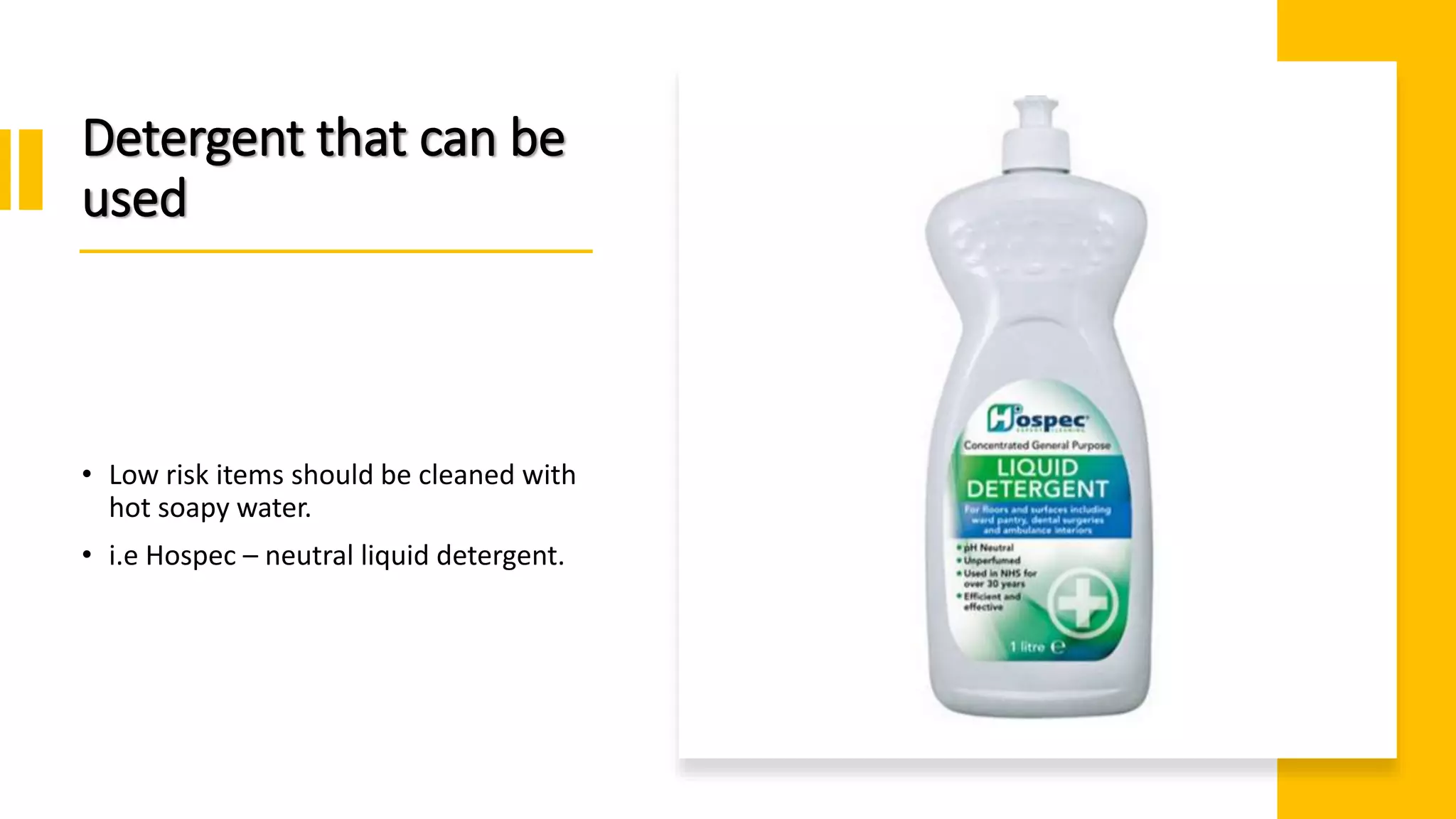
This process involves using a general-purpose neutral detergent i.e. Hospec.
Personal Protective Equipment
• Single use disposable aprons and gloves should be used when cleaning or disinfecting equipment.
• Hands should always be washed after removing gloves and aprons.
Cleanliness is intrinsically linked to infection prevention and control.
All patient equipment should be visibly clean with no blood or body
substances, dust, dirt, debris, or spillages
The environment/ equipment can be contaminated with patient derived
microorganisms.
Different spaces require different types of cleaning depending on what
activities are carried out in those spaces.
Detergent that can be
used
• Low risk items should be cleaned with
hot soapy water.
• i.e Hospec – neutral liquid detergent.
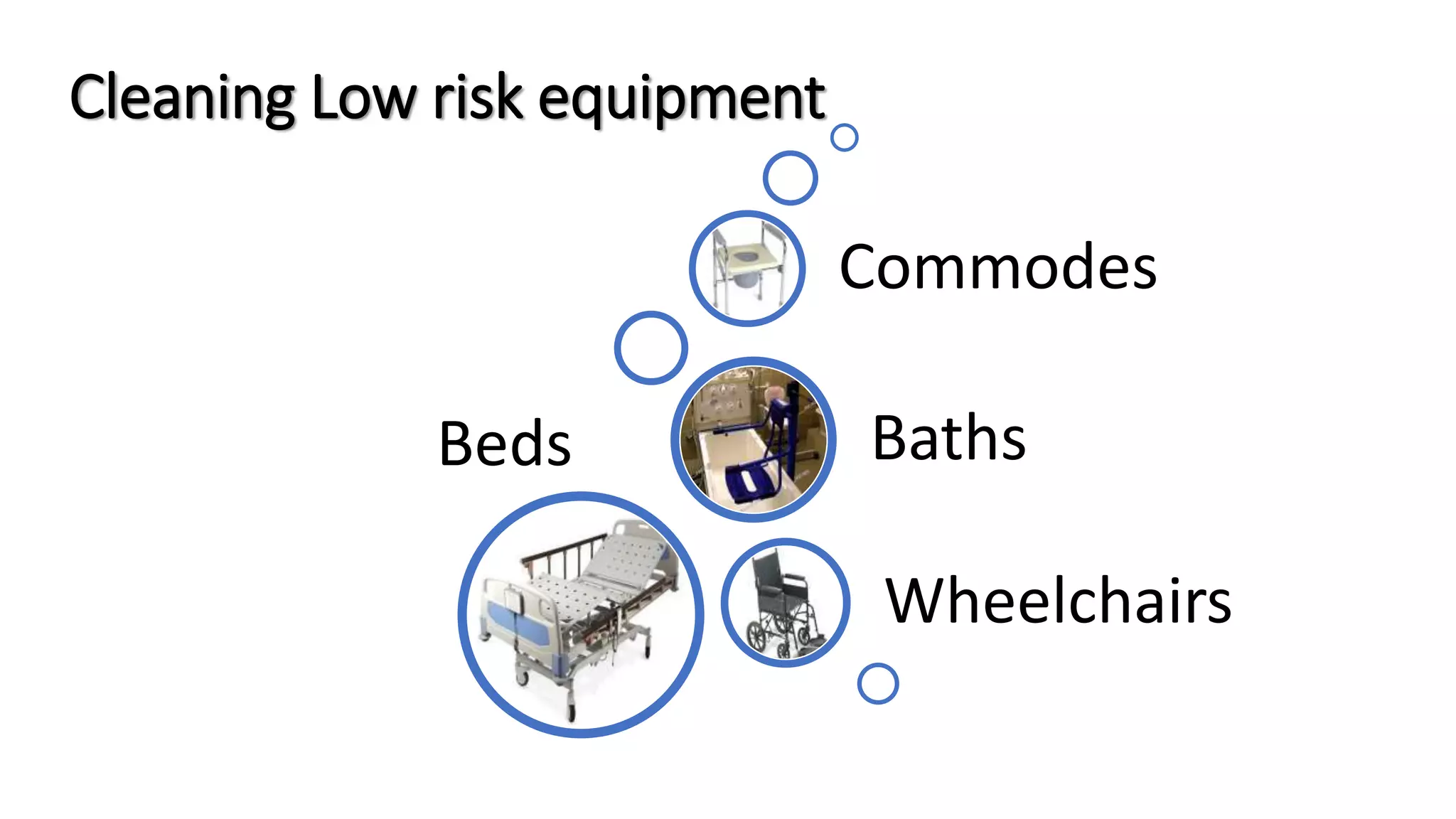
Cleaning Low risk equipment
Beds
Wheelchairs
Baths
Commodes
Wheelchairs
• Wheelchairs should be cleaned
daily according to manufacturers
instructions.
• This includes all parts not just
cushions.
Mattress Checks
• Establish a frequent inspection regime for records and keep
written record of inspection checks.
• Mattresses should be checked monthly.
• Remove the cover and inspect its inside surface and the
mattress core for staining or contamination.
• Safely dispose of any covers showing signs of damage or
staining.
• Arrange for contaminated mattress cores to be cleaned and
decontaminated in accordance with the manufacturer’s
instructions or safely disposed of.
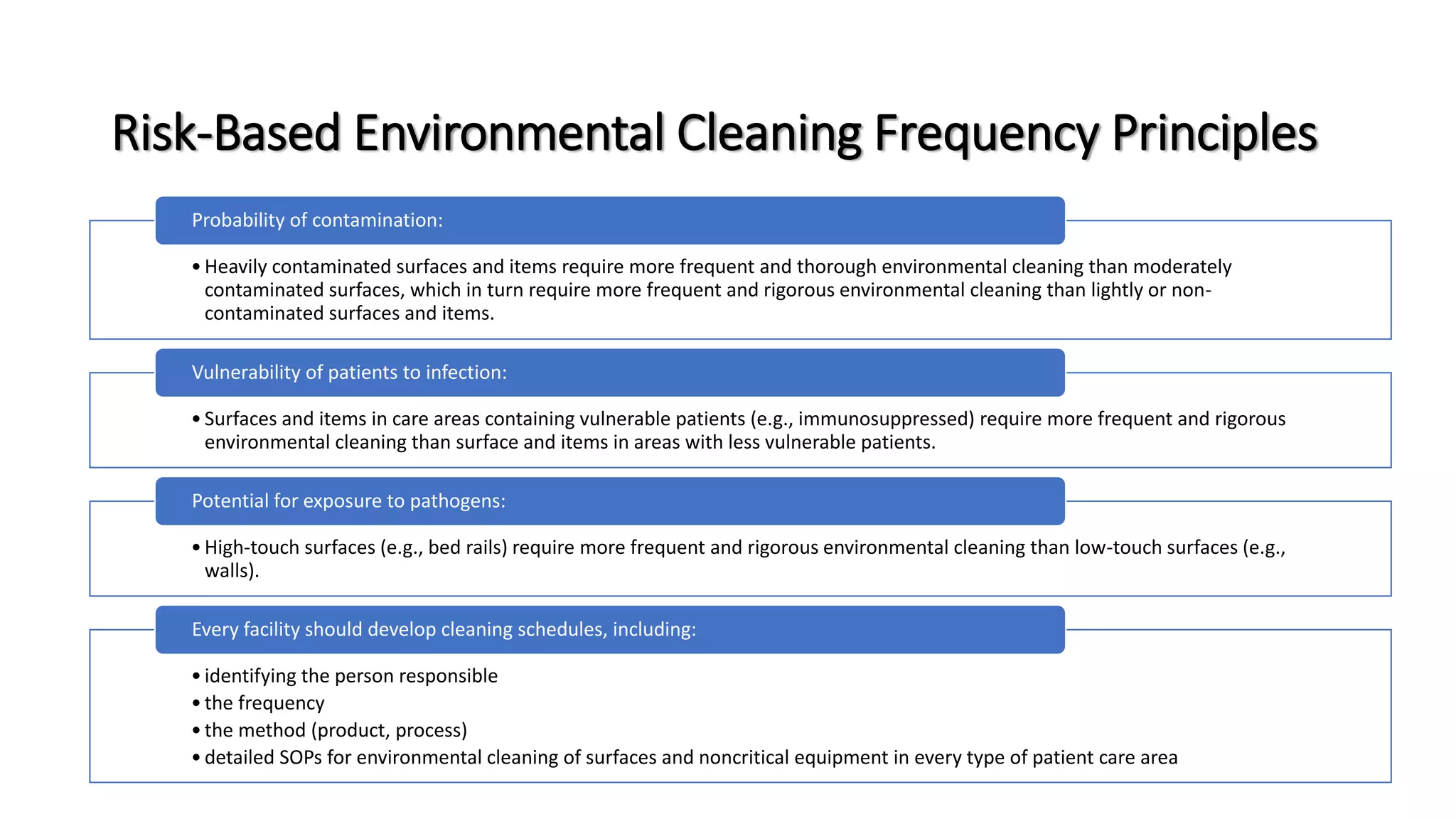
Risk-Based Environmental Cleaning Frequency Principles
•Heavily contaminated surfaces and items require more frequent and thorough environmental cleaning than moderately
contaminated surfaces, which in turn require more frequent and rigorous environmental cleaning than lightly or non-
contaminated surfaces and items.
Probability of contamination:
•Surfaces and items in care areas containing vulnerable patients (e.g., immunosuppressed) require more frequent and rigorous
environmental cleaning than surface and items in areas with less vulnerable patients.
Vulnerability of patients to infection:
•High-touch surfaces (e.g., bed rails) require more frequent and rigorous environmental cleaning than low-touch surfaces (e.g.,
walls).
Potential for exposure to pathogens:
•identifying the person responsible
•the frequency
•the method (product, process)
•detailed SOPs for environmental cleaning of surfaces and noncritical equipment in every type of patient care area
Every facility should develop cleaning schedules, including:
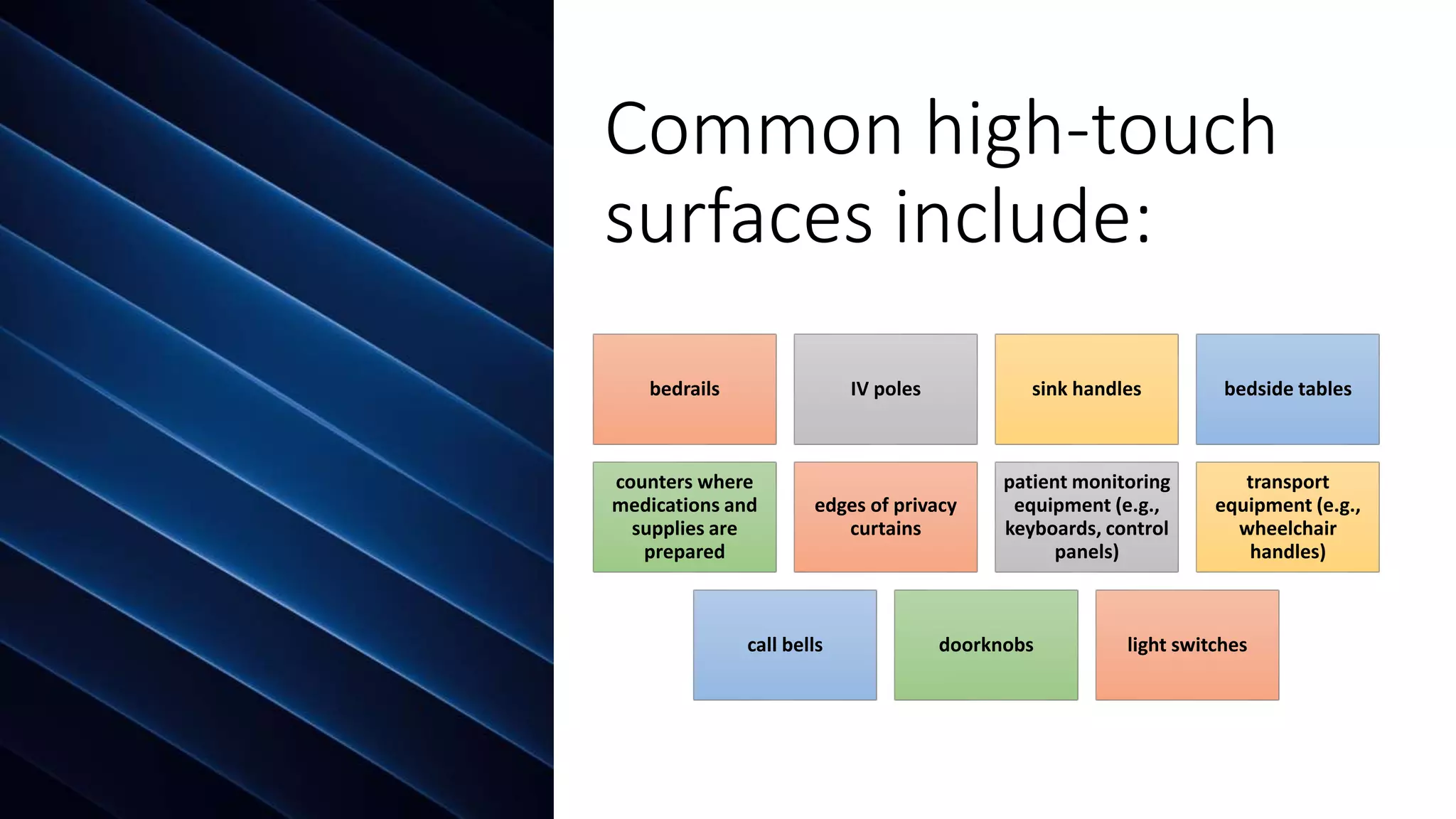
Common high-touch
surfaces include:
bedrails IV poles sink handles bedside tables
counters where
medications and
supplies are
prepared
edges of privacy
curtains
patient monitoring
equipment (e.g.,
keyboards, control
panels)
transport
equipment (e.g.,
wheelchair
handles)
call bells doorknobs light switches
General
patient
areas
outpatient or ambulatory care wards
general inpatient wards with patients admitted for
medical procedures, who are not receiving acute care
(i.e., sudden, urgent or emergent episodes of injury
and illness that require rapid intervention)
Three types of cleaning are required for these areas:
• routine cleaning
• terminal cleaning
• scheduled cleaning
Routine cleaning of inpatient wards
• Routine cleaning of inpatient areas occurs while the patient is admitted,
focuses on the patient zones and aims to remove organic material and
reduce microbial contamination to provide a visually clean environment.
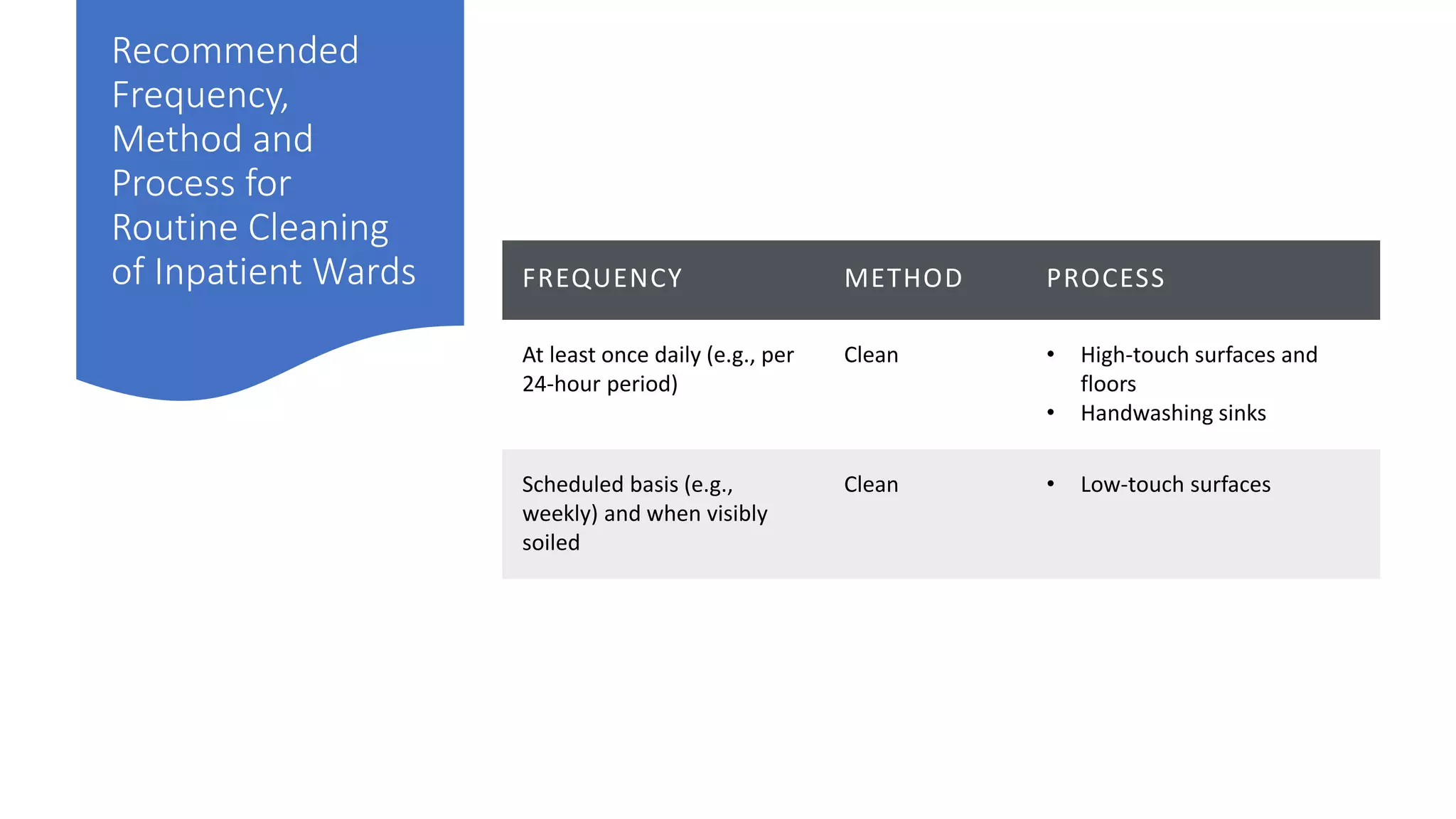
Recommended
Frequency,
Method and
Process for
Routine Cleaning
of Inpatient Wards FREQUENCY METHOD PROCESS
At least once daily (e.g., per
24-hour period)
Clean • High-touch surfaces and
floors
• Handwashing sinks
Scheduled basis (e.g.,
weekly) and when visibly
soiled
Clean • Low-touch surfaces
Terminal or discharge cleaning of inpatient
wards
Terminal cleaning of inpatient areas, which occurs after the patient is
discharged/transferred, includes the patient zone and the wider patient care area and
aims to remove organic material and significantly reduce and eliminate microbial
contamination to ensure that there is no transfer of microorganisms to the next patient.
Terminal cleaning requires collaboration between cleaning, IPC, and clinical staff, to
delineate responsibility for every surface and item, including ensuring that:
• disposable personal care items are discarded
• patient care equipment is removed for reprocessing
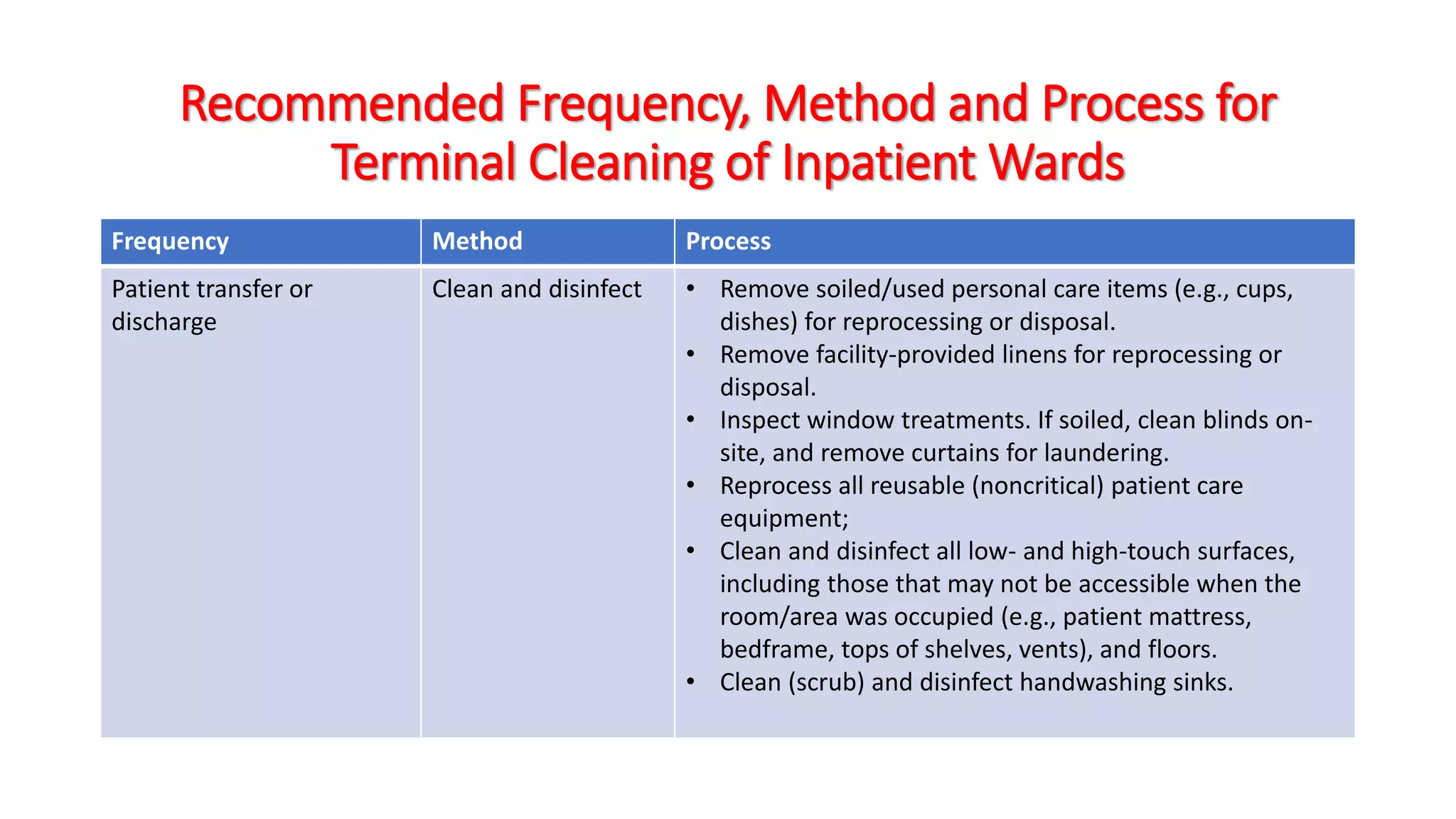
Recommended Frequency, Method and Process for
Terminal Cleaning of Inpatient Wards
Frequency Method Process
Patient transfer or
discharge
Clean and disinfect • Remove soiled/used personal care items (e.g., cups,
dishes) for reprocessing or disposal.
• Remove facility-provided linens for reprocessing or
disposal.
• Inspect window treatments. If soiled, clean blinds on-
site, and remove curtains for laundering.
• Reprocess all reusable (noncritical) patient care
equipment;
• Clean and disinfect all low- and high-touch surfaces,
including those that may not be accessible when the
room/area was occupied (e.g., patient mattress,
bedframe, tops of shelves, vents), and floors.
• Clean (scrub) and disinfect handwashing sinks.
Scheduled
cleaning
Scheduled cleaning occurs concurrently with
routine or terminal cleaning and aims to
reduce dust and soiling on low touch items or
surfaces.
Perform scheduled cleaning on items or
surfaces that are not at risk for soiling under
normal circumstances, using neutral
detergent and water.
But if they are visibly soiled with blood or
body fluids, clean and disinfect these items as
soon as possible.
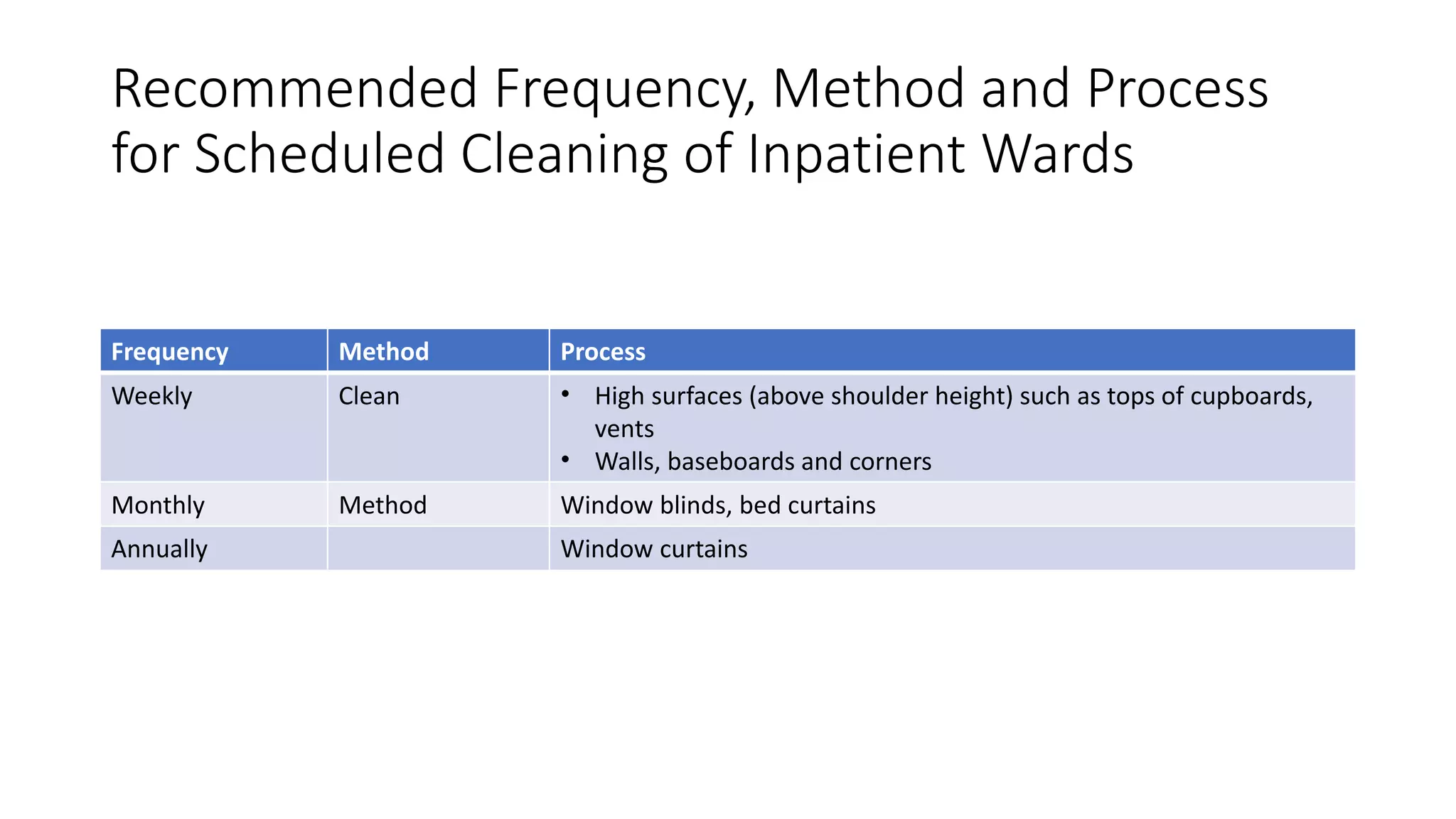
Recommended Frequency, Method and Process
for Scheduled Cleaning of Inpatient Wards
Frequency Method Process
Weekly Clean • High surfaces (above shoulder height) such as tops of cupboards,
vents
• Walls, baseboards and corners
Monthly Method Window blinds, bed curtains
Annually Window curtains
Spills of Blood or Body Fluids
• Regardless of the risk-level of an
area, spills or contamination from
blood or body fluid (e.g., vomitus),
must be cleaned and disinfected
immediately using a two-step
process.
Recommended Frequency, Method and Process for Spills of Blood or Body Fluids
Area Frequency Method Process
Any spill in
any patient
or non-
patient area
Immediately,
as soon as
possible
Clean and disinfect:
• do not use
combined
detergent-
disinfectant
product
• use intermediate-
level disinfectant
• Wear appropriate PPE.
• Confine the spill and wipe it up immediately with absorbent
(paper) towels, cloths, or absorbent granules (if available)
that are spread over the spill to solidify the blood or body
fluid (all should then be disposed as infectious waste).
• Clean thoroughly, using neutral detergent and warm water
solution.
• Disinfect by using a facility-approved intermediate-level
disinfectant.
• Typically, chlorine-based disinfectants.
• Take care to allow the disinfectant to remain wet on the
surface for the required contact time (e.g., 10 minutes), and
then rinse the area with clean water to remove the
disinfectant residue (if required).
• Immediately send all reusable supplies and equipment (e.g.,
cleaning cloths, mops) for reprocessing (i.e., cleaning and
disinfection) after the spill is cleaned up.
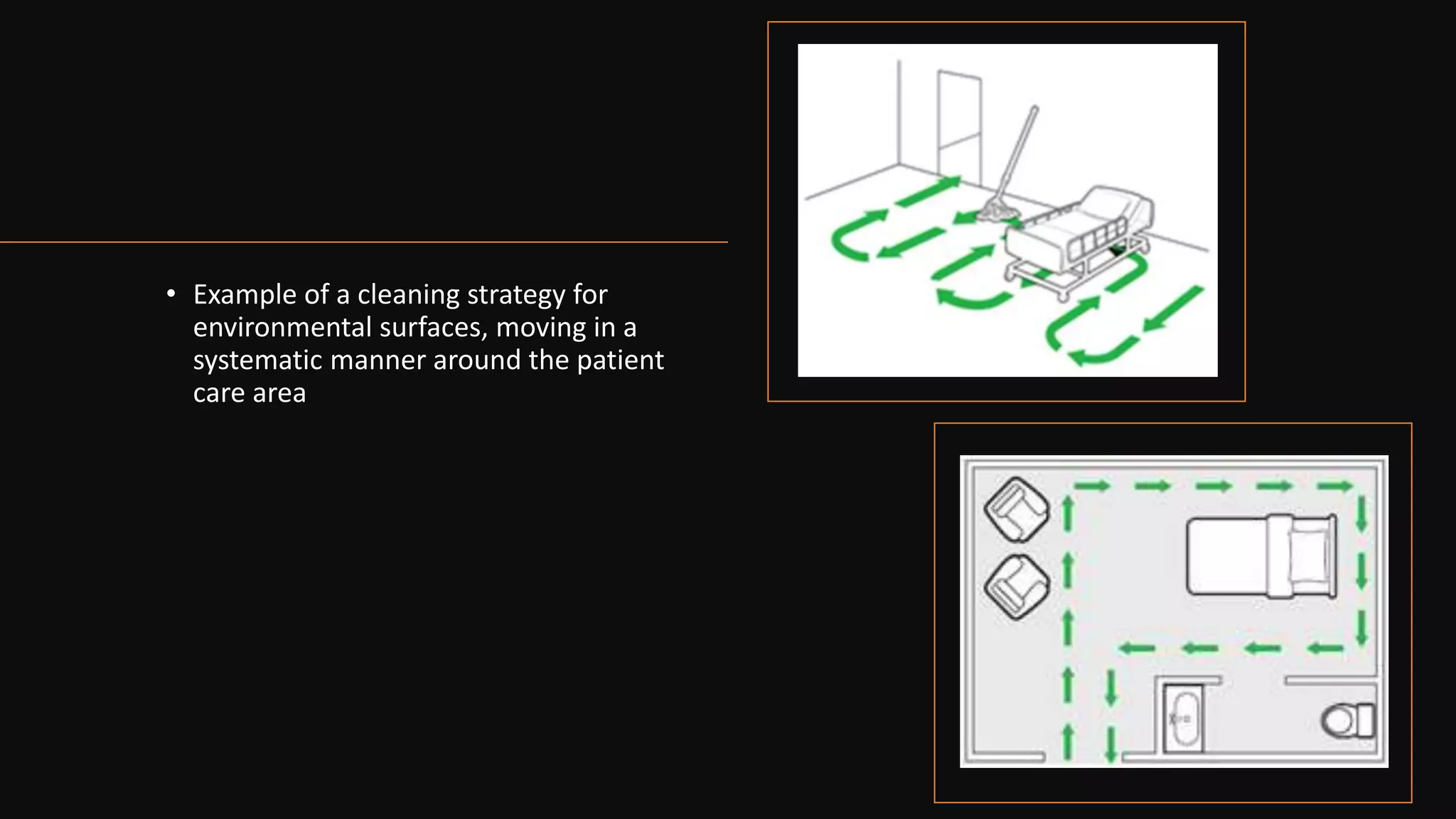
• Example of a cleaning strategy for
environmental surfaces, moving in a
systematic manner around the patient
care area
Transmission-based precaution/Isolation
wards
Isolation or cohorted areas with suspected or confirmed cases of infections requiring
transmission-based precautions are considered high-risk areas, particularly for:
• environmentally hardy pathogens (e.g., resistant to disinfectants)
• multidrug-resistant pathogens that are highly transmissible and/or are associated with high morbidity and
mortality.
The three types of transmission-based precautions are:
• airborne
• contact
• droplet
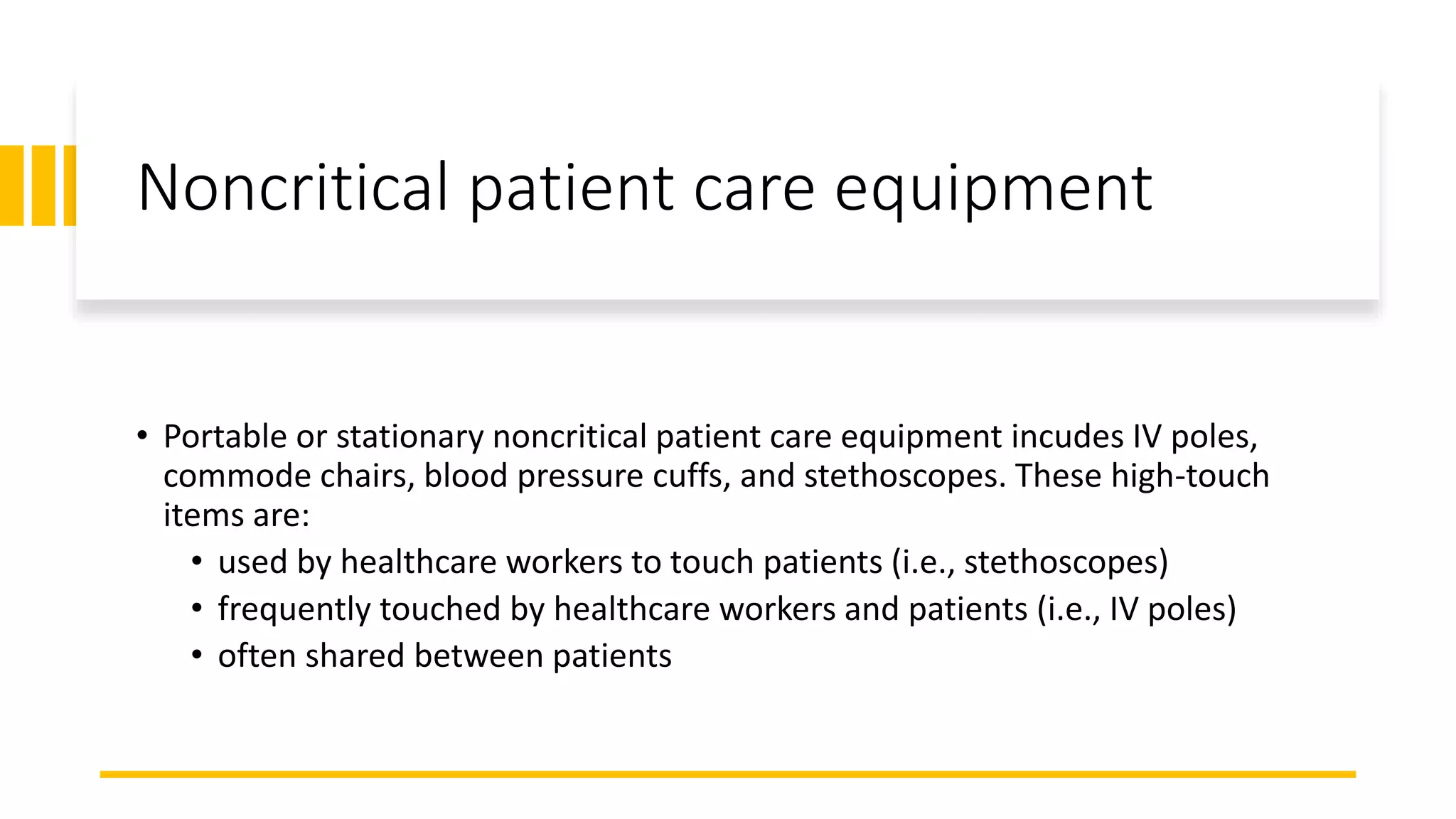
Noncritical patient care equipment
• Portable or stationary noncritical patient care equipment incudes IV poles,
commode chairs, blood pressure cuffs, and stethoscopes. These high-touch
items are:
• used by healthcare workers to touch patients (i.e., stethoscopes)
• frequently touched by healthcare workers and patients (i.e., IV poles)
• often shared between patients
The best practices for
selection and care of
noncritical patient care
equipment:
Clean all equipment using the methods and products available at the
facility.
All equipment should include detailed written instructions for
cleaning and disinfection from the manufacturer, including pictorial
instructions if disassembly is required.
Train the staff responsible for cleaning equipment on procedures
before the equipment is placed into use.
In patient care areas, do not purchase, install, or use equipment that
cannot be cleaned and disinfected, unless they can be fitted with
plastic (or other material) coverings.
If plastic coverings are protecting difficult-to-clean equipment, clean
these items with the same frequency, inspect coverings for damage
on a regular basis, and repair or replace them as needed.
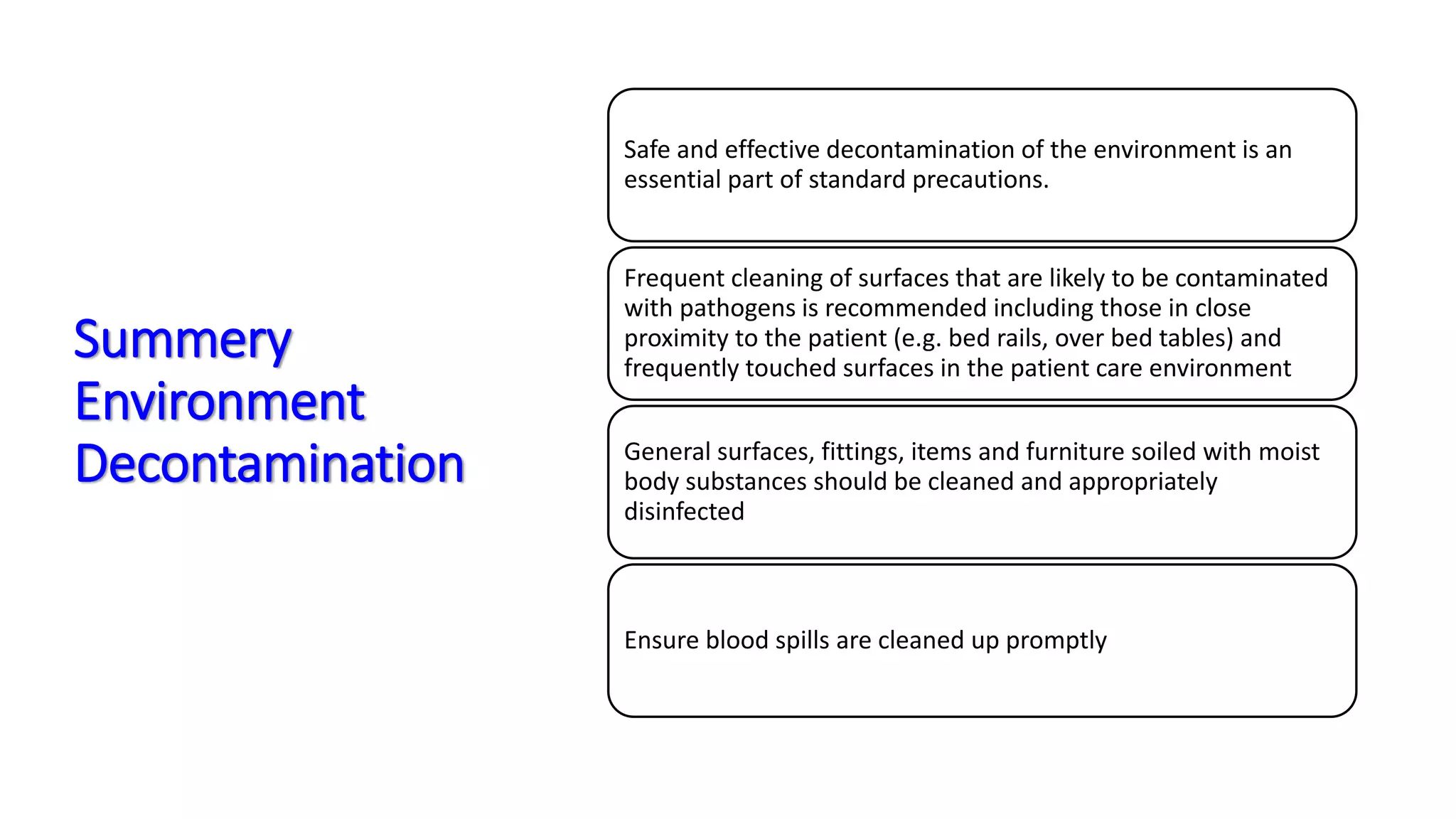
Summery
Environment
Decontamination
Safe and effective decontamination of the environment is an
essential part of standard precautions.
Frequent cleaning of surfaces that are likely to be contaminated
with pathogens is recommended including those in close
proximity to the patient (e.g. bed rails, over bed tables) and
frequently touched surfaces in the patient care environment
General surfaces, fittings, items and furniture soiled with moist
body substances should be cleaned and appropriately
disinfected
Ensure blood spills are cleaned up promptly
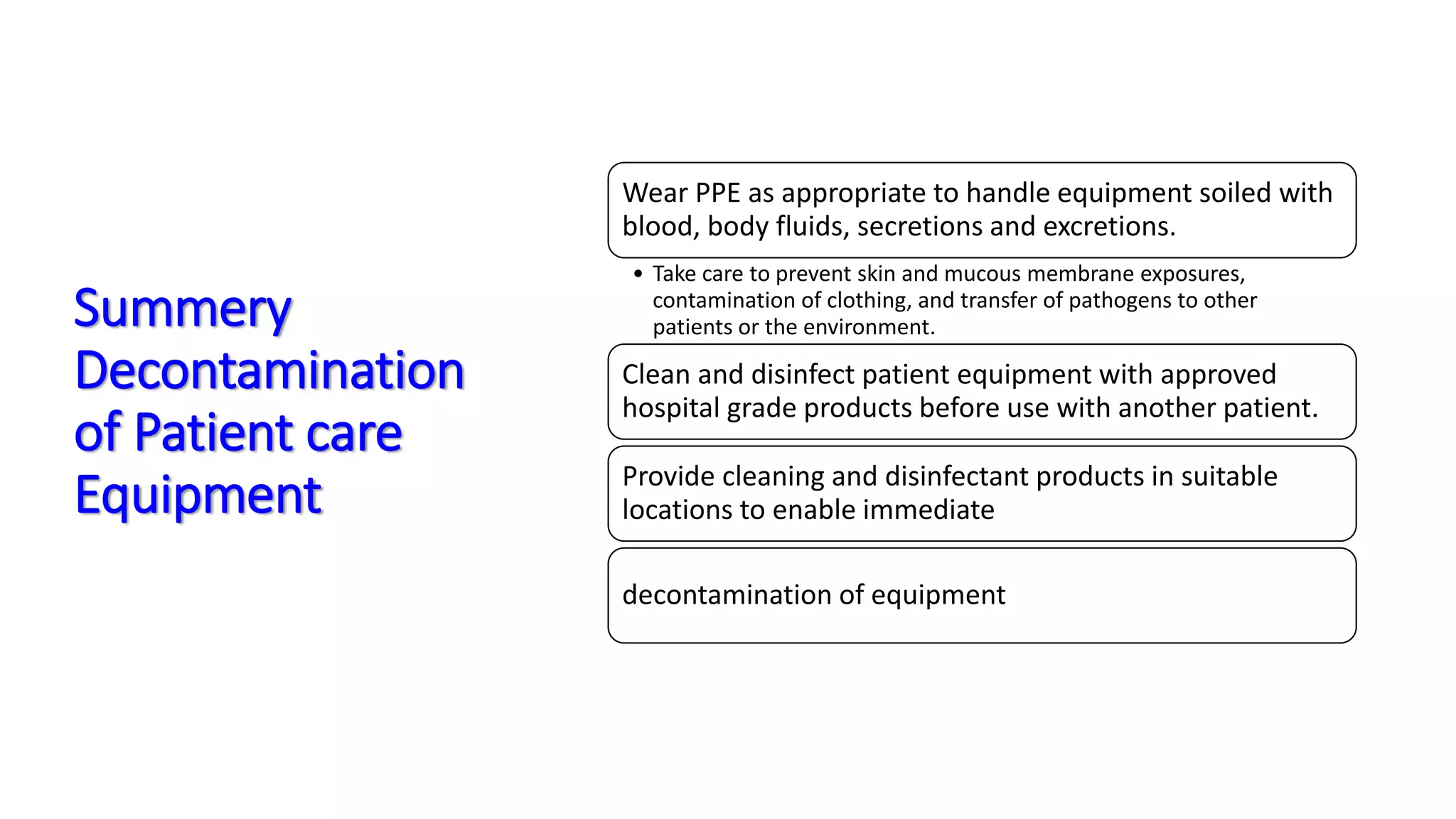
Summery
Decontamination
of Patient care
Equipment
Wear PPE as appropriate to handle equipment soiled with
blood, body fluids, secretions and excretions.
• Take care to prevent skin and mucous membrane exposures,
contamination of clothing, and transfer of pathogens to other
patients or the environment.
Clean and disinfect patient equipment with approved
hospital grade products before use with another patient.
Provide cleaning and disinfectant products in suitable
locations to enable immediate
decontamination of equipment
Cleaning and Decontamination in Hospitals.pptx

Cleaning and Decontamination in Hospitals.pptx

  • 1.
    Cleaning and Decontamination inHospitals Ahmad Thanin
  • 2.
    Introduction The determination ofenvironmental cleaning procedures for individual patient care areas, including frequency, method, and process, should be based on the risk of pathogen transmission. This risk is a function of the: • probability of contamination • vulnerability of the patients to infection • potential for exposure (i.e., high-touch vs low-touch surfaces)
  • 3.
    WHAT IS DECONTAMINATION? A processwhich removes or destroys contamination so that infectious agents do not multiply at a susceptible site There are 3 levels of decontamination: • Cleaning • Disinfection • Sterilization
  • 4.
    Definition of Detergent •A cleansing substance that acts similarly to soap but is made from chemical compounds rather than fats and lye. Definition of Disinfectant • A chemical agent which under defined conditions is capable of disinfection. Disinfection • A process used to reduce the number of micro-organisms but not usually bacterial spores. • This process does not necessarily kill or remove all micro-organisms, but reduces their number to a level which is not harmful to health
  • 5.
    Cleaning A process thatphysically removes infectious agents and the organic matter in which they thrive but does not necessarily destroy infectious agents. Any shared equipment should be cleaned patients i.e baths, commodes, beds, Cleaning is an essential prerequisite to ensure effective disinfection or sterilization. This process involves using a general-purpose neutral detergent i.e. Hospec. Personal Protective Equipment • Single use disposable aprons and gloves should be used when cleaning or disinfecting equipment. • Hands should always be washed after removing gloves and aprons.
  • 6.
    Cleanliness is intrinsicallylinked to infection prevention and control. All patient equipment should be visibly clean with no blood or body substances, dust, dirt, debris, or spillages The environment/ equipment can be contaminated with patient derived microorganisms. Different spaces require different types of cleaning depending on what activities are carried out in those spaces.
  • 7.
    Detergent that canbe used • Low risk items should be cleaned with hot soapy water. • i.e Hospec – neutral liquid detergent.
  • 8.
    Cleaning Low riskequipment Beds Wheelchairs Baths Commodes
  • 9.
    Wheelchairs • Wheelchairs shouldbe cleaned daily according to manufacturers instructions. • This includes all parts not just cushions.
  • 10.
    Mattress Checks • Establisha frequent inspection regime for records and keep written record of inspection checks. • Mattresses should be checked monthly. • Remove the cover and inspect its inside surface and the mattress core for staining or contamination. • Safely dispose of any covers showing signs of damage or staining. • Arrange for contaminated mattress cores to be cleaned and decontaminated in accordance with the manufacturer’s instructions or safely disposed of.
  • 11.
    Risk-Based Environmental CleaningFrequency Principles •Heavily contaminated surfaces and items require more frequent and thorough environmental cleaning than moderately contaminated surfaces, which in turn require more frequent and rigorous environmental cleaning than lightly or non- contaminated surfaces and items. Probability of contamination: •Surfaces and items in care areas containing vulnerable patients (e.g., immunosuppressed) require more frequent and rigorous environmental cleaning than surface and items in areas with less vulnerable patients. Vulnerability of patients to infection: •High-touch surfaces (e.g., bed rails) require more frequent and rigorous environmental cleaning than low-touch surfaces (e.g., walls). Potential for exposure to pathogens: •identifying the person responsible •the frequency •the method (product, process) •detailed SOPs for environmental cleaning of surfaces and noncritical equipment in every type of patient care area Every facility should develop cleaning schedules, including:
  • 12.
    Common high-touch surfaces include: bedrailsIV poles sink handles bedside tables counters where medications and supplies are prepared edges of privacy curtains patient monitoring equipment (e.g., keyboards, control panels) transport equipment (e.g., wheelchair handles) call bells doorknobs light switches
  • 13.
    General patient areas outpatient or ambulatorycare wards general inpatient wards with patients admitted for medical procedures, who are not receiving acute care (i.e., sudden, urgent or emergent episodes of injury and illness that require rapid intervention) Three types of cleaning are required for these areas: • routine cleaning • terminal cleaning • scheduled cleaning
  • 14.
    Routine cleaning ofinpatient wards • Routine cleaning of inpatient areas occurs while the patient is admitted, focuses on the patient zones and aims to remove organic material and reduce microbial contamination to provide a visually clean environment.
  • 15.
    Recommended Frequency, Method and Process for RoutineCleaning of Inpatient Wards FREQUENCY METHOD PROCESS At least once daily (e.g., per 24-hour period) Clean • High-touch surfaces and floors • Handwashing sinks Scheduled basis (e.g., weekly) and when visibly soiled Clean • Low-touch surfaces
  • 16.
    Terminal or dischargecleaning of inpatient wards Terminal cleaning of inpatient areas, which occurs after the patient is discharged/transferred, includes the patient zone and the wider patient care area and aims to remove organic material and significantly reduce and eliminate microbial contamination to ensure that there is no transfer of microorganisms to the next patient. Terminal cleaning requires collaboration between cleaning, IPC, and clinical staff, to delineate responsibility for every surface and item, including ensuring that: • disposable personal care items are discarded • patient care equipment is removed for reprocessing
  • 17.
    Recommended Frequency, Methodand Process for Terminal Cleaning of Inpatient Wards Frequency Method Process Patient transfer or discharge Clean and disinfect • Remove soiled/used personal care items (e.g., cups, dishes) for reprocessing or disposal. • Remove facility-provided linens for reprocessing or disposal. • Inspect window treatments. If soiled, clean blinds on- site, and remove curtains for laundering. • Reprocess all reusable (noncritical) patient care equipment; • Clean and disinfect all low- and high-touch surfaces, including those that may not be accessible when the room/area was occupied (e.g., patient mattress, bedframe, tops of shelves, vents), and floors. • Clean (scrub) and disinfect handwashing sinks.
  • 18.
    Scheduled cleaning Scheduled cleaning occursconcurrently with routine or terminal cleaning and aims to reduce dust and soiling on low touch items or surfaces. Perform scheduled cleaning on items or surfaces that are not at risk for soiling under normal circumstances, using neutral detergent and water. But if they are visibly soiled with blood or body fluids, clean and disinfect these items as soon as possible.
  • 19.
    Recommended Frequency, Methodand Process for Scheduled Cleaning of Inpatient Wards Frequency Method Process Weekly Clean • High surfaces (above shoulder height) such as tops of cupboards, vents • Walls, baseboards and corners Monthly Method Window blinds, bed curtains Annually Window curtains
  • 20.
    Spills of Bloodor Body Fluids • Regardless of the risk-level of an area, spills or contamination from blood or body fluid (e.g., vomitus), must be cleaned and disinfected immediately using a two-step process.
  • 21.
    Recommended Frequency, Methodand Process for Spills of Blood or Body Fluids Area Frequency Method Process Any spill in any patient or non- patient area Immediately, as soon as possible Clean and disinfect: • do not use combined detergent- disinfectant product • use intermediate- level disinfectant • Wear appropriate PPE. • Confine the spill and wipe it up immediately with absorbent (paper) towels, cloths, or absorbent granules (if available) that are spread over the spill to solidify the blood or body fluid (all should then be disposed as infectious waste). • Clean thoroughly, using neutral detergent and warm water solution. • Disinfect by using a facility-approved intermediate-level disinfectant. • Typically, chlorine-based disinfectants. • Take care to allow the disinfectant to remain wet on the surface for the required contact time (e.g., 10 minutes), and then rinse the area with clean water to remove the disinfectant residue (if required). • Immediately send all reusable supplies and equipment (e.g., cleaning cloths, mops) for reprocessing (i.e., cleaning and disinfection) after the spill is cleaned up.
  • 22.
    • Example ofa cleaning strategy for environmental surfaces, moving in a systematic manner around the patient care area
  • 23.
    Transmission-based precaution/Isolation wards Isolation orcohorted areas with suspected or confirmed cases of infections requiring transmission-based precautions are considered high-risk areas, particularly for: • environmentally hardy pathogens (e.g., resistant to disinfectants) • multidrug-resistant pathogens that are highly transmissible and/or are associated with high morbidity and mortality. The three types of transmission-based precautions are: • airborne • contact • droplet
  • 24.
    Noncritical patient careequipment • Portable or stationary noncritical patient care equipment incudes IV poles, commode chairs, blood pressure cuffs, and stethoscopes. These high-touch items are: • used by healthcare workers to touch patients (i.e., stethoscopes) • frequently touched by healthcare workers and patients (i.e., IV poles) • often shared between patients
  • 25.
    The best practicesfor selection and care of noncritical patient care equipment: Clean all equipment using the methods and products available at the facility. All equipment should include detailed written instructions for cleaning and disinfection from the manufacturer, including pictorial instructions if disassembly is required. Train the staff responsible for cleaning equipment on procedures before the equipment is placed into use. In patient care areas, do not purchase, install, or use equipment that cannot be cleaned and disinfected, unless they can be fitted with plastic (or other material) coverings. If plastic coverings are protecting difficult-to-clean equipment, clean these items with the same frequency, inspect coverings for damage on a regular basis, and repair or replace them as needed.
  • 26.
    Summery Environment Decontamination Safe and effectivedecontamination of the environment is an essential part of standard precautions. Frequent cleaning of surfaces that are likely to be contaminated with pathogens is recommended including those in close proximity to the patient (e.g. bed rails, over bed tables) and frequently touched surfaces in the patient care environment General surfaces, fittings, items and furniture soiled with moist body substances should be cleaned and appropriately disinfected Ensure blood spills are cleaned up promptly
  • 27.
    Summery Decontamination of Patient care Equipment WearPPE as appropriate to handle equipment soiled with blood, body fluids, secretions and excretions. • Take care to prevent skin and mucous membrane exposures, contamination of clothing, and transfer of pathogens to other patients or the environment. Clean and disinfect patient equipment with approved hospital grade products before use with another patient. Provide cleaning and disinfectant products in suitable locations to enable immediate decontamination of equipment