STANDARD PRECAUTION
PRESENTED BY:
G. LYNNE CHANCY, MSN, ARNP, ACAGNP-B
ADJUNCT PROFESSOR OF NURSING
MAY 2016
DEFINITION
Standard Precautions
• Previously known by various names including “universal
precautions”
• Standard precautions are designed to reduce the risk of
transmission of bloodborne and other pathogens from
both recognized and unrecognized sources to a
susceptible host.
• They are the basic level of infection control precaution
• Hospital Infection is the result of a combination of
factors: Microbial source + Transmission + Susceptible
host = Infection
History of Infection Control Precautions
Year Infection Control Precautions
1877,1910 Separates facilities, Antisepsis and disinfections ... etc
1985 UNIVERSAL PRECAUTIONS (guidelines for protecting healthcare
worker because the emergence of HIV & other bloodborne
pathogens)
1987 BODY SUBSTANCE ISOLATION ( focused on protecting patients and
health personnel from all moist body fluids not just blood: semen,
vaginal secretions, wound drainage, sputum, saliva etc
1996 STANDARD PRECAUTIONS:Two level approach:
•Standard Precautions which apply to all clients and patients
attending healthcare facilities
•Transmission-based Precautions which apply only to hospitalized
patients
2007 ISOLATION PRECAUTIONS (new pathogens; SARS, Avian Influenzae
H5N1, H1N1)
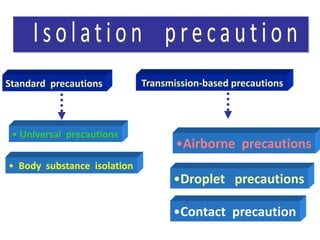
Standard precautions Transmission-based precautions
• Universal precautions
• Body substance isolation
•Airborne precautions
•Droplet precautions
•Contact precaution
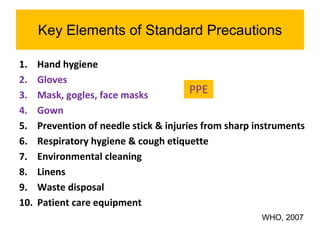
Key Elements of Standard Precautions
1. Hand hygiene
2. Gloves
3. Mask, gogles, face masks
4. Gown
5. Prevention of needle stick & injuries from sharp instruments
6. Respiratory hygiene & cough etiquette
7. Environmental cleaning
8. Linens
9. Waste disposal
10. Patient care equipment
WHO, 2007
PPE
Definitions of Hand hygiene
• Hand-washing
– Washing hands with plain soap and water
• Antiseptic hand-wash
– Washing hands with water and soap or other detergents
containing an antiseptic agent
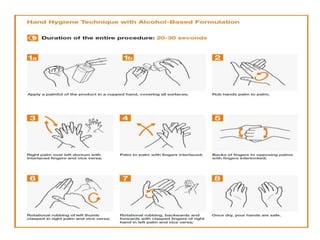
• Alcohol-based hand-rub
– Rubbing hands with an alcohol-containing preparation
• Surgical hand hygiene/antisepsis
– Hand-washing or using an alcohol-based hand-rub before
operations by surgical personnel
Guideline for Hand Hygiene in Health-care Settings. MMWR 2002; vol. 51, no. RR-16.
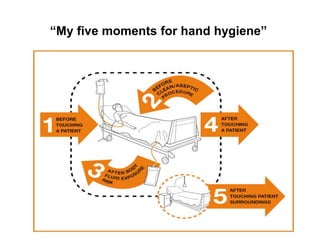
“My five moments for hand hygiene”
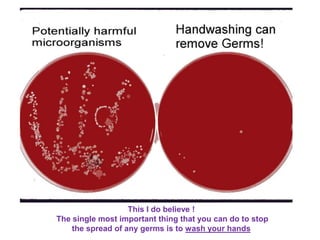
This I do believe !
The single most important thing that you can do to stop
the spread of any germs is to wash your hands
PPE
PPE Working Condition
gloves should be used when touching blood, body fluids,
secretions, excretions, or contaminated items and for
touching mucous membranes and nonintact skin.
gowns should be used during procedures and patient care
activities when contact of clothing and/or exposed skin
with blood, body fluids, secretions, or excretions is
anticipated. Aprons are sometimes used as PPE over
scrubs, such as in hemodialysis centers when
inserting a needle into a fistula.
Mask and
goggles or a
face shield
should be used during patient care activities that are
likely to generate splashes and sprays of blood, body
fluids, secretions, or excretions.
Precaution for suspected Avian
Influenza :
Full Barrier Precaution
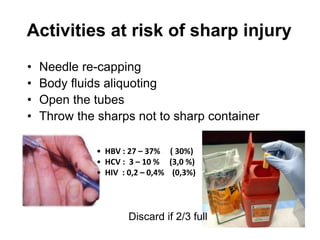
Activities at risk of sharp injury
• Needle re-capping
• Body fluids aliquoting
• Open the tubes
• Throw the sharps not to sharp container
Discard if 2/3 full
• HBV : 27 – 37% ( 30%)
• HCV : 3 – 10 % (3,0 %)
• HIV : 0,2 – 0,4% (0,3%)
Transmission-Based Precautions
• Used in addition to Standard Precautions for
Specified Patients
• Designed for the Care of Specified Patients
known or suspected to be infected by
epidemiologically important pathogens spread by:
airborne, droplet, or contact transmission.
Droplet Transmission
• For infectious agents with droplet nuclei >
5 microns
• Examples:
– Pertussis
– Meningococcal meningitis
• Precaution Examples:
– Private room
– Mask if within 3’ of patient
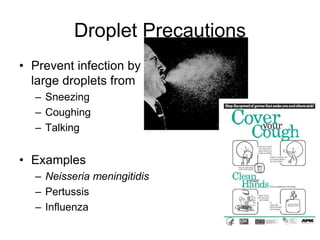
Droplet Precautions
• Prevent infection by
large droplets from
– Sneezing
– Coughing
– Talking
• Examples
– Neisseria meningitidis
– Pertussis
– Influenza
Airborne Transmission
• For infectious agents with droplet nuclei < 5
microns
• Examples:
– Tuberculosis
– Measles
• Precaution Examples
– Isolation rooms under negative pressure
– N95 or HEPA respirator use
Airborne Precautions for Avian
Influenza
• Respiratory Protection
– N95 respirator
• Patient in isolation/cohorting
• Patient Transport
– Limit patient movement
and transport,
place a surgical mask
on the patient
• Airborne isolation room, if available
– Air exhaust to outside or
re-circulated with HEPA filtration
Linens
• Handle, transport, and process used
linen in a manner which:
• Prevents skin and mucous membrane
exposures and contamination of clothing.
• Avoids transfer of pathogens to other
patients and or the environment.
Waste disposal
• Ensure safe waste management.
• Treat waste contaminated with blood, body
fluids, secretions and excretions as clinical
waste, in accordance with local regulations.
• Human tissues and laboratory waste that is
directly associated with specimen processing
should also be treated as clinical waste.
• Discard single use items properly.
Patient care equipment
• Handle equipment soiled with blood, body
fluids, secretions, and excretions in a
manner that prevents skin and mucous
membrane exposures, contamination of
clothing, and transfer of pathogens to
other patients or the environment.
• Clean, disinfect, and reprocess reusable
equipment appropriately before use with
another patient.
Contact Precautions
• For protection against skin-to-skin contact and physical
transfer of microorganisms to a host from a source
• Precaution Examples:
– Private room
– Handwashing
– Glove changes
• Examples
– Scabies
– VRE
345879847-STANDARD-PRECAUTIONS template presentation

345879847-STANDARD-PRECAUTIONS template presentation

  • 1.
    STANDARD PRECAUTION PRESENTED BY: G.LYNNE CHANCY, MSN, ARNP, ACAGNP-B ADJUNCT PROFESSOR OF NURSING MAY 2016
  • 2.
    DEFINITION Standard Precautions • Previouslyknown by various names including “universal precautions” • Standard precautions are designed to reduce the risk of transmission of bloodborne and other pathogens from both recognized and unrecognized sources to a susceptible host. • They are the basic level of infection control precaution • Hospital Infection is the result of a combination of factors: Microbial source + Transmission + Susceptible host = Infection
  • 3.
    History of InfectionControl Precautions Year Infection Control Precautions 1877,1910 Separates facilities, Antisepsis and disinfections ... etc 1985 UNIVERSAL PRECAUTIONS (guidelines for protecting healthcare worker because the emergence of HIV & other bloodborne pathogens) 1987 BODY SUBSTANCE ISOLATION ( focused on protecting patients and health personnel from all moist body fluids not just blood: semen, vaginal secretions, wound drainage, sputum, saliva etc 1996 STANDARD PRECAUTIONS:Two level approach: •Standard Precautions which apply to all clients and patients attending healthcare facilities •Transmission-based Precautions which apply only to hospitalized patients 2007 ISOLATION PRECAUTIONS (new pathogens; SARS, Avian Influenzae H5N1, H1N1)
  • 4.
    Standard precautions Transmission-basedprecautions • Universal precautions • Body substance isolation •Airborne precautions •Droplet precautions •Contact precaution
  • 5.
    Key Elements ofStandard Precautions 1. Hand hygiene 2. Gloves 3. Mask, gogles, face masks 4. Gown 5. Prevention of needle stick & injuries from sharp instruments 6. Respiratory hygiene & cough etiquette 7. Environmental cleaning 8. Linens 9. Waste disposal 10. Patient care equipment WHO, 2007 PPE
  • 6.
    Definitions of Handhygiene • Hand-washing – Washing hands with plain soap and water • Antiseptic hand-wash – Washing hands with water and soap or other detergents containing an antiseptic agent • Alcohol-based hand-rub – Rubbing hands with an alcohol-containing preparation • Surgical hand hygiene/antisepsis – Hand-washing or using an alcohol-based hand-rub before operations by surgical personnel Guideline for Hand Hygiene in Health-care Settings. MMWR 2002; vol. 51, no. RR-16.
  • 7.
    “My five momentsfor hand hygiene”
  • 10.
    This I dobelieve ! The single most important thing that you can do to stop the spread of any germs is to wash your hands
  • 11.
    PPE PPE Working Condition glovesshould be used when touching blood, body fluids, secretions, excretions, or contaminated items and for touching mucous membranes and nonintact skin. gowns should be used during procedures and patient care activities when contact of clothing and/or exposed skin with blood, body fluids, secretions, or excretions is anticipated. Aprons are sometimes used as PPE over scrubs, such as in hemodialysis centers when inserting a needle into a fistula. Mask and goggles or a face shield should be used during patient care activities that are likely to generate splashes and sprays of blood, body fluids, secretions, or excretions.
  • 12.
    Precaution for suspectedAvian Influenza : Full Barrier Precaution
  • 13.
    Activities at riskof sharp injury • Needle re-capping • Body fluids aliquoting • Open the tubes • Throw the sharps not to sharp container Discard if 2/3 full • HBV : 27 – 37% ( 30%) • HCV : 3 – 10 % (3,0 %) • HIV : 0,2 – 0,4% (0,3%)
  • 14.
    Transmission-Based Precautions • Usedin addition to Standard Precautions for Specified Patients • Designed for the Care of Specified Patients known or suspected to be infected by epidemiologically important pathogens spread by: airborne, droplet, or contact transmission.
  • 15.
    Droplet Transmission • Forinfectious agents with droplet nuclei > 5 microns • Examples: – Pertussis – Meningococcal meningitis • Precaution Examples: – Private room – Mask if within 3’ of patient
  • 16.
    Droplet Precautions • Preventinfection by large droplets from – Sneezing – Coughing – Talking • Examples – Neisseria meningitidis – Pertussis – Influenza
  • 17.
    Airborne Transmission • Forinfectious agents with droplet nuclei < 5 microns • Examples: – Tuberculosis – Measles • Precaution Examples – Isolation rooms under negative pressure – N95 or HEPA respirator use
  • 18.
    Airborne Precautions forAvian Influenza • Respiratory Protection – N95 respirator • Patient in isolation/cohorting • Patient Transport – Limit patient movement and transport, place a surgical mask on the patient • Airborne isolation room, if available – Air exhaust to outside or re-circulated with HEPA filtration
  • 19.
    Linens • Handle, transport,and process used linen in a manner which: • Prevents skin and mucous membrane exposures and contamination of clothing. • Avoids transfer of pathogens to other patients and or the environment.
  • 20.
    Waste disposal • Ensuresafe waste management. • Treat waste contaminated with blood, body fluids, secretions and excretions as clinical waste, in accordance with local regulations. • Human tissues and laboratory waste that is directly associated with specimen processing should also be treated as clinical waste. • Discard single use items properly.
  • 21.
    Patient care equipment •Handle equipment soiled with blood, body fluids, secretions, and excretions in a manner that prevents skin and mucous membrane exposures, contamination of clothing, and transfer of pathogens to other patients or the environment. • Clean, disinfect, and reprocess reusable equipment appropriately before use with another patient.
  • 22.
    Contact Precautions • Forprotection against skin-to-skin contact and physical transfer of microorganisms to a host from a source • Precaution Examples: – Private room – Handwashing – Glove changes • Examples – Scabies – VRE