Sushmita Chakraborty
Gargi Biswas
Definition
• Infection:
Infection is the invasion of an organism's
body tissues by disease-causing agents, their
multiplication, and the reaction of host tissues to
these organisms and the toxins they produce.
• Healthcare associated infection:
Healthcare associated infections (HCAI’s) are
infections that develop in a patient, as a direct
result of receiving healthcare, either in hospital or
in a community setting.
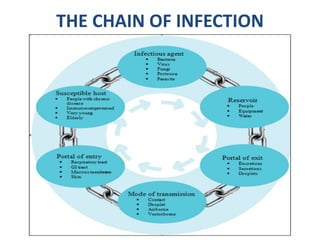
THE CHAIN OF INFECTION
INFECTION CONTROL IN HEALTH CARE
FACILITIES
• An infection control programme is considered
efficient which, when used appropriately,
restricts the spread of infection among
patients and staff in the hospital.
• It reduces patients’ morbidity and mortality,
length of hospital stay and cost associated
with hospital stay.
• This is achieved through the application of
research based knowledge to practices.
Objectives of infection control
programme
The specific objectives of these guidelines are to
provide directions and information in relation
to:
• Facilities, equipment, and procedures
necessary to implement standard and
additional (transmission- based) precautions
for control of infections
• Cleaning, disinfecting and reprocessing of
reusable equipment
Contd.
• Waste management
• Protection of health care workers from
transmissible infections
• Prevention of HAI in patients
• Infection control practices in special situations
Components of infection control
programme
• Basic measure for infection control- Standard
and additional precaution
• Education and training of health care workers
• Protection of health care workers
• Identification of hazards and minimizing risks
• Aseptic techniques
• Use of single use device, reprocessing of
instruments and equipment
Contd.
• Antibiotic usage, management of blood/ body
fluid exposure, handling of blood/ blood
products and hospital waste management.
• Surveillance
• Outbreak investigation
• Incident monitoring
Categories of infection control
practices
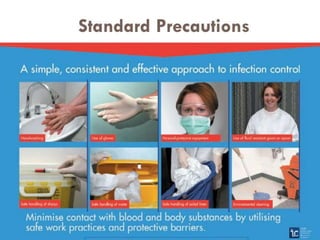
1. Standard Precautions: all patients all time.
It aims to prevent transmission of infections
from:
• Patient to health care worker
• Health care worker to patient
• Patient to patient (cross- transmission)
• Hospital environment to patient
• Hospital waste to community spread
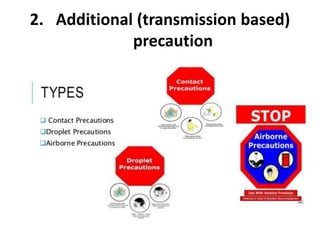
2. Additional (transmission based)
precaution
1. Universal Precautions
Rules of universal precautions:
• Consider All patients potentially infectious.
• Assume All blood and body fluids and tissue to
be potentially infectious.
• Assume All unsterile needles and other sharps
to be similarly contaminated.
2. Other standard precautions
• Wash hands before and after all patient or
specimen contact.
• Handle the blood of all patients as potentially
infectious.
• Wear gloves for potential contact with blood
and body fluids.
• Prevent needle stick/sharp injuries.
• Wear personal protective equipment (PPE)
while handling blood or body fluids.
Contd.
• Handle all linen soiled with blood and/or body
secretion as potentially infectious.
• Process all laboratory specimens as potentially
infectious.
• Wear a mask for TB and other contagious
respiratory infections (HIV is not air-borne).
• Correctly process instruments and patient care
equipment.
• Maintain environmental cleanliness.
• Follow proper waste disposal practices.
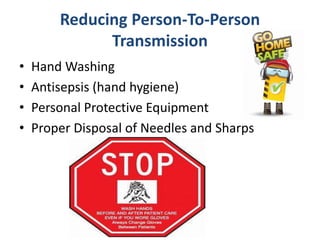
Reducing Person-To-Person
Transmission
• Hand Washing
• Antisepsis (hand hygiene)
• Personal Protective Equipment
• Proper Disposal of Needles and Sharps
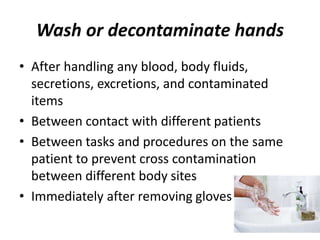
Wash or decontaminate hands
• After handling any blood, body fluids,
secretions, excretions, and contaminated
items
• Between contact with different patients
• Between tasks and procedures on the same
patient to prevent cross contamination
between different body sites
• Immediately after removing gloves
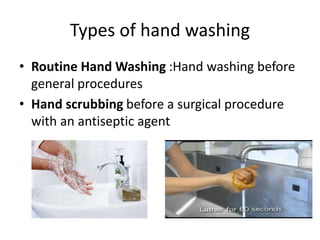
Types of hand washing
• Routine Hand Washing :Hand washing before
general procedures
• Hand scrubbing before a surgical procedure
with an antiseptic agent
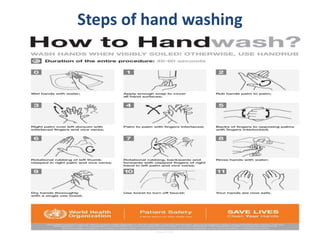
Steps of hand washing
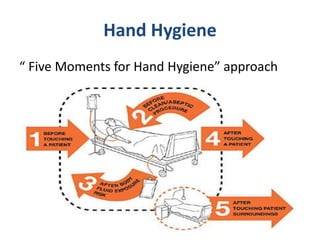
Hand Hygiene
“ Five Moments for Hand Hygiene” approach
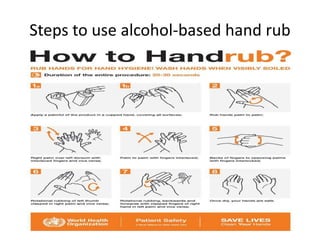
Steps to use alcohol-based hand rub
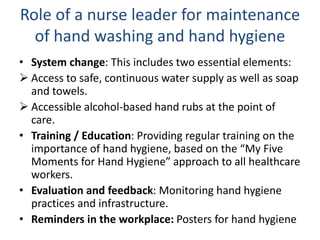
Role of a nurse leader for maintenance
of hand washing and hand hygiene
• System change: This includes two essential elements:
 Access to safe, continuous water supply as well as soap
and towels.
 Accessible alcohol-based hand rubs at the point of
care.
• Training / Education: Providing regular training on the
importance of hand hygiene, based on the “My Five
Moments for Hand Hygiene” approach to all healthcare
workers.
• Evaluation and feedback: Monitoring hand hygiene
practices and infrastructure.
• Reminders in the workplace: Posters for hand hygiene
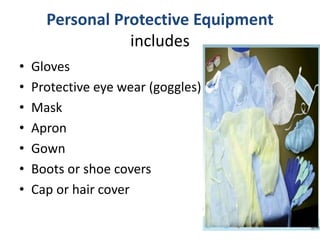
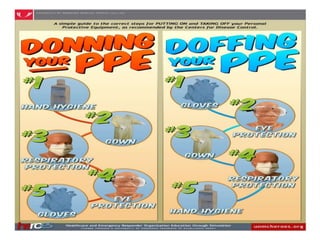
Personal Protective Equipment
includes
• Gloves
• Protective eye wear (goggles)
• Mask
• Apron
• Gown
• Boots or shoe covers
• Cap or hair cover
Personal Protective Equipment
Used by:
• Healthcare workers who provide direct care to
patients and who work in situations where
they may have contact with blood, body
fluids, excretions, and secretions.
• Support staff including medical aides,
cleaners, and laundry staff in situations where
they may have contact with blood, body
fluids, secretions, and excretions.
PPE used by
• Laboratory staff, who handle patient
specimens.
• Family members who provide care to patients
and are in a situation where they may have
contact with blood, body fluids, secretions,
and excretions.
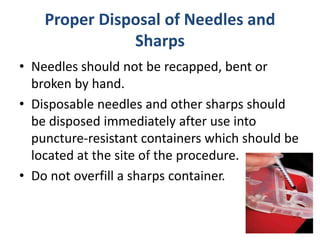
Proper Disposal of Needles and
Sharps
• Needles should not be recapped, bent or
broken by hand.
• Disposable needles and other sharps should
be disposed immediately after use into
puncture-resistant containers which should be
located at the site of the procedure.
• Do not overfill a sharps container.
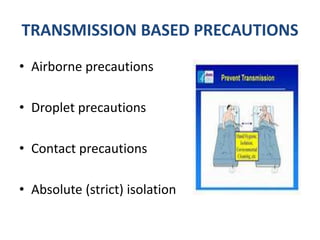
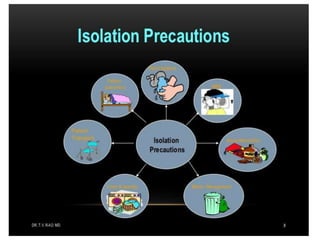
TRANSMISSION BASED PRECAUTIONS
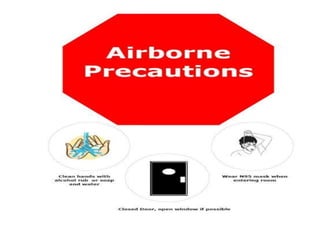
• Airborne precautions
• Droplet precautions
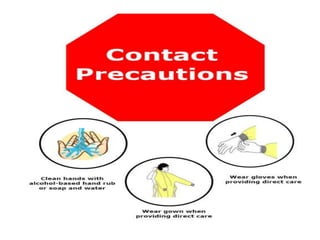
• Contact precautions
• Absolute (strict) isolation
Air-Borne Transmission
• Occurs through dissemination of air-borne
droplet nuclei (small particle residue less than
5µm in size) containing microorganisms that
remain suspended in the air for long periods
of time.
• Microorganisms transmitted include
mycobacterium tuberculosis, measles,
varicella virus
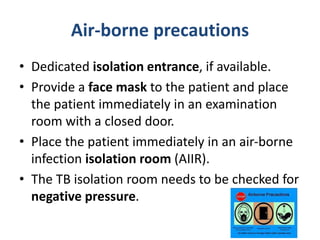
Air-borne precautions
• Dedicated isolation entrance, if available.
• Provide a face mask to the patient and place
the patient immediately in an examination
room with a closed door.
• Place the patient immediately in an air-borne
infection isolation room (AIIR).
• The TB isolation room needs to be checked for
negative pressure.
Contd.
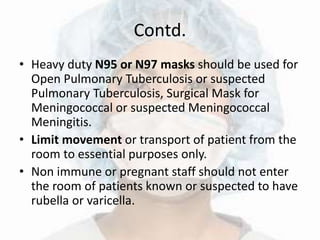
• Heavy duty N95 or N97 masks should be used for
Open Pulmonary Tuberculosis or suspected
Pulmonary Tuberculosis, Surgical Mask for
Meningococcal or suspected Meningococcal
Meningitis.
• Limit movement or transport of patient from the
room to essential purposes only.
• Non immune or pregnant staff should not enter
the room of patients known or suspected to have
rubella or varicella.
Droplet Transmission
• Droplets: large particles, size >5µm.
• Droplets are generated from the patient
primarily during coughing, sneezing, and
during certain procedures such as suctioning
and bronchoscopy.
• special air handling and ventilation are not
required.
Contd.
Microorganisms transmitted include-
• Respiratory viruses : influenza, parainfluenza
virus, adenovirus, respiratory syncytial virus,
human metapneumovirus
• Bordetella pertussis
• Neisseria meningitides, group A
streptococcus(For first 24 hours of therapy)
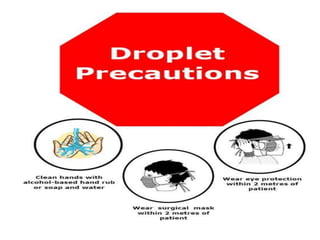
Droplet precautions
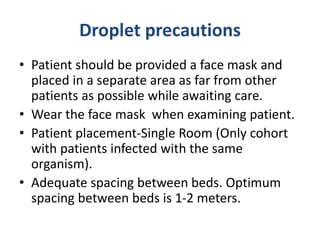
• Patient should be provided a face mask and
placed in a separate area as far from other
patients as possible while awaiting care.
• Wear the face mask when examining patient.
• Patient placement-Single Room (Only cohort
with patients infected with the same
organism).
• Adequate spacing between beds. Optimum
spacing between beds is 1-2 meters.
Contact transmission
Applies to patients with conditions like-
• Presence of stool incontinence(norovirus,
rotavirus, or Clostridium difficile),draining
wounds, uncontrolled secretions, pressure ulcers,
or presence of ostomy draining body fluids.
• Multi drug resistant organisms(MDRO), ie,
MRSA(methicillin resistant Staphylococcus
aureus), VRE(vancomycin resistant enterococcus)
• Presence of generalized rash or exanthemas.
Contact precautions
• Perform hand hygiene
• Wear PPE (gloves and gown) when touching
the patient or belongings.
• Clean or disinfect the examination room.
• Patient placement: Cohort only with patients
who are affected by the same organism.
• Patient transport: Limit the movement and
transport of the patient
• Patient care equipment: individualized or
disinfected before use for another patient.
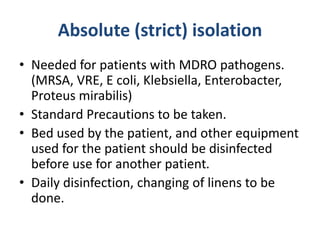
Absolute (strict) isolation
• Needed for patients with MDRO pathogens.
(MRSA, VRE, E coli, Klebsiella, Enterobacter,
Proteus mirabilis)
• Standard Precautions to be taken.
• Bed used by the patient, and other equipment
used for the patient should be disinfected
before use for another patient.
• Daily disinfection, changing of linens to be
done.
Contd.
• The ward sisters and doctors concerned have
the responsibility of informing the patients’
relatives of the measures to be taken and the
importance of restriction of visitors.
• Children below 12 years of age should not be
allowed into isolation areas.
• Any prophylactic medication or active
immunization for attendants should be
conducted by the physician in charge.
Indication for discontinuing of
isolation
• For patients, colonized or infected with
microorganisms like MRSA or VRE, three
negative cultures taken one week apart can be
used to discontinue contact precautions.
• In other patients, resolution of symptoms that
lead to the isolation (such as diarrhoea in the
case of C. difficile infection) may be a
reasonable time to stop the isolation.

infection control sush.pptx

  • 4.
  • 5.
    Definition • Infection: Infection isthe invasion of an organism's body tissues by disease-causing agents, their multiplication, and the reaction of host tissues to these organisms and the toxins they produce. • Healthcare associated infection: Healthcare associated infections (HCAI’s) are infections that develop in a patient, as a direct result of receiving healthcare, either in hospital or in a community setting.
  • 6.
    THE CHAIN OFINFECTION
  • 7.
    INFECTION CONTROL INHEALTH CARE FACILITIES • An infection control programme is considered efficient which, when used appropriately, restricts the spread of infection among patients and staff in the hospital. • It reduces patients’ morbidity and mortality, length of hospital stay and cost associated with hospital stay. • This is achieved through the application of research based knowledge to practices.
  • 8.
    Objectives of infectioncontrol programme The specific objectives of these guidelines are to provide directions and information in relation to: • Facilities, equipment, and procedures necessary to implement standard and additional (transmission- based) precautions for control of infections • Cleaning, disinfecting and reprocessing of reusable equipment
  • 9.
    Contd. • Waste management •Protection of health care workers from transmissible infections • Prevention of HAI in patients • Infection control practices in special situations
  • 10.
    Components of infectioncontrol programme • Basic measure for infection control- Standard and additional precaution • Education and training of health care workers • Protection of health care workers • Identification of hazards and minimizing risks • Aseptic techniques • Use of single use device, reprocessing of instruments and equipment
  • 11.
    Contd. • Antibiotic usage,management of blood/ body fluid exposure, handling of blood/ blood products and hospital waste management. • Surveillance • Outbreak investigation • Incident monitoring
  • 12.
    Categories of infectioncontrol practices 1. Standard Precautions: all patients all time. It aims to prevent transmission of infections from: • Patient to health care worker • Health care worker to patient • Patient to patient (cross- transmission) • Hospital environment to patient • Hospital waste to community spread
  • 13.
    2. Additional (transmissionbased) precaution
  • 15.
    1. Universal Precautions Rulesof universal precautions: • Consider All patients potentially infectious. • Assume All blood and body fluids and tissue to be potentially infectious. • Assume All unsterile needles and other sharps to be similarly contaminated.
  • 16.
    2. Other standardprecautions • Wash hands before and after all patient or specimen contact. • Handle the blood of all patients as potentially infectious. • Wear gloves for potential contact with blood and body fluids. • Prevent needle stick/sharp injuries. • Wear personal protective equipment (PPE) while handling blood or body fluids.
  • 17.
    Contd. • Handle alllinen soiled with blood and/or body secretion as potentially infectious. • Process all laboratory specimens as potentially infectious. • Wear a mask for TB and other contagious respiratory infections (HIV is not air-borne). • Correctly process instruments and patient care equipment. • Maintain environmental cleanliness. • Follow proper waste disposal practices.
  • 18.
    Reducing Person-To-Person Transmission • HandWashing • Antisepsis (hand hygiene) • Personal Protective Equipment • Proper Disposal of Needles and Sharps
  • 19.
    Wash or decontaminatehands • After handling any blood, body fluids, secretions, excretions, and contaminated items • Between contact with different patients • Between tasks and procedures on the same patient to prevent cross contamination between different body sites • Immediately after removing gloves
  • 20.
    Types of handwashing • Routine Hand Washing :Hand washing before general procedures • Hand scrubbing before a surgical procedure with an antiseptic agent
  • 21.
  • 22.
    Hand Hygiene “ FiveMoments for Hand Hygiene” approach
  • 23.
    Steps to usealcohol-based hand rub
  • 24.
    Role of anurse leader for maintenance of hand washing and hand hygiene • System change: This includes two essential elements:  Access to safe, continuous water supply as well as soap and towels.  Accessible alcohol-based hand rubs at the point of care. • Training / Education: Providing regular training on the importance of hand hygiene, based on the “My Five Moments for Hand Hygiene” approach to all healthcare workers. • Evaluation and feedback: Monitoring hand hygiene practices and infrastructure. • Reminders in the workplace: Posters for hand hygiene
  • 25.
    Personal Protective Equipment includes •Gloves • Protective eye wear (goggles) • Mask • Apron • Gown • Boots or shoe covers • Cap or hair cover
  • 26.
    Personal Protective Equipment Usedby: • Healthcare workers who provide direct care to patients and who work in situations where they may have contact with blood, body fluids, excretions, and secretions. • Support staff including medical aides, cleaners, and laundry staff in situations where they may have contact with blood, body fluids, secretions, and excretions.
  • 27.
    PPE used by •Laboratory staff, who handle patient specimens. • Family members who provide care to patients and are in a situation where they may have contact with blood, body fluids, secretions, and excretions.
  • 29.
    Proper Disposal ofNeedles and Sharps • Needles should not be recapped, bent or broken by hand. • Disposable needles and other sharps should be disposed immediately after use into puncture-resistant containers which should be located at the site of the procedure. • Do not overfill a sharps container.
  • 30.
    TRANSMISSION BASED PRECAUTIONS •Airborne precautions • Droplet precautions • Contact precautions • Absolute (strict) isolation
  • 31.
    Air-Borne Transmission • Occursthrough dissemination of air-borne droplet nuclei (small particle residue less than 5µm in size) containing microorganisms that remain suspended in the air for long periods of time. • Microorganisms transmitted include mycobacterium tuberculosis, measles, varicella virus
  • 33.
    Air-borne precautions • Dedicatedisolation entrance, if available. • Provide a face mask to the patient and place the patient immediately in an examination room with a closed door. • Place the patient immediately in an air-borne infection isolation room (AIIR). • The TB isolation room needs to be checked for negative pressure.
  • 34.
    Contd. • Heavy dutyN95 or N97 masks should be used for Open Pulmonary Tuberculosis or suspected Pulmonary Tuberculosis, Surgical Mask for Meningococcal or suspected Meningococcal Meningitis. • Limit movement or transport of patient from the room to essential purposes only. • Non immune or pregnant staff should not enter the room of patients known or suspected to have rubella or varicella.
  • 35.
    Droplet Transmission • Droplets:large particles, size >5µm. • Droplets are generated from the patient primarily during coughing, sneezing, and during certain procedures such as suctioning and bronchoscopy. • special air handling and ventilation are not required.
  • 36.
    Contd. Microorganisms transmitted include- •Respiratory viruses : influenza, parainfluenza virus, adenovirus, respiratory syncytial virus, human metapneumovirus • Bordetella pertussis • Neisseria meningitides, group A streptococcus(For first 24 hours of therapy)
  • 38.
    Droplet precautions • Patientshould be provided a face mask and placed in a separate area as far from other patients as possible while awaiting care. • Wear the face mask when examining patient. • Patient placement-Single Room (Only cohort with patients infected with the same organism). • Adequate spacing between beds. Optimum spacing between beds is 1-2 meters.
  • 39.
    Contact transmission Applies topatients with conditions like- • Presence of stool incontinence(norovirus, rotavirus, or Clostridium difficile),draining wounds, uncontrolled secretions, pressure ulcers, or presence of ostomy draining body fluids. • Multi drug resistant organisms(MDRO), ie, MRSA(methicillin resistant Staphylococcus aureus), VRE(vancomycin resistant enterococcus) • Presence of generalized rash or exanthemas.
  • 41.
    Contact precautions • Performhand hygiene • Wear PPE (gloves and gown) when touching the patient or belongings. • Clean or disinfect the examination room. • Patient placement: Cohort only with patients who are affected by the same organism. • Patient transport: Limit the movement and transport of the patient • Patient care equipment: individualized or disinfected before use for another patient.
  • 43.
    Absolute (strict) isolation •Needed for patients with MDRO pathogens. (MRSA, VRE, E coli, Klebsiella, Enterobacter, Proteus mirabilis) • Standard Precautions to be taken. • Bed used by the patient, and other equipment used for the patient should be disinfected before use for another patient. • Daily disinfection, changing of linens to be done.
  • 44.
    Contd. • The wardsisters and doctors concerned have the responsibility of informing the patients’ relatives of the measures to be taken and the importance of restriction of visitors. • Children below 12 years of age should not be allowed into isolation areas. • Any prophylactic medication or active immunization for attendants should be conducted by the physician in charge.
  • 45.
    Indication for discontinuingof isolation • For patients, colonized or infected with microorganisms like MRSA or VRE, three negative cultures taken one week apart can be used to discontinue contact precautions. • In other patients, resolution of symptoms that lead to the isolation (such as diarrhoea in the case of C. difficile infection) may be a reasonable time to stop the isolation.