Download to read offline
![International Research Journal of Engineering and Technology (IRJET) e-ISSN: 2395-0056
Volume: 06 Issue: 04 | Apr 2019 www.irjet.net p-ISSN: 2395-0072
© 2019, IRJET | Impact Factor value: 7.211 | ISO 9001:2008 Certified Journal | Page 2191
Lung Cancer Detection Using Grey Level Co-Occurrence Matrix
Mahpara Alam1, Bhavika Chaudhari2, Shamal Bangar3, Pratiksha Desale4, Prof. Chaitali Patil5
1,2,3,4,Students, Department of Computer Engineering, K.K.W.I.E.E.R, Maharashtra, India
5Professor, Department of Computer Engineering, K.K.W.I.E.E.R, Maharashtra, India
---------------------------------------------------------------------***----------------------------------------------------------------------
Abstract - Lung cancer is curable disease if detected in its
early stages. In recent years, Image processing techniques are
widely used in medical domain for image improvement in
earlier detection. For diagnosis of lung cancer, CT image of
lung is one of the most common imaging modalities. Manually
identifying tumor from hundreds of CT images for any patient
may prove to be very tedious and time consuming task. Hence
this system aims at detection of cancer through an automated
process to minimize human error and making the process
more accurate and hassle-free. Lung carcinomas are
categorized by the size and appearance of the malignantcells.
The growth of epithelial cells on lung parenchyma region
shows in CT image which can be used in the system. In this
proposed approach image pre-processing techniquesareused
like noise removal, enhancement and image segmentation
then the feature extraction recognize the region of interest of
tumor. SVM (Support Vector Machine) algorithm can be used
for classification. GLCM (Grey Level co-occurrence Matrix)
based textual features detection can be usedtosearchthelung
parenchyma region and extract the features.
Key Words: GLCM, CT images, SVM, Feature extraction,
Image processing
1. INTRODUCTION
Manually identifying tumours from hundreds of MRI slices
for any patient may prove to be very tedious and time
consuming task. Cancer is curable disease if it detected in its
early stage. To reduce the death rates due to occurrence of
lung cancer we need some methodology to detect the cancer
in its early stage. Not only the detection of diseaseinitsearly
stage may reduce the death rate but also proper diet and
doctor treatment can be done on time.
Detecting Cancer is still challenging for the doctors in the
field of medical. Even now the actual reason and complete
cure of cancer is not invented. For better solution we are
going to design and implement lung cancerdetectionsystem
to minimize human error and makingprocessmoreaccurate
and hassle-free.
2. LITERATURE SURVEY
Mokhled S. AL-TARAWNEH [1], The study on the image
processing techniques is carried out for detection of cancer.
According to author many techniques are available todetect
cancer earlier, but none of the technique gave good result
because of time factor. Image quality and accuracy was the
core factor of this research. Imagequalityassessmentaswell
as improvement depends on the enhancement stage where
pre-processing techniques was used.
Ritika Agarwal, Ankit Shankhadhar, Raj Kumar Sagar [2],
Many techniques are available to determine the existence of
nodule in the lung in its early stage but noneofthetechnique
gave the best result. Therefore theyimplementedthesystem
to give more accuracy and best result they propose a system
called as Computer Aided diagnosis System CAD for
identifying the presence of nodule in lung.
Khinn Mya Mya Tun [3] , The implementation of image pre-
processing and image segmentation is carried out to obtain
the diagnosis result. Median filter was used for image pre-
processing. In feature extraction Gray Level Co-Occurrence
matrix (GLCM) was used. In classification, feed-forward
neural network was used to classify the lung cancer stages.
Mr. Akshay Bhor, Mr. Aditya Likhar, Mr. Azhar Maner, Mr.
Aditya Patil, Prof. Dipti Chaudhari [4], The main aim of the
system was to automate the classification method for the
first detection of carcinoma. It included classification
algorithmic program i.e. Neural Network and for
improvement GA (Genetic Algorithm) was employed.
Tanushree Sinha Roy, Neeraj Sirohi, Arti Patle[5], focuses
their study mainly on the classification of lung images as
affected by cancer disease or not. In their system lung CT
scan image was used as input image and then some
important features was extracted to classify the image. To
classify the image Fuzzy Interface System was used. The
system used both neural network and fuzzy logic technique.
3. PROPOSED SYSTEM
Fig -1: Proposed System](https://image.slidesharecdn.com/irjet-v6i4471-190703063220/85/IRJET-Lung-Cancer-Detection-using-Grey-Level-Co-Occurrence-Matrix-1-320.jpg)
![International Research Journal of Engineering and Technology (IRJET) e-ISSN: 2395-0056
Volume: 06 Issue: 04 | Apr 2019 www.irjet.net p-ISSN: 2395-0072
© 2019, IRJET | Impact Factor value: 7.211 | ISO 9001:2008 Certified Journal | Page 2191
Lung Cancer Detection Using Grey Level Co-Occurrence Matrix
Mahpara Alam1, Bhavika Chaudhari2, Shamal Bangar3, Pratiksha Desale4, Prof. Chaitali Patil5
1,2,3,4,Students, Department of Computer Engineering, K.K.W.I.E.E.R, Maharashtra, India
5Professor, Department of Computer Engineering, K.K.W.I.E.E.R, Maharashtra, India
---------------------------------------------------------------------***----------------------------------------------------------------------
Abstract - Lung cancer is curable disease if detected in its
early stages. In recent years, Image processing techniques are
widely used in medical domain for image improvement in
earlier detection. For diagnosis of lung cancer, CT image of
lung is one of the most common imaging modalities. Manually
identifying tumor from hundreds of CT images for any patient
may prove to be very tedious and time consuming task. Hence
this system aims at detection of cancer through an automated
process to minimize human error and making the process
more accurate and hassle-free. Lung carcinomas are
categorized by the size and appearance of the malignantcells.
The growth of epithelial cells on lung parenchyma region
shows in CT image which can be used in the system. In this
proposed approach image pre-processing techniquesareused
like noise removal, enhancement and image segmentation
then the feature extraction recognize the region of interest of
tumor. SVM (Support Vector Machine) algorithm can be used
for classification. GLCM (Grey Level co-occurrence Matrix)
based textual features detection can be usedtosearchthelung
parenchyma region and extract the features.
Key Words: GLCM, CT images, SVM, Feature extraction,
Image processing
1. INTRODUCTION
Manually identifying tumours from hundreds of MRI slices
for any patient may prove to be very tedious and time
consuming task. Cancer is curable disease if it detected in its
early stage. To reduce the death rates due to occurrence of
lung cancer we need some methodology to detect the cancer
in its early stage. Not only the detection of diseaseinitsearly
stage may reduce the death rate but also proper diet and
doctor treatment can be done on time.
Detecting Cancer is still challenging for the doctors in the
field of medical. Even now the actual reason and complete
cure of cancer is not invented. For better solution we are
going to design and implement lung cancerdetectionsystem
to minimize human error and makingprocessmoreaccurate
and hassle-free.
2. LITERATURE SURVEY
Mokhled S. AL-TARAWNEH [1], The study on the image
processing techniques is carried out for detection of cancer.
According to author many techniques are available todetect
cancer earlier, but none of the technique gave good result
because of time factor. Image quality and accuracy was the
core factor of this research. Imagequalityassessmentaswell
as improvement depends on the enhancement stage where
pre-processing techniques was used.
Ritika Agarwal, Ankit Shankhadhar, Raj Kumar Sagar [2],
Many techniques are available to determine the existence of
nodule in the lung in its early stage but noneofthetechnique
gave the best result. Therefore theyimplementedthesystem
to give more accuracy and best result they propose a system
called as Computer Aided diagnosis System CAD for
identifying the presence of nodule in lung.
Khinn Mya Mya Tun [3] , The implementation of image pre-
processing and image segmentation is carried out to obtain
the diagnosis result. Median filter was used for image pre-
processing. In feature extraction Gray Level Co-Occurrence
matrix (GLCM) was used. In classification, feed-forward
neural network was used to classify the lung cancer stages.
Mr. Akshay Bhor, Mr. Aditya Likhar, Mr. Azhar Maner, Mr.
Aditya Patil, Prof. Dipti Chaudhari [4], The main aim of the
system was to automate the classification method for the
first detection of carcinoma. It included classification
algorithmic program i.e. Neural Network and for
improvement GA (Genetic Algorithm) was employed.
Tanushree Sinha Roy, Neeraj Sirohi, Arti Patle[5], focuses
their study mainly on the classification of lung images as
affected by cancer disease or not. In their system lung CT
scan image was used as input image and then some
important features was extracted to classify the image. To
classify the image Fuzzy Interface System was used. The
system used both neural network and fuzzy logic technique.
3. PROPOSED SYSTEM
Fig -1: Proposed System](https://image.slidesharecdn.com/irjet-v6i4471-190703063220/75/IRJET-Lung-Cancer-Detection-using-Grey-Level-Co-Occurrence-Matrix-1-2048.jpg)
![International Research Journal of Engineering and Technology (IRJET) e-ISSN: 2395-0056
Volume: 06 Issue: 04 | Apr 2019 www.irjet.net p-ISSN: 2395-0072
© 2019, IRJET | Impact Factor value: 7.211 | ISO 9001:2008 Certified Journal | Page 2193
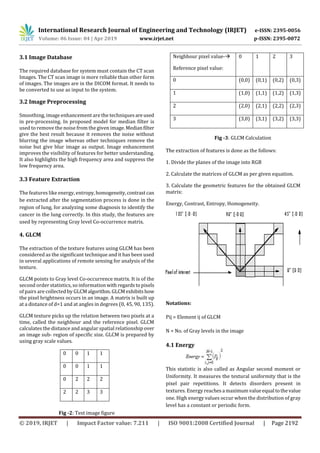
4.2 Entropy
This statistic measures the complexity of an image. The
entropy is large when the image is not texturally uniform
and many of the GLCM elements have very small values.
Complex textures tend to have a high entropy. Entropy is
strongly, but inversely correlated to the energy.
4.3 Contrast
This statistic measures the spatial frequency of an image
which is the difference moment of GLCM. It is the difference
between the highest and the lowest values of a contiguous
set of pixels present in an image.
4.4 Homogeneity
This statistic is also called as the InverseDifferenceMoment.
It measures image homogeneity. It is sensitive to the
presence of near diagonal elements in the GLCM. When all
elements in the image are same it gives maximum value.
GLCM homogeneity and contrast are strongly, but inversely
correlated in terms of equivalent distribution in the pixel
pair population. It means if contrast increases homogeneity
decreases while energy is kept constant.
5. CONCLUSIONS
Lung Cancer is one of the largest occurred disease in the
world. Only early detection of disease may help to decrease
the death rate due to the lung cancer. Image processing
techniques are widely used in some medical areas for image
improvement in earlier detection and treatment stages,
where the time factor is very important to discover the
abnormality issues in target images.
This proposed system is able to detect the cancer in early
stages more correctly. We proposed the methodology to
detect the cancerous lung CT image based on GLCM.
REFERENCES
[1] Mokhled S. AL-TARAWNEH,”Lung Cancer Detection
Using Image Processing Techniques”. Leonardo
Electronic Journal of Practices and Technologies,2012
[2] Ritika Agarwal, Ankit Shankhadhar, Raj Kumar Sagar
,”Detection of Lung Cancer using content based Medical
Image Retrieval ,Fifth International Conference on
Advanced Computing and Communication
Technologies,2015
[3] Khinn Mya Mya Tun ,Feature Extraction and
Classification of Lung Cancer Nodule using Image
ProcessingTechniques,International Journal ofAdvance
Research in Engineering, Science & Technology,2014
[4] Mr. Akshay Bhor, Mr. Aditya Likhar , Mr. Azhar Maner ,
Mr. Aditya Patil, Prof. Dipti Chaudhari , Classification of
lung cancer stages using Quantitative Image and
Genomic Biomarker, International Journal of Advance
Research in Engineering, Science & Technology, 2017
[5] Tanushree Sinha Roy, Neeraj Sirohi, ArtiPatle ,
”Classification of Lung Image and Nodule Detection
Using Fuzzy Inference System,” International
Conference on Computing, Communication and
Automation ,2015](https://image.slidesharecdn.com/irjet-v6i4471-190703063220/85/IRJET-Lung-Cancer-Detection-using-Grey-Level-Co-Occurrence-Matrix-3-320.jpg)

1) The document presents a proposed approach for detecting lung cancer from CT images using image processing and machine learning techniques. It involves preprocessing images, extracting features using grey level co-occurrence matrix (GLCM) and classifying images using support vector machine (SVM). 2) A key step is applying GLCM to extract texture features from lung regions, capturing relationships between pixel pairs. Features like energy, entropy, homogeneity and contrast are calculated from the GLCM matrix. 3) The proposed system aims to automate lung cancer detection from CT images to reduce errors and make the process more accurate and efficient compared to manual detection. This could help detect cancer at earlier stages when treatment outcomes are better.


