International Research Journal of Engineering and Technology (IRJET) e-ISSN: 2395-0056
Volume: 05 Issue: 12 | Dec 2018 www.irjet.net p-ISSN: 2395-0072
© 2018, IRJET | Impact Factor value: 7.211 | ISO 9001:2008 Certified Journal | Page 27
A New Strategy to Detect Lung Cancer on CT Images
Fatema Tuj Johora1, Mehdi Hassan Jony2, Parvin Khatun3
1Lecturer, Department of Computer Science & Engineering, Green University of Bangladesh.
2Research Assistant, School of Computer Science & Technology, Hefei University of Technology, China.
3Junior Officer, Department of Computer Science & Engineering, Green University of Bangladesh
---------------------------------------------------------------------***----------------------------------------------------------------------
Abstract - Lung cancer has a very low level of healing, with
effective detection, the survival of lung cancer can be highly
appreciated. In the early stages, lungcancerdetectionplaysan
important role in human health. Computed tomography (CT)
images, which provide an electronic density of tissues, are
widely applied in radiotherapy planning. Based on CT
technology, the proposed system consists of a few steps like
photo acquisition, preprocessing, feature extraction and
categorization. At the preprocessing stage, RGB images are
converted to grayscale images, used for reducing the Gabor
filter, the Adaptive thresholding method transforms CT scan
images into binary images, and the REGIONPROPS function is
used for the right body, from the binary image to the region.
Feature extraction platforms, such as contrast, correlation,
energy, home genetics, are characterized by a static method
called Gray Level Co-occurrence Matrix (GLCM). In the final
stage, features integrated with Support vector machines
(SVM) and Back Propagation Neural Network (BPNN) are
used to detect lung cancer from CT images. The performance
of the proposed approach shows the accuracy of 96.32%
accuracy in SVM and 83.07% accuracy in BPNN.
Key Words: lung cancer detection; image processing;
adaptive threshold; GLCM; BPNN; SVM
1. INTRODUCTION
WHO has reported (WHO 2018), cancer, accounting for 8.8
million deaths, a leading cause of global death. Compared
with other cancers, such as breast cancer, brain cancer and
prostate cancer, lung cancer, which is responsible for 1.76
million deaths, the highest mortality rates.
The main reason for non-accidental death is cancer. Lung
cancer is one of the most serious human problems in the
world. The death rate of lung disease is the death of all other
types of cancer worldwide in men and women. Studying
cancer at early stages is very difficult. Many PC-aided
systems are designed to detect lung cancer at its premature
stage. Image enhancement and classification can be a great
work, especially when performing the medical field. During
this paper, various strategies for detecting lung cancer
disorders have been discussed and whether it is modest or
deadly. Computer tomography (CT) may be more effective
than X-rays for lung cancer detection and detection.
2. LITERATURE REVIEW
There are many existing strategies for diagnosing lung
cancer, such as computed tomography (CT), chest
radiography (X-rays), magnetic resonance imaging (MRI
scan) and sputum Cyrillic [1] [2]. B. Sahiner et.al., [3] There
are two stages in the paper-printing process. In the first
phase, the sound and film artificial can be removed using the
median filter. In the second stage, the decay structure
material is applied thrice; But each time the structure
decreases the size of one of the components. The unexpected
ribcage part has been removed from the results obtained.
This preprocessing also maintains a tumour, reducing
segmentation problems on. [4] The lung area classifies
extinction methods in two categories, rule-based and pixel-
classified sections. [5] City creates an image processing
algorithm for the detection of lung cancer in images, and
initially, the rate of lung cancer survival rates increased by
14% to 49%. [6] Used in the sense that the algorithm for
image segmentation, in this study,featureswereextractedby
GLCM, and classified by BPNN. [7] To reduce false positive
rates, Computed Tomography (CT) images represent an
automated computer-aided detection(CAD)systemtodetect
a large lung sample from surrounding Chest radiographs.
Artificial intelligent algorithms are considered as powerful
tools for background and categorization [8], such as BPNN
and SVM, these models are generally applied to analysis due
to fast learning advantages, self-adaptations, and strong
tolerance of errors. These features make it possible that
models based on artificial intelligent algorithmscanmeetthe
image processing technology, perform better in cancer
detection [9].
On this paper, we have proposed two models based on SVM
and BPNN, respectively, using it with the features used to
identify lung cancer from city images. In addition, the
strength of these two models has been compared to lung
cancer detection.
3. METHODOLOGY
Focus on the method to obtain a more accurate result. In the
proposed method, it is increasing in contrast to the input
image via the pre-processing method. The first one is done
by converting the input image to a grayscale image. The
images have been corrected with the Gabor filter to enhance
image contrast. Frequency and adaptation presentations of
Gabor filters are similar to human visual systems, and they
have been considered strongly for constructive
representation and discrimination [1].
International Research Journal of Engineering and Technology (IRJET) e-ISSN: 2395-0056
Volume: 05 Issue: 12 | Dec 2018 www.irjet.net p-ISSN: 2395-0072
© 2018, IRJET | Impact Factor value: 7.211 | ISO 9001:2008 Certified Journal | Page 28
In image processing, the division is a more important part,
ideally enhanced images in this section are divided into two
or more sub-segments, which will be easy to represent
images for more elements of the element. Partitioning
objects can be used for recognition, speed, or binding
boundaries between binarysystems.Imagesplittingtargetis
related to clusters of pixels, individual surfaces, objects, or
natural elements of the object in relevant image areas. We
mainly follow a method like a threshold. Feature extraction,
the process of comparing a pixel is to offer this paper. The
first phase of the collection of City images (normal and
unusual) from database found at IMBA Home (Via-LCAP
public access) begins. [1]
Figure 1: Methodology
3.1 Image Acquisition
An image is artificial which limits visual perception, which
usually has an object with a real object or a person's
appearance. The first step of pre-processing consists of the
human lung image to create a visible representationofsome
organs and tissues. There are many medical images
capturing methods such as tactile imaging, magnetic
resonance imaging (MRI), computed tomography (CT),
positron emission tomography (PET), etc. Single-photon
emission math tomography (Spect), etc. theimagescollected
from ELCAP public lung image database which is released
December 20, 2003. The whole-lung dataset consists of 50
CT scans obtained in a single breath hold with a 1.25 mm
slice thickness. DICOM (Digital Imaging and Communication
in Medicine) has become a standard for medical imaging.
The acquired image is in raw form. A lot of noise in the
acquired image is observed. To improve contrast,
transparency, background sound separation, it needs to be
pre-processed. Therefore, different techniques like
enhancement, the required form is developed from images.
3.2 Image Enhancement
The image begins with image enhancement in the pre-
processing phase. The goal of image enhancement is to
provide better input for information about the information
contained in the image ortothemodernizationofknowledge
or other automated image processing techniques for the
human audience. Image enhancement strategies can be
divided into two broad categories: Spatial Domain Method
and Frequency Domain Process [10].
1) Spatial domain techniques- which operate directly on
pixels.
2) Frequency domain techniques- which operate on the
Fourier transform of an image.
Different image enhancement strategies can be identified
as the Spatial Domain Method and Frequency Domain
Process. This includes polishing and light removal, laziness
etc. There are many ways to improve the image, but the
Gabor filter is considered suitable for both CT and MRI
images. In the image enhancement stage, we have used the
following Gabor filter strategies.
Gabor filter: Gabor filter is a linear filter which is defined
by a coherent function multiply by a Gaussian function
replicating the reflection. Due to the quality of the
convoluted property, the transit of the Fourier transit of
Gabor filters is impulse transcript to the Pharmacological
function and Fourier transformation of the Fourier
transformation of Gaussian Function [11]. It basically
analyzes whether there is a concrete frequency content in
the concrete directions of the local region of the area of
analysis or analysis. A set of Gabor filters with different
frequencies and adaptations maybehelpful foranelementof
effective features from an image. Isolated domain, given by
2D Gabor filter,
Gc[i,j]=Be^((i^2+j^2)/(2µ^2))cos(2πf(icosβ+jsinβ))...(1)
Gc[i,j]=Ce^((i^2+j^2)/(2µ^2))sin(2πf(icosβ+jsinβ))…(2)
Where B and C determine the normalization reason. 2-D
Gabor filters are rich in image processing, especially texture
analysis and category features. F definesthefittedfrequency
for the texture. By varying β, we can look for a specific
texture based texture. By varying µ, we support the basis of
the region or size of the image being analyzed.
International Research Journal of Engineering and Technology (IRJET) e-ISSN: 2395-0056
Volume: 05 Issue: 12 | Dec 2018 www.irjet.net p-ISSN: 2395-0072
© 2018, IRJET | Impact Factor value: 7.211 | ISO 9001:2008 Certified Journal | Page 29
Figure 2: Original Image to Gabor Image
3.4 Image Segmentation:
Image segmentation helps make the presentation of such an
image more meaningful and easier to analyze. Image
segmentation objects and borders are allocated. This is the
process of determining the label of pixels per image, such as
labelled pixels sharing specific visual properties [12]. Image
splitting result is a set of segments that covers a set of
contours that are fully taken from the entire image or image.
Each pixel in a region's image is significantly different from
some of the featured or notable properties, such as color,
intensity, or texture, related to similar features. [13] In this
study, we have used the adaptive threshold image
segmentation method:
Adaptive threshold: Adaptive Thresholding usuallytakesa
grayscale or color image as input and, in a simple
implementation, represents a binary image segmentation
output. For each pixel of the image, a threshold has been
calculated. If the pixel value is below thethreshold,itissetto
the background value, otherwise, it estimates the forum
value. In adaptive thresholding, different threshold values
for different local areas are used.
There are two main ways to find threshold: (i) Chow and
Kaneko [14] methods and (ii) Local thresholding. The idea
behind both methods is that the smaller image can have
almost identical illuminations in the region, thus making it
more suitable for thresholding. Chow and Kaneko segment
an image into a row overlapping subcontinent and find out
the best threshold for each sub-continentbyinvestigatingits
histogram. The results of threshold submissions are
separated for every single pixel. The error of this method is
computational and is therefore not suitable for real-time
applications.
Figure 3: Gabor to threshold
3.5 Body Region extraction
In this study, the body area of a lung city image was found
using MATLAB's Image ProcessingToolbox'sREGIONPROPS
function. The binary image of the adaptive threshold was
considered as input on REGIONPROPS, and a decreasing set
of features was selected to describe the binary image. The
selected features were 'Area', 'Boundingbox' and 'Field
Image'. The 'area' was a scalar, indicatingthetotal numberof
pixels in each part of the image. The lower edge of the
'Boundingbox' volume has the coordinate and the minimum
area rectangle in the area with length and width. The
'FilledImage' binary image filling the logical matrix which
was the same size in the same region. After counting three
properties, the indicator related to the area related to the
greater area was obtained, then the minimum encoding
rectangles can be taken to crop the noise-free image and the
area of the body used as a template to extract the fill image.
Figure 4: Threshold to Region Glow
4. Feature Extraction
For extracting feature using the Gray-level co-occurrence
Matrix (GLCM) to represent a set of features to reduces the
misclassification of the glaucoma image. GLCM describes
how many coordinates of pixel brightnessvaluesinanimage
illustration. GLCM represents the combined frequency of all
pairs of gray levels i and j divided by a distance in the
direction of nodules. GLCM Characteristicsofbasiccharacter
areas, perimeter, and Eccentricity this scale is measured in
[15]. The GLCM, proposed by Haralick [20], was utilized as
the main tool for image texture analysis in this study. A
binary representation of the shape object expanded. Size
features refer to the geometric properties of an object, and
the external boundary is used to calculate these
characteristics. The area, perimeter, and circularity are big
features that we count in our method. Extra shape features
can provide powerful informationforthecategoryofimages.
The properties of shape vary for different types of a tumour.
Size is calculated by using the image region attached to the
image. Boundary pixel circumference and area are counted.
The measurement is calculated using the area and the
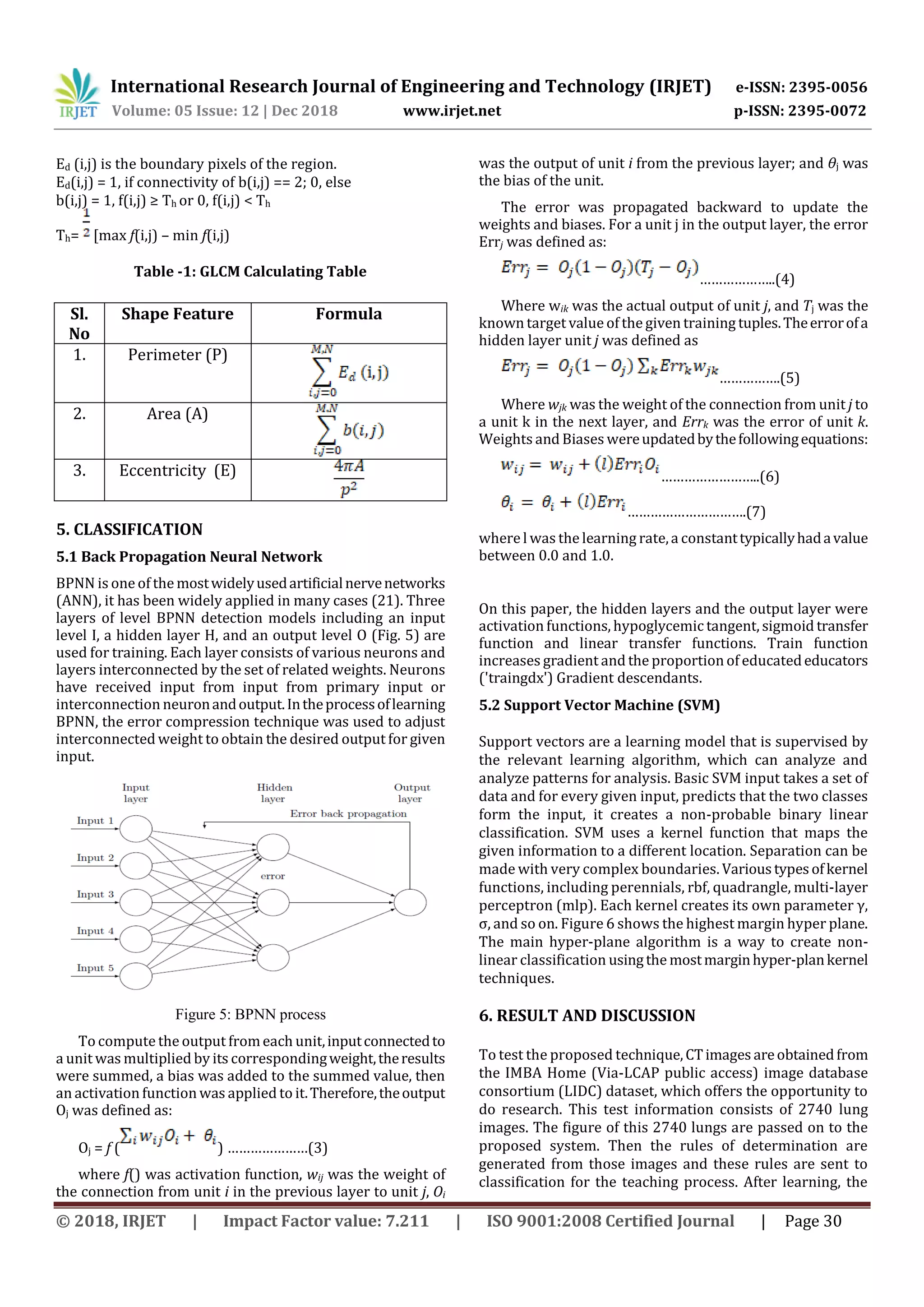
circumference. The formulas used to calculate size features
are given in table 1.
International Research Journal of Engineering and Technology (IRJET) e-ISSN: 2395-0056
Volume: 05 Issue: 12 | Dec 2018 www.irjet.net p-ISSN: 2395-0072
© 2018, IRJET | Impact Factor value: 7.211 | ISO 9001:2008 Certified Journal | Page 30
Ed (i,j) is the boundary pixels of the region.
Ed(i,j) = 1, if connectivity of b(i,j) == 2; 0, else
b(i,j) = 1, f(i,j) ≥ Th or 0, f(i,j) < Th
Th= [max f(i,j) – min f(i,j)
Table -1: GLCM Calculating Table
Sl.
No
Shape Feature Formula
1. Perimeter (P)
2. Area (A)
3. Eccentricity (E)
5. CLASSIFICATION
5.1 Back Propagation Neural Network
BPNN is one of the mostwidelyusedartificialnervenetworks
(ANN), it has been widely applied in many cases (21). Three
layers of level BPNN detection models including an input
level I, a hidden layer H, and an output level O (Fig. 5) are
used for training. Each layer consists of various neurons and
layers interconnected by the set of related weights. Neurons
have received input from input from primary input or
interconnection neuronandoutput.Intheprocessoflearning
BPNN, the error compression technique was used to adjust
interconnected weight to obtain the desired output for given
input.
Figure 5: BPNN process
To compute the output fromeach unit,inputconnectedto
a unit was multiplied by its correspondingweight,theresults
were summed, a bias was added to the summed value, then
an activation function was applied to it.Therefore,theoutput
Oj was defined as:
Oj = f ( ) …………………(3)
where f() was activation function, wij was the weight of
the connection from unit i in the previous layer to unit j, Oi
was the output of unit i from the previous layer; and θj was
the bias of the unit.
The error was propagated backward to update the
weights and biases. For a unit j in the output layer, the error
Errj was defined as:
………………..(4)
Where wik was the actual output of unit j, and Tj was the
known target value of the given training tuples.Theerrorofa
hidden layer unit j was defined as
…………….(5)
Where wjk was the weight of the connection from unit j to
a unit k in the next layer, and Errk was the error of unit k.
Weights and Biases wereupdatedbythefollowingequations:
……………………..(6)
………………………….(7)
where l was the learning rate,a constanttypicallyhadavalue
between 0.0 and 1.0.
On this paper, the hidden layers and the output layer were
activation functions, hypoglycemic tangent, sigmoid transfer
function and linear transfer functions. Train function
increases gradient and the proportion of educatededucators
('traingdx') Gradient descendants.
5.2 Support Vector Machine (SVM)
Support vectors are a learning model that is supervised by
the relevant learning algorithm, which can analyze and
analyze patterns for analysis. Basic SVM input takes a set of
data and for every given input, predicts that the two classes
form the input, it creates a non-probable binary linear
classification. SVM uses a kernel function that maps the
given information to a different location. Separation can be
made with very complex boundaries. Varioustypesofkernel
functions, including perennials, rbf, quadrangle, multi-layer
perceptron (mlp). Each kernel creates its own parameter γ,
σ, and so on. Figure 6 shows the highest margin hyper plane.
The main hyper-plane algorithm is a way to create non-
linear classification usingthe mostmarginhyper-plankernel
techniques.
6. RESULT AND DISCUSSION
To test the proposed technique,CTimages areobtainedfrom
the IMBA Home (Via-LCAP public access) image database
consortium (LIDC) dataset, which offers the opportunity to
do research. This test information consists of 2740 lung
images. The figure of this 2740 lungs are passed on to the
proposed system. Then the rules of determination are
generated from those images and these rules are sent to
classification for the teaching process. After learning, the
International Research Journal of Engineering and Technology (IRJET) e-ISSN: 2395-0056
Volume: 05 Issue: 12 | Dec 2018 www.irjet.net p-ISSN: 2395-0072
© 2018, IRJET | Impact Factor value: 7.211 | ISO 9001:2008 Certified Journal | Page 31
lungs picture is passed on to the proposed system. Then the
proposed procedure will be processed through its
processing steps and finally it will detect whether lung
cancer is cancerous or not. Table 2 listed the performance of
BPNN and SVM models on the prediction set.Itcouldbeseen
that BPNN model has a better performance than SVM model
on identification lung cancer from CT images. BPNN model,
the Accuracy was 96.32%, the Error rate was just 3.68%,the
Sensitivity was 96.71%, and the Specificity was 96.09%.
While for SVM model, the Accuracy was 83.07%, the Error
rate was 16.93%, the Sensitivity was 65.64%, the Specificity
was 92.36%, it suggested that BPNN was more suitable and
effective for lung cancer detection from CT images.
Figure 6: Detected image
Table:2 Performance of BPNN and SVM
Classifier Accuracy Error
rate
Sensitivity Specificity
BPNN 96.32% 3.68% 96.71% 96.71%
SVM 83.07 % 16.93 % 65.64 % 92.36 %
In this study, it was shown that lung cancer can be detected
in early stage of city images using image processing
technology and artificial intelligent algorithms. In our
proposed system, first, the City images were extended to
remove sounds using the Gobo Filter.Second,thepredefined
images are converted into binary images by following the
thresholding method. Thirdly, physical areas are expelled
from binary images (in contrast, correlation, energy and
unity) using GLCM in body areas. Finally, BPNN and SVM,
together with features, are used to establish lung cancer
detection models. The results showed that the BPL model
and SVM model estimates were respectively 96.32% and
83.07% for lung cancer detection at Forecast Set (2740
Figures), it has been decided that the SVM-based model is a
promising tool for recognition of lung cancer at the initial
stage, above The theory proves validation. In the future, we
will apply deeper nerve network tactics to lung cancer
detection problems and look for new systemsfor pulmonary
needle detection.
REFERENCES
[1] M . S. Al-Tarawneh, “Lung cancer detection using image
processing techniques,” Leonardo Electronic Journal of
Practices and Technologies, vol. 11, Jan. 2012, pp. 147-
158.
[2] A. Chaudhary, & S. S. Singh, “Lung Cancer Detection on
CT Images by Using Image Processing,” Proc.
International Conference on Computing Sciences (ICCS
12), IEEE Computer Society, Sep. 2012, pp. 142-146,
doi:10.1109/ICCS.2012.43.
[3] B. Sahiner, H. P. Chan, L. M. Hadjiiski, P. N Cascade, A. R.
Chughtai, C. Poopat, T. Song, L. Frank, J. Stojanovska, A.
Attili, Effect of CAD on radiologists' detection of lung
nodules on thoracic CT scans analysis of an observer
performance study by nodule size: Acad Radiol, vol.16,
no.12, pp.1518-1530, Dec 2009.
[4] V. B. Ginneken, T. B. Romeny, and M. A. Viergever,
“Computeraided diagnosis in chest radiography: a
survey,” IEEE Transactions on Medical Imaging, vol. 20,
Dec. 2001, pp. 1228-1241, doi:10.1109/42.974918.
[5] K. Dimililer, Y. Kirsal-Ever, and B. Ugur, “Tumor
Detection on CT Lung Images using Image
Enhancement,” The Online Journal of Science and
Technology, vol. 7, Jan. 2017, pp. 133-138.
[6] P. B. Sangamithraa, and S. Govindaraju, “Lung tumour
detection and classification using EK-Mean clustering,”
Proc. International Conference on Wireless
Communications, Signal Processing and NETWORKING
(WiSPNET 16), IEEE, Mar. 2016, pp. 2201-2206,
doi:10.1109/WiSPNET.2016.7566533.
[7] M. Mai, A. Karrar, and A. Sharawy, “Computer aided
detection of large lung nodules using chest computer
tomography images,” International Journal of Applied
Information Systems, vol. 3, Aug. 2012, pp. 12-18,
doi:10.5120/ijais12-450560.
[8] C. Lau, Neural networks: theoretical foundations and
analysis, IEEE press, 1991.
[9] C. H. Chen, L. F. Pau, and P. S. P. Wang, “Handbook of
pattern recognition and computer vision,” World
Scientific, vol. 50, 2005, pp. 996, doi:10.1142/1802.
[10] H. Rutika r, “Automated detection and diagnosis from
lungs CT scan images”, International Journal of
Emerging Technologies and Innovative Research
(www.jetir.org — UGC and issn Approved), ISSN:2349-
5162, vol. 2, no. 3, pp. pp785-787, 2015.
[11] S. Avinash, K. Manjunath and S. Kumar, “An improved
image processing analysis for the detection of lung
cancer using Gabor filters and watershed segmentation
technique”, 2016 International ConferenceonInventive
Computation Technologies (ICICT), 2016.
[12] M. Firmino, G. Angelo, H. Morais, M. Dantas and R.
Valentim, “Computer-aided detection (CADe) and
diagnosis (CADx) system for lung cancer withlikelihood
of malignancy”, BioMedical Engineering OnLine, vol.15,
no. 1, 2016.
[13] H. Ren, Y. Zhou and M. Zhu, “Tree Image Segmentation
Based on an Improved Two-Dimensional Otsu
Algorithm”, International Journal of HybridInformation
Technology, vol. 9, no. 9, pp. 199-210, 2016.
[14] C.K.CHow and T.Kaneko. Automatic boundary detection
of the left-ventricle from cineangiograms. Comput.
Biomed., 5:388–410, 1972.
[15] M. H. Jony, “Early Detection of LungCancerfromCTScan
Images Using GLCM and SVM”ProceedingsoftheIEEyet
to published.
[16] R. M. Haralick, “Statistical and structural approaches to
texture,” Proceedings of the IEEE, vol. 67, May. 1979, pp.
786-804, doi:10.1109/PROC.1979.11328.
7. CONCLUSION
International Research Journal of Engineering and Technology (IRJET) e-ISSN: 2395-0056
Volume: 05 Issue: 12 | Dec 2018 www.irjet.net p-ISSN: 2395-0072
© 2018, IRJET | Impact Factor value: 7.211 | ISO 9001:2008 Certified Journal | Page 32
[17] Penedo. M. G, Carreira. M. J, Mosquera. A and Cabello. D,
“Computeraided diagnosis: a neuralnetwork- based
approach to lung nodule detection”, IEEE Transactions
on Medical Imaging, vol: 17, pp: 872 – 880, 1998.
BIOGRAPHIES
Fatema Tuj Johora, received her
B.Sc. degree from Green University
of Bangladesh, in 2017. She is
currently a contractual Lecturer of
Computer Science & Engineering
Department in Green University of
Bangladesh. Her researchinterests
include privacy and security in
cloud database.
Mehdi Hassan Jony received his
B.S. degree from Green University
of Bangladesh, in 2017. He is
currently pursuing the M.S. degree
in information security from Hefei
University of Technology, China.
His research interests include
privacy and security in database.
Parvin Khatun, received her B.Sc.
degree from Green University of
Bangladesh, in 2017. She is
currently a junior lecturer of
Computer Science & Engineering
Department in Green University of
Bangladesh. Her researchinterests
include privacy and security in
cloud database.

IRJET- A New Strategy to Detect Lung Cancer on CT Images

  • 1.
    International Research Journalof Engineering and Technology (IRJET) e-ISSN: 2395-0056 Volume: 05 Issue: 12 | Dec 2018 www.irjet.net p-ISSN: 2395-0072 © 2018, IRJET | Impact Factor value: 7.211 | ISO 9001:2008 Certified Journal | Page 27 A New Strategy to Detect Lung Cancer on CT Images Fatema Tuj Johora1, Mehdi Hassan Jony2, Parvin Khatun3 1Lecturer, Department of Computer Science & Engineering, Green University of Bangladesh. 2Research Assistant, School of Computer Science & Technology, Hefei University of Technology, China. 3Junior Officer, Department of Computer Science & Engineering, Green University of Bangladesh ---------------------------------------------------------------------***---------------------------------------------------------------------- Abstract - Lung cancer has a very low level of healing, with effective detection, the survival of lung cancer can be highly appreciated. In the early stages, lungcancerdetectionplaysan important role in human health. Computed tomography (CT) images, which provide an electronic density of tissues, are widely applied in radiotherapy planning. Based on CT technology, the proposed system consists of a few steps like photo acquisition, preprocessing, feature extraction and categorization. At the preprocessing stage, RGB images are converted to grayscale images, used for reducing the Gabor filter, the Adaptive thresholding method transforms CT scan images into binary images, and the REGIONPROPS function is used for the right body, from the binary image to the region. Feature extraction platforms, such as contrast, correlation, energy, home genetics, are characterized by a static method called Gray Level Co-occurrence Matrix (GLCM). In the final stage, features integrated with Support vector machines (SVM) and Back Propagation Neural Network (BPNN) are used to detect lung cancer from CT images. The performance of the proposed approach shows the accuracy of 96.32% accuracy in SVM and 83.07% accuracy in BPNN. Key Words: lung cancer detection; image processing; adaptive threshold; GLCM; BPNN; SVM 1. INTRODUCTION WHO has reported (WHO 2018), cancer, accounting for 8.8 million deaths, a leading cause of global death. Compared with other cancers, such as breast cancer, brain cancer and prostate cancer, lung cancer, which is responsible for 1.76 million deaths, the highest mortality rates. The main reason for non-accidental death is cancer. Lung cancer is one of the most serious human problems in the world. The death rate of lung disease is the death of all other types of cancer worldwide in men and women. Studying cancer at early stages is very difficult. Many PC-aided systems are designed to detect lung cancer at its premature stage. Image enhancement and classification can be a great work, especially when performing the medical field. During this paper, various strategies for detecting lung cancer disorders have been discussed and whether it is modest or deadly. Computer tomography (CT) may be more effective than X-rays for lung cancer detection and detection. 2. LITERATURE REVIEW There are many existing strategies for diagnosing lung cancer, such as computed tomography (CT), chest radiography (X-rays), magnetic resonance imaging (MRI scan) and sputum Cyrillic [1] [2]. B. Sahiner et.al., [3] There are two stages in the paper-printing process. In the first phase, the sound and film artificial can be removed using the median filter. In the second stage, the decay structure material is applied thrice; But each time the structure decreases the size of one of the components. The unexpected ribcage part has been removed from the results obtained. This preprocessing also maintains a tumour, reducing segmentation problems on. [4] The lung area classifies extinction methods in two categories, rule-based and pixel- classified sections. [5] City creates an image processing algorithm for the detection of lung cancer in images, and initially, the rate of lung cancer survival rates increased by 14% to 49%. [6] Used in the sense that the algorithm for image segmentation, in this study,featureswereextractedby GLCM, and classified by BPNN. [7] To reduce false positive rates, Computed Tomography (CT) images represent an automated computer-aided detection(CAD)systemtodetect a large lung sample from surrounding Chest radiographs. Artificial intelligent algorithms are considered as powerful tools for background and categorization [8], such as BPNN and SVM, these models are generally applied to analysis due to fast learning advantages, self-adaptations, and strong tolerance of errors. These features make it possible that models based on artificial intelligent algorithmscanmeetthe image processing technology, perform better in cancer detection [9]. On this paper, we have proposed two models based on SVM and BPNN, respectively, using it with the features used to identify lung cancer from city images. In addition, the strength of these two models has been compared to lung cancer detection. 3. METHODOLOGY Focus on the method to obtain a more accurate result. In the proposed method, it is increasing in contrast to the input image via the pre-processing method. The first one is done by converting the input image to a grayscale image. The images have been corrected with the Gabor filter to enhance image contrast. Frequency and adaptation presentations of Gabor filters are similar to human visual systems, and they have been considered strongly for constructive representation and discrimination [1].
  • 2.
    International Research Journalof Engineering and Technology (IRJET) e-ISSN: 2395-0056 Volume: 05 Issue: 12 | Dec 2018 www.irjet.net p-ISSN: 2395-0072 © 2018, IRJET | Impact Factor value: 7.211 | ISO 9001:2008 Certified Journal | Page 28 In image processing, the division is a more important part, ideally enhanced images in this section are divided into two or more sub-segments, which will be easy to represent images for more elements of the element. Partitioning objects can be used for recognition, speed, or binding boundaries between binarysystems.Imagesplittingtargetis related to clusters of pixels, individual surfaces, objects, or natural elements of the object in relevant image areas. We mainly follow a method like a threshold. Feature extraction, the process of comparing a pixel is to offer this paper. The first phase of the collection of City images (normal and unusual) from database found at IMBA Home (Via-LCAP public access) begins. [1] Figure 1: Methodology 3.1 Image Acquisition An image is artificial which limits visual perception, which usually has an object with a real object or a person's appearance. The first step of pre-processing consists of the human lung image to create a visible representationofsome organs and tissues. There are many medical images capturing methods such as tactile imaging, magnetic resonance imaging (MRI), computed tomography (CT), positron emission tomography (PET), etc. Single-photon emission math tomography (Spect), etc. theimagescollected from ELCAP public lung image database which is released December 20, 2003. The whole-lung dataset consists of 50 CT scans obtained in a single breath hold with a 1.25 mm slice thickness. DICOM (Digital Imaging and Communication in Medicine) has become a standard for medical imaging. The acquired image is in raw form. A lot of noise in the acquired image is observed. To improve contrast, transparency, background sound separation, it needs to be pre-processed. Therefore, different techniques like enhancement, the required form is developed from images. 3.2 Image Enhancement The image begins with image enhancement in the pre- processing phase. The goal of image enhancement is to provide better input for information about the information contained in the image ortothemodernizationofknowledge or other automated image processing techniques for the human audience. Image enhancement strategies can be divided into two broad categories: Spatial Domain Method and Frequency Domain Process [10]. 1) Spatial domain techniques- which operate directly on pixels. 2) Frequency domain techniques- which operate on the Fourier transform of an image. Different image enhancement strategies can be identified as the Spatial Domain Method and Frequency Domain Process. This includes polishing and light removal, laziness etc. There are many ways to improve the image, but the Gabor filter is considered suitable for both CT and MRI images. In the image enhancement stage, we have used the following Gabor filter strategies. Gabor filter: Gabor filter is a linear filter which is defined by a coherent function multiply by a Gaussian function replicating the reflection. Due to the quality of the convoluted property, the transit of the Fourier transit of Gabor filters is impulse transcript to the Pharmacological function and Fourier transformation of the Fourier transformation of Gaussian Function [11]. It basically analyzes whether there is a concrete frequency content in the concrete directions of the local region of the area of analysis or analysis. A set of Gabor filters with different frequencies and adaptations maybehelpful foranelementof effective features from an image. Isolated domain, given by 2D Gabor filter, Gc[i,j]=Be^((i^2+j^2)/(2µ^2))cos(2πf(icosβ+jsinβ))...(1) Gc[i,j]=Ce^((i^2+j^2)/(2µ^2))sin(2πf(icosβ+jsinβ))…(2) Where B and C determine the normalization reason. 2-D Gabor filters are rich in image processing, especially texture analysis and category features. F definesthefittedfrequency for the texture. By varying β, we can look for a specific texture based texture. By varying µ, we support the basis of the region or size of the image being analyzed.
  • 3.
    International Research Journalof Engineering and Technology (IRJET) e-ISSN: 2395-0056 Volume: 05 Issue: 12 | Dec 2018 www.irjet.net p-ISSN: 2395-0072 © 2018, IRJET | Impact Factor value: 7.211 | ISO 9001:2008 Certified Journal | Page 29 Figure 2: Original Image to Gabor Image 3.4 Image Segmentation: Image segmentation helps make the presentation of such an image more meaningful and easier to analyze. Image segmentation objects and borders are allocated. This is the process of determining the label of pixels per image, such as labelled pixels sharing specific visual properties [12]. Image splitting result is a set of segments that covers a set of contours that are fully taken from the entire image or image. Each pixel in a region's image is significantly different from some of the featured or notable properties, such as color, intensity, or texture, related to similar features. [13] In this study, we have used the adaptive threshold image segmentation method: Adaptive threshold: Adaptive Thresholding usuallytakesa grayscale or color image as input and, in a simple implementation, represents a binary image segmentation output. For each pixel of the image, a threshold has been calculated. If the pixel value is below thethreshold,itissetto the background value, otherwise, it estimates the forum value. In adaptive thresholding, different threshold values for different local areas are used. There are two main ways to find threshold: (i) Chow and Kaneko [14] methods and (ii) Local thresholding. The idea behind both methods is that the smaller image can have almost identical illuminations in the region, thus making it more suitable for thresholding. Chow and Kaneko segment an image into a row overlapping subcontinent and find out the best threshold for each sub-continentbyinvestigatingits histogram. The results of threshold submissions are separated for every single pixel. The error of this method is computational and is therefore not suitable for real-time applications. Figure 3: Gabor to threshold 3.5 Body Region extraction In this study, the body area of a lung city image was found using MATLAB's Image ProcessingToolbox'sREGIONPROPS function. The binary image of the adaptive threshold was considered as input on REGIONPROPS, and a decreasing set of features was selected to describe the binary image. The selected features were 'Area', 'Boundingbox' and 'Field Image'. The 'area' was a scalar, indicatingthetotal numberof pixels in each part of the image. The lower edge of the 'Boundingbox' volume has the coordinate and the minimum area rectangle in the area with length and width. The 'FilledImage' binary image filling the logical matrix which was the same size in the same region. After counting three properties, the indicator related to the area related to the greater area was obtained, then the minimum encoding rectangles can be taken to crop the noise-free image and the area of the body used as a template to extract the fill image. Figure 4: Threshold to Region Glow 4. Feature Extraction For extracting feature using the Gray-level co-occurrence Matrix (GLCM) to represent a set of features to reduces the misclassification of the glaucoma image. GLCM describes how many coordinates of pixel brightnessvaluesinanimage illustration. GLCM represents the combined frequency of all pairs of gray levels i and j divided by a distance in the direction of nodules. GLCM Characteristicsofbasiccharacter areas, perimeter, and Eccentricity this scale is measured in [15]. The GLCM, proposed by Haralick [20], was utilized as the main tool for image texture analysis in this study. A binary representation of the shape object expanded. Size features refer to the geometric properties of an object, and the external boundary is used to calculate these characteristics. The area, perimeter, and circularity are big features that we count in our method. Extra shape features can provide powerful informationforthecategoryofimages. The properties of shape vary for different types of a tumour. Size is calculated by using the image region attached to the image. Boundary pixel circumference and area are counted. The measurement is calculated using the area and the circumference. The formulas used to calculate size features are given in table 1.
  • 4.
    International Research Journalof Engineering and Technology (IRJET) e-ISSN: 2395-0056 Volume: 05 Issue: 12 | Dec 2018 www.irjet.net p-ISSN: 2395-0072 © 2018, IRJET | Impact Factor value: 7.211 | ISO 9001:2008 Certified Journal | Page 30 Ed (i,j) is the boundary pixels of the region. Ed(i,j) = 1, if connectivity of b(i,j) == 2; 0, else b(i,j) = 1, f(i,j) ≥ Th or 0, f(i,j) < Th Th= [max f(i,j) – min f(i,j) Table -1: GLCM Calculating Table Sl. No Shape Feature Formula 1. Perimeter (P) 2. Area (A) 3. Eccentricity (E) 5. CLASSIFICATION 5.1 Back Propagation Neural Network BPNN is one of the mostwidelyusedartificialnervenetworks (ANN), it has been widely applied in many cases (21). Three layers of level BPNN detection models including an input level I, a hidden layer H, and an output level O (Fig. 5) are used for training. Each layer consists of various neurons and layers interconnected by the set of related weights. Neurons have received input from input from primary input or interconnection neuronandoutput.Intheprocessoflearning BPNN, the error compression technique was used to adjust interconnected weight to obtain the desired output for given input. Figure 5: BPNN process To compute the output fromeach unit,inputconnectedto a unit was multiplied by its correspondingweight,theresults were summed, a bias was added to the summed value, then an activation function was applied to it.Therefore,theoutput Oj was defined as: Oj = f ( ) …………………(3) where f() was activation function, wij was the weight of the connection from unit i in the previous layer to unit j, Oi was the output of unit i from the previous layer; and θj was the bias of the unit. The error was propagated backward to update the weights and biases. For a unit j in the output layer, the error Errj was defined as: ………………..(4) Where wik was the actual output of unit j, and Tj was the known target value of the given training tuples.Theerrorofa hidden layer unit j was defined as …………….(5) Where wjk was the weight of the connection from unit j to a unit k in the next layer, and Errk was the error of unit k. Weights and Biases wereupdatedbythefollowingequations: ……………………..(6) ………………………….(7) where l was the learning rate,a constanttypicallyhadavalue between 0.0 and 1.0. On this paper, the hidden layers and the output layer were activation functions, hypoglycemic tangent, sigmoid transfer function and linear transfer functions. Train function increases gradient and the proportion of educatededucators ('traingdx') Gradient descendants. 5.2 Support Vector Machine (SVM) Support vectors are a learning model that is supervised by the relevant learning algorithm, which can analyze and analyze patterns for analysis. Basic SVM input takes a set of data and for every given input, predicts that the two classes form the input, it creates a non-probable binary linear classification. SVM uses a kernel function that maps the given information to a different location. Separation can be made with very complex boundaries. Varioustypesofkernel functions, including perennials, rbf, quadrangle, multi-layer perceptron (mlp). Each kernel creates its own parameter γ, σ, and so on. Figure 6 shows the highest margin hyper plane. The main hyper-plane algorithm is a way to create non- linear classification usingthe mostmarginhyper-plankernel techniques. 6. RESULT AND DISCUSSION To test the proposed technique,CTimages areobtainedfrom the IMBA Home (Via-LCAP public access) image database consortium (LIDC) dataset, which offers the opportunity to do research. This test information consists of 2740 lung images. The figure of this 2740 lungs are passed on to the proposed system. Then the rules of determination are generated from those images and these rules are sent to classification for the teaching process. After learning, the
  • 5.
    International Research Journalof Engineering and Technology (IRJET) e-ISSN: 2395-0056 Volume: 05 Issue: 12 | Dec 2018 www.irjet.net p-ISSN: 2395-0072 © 2018, IRJET | Impact Factor value: 7.211 | ISO 9001:2008 Certified Journal | Page 31 lungs picture is passed on to the proposed system. Then the proposed procedure will be processed through its processing steps and finally it will detect whether lung cancer is cancerous or not. Table 2 listed the performance of BPNN and SVM models on the prediction set.Itcouldbeseen that BPNN model has a better performance than SVM model on identification lung cancer from CT images. BPNN model, the Accuracy was 96.32%, the Error rate was just 3.68%,the Sensitivity was 96.71%, and the Specificity was 96.09%. While for SVM model, the Accuracy was 83.07%, the Error rate was 16.93%, the Sensitivity was 65.64%, the Specificity was 92.36%, it suggested that BPNN was more suitable and effective for lung cancer detection from CT images. Figure 6: Detected image Table:2 Performance of BPNN and SVM Classifier Accuracy Error rate Sensitivity Specificity BPNN 96.32% 3.68% 96.71% 96.71% SVM 83.07 % 16.93 % 65.64 % 92.36 % In this study, it was shown that lung cancer can be detected in early stage of city images using image processing technology and artificial intelligent algorithms. In our proposed system, first, the City images were extended to remove sounds using the Gobo Filter.Second,thepredefined images are converted into binary images by following the thresholding method. Thirdly, physical areas are expelled from binary images (in contrast, correlation, energy and unity) using GLCM in body areas. Finally, BPNN and SVM, together with features, are used to establish lung cancer detection models. The results showed that the BPL model and SVM model estimates were respectively 96.32% and 83.07% for lung cancer detection at Forecast Set (2740 Figures), it has been decided that the SVM-based model is a promising tool for recognition of lung cancer at the initial stage, above The theory proves validation. In the future, we will apply deeper nerve network tactics to lung cancer detection problems and look for new systemsfor pulmonary needle detection. REFERENCES [1] M . S. Al-Tarawneh, “Lung cancer detection using image processing techniques,” Leonardo Electronic Journal of Practices and Technologies, vol. 11, Jan. 2012, pp. 147- 158. [2] A. Chaudhary, & S. S. Singh, “Lung Cancer Detection on CT Images by Using Image Processing,” Proc. International Conference on Computing Sciences (ICCS 12), IEEE Computer Society, Sep. 2012, pp. 142-146, doi:10.1109/ICCS.2012.43. [3] B. Sahiner, H. P. Chan, L. M. Hadjiiski, P. N Cascade, A. R. Chughtai, C. Poopat, T. Song, L. Frank, J. Stojanovska, A. Attili, Effect of CAD on radiologists' detection of lung nodules on thoracic CT scans analysis of an observer performance study by nodule size: Acad Radiol, vol.16, no.12, pp.1518-1530, Dec 2009. [4] V. B. Ginneken, T. B. Romeny, and M. A. Viergever, “Computeraided diagnosis in chest radiography: a survey,” IEEE Transactions on Medical Imaging, vol. 20, Dec. 2001, pp. 1228-1241, doi:10.1109/42.974918. [5] K. Dimililer, Y. Kirsal-Ever, and B. Ugur, “Tumor Detection on CT Lung Images using Image Enhancement,” The Online Journal of Science and Technology, vol. 7, Jan. 2017, pp. 133-138. [6] P. B. Sangamithraa, and S. Govindaraju, “Lung tumour detection and classification using EK-Mean clustering,” Proc. International Conference on Wireless Communications, Signal Processing and NETWORKING (WiSPNET 16), IEEE, Mar. 2016, pp. 2201-2206, doi:10.1109/WiSPNET.2016.7566533. [7] M. Mai, A. Karrar, and A. Sharawy, “Computer aided detection of large lung nodules using chest computer tomography images,” International Journal of Applied Information Systems, vol. 3, Aug. 2012, pp. 12-18, doi:10.5120/ijais12-450560. [8] C. Lau, Neural networks: theoretical foundations and analysis, IEEE press, 1991. [9] C. H. Chen, L. F. Pau, and P. S. P. Wang, “Handbook of pattern recognition and computer vision,” World Scientific, vol. 50, 2005, pp. 996, doi:10.1142/1802. [10] H. Rutika r, “Automated detection and diagnosis from lungs CT scan images”, International Journal of Emerging Technologies and Innovative Research (www.jetir.org — UGC and issn Approved), ISSN:2349- 5162, vol. 2, no. 3, pp. pp785-787, 2015. [11] S. Avinash, K. Manjunath and S. Kumar, “An improved image processing analysis for the detection of lung cancer using Gabor filters and watershed segmentation technique”, 2016 International ConferenceonInventive Computation Technologies (ICICT), 2016. [12] M. Firmino, G. Angelo, H. Morais, M. Dantas and R. Valentim, “Computer-aided detection (CADe) and diagnosis (CADx) system for lung cancer withlikelihood of malignancy”, BioMedical Engineering OnLine, vol.15, no. 1, 2016. [13] H. Ren, Y. Zhou and M. Zhu, “Tree Image Segmentation Based on an Improved Two-Dimensional Otsu Algorithm”, International Journal of HybridInformation Technology, vol. 9, no. 9, pp. 199-210, 2016. [14] C.K.CHow and T.Kaneko. Automatic boundary detection of the left-ventricle from cineangiograms. Comput. Biomed., 5:388–410, 1972. [15] M. H. Jony, “Early Detection of LungCancerfromCTScan Images Using GLCM and SVM”ProceedingsoftheIEEyet to published. [16] R. M. Haralick, “Statistical and structural approaches to texture,” Proceedings of the IEEE, vol. 67, May. 1979, pp. 786-804, doi:10.1109/PROC.1979.11328. 7. CONCLUSION
  • 6.
    International Research Journalof Engineering and Technology (IRJET) e-ISSN: 2395-0056 Volume: 05 Issue: 12 | Dec 2018 www.irjet.net p-ISSN: 2395-0072 © 2018, IRJET | Impact Factor value: 7.211 | ISO 9001:2008 Certified Journal | Page 32 [17] Penedo. M. G, Carreira. M. J, Mosquera. A and Cabello. D, “Computeraided diagnosis: a neuralnetwork- based approach to lung nodule detection”, IEEE Transactions on Medical Imaging, vol: 17, pp: 872 – 880, 1998. BIOGRAPHIES Fatema Tuj Johora, received her B.Sc. degree from Green University of Bangladesh, in 2017. She is currently a contractual Lecturer of Computer Science & Engineering Department in Green University of Bangladesh. Her researchinterests include privacy and security in cloud database. Mehdi Hassan Jony received his B.S. degree from Green University of Bangladesh, in 2017. He is currently pursuing the M.S. degree in information security from Hefei University of Technology, China. His research interests include privacy and security in database. Parvin Khatun, received her B.Sc. degree from Green University of Bangladesh, in 2017. She is currently a junior lecturer of Computer Science & Engineering Department in Green University of Bangladesh. Her researchinterests include privacy and security in cloud database.