


Yogesh Mhadgut
M.Sc. Part – 1
Roll No:075
Analytical chemistry
Ruparel College
INTRODUCTION:
 Infrared spectroscopy, involves the interaction of Infrared radiation with matter.
 It is mostly based on vibrational excitation of molecule.
 The IR spectroscopic techniques used to identify and study chemicals.
 The samples may be :
 Solid
 Liquid
 gas
 The Infrared technique of Infrared spectroscopy is conducted with an instrument
called as an Infrared spectrometers to produce Infrared spectrum.
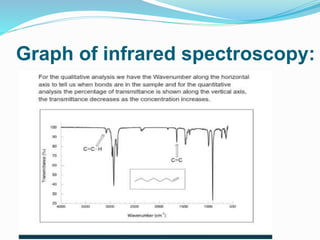
 An IR spectrum can be visualized in a graph of Infrared light absorbance on the
vertical axis vs frequency or wavelength on the horizontal axis.
 A common laboratory instrument that used this technique is a Fourier transform IR
spectrometers. (FTIR)
PRINCIPLE:
Infrared spectroscopy based on vibrational excitation of the molecule . A
molecule is not a rigid attachment of atoms .The bonds are flexible .Hence
the atoms of a molecule vibrate in different ways.A molecule has 2 types of
fundamental vibrations.
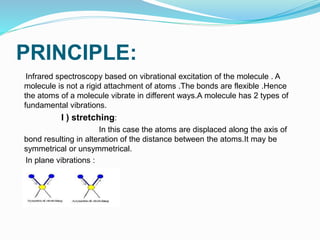
I ) stretching:
In this case the atoms are displaced along the axis of
bond resulting in alteration of the distance between the atoms.It may be
symmetrical or unsymmetrical.
In plane vibrations :
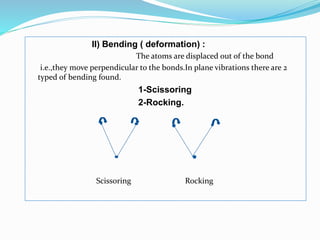
II) Bending ( deformation) :
The atoms are displaced out of the bond
i.e.,they move perpendicular to the bonds.In plane vibrations there are 2
typed of bending found.
1-Scissoring
2-Rocking.
Scissoring Rocking
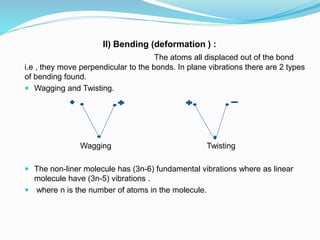
II) Bending (deformation ) :
The atoms all displaced out of the bond
i.e , they move perpendicular to the bonds. In plane vibrations there are 2 types
of bending found.
 Wagging and Twisting.
Wagging Twisting
 The non-liner molecule has (3n-6) fundamental vibrations where as linear
molecule have (3n-5) vibrations .
 where n is the number of atoms in the molecule.
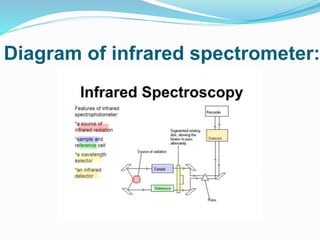
Diagram of infrared spectrometer:
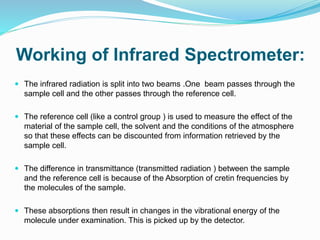
Working of Infrared Spectrometer:
 The infrared radiation is split into two beams .One beam passes through the
sample cell and the other passes through the reference cell.
 The reference cell (like a control group ) is used to measure the effect of the
material of the sample cell, the solvent and the conditions of the atmosphere
so that these effects can be discounted from information retrieved by the
sample cell.
 The difference in transmittance (transmitted radiation ) between the sample
and the reference cell is because of the Absorption of cretin frequencies by
the molecules of the sample.
 These absorptions then result in changes in the vibrational energy of the
molecule under examination. This is picked up by the detector.
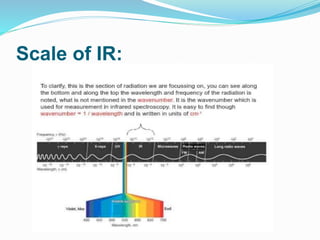
Scale of IR:
Graph of infrared spectroscopy:
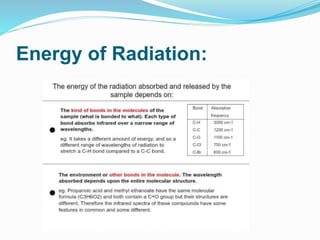
Energy of Radiation:
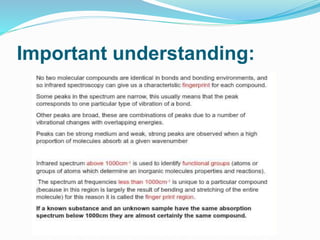
Important understanding:
Usefulness and Suitability:
Advantage and Disadvantage:
Bibliography:
 http://chemwiki.ucdavis.edu/Analytical_Chemistry/Analytical_Chemistry_
With_a_Biological_Emphasis/Chapter_4%3A_Structure_Determination_I/
Section_4.2%/3A_Infrared_spectroscopy.
THANK
YOU

Ir absorption spectroscopy

  • 1.
    Yogesh Mhadgut M.Sc. Part– 1 Roll No:075 Analytical chemistry Ruparel College
  • 2.
    INTRODUCTION:  Infrared spectroscopy,involves the interaction of Infrared radiation with matter.  It is mostly based on vibrational excitation of molecule.  The IR spectroscopic techniques used to identify and study chemicals.  The samples may be :  Solid  Liquid  gas  The Infrared technique of Infrared spectroscopy is conducted with an instrument called as an Infrared spectrometers to produce Infrared spectrum.  An IR spectrum can be visualized in a graph of Infrared light absorbance on the vertical axis vs frequency or wavelength on the horizontal axis.  A common laboratory instrument that used this technique is a Fourier transform IR spectrometers. (FTIR)
  • 3.
    PRINCIPLE: Infrared spectroscopy basedon vibrational excitation of the molecule . A molecule is not a rigid attachment of atoms .The bonds are flexible .Hence the atoms of a molecule vibrate in different ways.A molecule has 2 types of fundamental vibrations. I ) stretching: In this case the atoms are displaced along the axis of bond resulting in alteration of the distance between the atoms.It may be symmetrical or unsymmetrical. In plane vibrations :
  • 4.
    II) Bending (deformation) : The atoms are displaced out of the bond i.e.,they move perpendicular to the bonds.In plane vibrations there are 2 typed of bending found. 1-Scissoring 2-Rocking. Scissoring Rocking
  • 5.
    II) Bending (deformation) : The atoms all displaced out of the bond i.e , they move perpendicular to the bonds. In plane vibrations there are 2 types of bending found.  Wagging and Twisting. Wagging Twisting  The non-liner molecule has (3n-6) fundamental vibrations where as linear molecule have (3n-5) vibrations .  where n is the number of atoms in the molecule.
  • 6.
    Diagram of infraredspectrometer:
  • 7.
    Working of InfraredSpectrometer:  The infrared radiation is split into two beams .One beam passes through the sample cell and the other passes through the reference cell.  The reference cell (like a control group ) is used to measure the effect of the material of the sample cell, the solvent and the conditions of the atmosphere so that these effects can be discounted from information retrieved by the sample cell.  The difference in transmittance (transmitted radiation ) between the sample and the reference cell is because of the Absorption of cretin frequencies by the molecules of the sample.  These absorptions then result in changes in the vibrational energy of the molecule under examination. This is picked up by the detector.
  • 8.
  • 9.
    Graph of infraredspectroscopy:
  • 10.
  • 11.
  • 12.
  • 13.
  • 14.
  • 15.

Editor's Notes