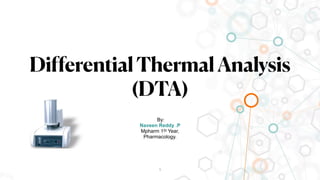
DifferentialThermalAnalysis
(DTA)
By:
Naveen Reddy .P
Mpharm 1St Year,
Pharmacology.
1
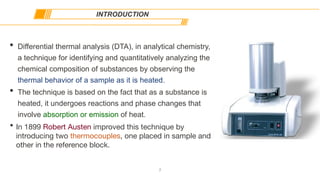
• Differential thermal analysis (DTA), in analytical chemistry,
a technique for identifying and quantitatively analyzing the
chemical composition of substances by observing the
thermal behavior of a sample as it is heated.
• The technique is based on the fact that as a substance is
heated, it undergoes reactions and phase changes that
involve absorption or emission of heat.
• In 1899 Robert Austen improved this technique by
introducing two thermocouples, one placed in sample and
other in the reference block.
INTRODUCTION
2
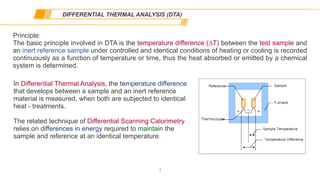
Principle:
The basic principle involved in DTA is the temperature difference (∆T) between the test sample and
an inert reference sample under controlled and identical conditions of heating or cooling is recorded
continuously as a function of temperature or time, thus the heat absorbed or emitted by a chemical
system is determined.
In Differential Thermal Analysis, the temperature difference
that develops between a sample and an inert reference
material is measured, when both are subjected to identical
heat - treatments.
The related technique of Differential Scanning Calorimetry
relies on differences in energy required to maintain the
sample and reference at an identical temperature.
DIFFERENTIAL THERMAL ANALYSIS (DTA)
3
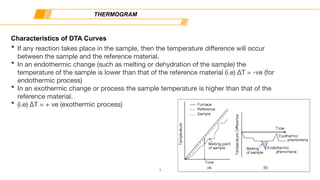
Characteristics of DTA Curves
• If any reaction takes place in the sample, then the temperature difference will occur
between the sample and the reference material. 

• In an endothermic change (such as melting or dehydration of the sample) the
temperature of the sample is lower than that of the reference material (i.e) ∆T = -ve (for
endothermic process)

• In an exothermic change or process the sample temperature is higher than that of the
reference material. 

• (i.e) ∆T = + ve (exothermic process)
THERMOGRAM
4
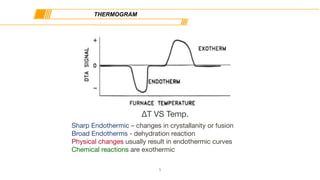
Sharp Endothermic – changes in crystallanity or fusion

Broad Endotherms - dehydration reaction 

Physical changes usually result in endothermic curves

Chemical reactions are exothermic
∆T VS Temp.
THERMOGRAM
5
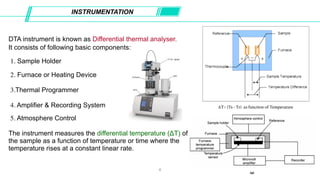
INSTRUMENTATION
DTA instrument is known as Differential thermal analyser.
It consists of following basic components:
1. Sample Holder
2. Furnace or Heating Device
3.Thermal Programmer
4. Amplifier & Recording System
5. Atmosphere Control
The instrument measures the differential temperature (ΔT) of
the sample as a function of temperature or time where the
temperature rises at a constant linear rate.
ΔT= (Ts - Tr) as function of Temperature
6
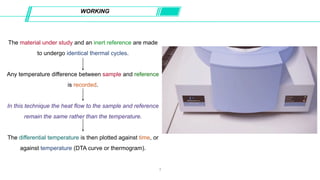
The material under study and an inert reference are made
to undergo identical thermal cycles.
Any temperature difference between sample and reference
is recorded.
In this technique the heat flow to the sample and reference
remain the same rather than the temperature.
The differential temperature is then plotted against time, or
against temperature (DTA curve or thermogram).
WORKING
7
8
1. Source of Uniform heating:
• Nichrome (nickel and chromium alloy) furnace can be used up to 1300 °C,
• Platinum and its alloys up to 1750 °C and
• Molybdenum (Mo) for higher range up to 2000 °C.
2. Specimen Holder
• It is designed to accommodate small quantity of material and to give maximum thermal effect.
• It can be of Pt, Ni, stainless steel, Ag and alloy.
• Ceramic materials: sintered alumina , silica.
• Reference material like (α-alumina).
3. Temperature regulating System:
• Uniform rate of heating of the furnace is ensured through Electronic Temperature Regulators.
INSTRUMENTATION
9
4. Measurement of Temperature
• Rare metal alloy Pt- Rh (Pt 10 - Rh 13%) used as thermocouple for measuring the
temperature.
• For higher temperature up to 2000 0C W-Mo thermocouple may also be used.
5. Temperature Recording System
• Galvanometric observation, used only for few samples.
• Automatic pen and ink electronic recorder found to be more convenient.
INSTRUMENTATION
10
Factors affecting DTA curves:
DTA is a dynamic temperature technique. Therefore, a large number of factors can affect the
resulting experimental curves. Similar to TGA curves, these factors can be divided into the two
groups:
i) Sample factors, and
ii) Instrumental factors
The Instrumental factors
• Size and shape of sample holder,
• Sample holder material,
• Heating rate of the sample,
• Sensitivity of recording system,
• Location of thermocouple in the sample and atmosphere around sample.
Most of these factors are associated with instrumental design. We have very little control on these
factors.
FACTORS AFFECTING
11
Sample characteristics
• Amount of sample,
- Peak area of DTA Curve is proportional to the mass of the sample.
- mg of powdered solid sample is used.
• Particle size,
- sample should have similar particle size.
• Packing density,
- Packing density of sample influences the shape of DTA Curve.
• Degree of crystallinity,
• Diluents used (inert material)
• Swelling and shrinkage of the sample.
FACTORS AFFECTING
12
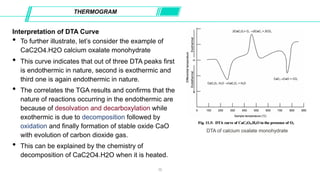
Interpretation of DTA Curve
• To further illustrate, let’s consider the example of
CaC2O4.H2O calcium oxalate monohydrate
• This curve indicates that out of three DTA peaks first
is endothermic in nature, second is exothermic and
third one is again endothermic in nature.
• The correlates the TGA results and confirms that the
nature of reactions occurring in the endothermic are
because of desolvation and decarboxylation while
exothermic is due to decomposition followed by
oxidation and finally formation of stable oxide CaO
with evolution of carbon dioxide gas.
• This can be explained by the chemistry of
decomposition of CaC2O4.H2O when it is heated.
DTA of calcium oxalate monohydrate
THERMOGRAM
13
ADVANTAGES OF DTA:
➢Instrument can be used at high temperature.
➢Instrument is highly sensitive.
➢Flexibility in crucible volume/form.
➢Characteristic transition or reaction can be accurately determined.
DISADVANTAGES OF DTA:
➢Uncertainty in heat of fusions.
➢Reaction or transition estimation is only 20%to50% in DTA.
➢Need calibration over the entire temperature for DTA.
PROS AND CONS
14
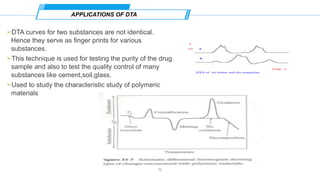
➢DTA curves for two substances are not identical.
Hence they serve as finger prints for various
substances.
➢This technique is used for testing the purity of the drug
sample and also to test the quality control of many
substances like cement,soil,glass.
➢Used to study the characteristic study of polymeric
materials
APPLICATIONS OF DTA
15
➢Used for the determination of heat of reaction, specific heat and energy change
occurring during melting..
➢DTA offers a wide spectrum of investigations related to reaction kinetics, solvent
retention, Phase-transformations, solid-phase reactions and drying properties of
product.
➢Analysis of Biological samples: DTA curves are used to date Bone remains
or to study archaeological materials.
➢Measurement of Crystalline: measurement of the mass fraction of crystalline
material in semi-crystalline polymers.
APPLICATIONS OF DTA
16
!Characterisation of rare earth chlorides:
They concluded on the basis of DTA curve these compounds can be divided in
to four groups each of which are characterized by the presence or absence of
certain endothermic peaks.
✓Group Ⅰ:this group includes lanthanium,cerium, and there are one or two small
endothermic peaks.
✓Group Ⅱ: this group contains samarium,curopium,gadolinium and the
dehydration peaks contain just one maximum.
✓Group Ⅲ: This group contains terbium,holomium,erbium and thulium was
characterised by the splitting of dehydration into two peaks and also splitting
of oxychloride formation peaks.
APPLICATIONS OF DTA
17
✓Group Ⅳ:this group includes ytterbium, lutetium was characterized by splitting
of dehydration endothermic peak in addition to the peak appeared in the
310-325c temperature range.
➢Moisture content in the sample can be determined.
➢DTA method also provides a simple and accurate way of determining the
melting,Boiling,and decomposition points of organic compounds. Generally
data appears to be more consistent and reproducible than those obtained with
hot stage or a capillary tube.
APPLICATIONS OF DTA
18
REFERENCES
!Instrumental methods of chemical analysis by Gurdeep R.Chatwal.
!Skoog, dougla A, F James holler and timothy nieman, principles of instrumental analysis, 5th
edition New york 2001
!Differential thermal analysis (DTA) and differential scanning calorimetric (DSC) as a method of
material investigation, Greg Klančnik1, *, Josef Medved1 , Primo Mrvar1 1 , University of Ljubljana,
Faculty of natural science and engineering, Department of materials and metallurgy, Aškerčeva 12,
SI-1000 Ljubljana, Slovenia.
19

Differential Thermal Analysis (DTA)

  • 1.
  • 2.
    • Differential thermalanalysis (DTA), in analytical chemistry, a technique for identifying and quantitatively analyzing the chemical composition of substances by observing the thermal behavior of a sample as it is heated. • The technique is based on the fact that as a substance is heated, it undergoes reactions and phase changes that involve absorption or emission of heat. • In 1899 Robert Austen improved this technique by introducing two thermocouples, one placed in sample and other in the reference block. INTRODUCTION 2
  • 3.
    Principle: The basic principleinvolved in DTA is the temperature difference (∆T) between the test sample and an inert reference sample under controlled and identical conditions of heating or cooling is recorded continuously as a function of temperature or time, thus the heat absorbed or emitted by a chemical system is determined. In Differential Thermal Analysis, the temperature difference that develops between a sample and an inert reference material is measured, when both are subjected to identical heat - treatments. The related technique of Differential Scanning Calorimetry relies on differences in energy required to maintain the sample and reference at an identical temperature. DIFFERENTIAL THERMAL ANALYSIS (DTA) 3
  • 4.
    Characteristics of DTACurves • If any reaction takes place in the sample, then the temperature difference will occur between the sample and the reference material. • In an endothermic change (such as melting or dehydration of the sample) the temperature of the sample is lower than that of the reference material (i.e) ∆T = -ve (for endothermic process) • In an exothermic change or process the sample temperature is higher than that of the reference material. • (i.e) ∆T = + ve (exothermic process) THERMOGRAM 4
  • 5.
    Sharp Endothermic –changes in crystallanity or fusion Broad Endotherms - dehydration reaction Physical changes usually result in endothermic curves Chemical reactions are exothermic ∆T VS Temp. THERMOGRAM 5
  • 6.
    INSTRUMENTATION DTA instrument isknown as Differential thermal analyser. It consists of following basic components: 1. Sample Holder 2. Furnace or Heating Device 3.Thermal Programmer 4. Amplifier & Recording System 5. Atmosphere Control The instrument measures the differential temperature (ΔT) of the sample as a function of temperature or time where the temperature rises at a constant linear rate. ΔT= (Ts - Tr) as function of Temperature 6
  • 7.
    The material understudy and an inert reference are made to undergo identical thermal cycles. Any temperature difference between sample and reference is recorded. In this technique the heat flow to the sample and reference remain the same rather than the temperature. The differential temperature is then plotted against time, or against temperature (DTA curve or thermogram). WORKING 7
  • 8.
  • 9.
    1. Source ofUniform heating: • Nichrome (nickel and chromium alloy) furnace can be used up to 1300 °C, • Platinum and its alloys up to 1750 °C and • Molybdenum (Mo) for higher range up to 2000 °C. 2. Specimen Holder • It is designed to accommodate small quantity of material and to give maximum thermal effect. • It can be of Pt, Ni, stainless steel, Ag and alloy. • Ceramic materials: sintered alumina , silica. • Reference material like (α-alumina). 3. Temperature regulating System: • Uniform rate of heating of the furnace is ensured through Electronic Temperature Regulators. INSTRUMENTATION 9
  • 10.
    4. Measurement ofTemperature • Rare metal alloy Pt- Rh (Pt 10 - Rh 13%) used as thermocouple for measuring the temperature. • For higher temperature up to 2000 0C W-Mo thermocouple may also be used. 5. Temperature Recording System • Galvanometric observation, used only for few samples. • Automatic pen and ink electronic recorder found to be more convenient. INSTRUMENTATION 10
  • 11.
    Factors affecting DTAcurves: DTA is a dynamic temperature technique. Therefore, a large number of factors can affect the resulting experimental curves. Similar to TGA curves, these factors can be divided into the two groups: i) Sample factors, and ii) Instrumental factors The Instrumental factors • Size and shape of sample holder, • Sample holder material, • Heating rate of the sample, • Sensitivity of recording system, • Location of thermocouple in the sample and atmosphere around sample. Most of these factors are associated with instrumental design. We have very little control on these factors. FACTORS AFFECTING 11
  • 12.
    Sample characteristics • Amountof sample, - Peak area of DTA Curve is proportional to the mass of the sample. - mg of powdered solid sample is used. • Particle size, - sample should have similar particle size. • Packing density, - Packing density of sample influences the shape of DTA Curve. • Degree of crystallinity, • Diluents used (inert material) • Swelling and shrinkage of the sample. FACTORS AFFECTING 12
  • 13.
    Interpretation of DTACurve • To further illustrate, let’s consider the example of CaC2O4.H2O calcium oxalate monohydrate • This curve indicates that out of three DTA peaks first is endothermic in nature, second is exothermic and third one is again endothermic in nature. • The correlates the TGA results and confirms that the nature of reactions occurring in the endothermic are because of desolvation and decarboxylation while exothermic is due to decomposition followed by oxidation and finally formation of stable oxide CaO with evolution of carbon dioxide gas. • This can be explained by the chemistry of decomposition of CaC2O4.H2O when it is heated. DTA of calcium oxalate monohydrate THERMOGRAM 13
  • 14.
    ADVANTAGES OF DTA: ➢Instrumentcan be used at high temperature. ➢Instrument is highly sensitive. ➢Flexibility in crucible volume/form. ➢Characteristic transition or reaction can be accurately determined. DISADVANTAGES OF DTA: ➢Uncertainty in heat of fusions. ➢Reaction or transition estimation is only 20%to50% in DTA. ➢Need calibration over the entire temperature for DTA. PROS AND CONS 14
  • 15.
    ➢DTA curves fortwo substances are not identical. Hence they serve as finger prints for various substances. ➢This technique is used for testing the purity of the drug sample and also to test the quality control of many substances like cement,soil,glass. ➢Used to study the characteristic study of polymeric materials APPLICATIONS OF DTA 15
  • 16.
    ➢Used for thedetermination of heat of reaction, specific heat and energy change occurring during melting.. ➢DTA offers a wide spectrum of investigations related to reaction kinetics, solvent retention, Phase-transformations, solid-phase reactions and drying properties of product. ➢Analysis of Biological samples: DTA curves are used to date Bone remains or to study archaeological materials. ➢Measurement of Crystalline: measurement of the mass fraction of crystalline material in semi-crystalline polymers. APPLICATIONS OF DTA 16
  • 17.
    !Characterisation of rareearth chlorides: They concluded on the basis of DTA curve these compounds can be divided in to four groups each of which are characterized by the presence or absence of certain endothermic peaks. ✓Group Ⅰ:this group includes lanthanium,cerium, and there are one or two small endothermic peaks. ✓Group Ⅱ: this group contains samarium,curopium,gadolinium and the dehydration peaks contain just one maximum. ✓Group Ⅲ: This group contains terbium,holomium,erbium and thulium was characterised by the splitting of dehydration into two peaks and also splitting of oxychloride formation peaks. APPLICATIONS OF DTA 17
  • 18.
    ✓Group Ⅳ:this groupincludes ytterbium, lutetium was characterized by splitting of dehydration endothermic peak in addition to the peak appeared in the 310-325c temperature range. ➢Moisture content in the sample can be determined. ➢DTA method also provides a simple and accurate way of determining the melting,Boiling,and decomposition points of organic compounds. Generally data appears to be more consistent and reproducible than those obtained with hot stage or a capillary tube. APPLICATIONS OF DTA 18
  • 19.
    REFERENCES !Instrumental methods ofchemical analysis by Gurdeep R.Chatwal. !Skoog, dougla A, F James holler and timothy nieman, principles of instrumental analysis, 5th edition New york 2001 !Differential thermal analysis (DTA) and differential scanning calorimetric (DSC) as a method of material investigation, Greg Klančnik1, *, Josef Medved1 , Primo Mrvar1 1 , University of Ljubljana, Faculty of natural science and engineering, Department of materials and metallurgy, Aškerčeva 12, SI-1000 Ljubljana, Slovenia. 19