The document discusses the limitations and issues associated with IPv4, such as address exhaustion and security problems, and introduces IPv6 as a solution with a significantly larger address space and built-in security features. It explains various address types including unicast, multicast, and anycast, as well as transition strategies for migrating from IPv4 to IPv6. The document also outlines the notation formats for IPv6 addresses and emphasizes the need for dual-stack implementation during the transition period.
Overview of Advanced Networking course at Uva Wellassa University, Sri Lanka.
Overview of topics including IPv4, NAT, IPv6, and migration strategies in networking.
IPv4 is a widely used connection-less protocol, with 32-bit address (max ~4.3 billion), facing insufficiency and unique challenges.
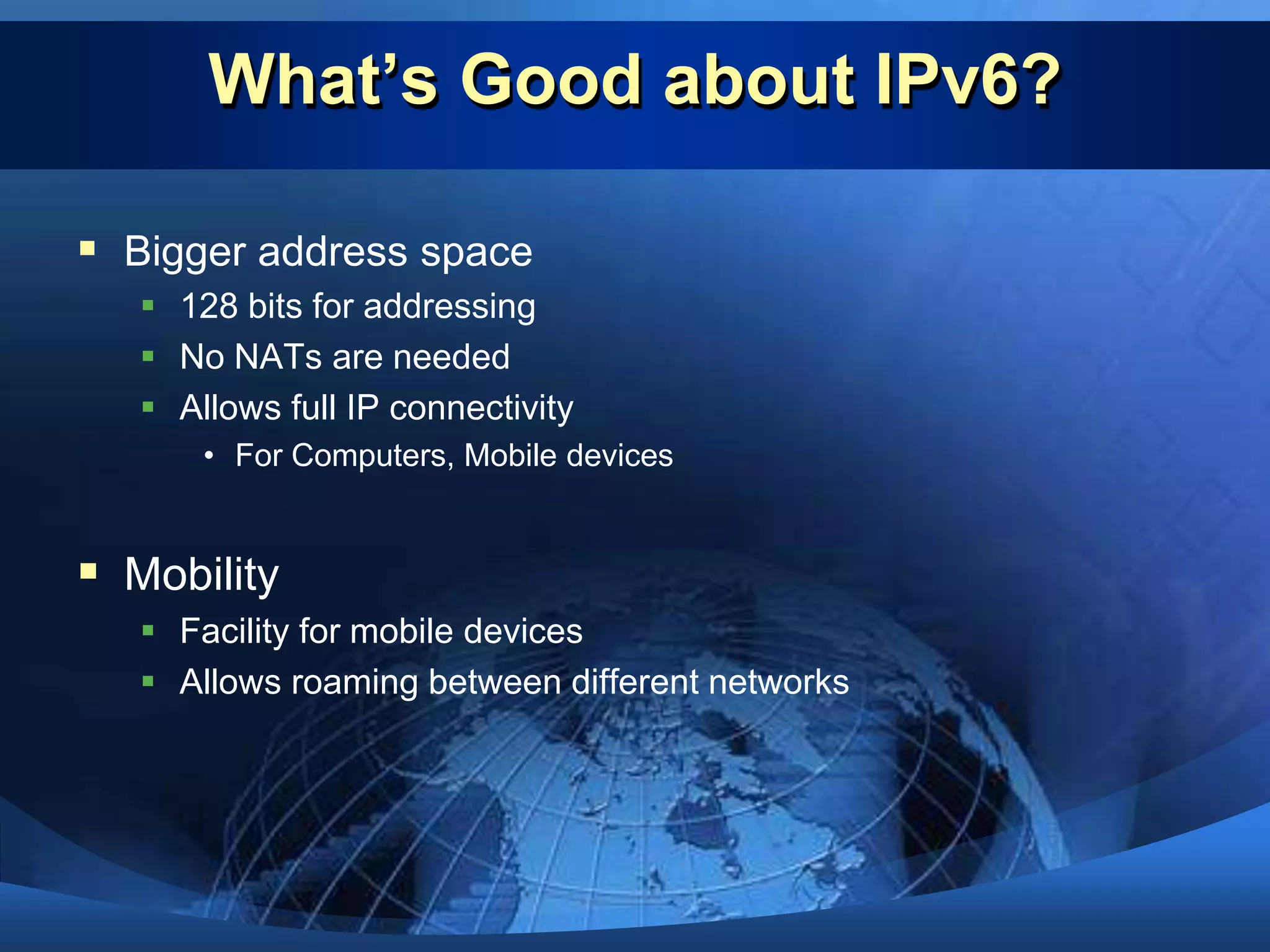
NAT maintains separate IP address pools, aids in server load balancing, and modifies address information during packet transfer.IPv6 advancements include 128-bit addressing, eliminating the need for NAT, and enhancing connectivity and mobility.
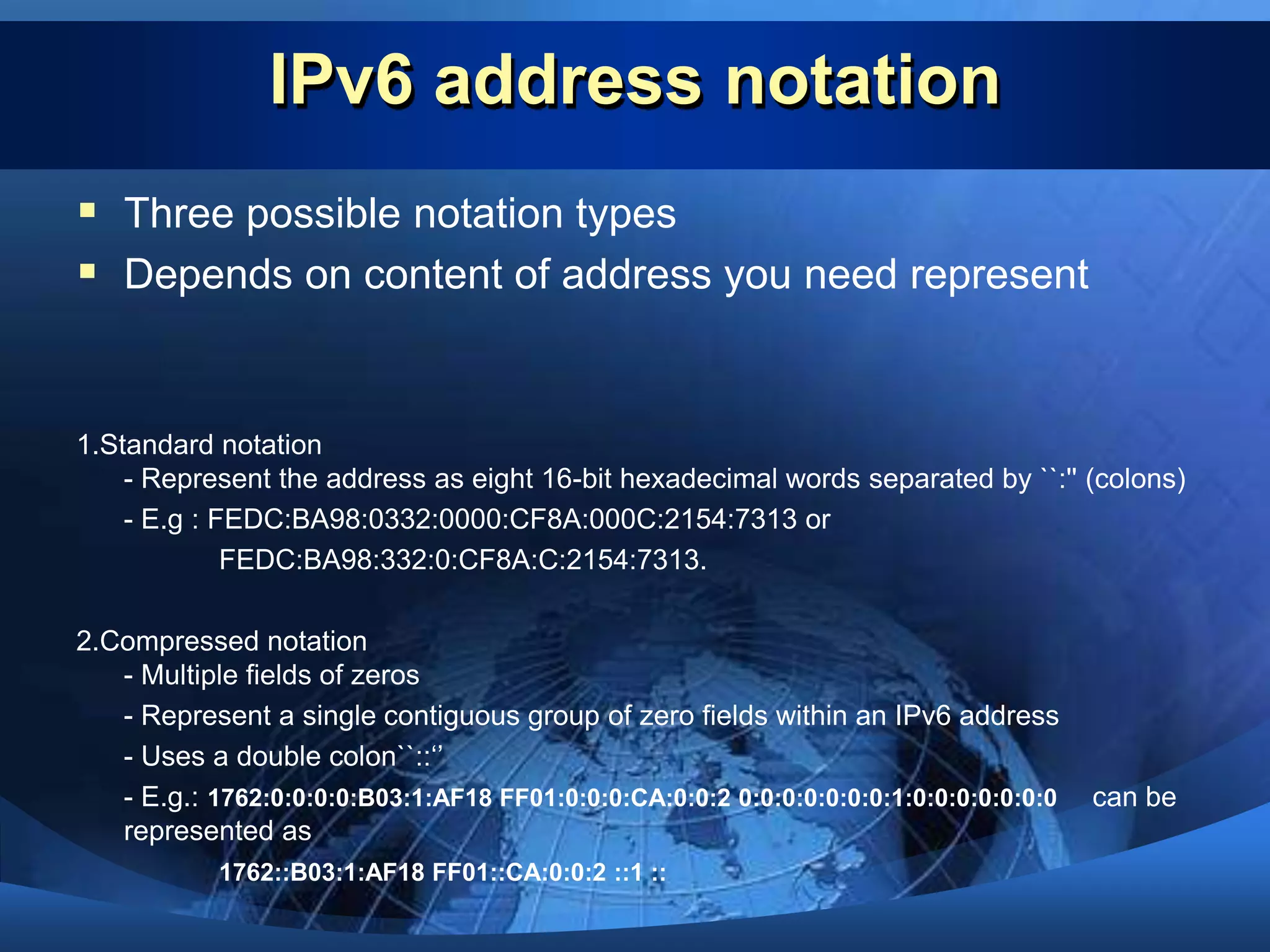
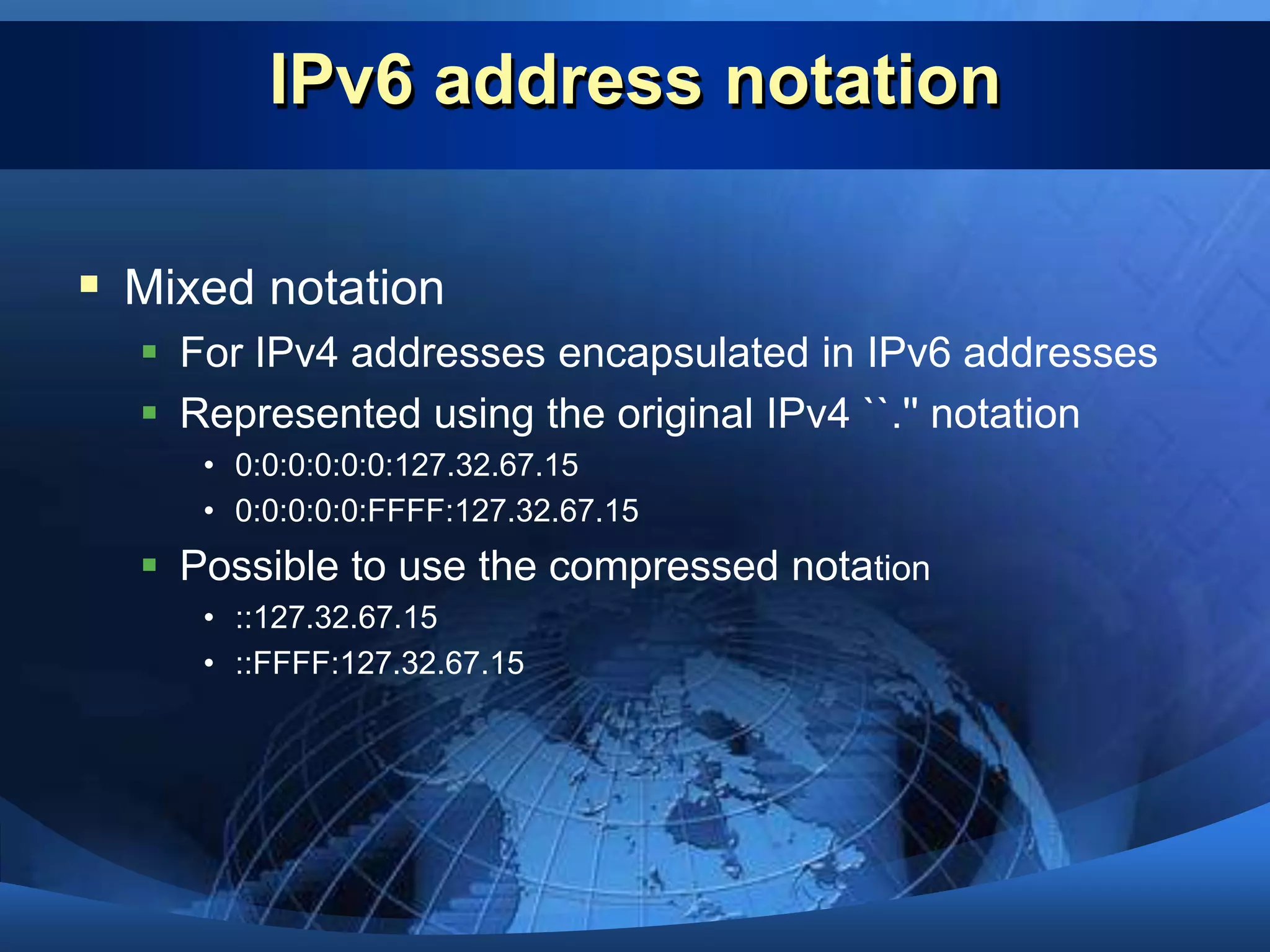
Different IPv6 address notations such as compressed and mixed notation for effective representation.
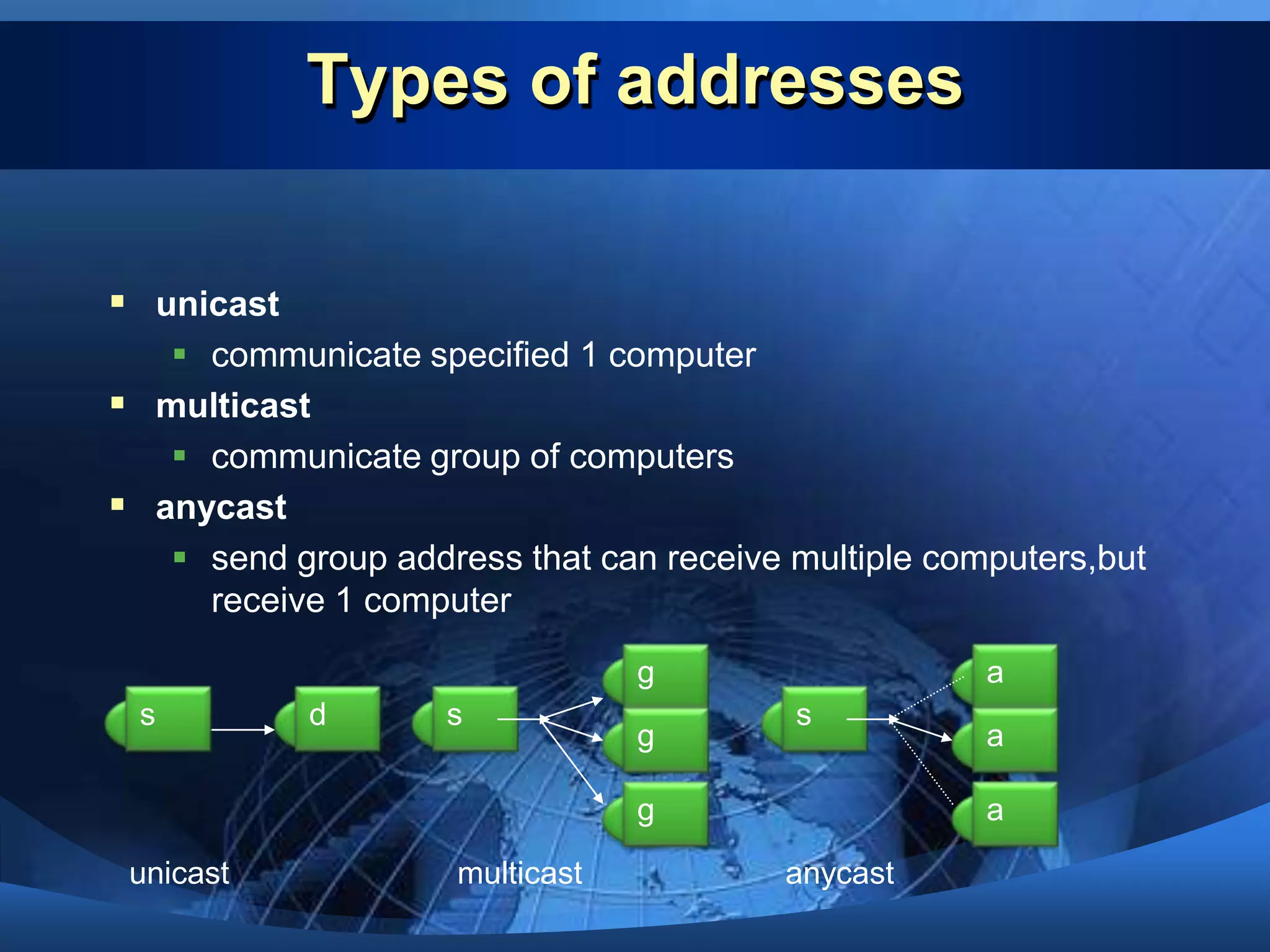
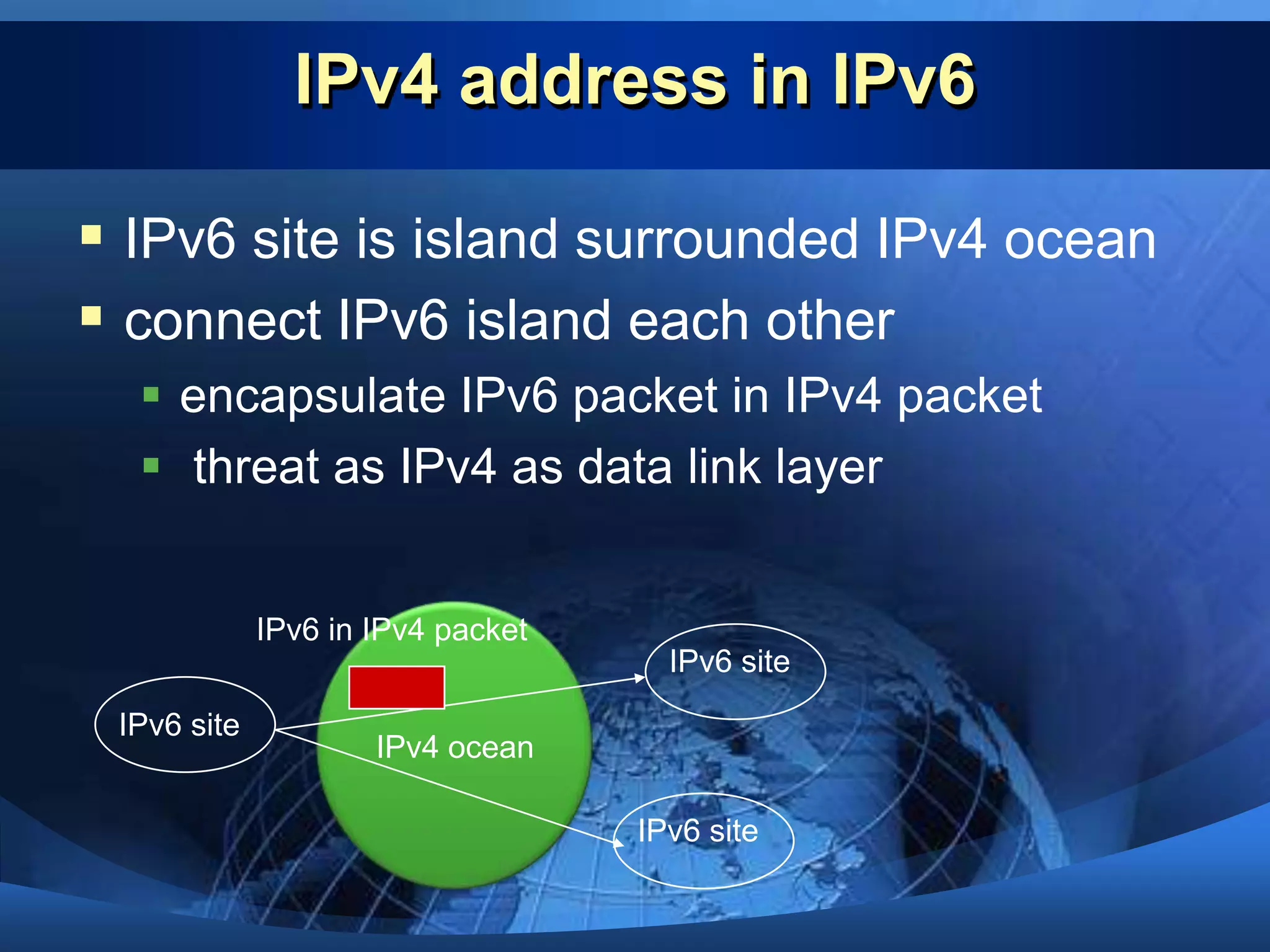
Key IPv6 address types: unicast for single communication, multicast for group communication, and anycast targeting nearest recipient.IPv6 encapsulation in IPv4 packets for effective communication and data transmission strategies across networks.
IPv6 multicast allows sending a single packet to multiple destinations for applications like telephony and real-time news.
Utilization of anycast for nearest service access and types of special IPv6 addresses such as private and loopback.
Applications designed to handle both IPv4 and IPv6 addressing effectively.
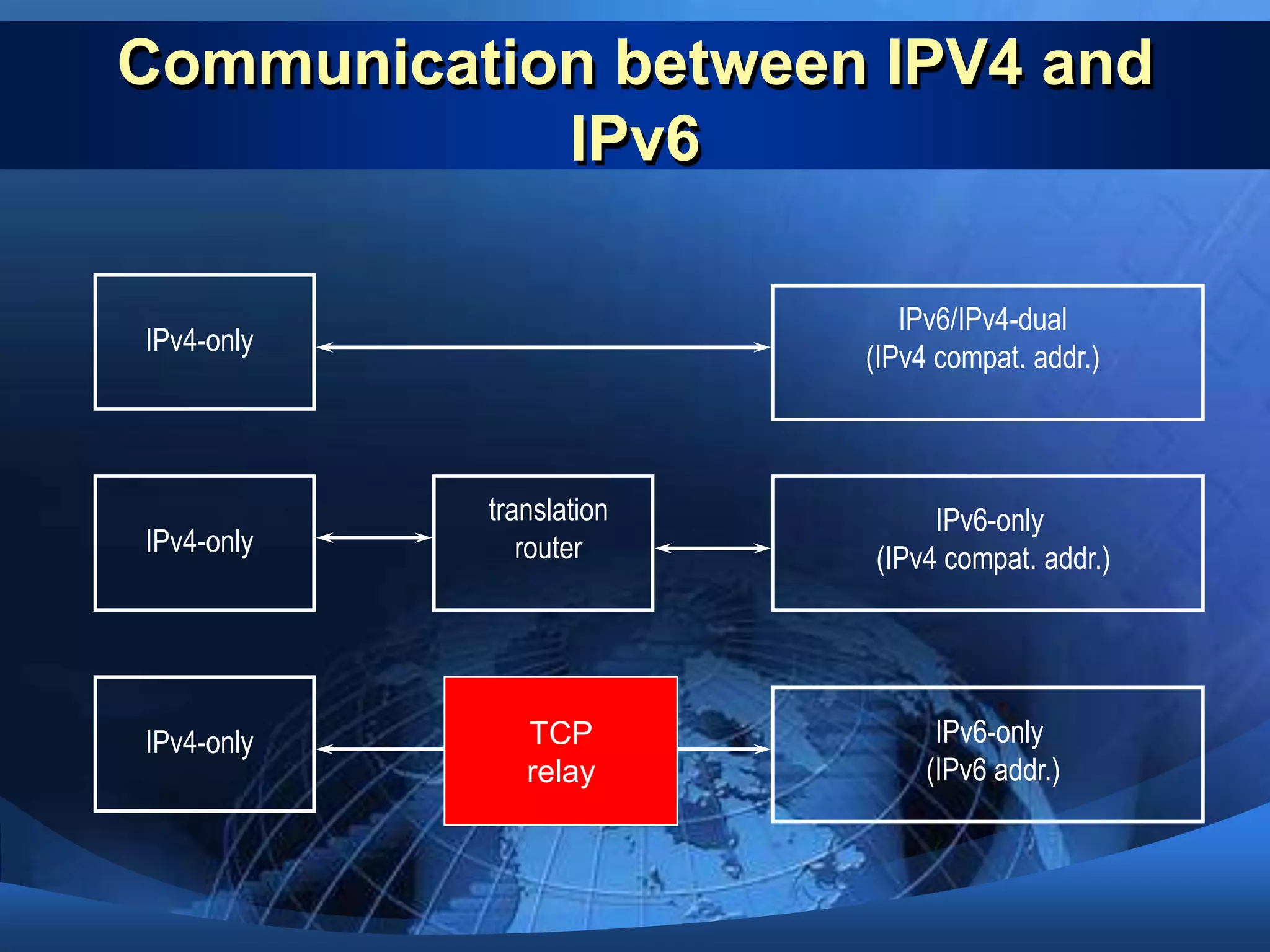
Phased transition from IPv4 to IPv6, including dual nodes and migration strategies for effective integration.
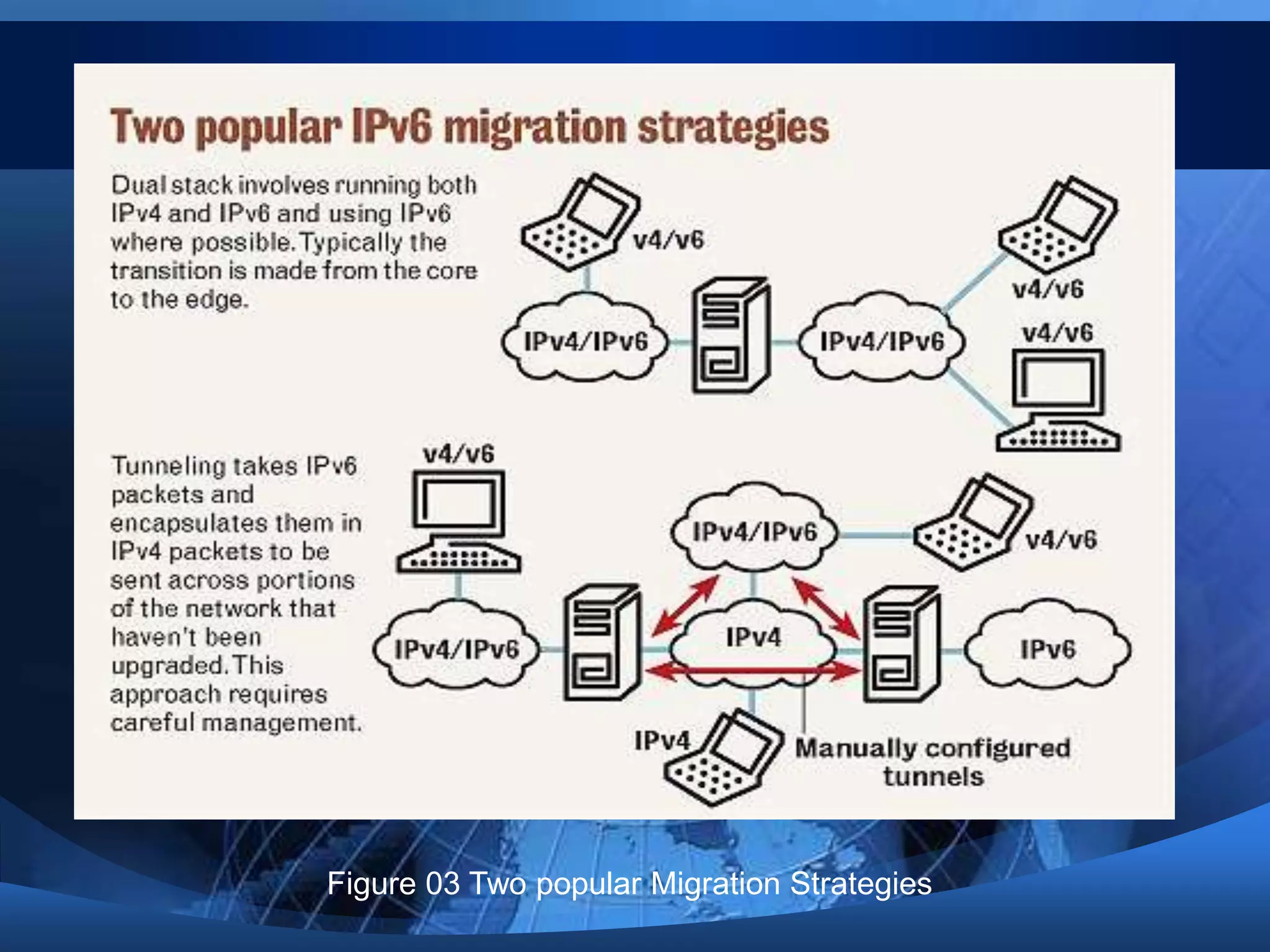
Overview of popular migration strategies for transitioning to IPv6 while maintaining IPv4 connectivity.
ContentsIP4Problems of IP4Networkaddress translationIPV6What’s Good about IP6IPv6 address notationTypes of addressesIPV4 address in IP6IPv6 unicastIPv6 multicastIPv6 anycastIPv6 special addressIPv6 ready applicationsTransition planMigration to IPv6Communication between ipv4 and IPv6
3.
IPv4Forth revision ofdevelopment of Internet Protocol(IP)Most widely used protocol at presentConnection-less protocol used on packet-switched Link Layer networksA system of addressesTo identify devices32 bits232 combinationsNearly 4.3 billionNot enough and more addresses are needed
4.
Problems of IPv41.Insuffieciency-Only four bytesMaximum nodes ~ 4.3 billionMuch less than the human population (6.799 billion)Not enough for growing number of users
5.
Will be exhaustedin near future2.Increasing routing information- Rapid growth of routing tables in backbones3. Increasing the number of Network Address Translation (NAT) - Breaking the Internet architecture
6.
Problems of IPv44.Securityissues - Number of ways to encrypt IPv4 trafficExample: IPSec - No real standard encryption method5.Real-time delivery of multimedia content and necessary bandwidth allocationQuality of Service (QoS) Different interpretationsQoS compliant devices are not compatible one another
7.
Network Address Translation(NAT)Allowsto maintain public IP addresses and private IP addresses separatelyAlso used in server load balancingThis operates in side the routerMaintains an address poolFirst the destination is checkedThe address is translated The network address information in the datagram is modified
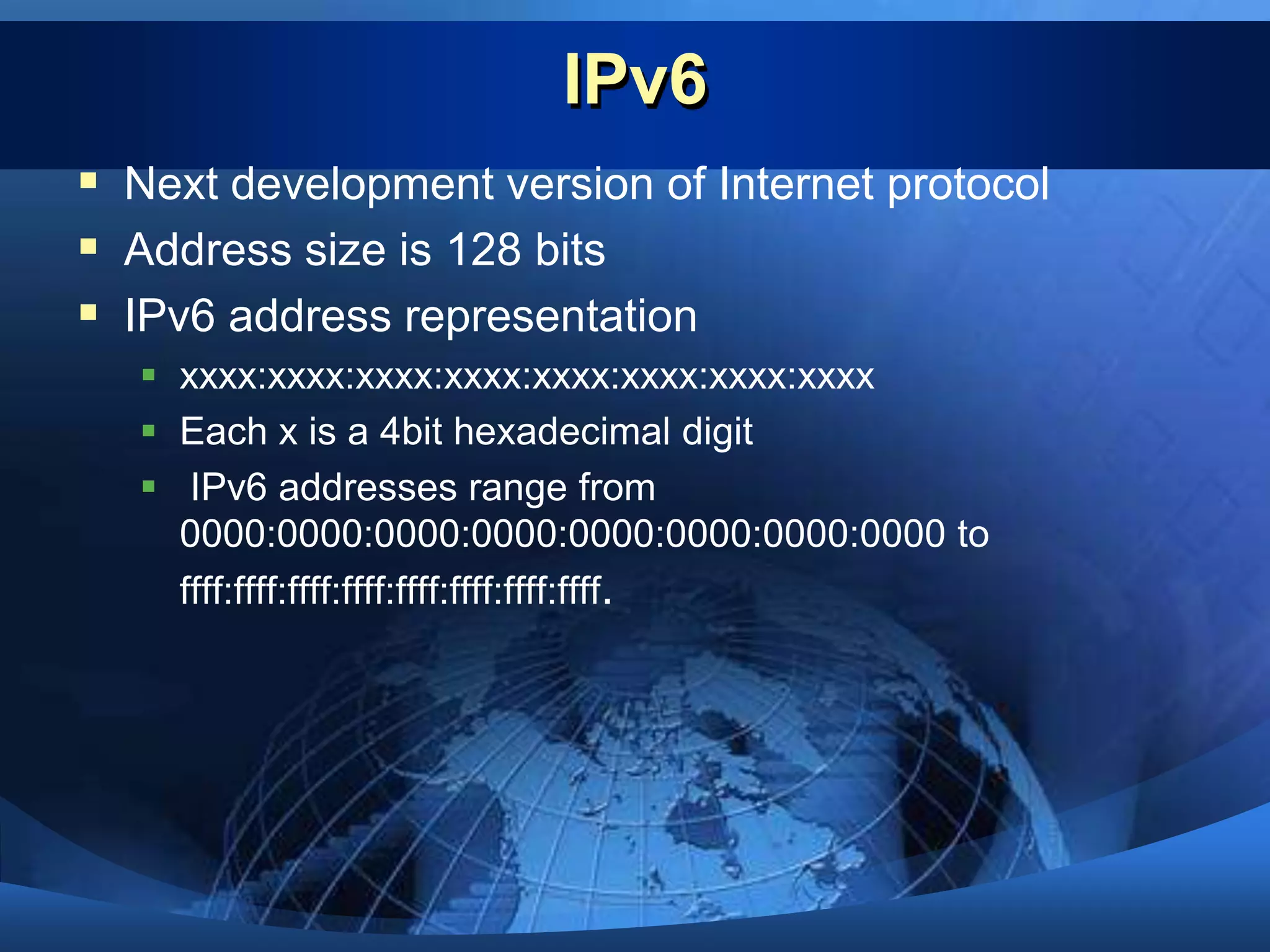
IPv6Next development versionof Internet protocolAddress size is 128 bitsIPv6 address representation xxxx:xxxx:xxxx:xxxx:xxxx:xxxx:xxxx:xxxxEach x is a 4bit hexadecimal digit IPv6 addresses range from 0000:0000:0000:0000:0000:0000:0000:0000 to ffff:ffff:ffff:ffff:ffff:ffff:ffff:ffff.
10.
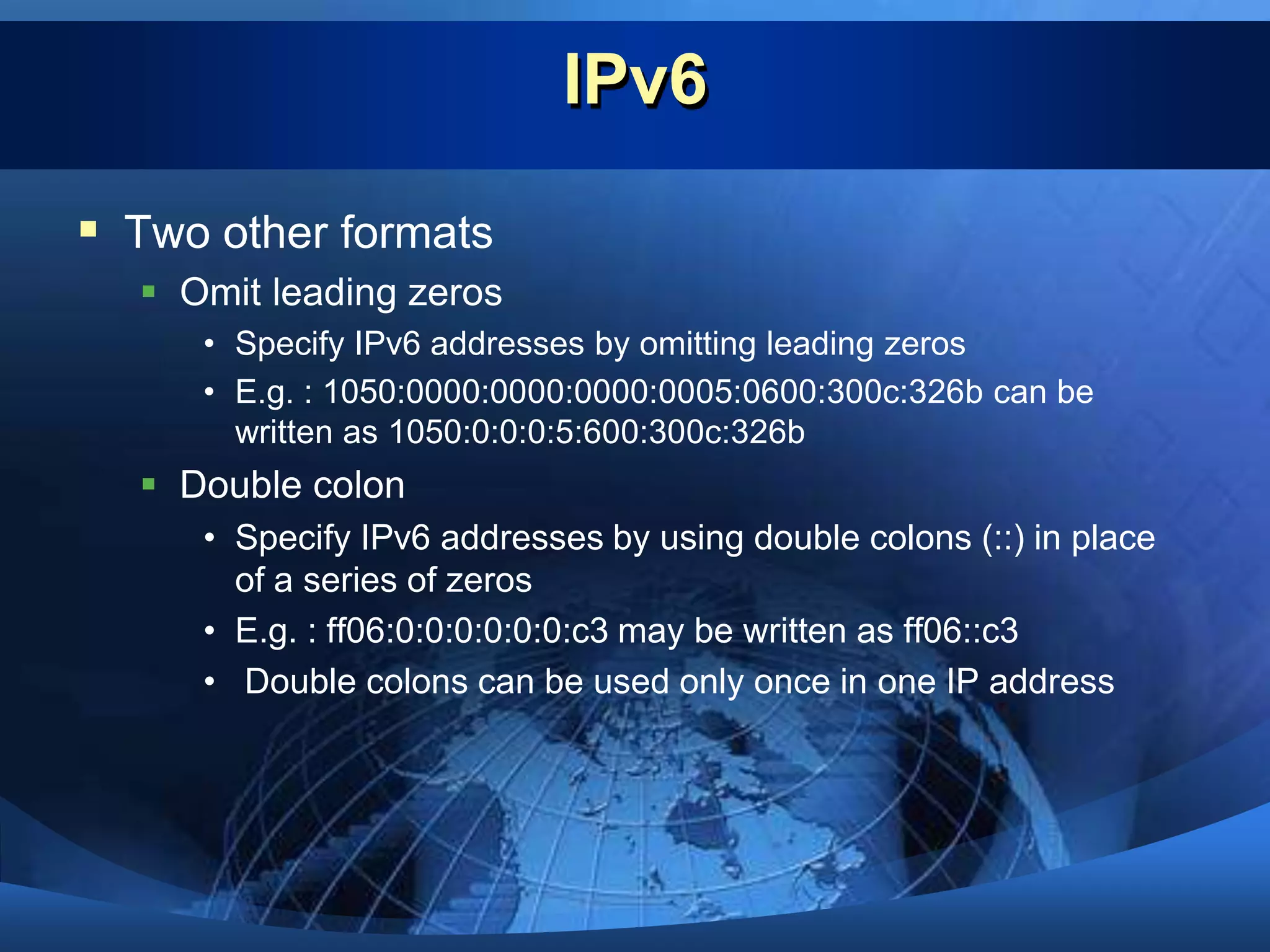
IPv6Two other formatsOmitleading zeros Specify IPv6 addresses by omitting leading zerosE.g. : 1050:0000:0000:0000:0005:0600:300c:326b can be written as 1050:0:0:0:5:600:300c:326bDouble colon Specify IPv6 addresses by using double colons (::) in place of a series of zerosE.g. : ff06:0:0:0:0:0:0:c3 may be written as ff06::c3 Double colons can be used only once in one IP address
11.
What’s Good aboutIPv6?Bigger address space128 bits for addressingNo NATs are neededAllows full IP connectivityFor Computers, Mobile devices MobilityFacility for mobile devices Allows roaming between different networks
12.
What’s Good aboutIPv6?Built-in securityIncludes IpsecAuthenticationEncryptionCompression
13.
IPv6 address notationThreepossible notation typesDepends on content of address you need represent1.Standard notation - Represent the address as eight 16-bit hexadecimal words separated by ``:'' (colons) - E.g : FEDC:BA98:0332:0000:CF8A:000C:2154:7313 or FEDC:BA98:332:0:CF8A:C:2154:7313.2.Compressed notation - Multiple fields of zeros - Represent a single contiguous group of zero fields within an IPv6 address - Uses a double colon``::‘’ - E.g.: 1762:0:0:0:0:B03:1:AF18 FF01:0:0:0:CA:0:0:2 0:0:0:0:0:0:0:1:0:0:0:0:0:0:0 can be represented as1762::B03:1:AF18 FF01::CA:0:0:2 ::1 ::
14.
IPv6 address notationMixednotation For IPv4 addresses encapsulated in IPv6 addressesRepresented using the original IPv4 ``.'' notation 0:0:0:0:0:0:127.32.67.15 0:0:0:0:0:FFFF:127.32.67.15Possible to use the compressed notation::127.32.67.15::FFFF:127.32.67.15
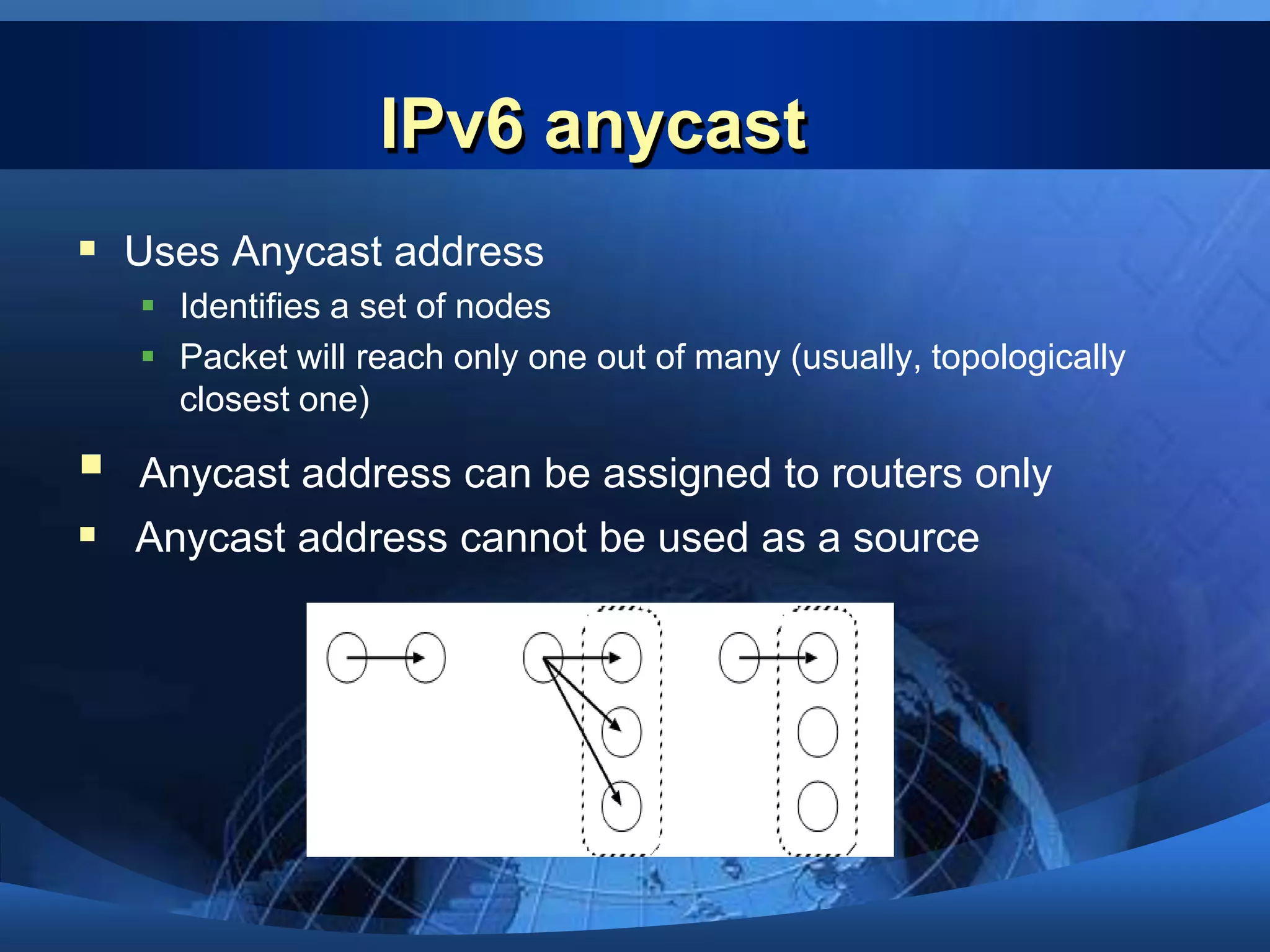
send group addressthat can receive multiple computers,but receive 1 computerunicastanycastmulticast
21.
IPv4 address inIPv6IPv6 site is island surrounded IPv4 oceanconnect IPv6 island each otherencapsulate IPv6 packet in IPv4 packet threat as IPv4 as data link layerIPv4 oceanIPv6 in IPv4 packetIPv6 siteIPv6 siteIPv6 site
22.
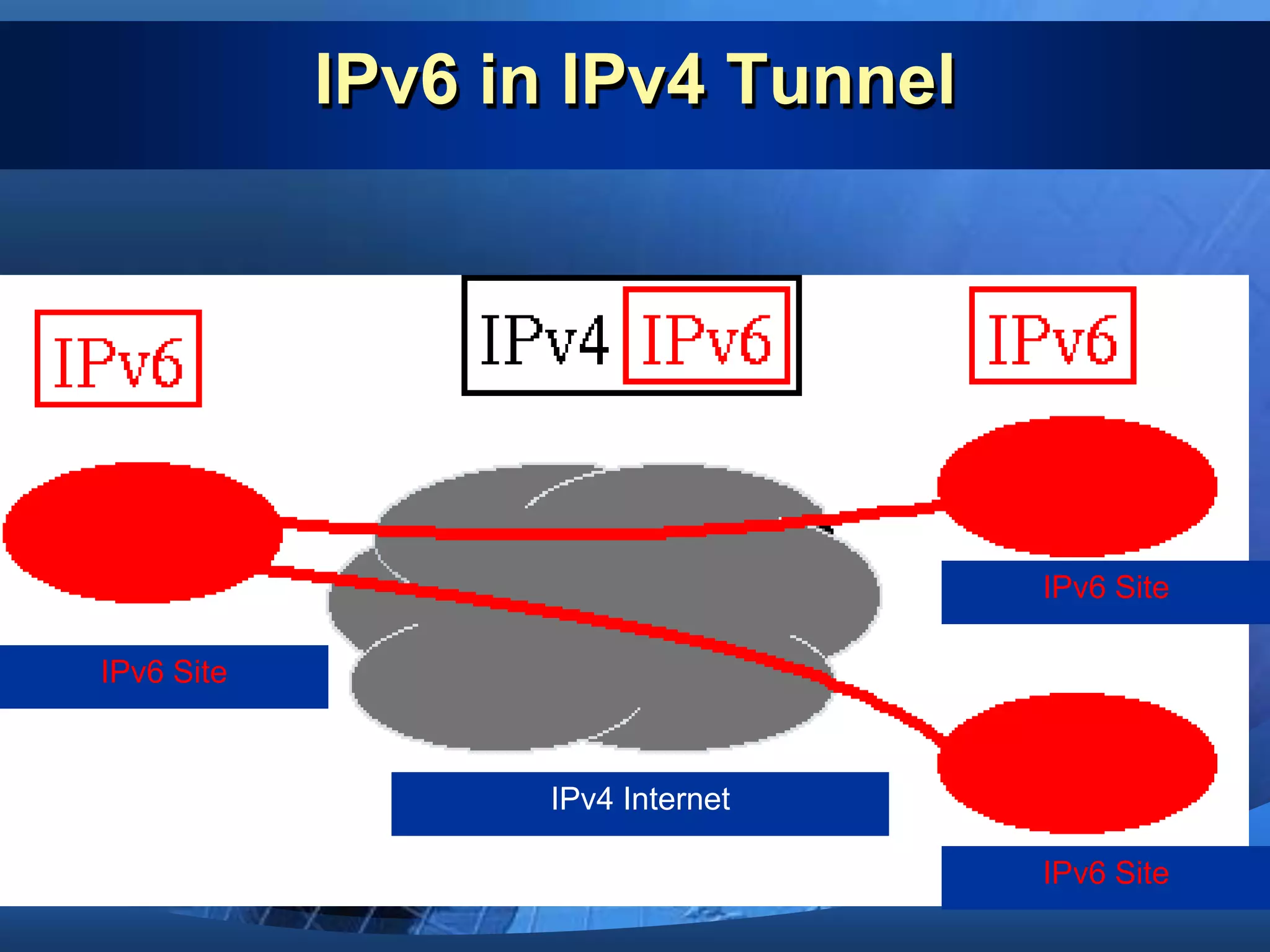
IPv6 in IPv4TunnelIPv6 SiteIPv6 SiteIPv4 InternetIPv6 Site
23.
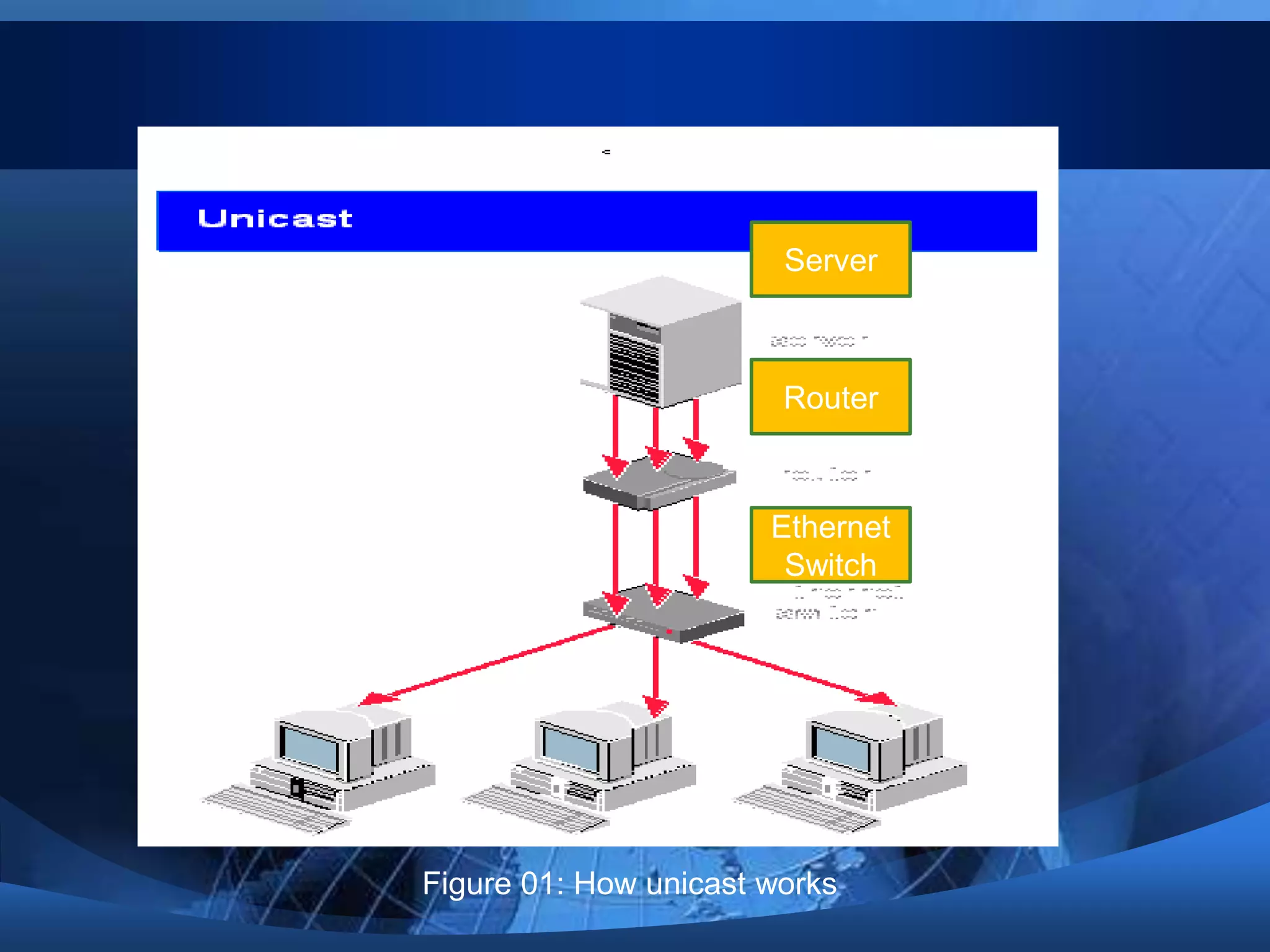
IPv6 UnicastTo transmitdata from one point to another.Multiple users might requestSame data From the same server At the same time duplicate data streams are transmitted one to each userScope may be Global or LocalGlobal for worldwide communicationLocal for communication within a site
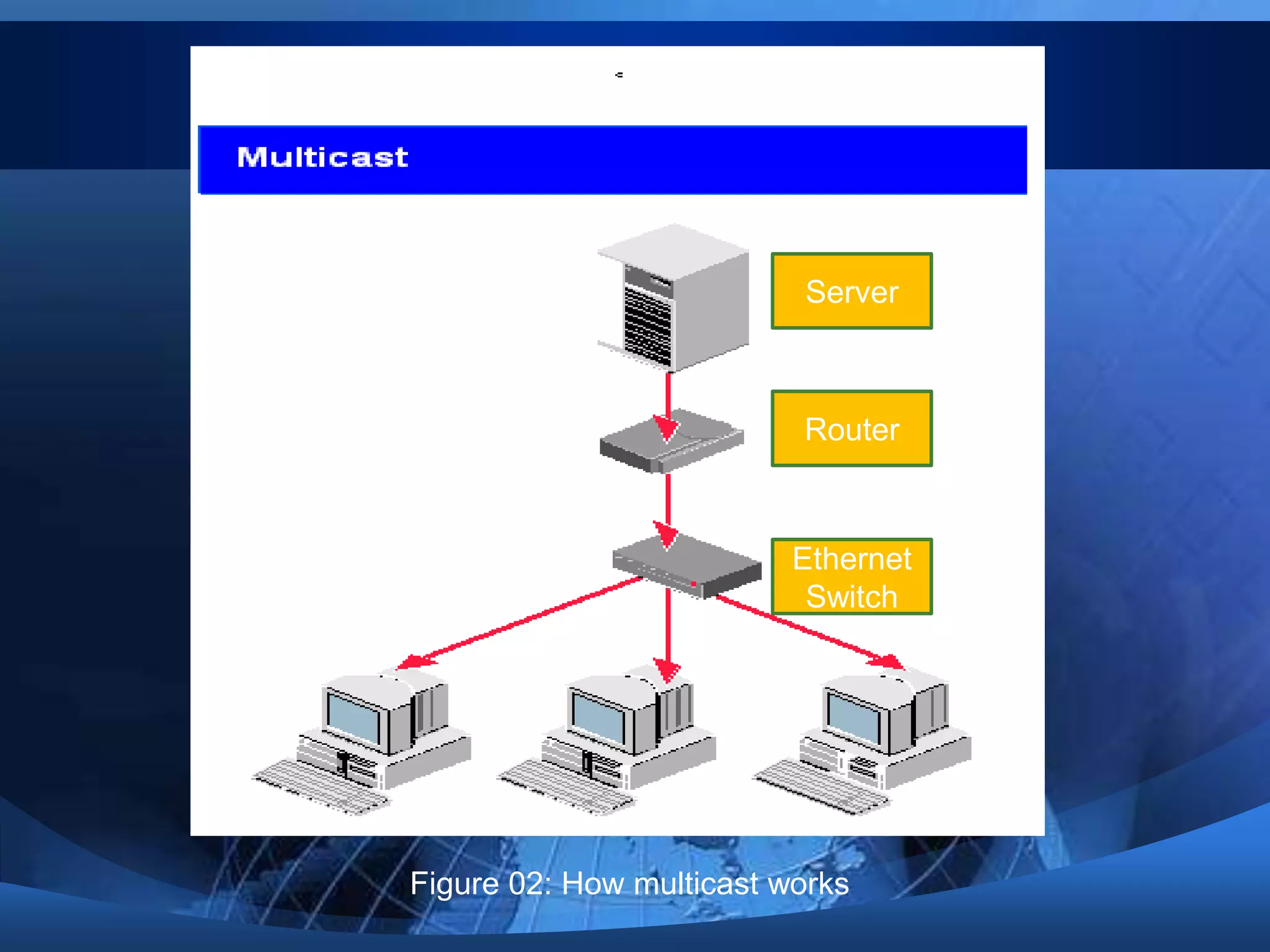
IPv6 multicastAbility tosend a single packet to multiple destinationsNo broadcastAbility to send a packet to all hosts on the attached linksame effect can be achieved by sending a packet to the link-local all hosts multicast groupApplicationsTelephony and video conferenceDatabase simultaneous updateParallel computingReal time news
IPv6 anycastUses AnycastaddressIdentifies a set of nodesPacket will reach only one out of many (usually, topologically closest one)Anycast address can be assigned to routers only Anycast address cannot be used as a source
28.
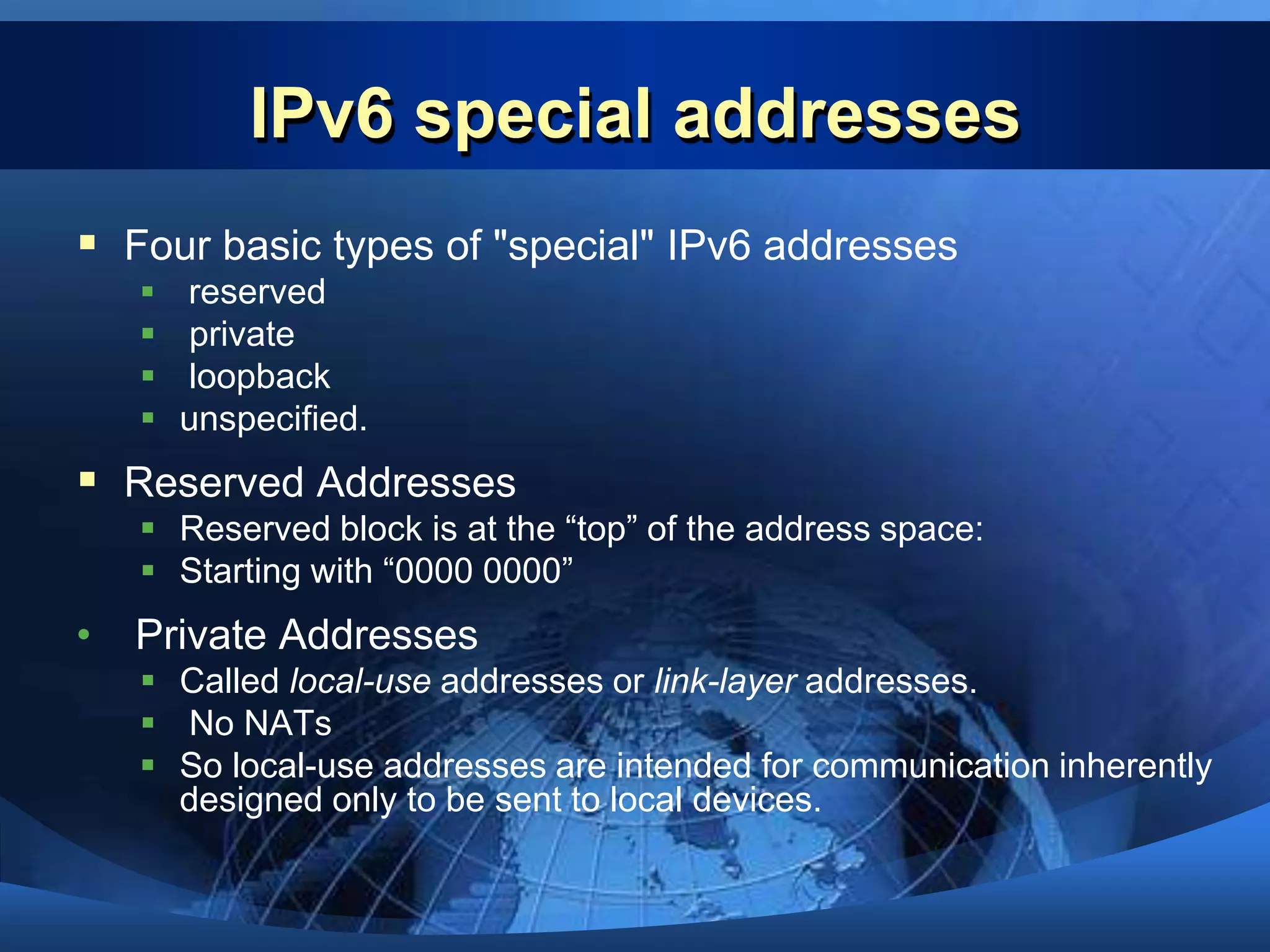
IPv6 special addressesFourbasic types of "special" IPv6 addressesreserved private loopbackunspecified.Reserved Addresses Reserved block is at the “top” of the address space:Starting with “0000 0000” Private Addresses Called local-use addresses or link-layer addresses. No NATsSo local-use addresses are intended for communication inherently designed only to be sent to local devices.
29.
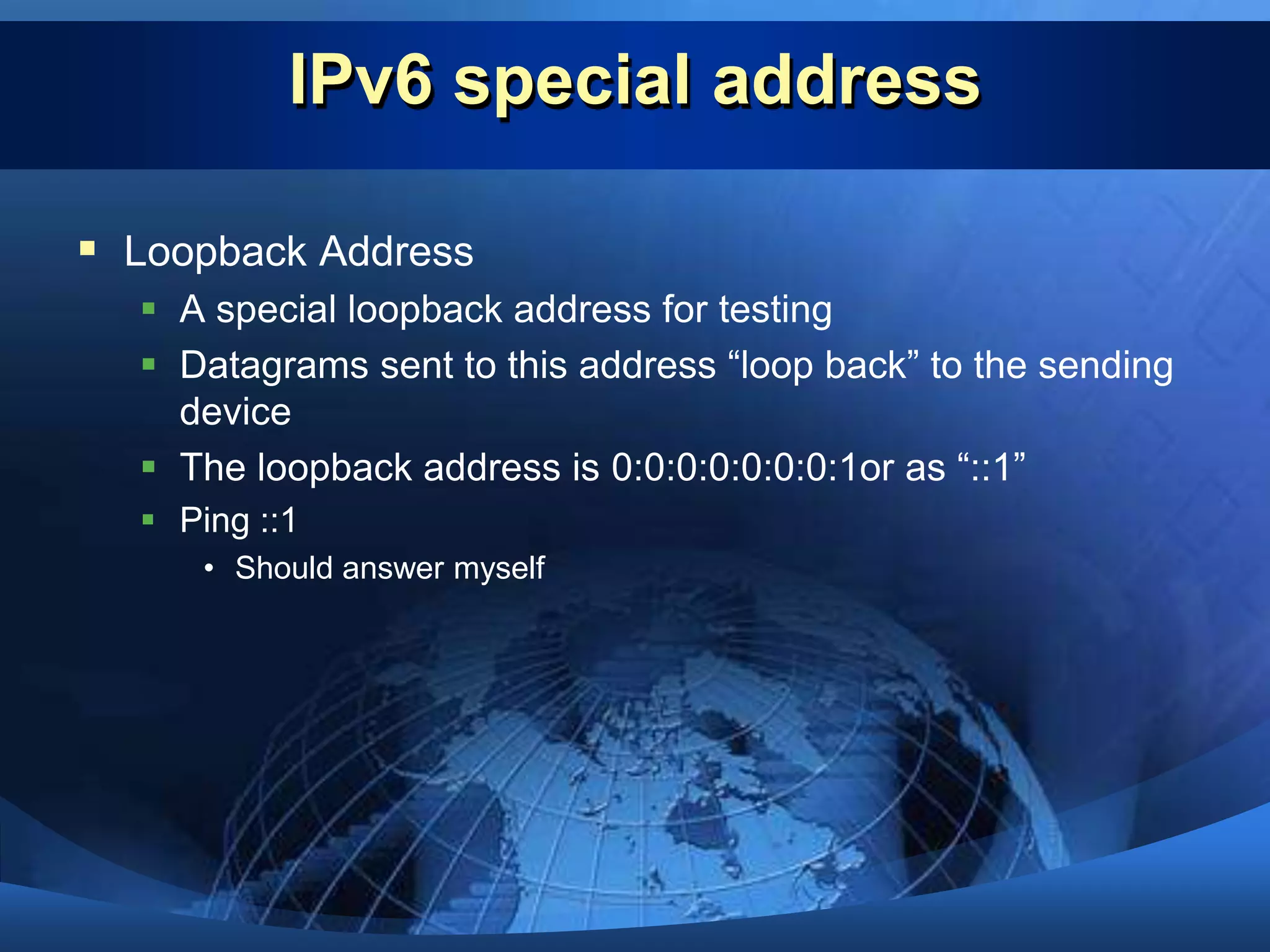
IPv6 special addressLoopbackAddress A special loopback address for testingDatagrams sent to this address “loop back” to the sending deviceThe loopback address is 0:0:0:0:0:0:0:1or as “::1”Ping ::1 Should answer myself
30.
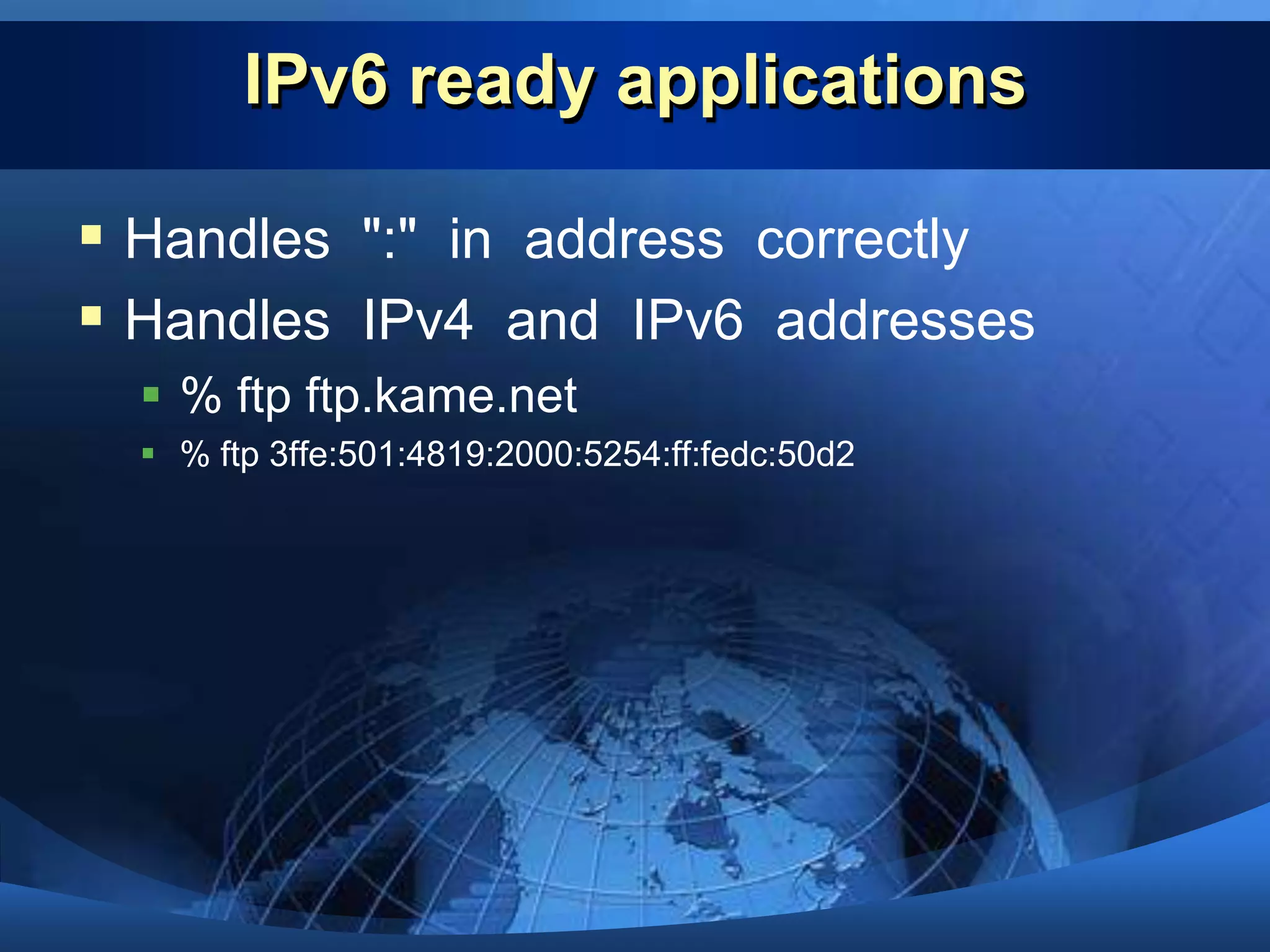
IPv6 ready applicationsHandles ":" in address correctlyHandles IPv4 and IPv6 addresses% ftp ftp.kame.net % ftp 3ffe:501:4819:2000:5254:ff:fedc:50d2
31.
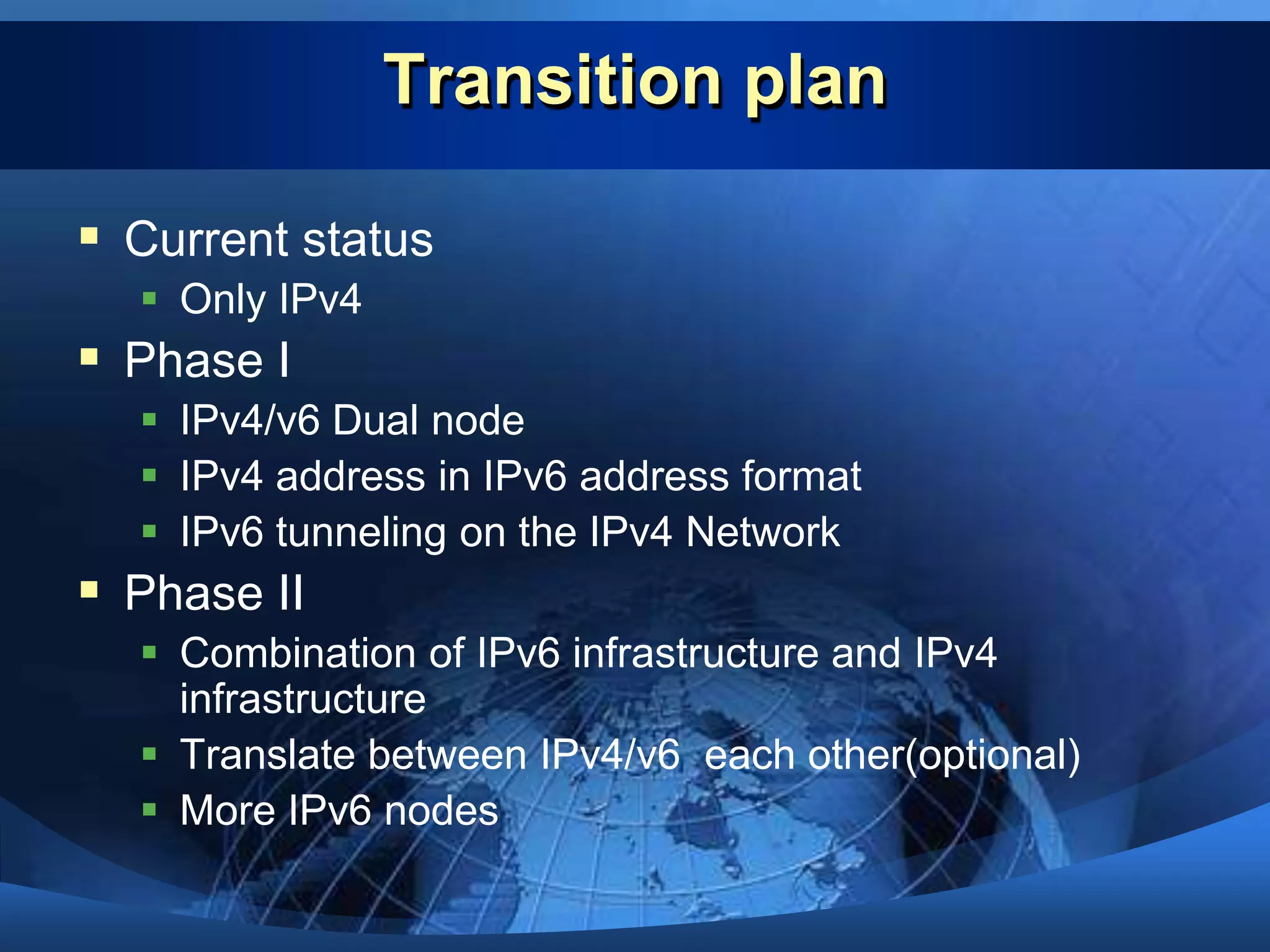
Transition planCurrent statusOnlyIPv4Phase IIPv4/v6 Dual nodeIPv4 address in IPv6 address formatIPv6 tunneling on the IPv4 NetworkPhase IICombination of IPv6 infrastructure and IPv4 infrastructureTranslate between IPv4/v6 each other(optional)More IPv6 nodes
32.
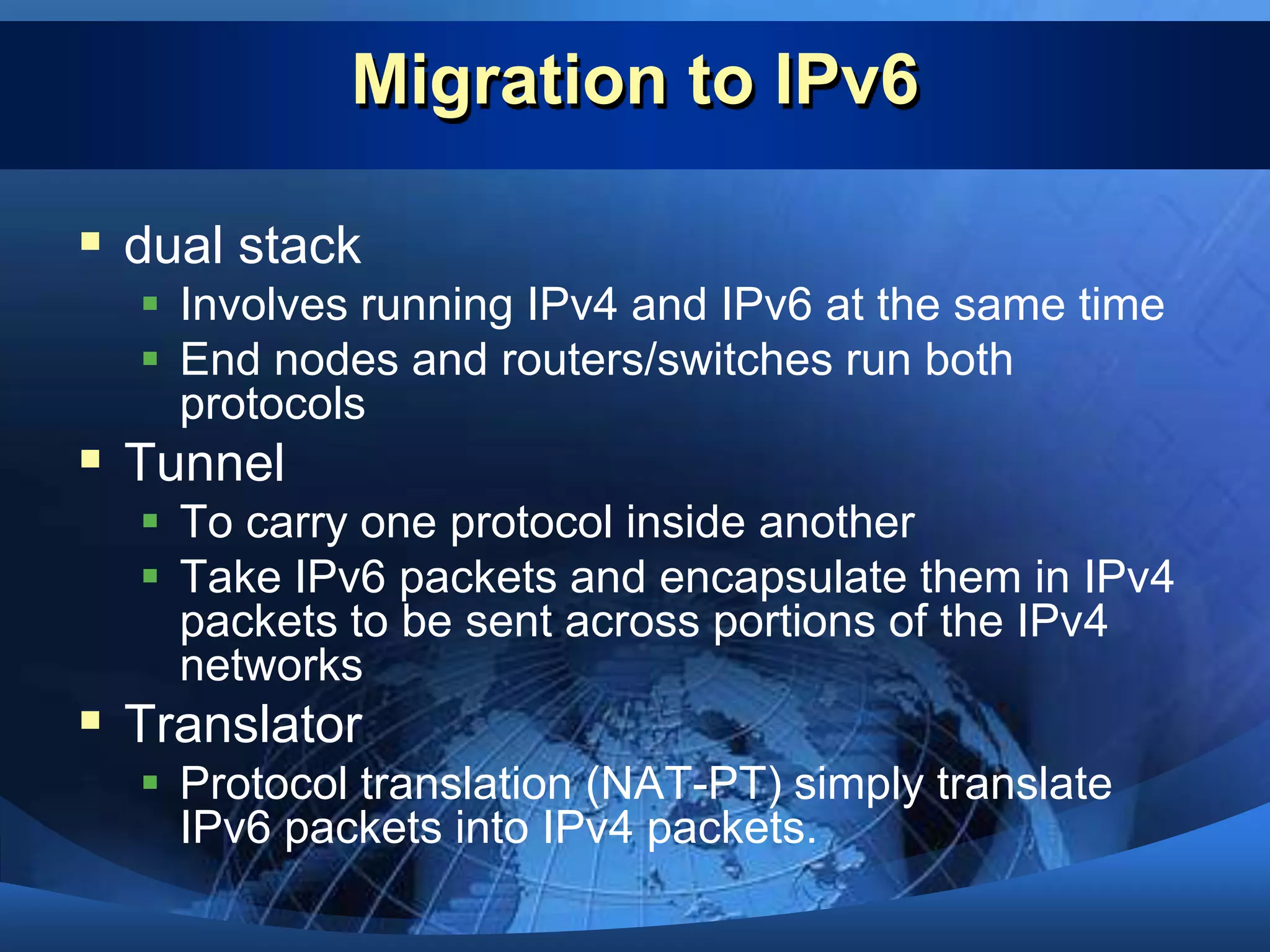
Migration to IPv6dualstackInvolves running IPv4 and IPv6 at the same timeEnd nodes and routers/switches run both protocolsTunnelTo carry one protocol inside anotherTake IPv6 packets and encapsulate them in IPv4 packets to be sent across portions of the IPv4 networksTranslatorProtocol translation (NAT-PT) simply translate IPv6 packets into IPv4 packets.