IPv6 Addressing
Prof. Papesh pathare
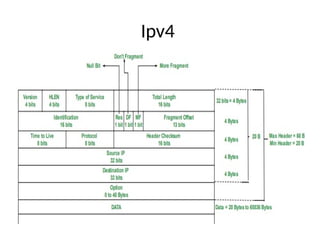
Ipv4
Address Structure
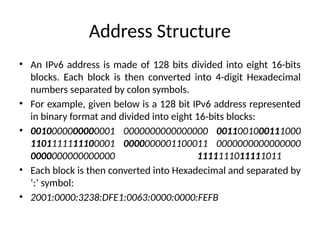
• An IPv6 address is made of 128 bits divided into eight 16-bits
blocks. Each block is then converted into 4-digit Hexadecimal
numbers separated by colon symbols.
• For example, given below is a 128 bit IPv6 address represented
in binary format and divided into eight 16-bits blocks:
• 0010000000000001 0000000000000000 0011001000111000
1101111111100001 0000000001100011 0000000000000000
0000000000000000 1111111011111011
• Each block is then converted into Hexadecimal and separated by
‘:’ symbol:
• 2001:0000:3238:DFE1:0063:0000:0000:FEFB
Rules:
• Even after converting into Hexadecimal
format, IPv6 address remains long. IPv6
provides some rules to shorten the address.
The rules are as follows:
• Rule.1: Discard leading Zero(es):
• In Block 5, 0063, the leading two 0s can be
omitted, such as (5th block):
• 2001:0000:3238:DFE1:63:0000:0000:FEFB
• Rule.2: If two of more blocks contain consecutive
zeroes, omit
• them all and replace with double colon sign ::, such as
(6th and 7th block):
• 2001:0000:3238:DFE1:63::FEFB
• Consecutive blocks of zeroes can be replaced only
once by :: so if there are still blocks of zeroes in the
address, they can be shrunk down to a single zero,
such as (2nd block):
• 2001:0:3238:DFE1:63::FEFB
Interface ID
• IPv6 has three different types of Unicast Address scheme.
• The second half of the address (last 64 bits) is always used for
Interface ID.
• The MAC address of a system is composed of 48-bits and
represented in Hexadecimal.
• MAC addresses are considered to be uniquely assigned worldwide.
• Interface ID takes advantage of this uniqueness of MAC addresses.
A host can auto-configure its Interface ID by using IEEE’s Extended
Unique Identifier (EUI-64) format.
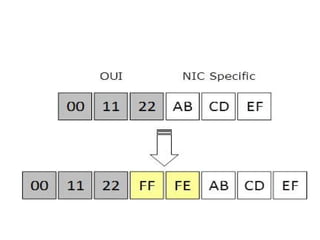
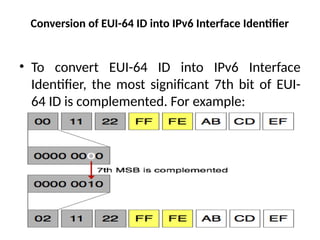
• First, a host divides its own MAC address into two 24-bits halves.
Then 16-bit Hex value 0xFFFE is sandwiched into those two halves
of MAC address, resulting in EUI-64 Interface ID.
Conversion of EUI-64 ID into IPv6 Interface Identifier
• To convert EUI-64 ID into IPv6 Interface
Identifier, the most significant 7th bit of EUI-
64 ID is complemented. For example:
Global Unicast Address
• This address type is equivalent to IPv4’s public address.
Global Unicast addresses in IPv6 are globally identifiable and
uniquely addressable.
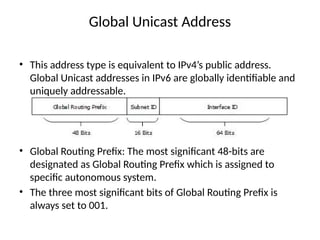
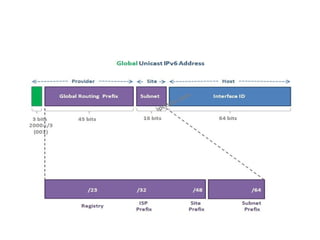
• Global Routing Prefix: The most significant 48-bits are
designated as Global Routing Prefix which is assigned to
specific autonomous system.
• The three most significant bits of Global Routing Prefix is
always set to 001.
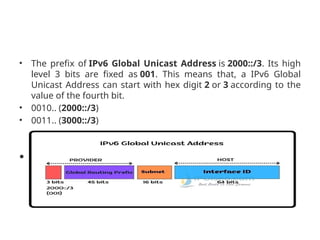
• The prefix of IPv6 Global Unicast Address is 2000::/3. Its high
level 3 bits are fixed as 001. This means that, a IPv6 Global
Unicast Address can start with hex digit 2 or 3 according to the
value of the fourth bit.
• 0010.. (2000::/3)
• 0011.. (3000::/3)
•
Link-Local Address
• IPv6 Link-Local Address is the local
address assigned only in a single subnet. They are
automatically assigned to the interfaces.
• IPv6 Link-Local Addresses are only used on
the same link.
• These addresses are not routable on Internet. They
are only used for neighbor discovery and next hop
configuration.
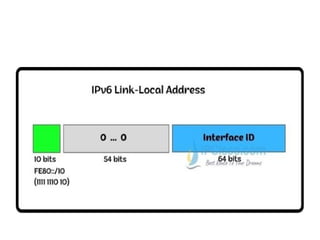
• The prefix of IPv6 Link-Local Address is FE80::/10.
• Its high level 10 bits are fixed as 1111 1110 10.
• The remaining 54 bits of network part is full of 0s.
Unique-Local Address
• IPv6 Unique Local Addresses are like IPv4 Private
addresses. They are used on local networks.
• They are not routable addresses on Interent. But with
IPv6 NAT you can use Unique Local IPv6 Address on
Internet.
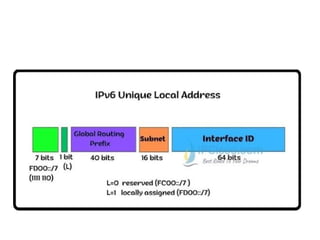
• The prefix of IPv6 Unique Local Address is FC00::/7. Its
high level 7 bits are fixed as 1111 110.
• This means that, a IPv6 Unique Local Address can start
with hex digit FC or FD according to the value of the
eight, L bit.
• FC00::/7 -> L=0 Reserved
• FD00::/7 -> L=1 Locally assigned
Anycast Addresses
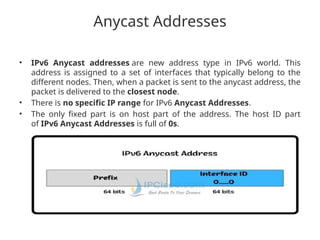
• IPv6 Anycast addresses are new address type in IPv6 world. This
address is assigned to a set of interfaces that typically belong to the
different nodes. Then, when a packet is sent to the anycast address, the
packet is delivered to the closest node.
• There is no specific IP range for IPv6 Anycast Addresses.
• The only fixed part is on host part of the address. The host ID part
of IPv6 Anycast Addresses is full of 0s.
IPv6 Multicast Addresses
• Like IPv4, there are also multicast addresses in IPv6. As you
know, a multicast address represents a group of interfaces or
devices.
• When a traffic sent to an IPv6 Multicast Address, multiple
devices and interfaces in the same group receive the same traffic.
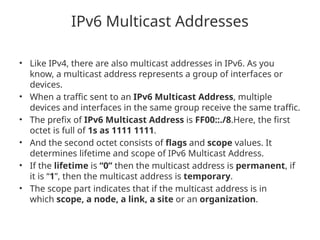
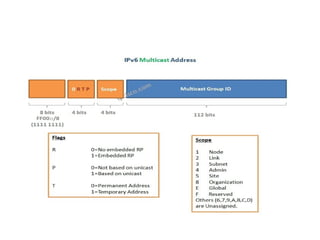
• The prefix of IPv6 Multicast Address is FF00::./8.Here, the first
octet is full of 1s as 1111 1111.
• And the second octet consists of flags and scope values. It
determines lifetime and scope of IPv6 Multicast Address.
• If the lifetime is “0” then the multicast address is permanent, if
it is “1”, then the multicast address is temporary.
• The scope part indicates that if the multicast address is in
which scope, a node, a link, a site or an organization.
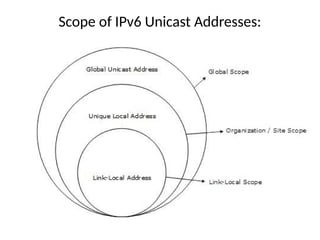
Scope of IPv6 Unicast Addresses:
Special IPv6 Addresses
• 0:0:0:0:0:0:0:0/0
• 0:0:0:0:0:0:0:0/128
• 0:0:0:0:0:0:0:1/128
•
• 0:0:0:0:0:0:0:0/0 : The abbreviation of this address is ::/0. It is used to while
defining a Default Route. The IPv4 equivalent of this special address is 0.0.0.0.
• 0:0:0:0:0:0:0:0/128 : The abbreviation of this address is ::/128. It is named
as Unspecified Address. And it is assigned to a host when it resolves its IPv6
link local address.
• 0:0:0:0:0:0:0:1/128: The abbreviation of this address is ::1/128. It is the Loopback
Address of local host. The IPv4 equivalent of this special address is 127.0.0.1.
Key benefits to IPv6 include:
• No more NAT (Network Address Translation)
• Auto-configuration
• No more private address collisions
• Better multicast routing
• Simpler header format
• Simplified, more efficient routing
• True quality of service (QoS), also called "flow labeling"
• Built-in authentication and privacy support
• Flexible options and extensions
• Easier administration (no more DHCP)

# Expense-Management-System-React-JS-Pro

  • 1.
  • 2.
  • 4.
    Address Structure • AnIPv6 address is made of 128 bits divided into eight 16-bits blocks. Each block is then converted into 4-digit Hexadecimal numbers separated by colon symbols. • For example, given below is a 128 bit IPv6 address represented in binary format and divided into eight 16-bits blocks: • 0010000000000001 0000000000000000 0011001000111000 1101111111100001 0000000001100011 0000000000000000 0000000000000000 1111111011111011 • Each block is then converted into Hexadecimal and separated by ‘:’ symbol: • 2001:0000:3238:DFE1:0063:0000:0000:FEFB
  • 5.
    Rules: • Even afterconverting into Hexadecimal format, IPv6 address remains long. IPv6 provides some rules to shorten the address. The rules are as follows: • Rule.1: Discard leading Zero(es): • In Block 5, 0063, the leading two 0s can be omitted, such as (5th block): • 2001:0000:3238:DFE1:63:0000:0000:FEFB
  • 6.
    • Rule.2: Iftwo of more blocks contain consecutive zeroes, omit • them all and replace with double colon sign ::, such as (6th and 7th block): • 2001:0000:3238:DFE1:63::FEFB • Consecutive blocks of zeroes can be replaced only once by :: so if there are still blocks of zeroes in the address, they can be shrunk down to a single zero, such as (2nd block): • 2001:0:3238:DFE1:63::FEFB
  • 7.
    Interface ID • IPv6has three different types of Unicast Address scheme. • The second half of the address (last 64 bits) is always used for Interface ID. • The MAC address of a system is composed of 48-bits and represented in Hexadecimal. • MAC addresses are considered to be uniquely assigned worldwide. • Interface ID takes advantage of this uniqueness of MAC addresses. A host can auto-configure its Interface ID by using IEEE’s Extended Unique Identifier (EUI-64) format. • First, a host divides its own MAC address into two 24-bits halves. Then 16-bit Hex value 0xFFFE is sandwiched into those two halves of MAC address, resulting in EUI-64 Interface ID.
  • 9.
    Conversion of EUI-64ID into IPv6 Interface Identifier • To convert EUI-64 ID into IPv6 Interface Identifier, the most significant 7th bit of EUI- 64 ID is complemented. For example:
  • 10.
    Global Unicast Address •This address type is equivalent to IPv4’s public address. Global Unicast addresses in IPv6 are globally identifiable and uniquely addressable. • Global Routing Prefix: The most significant 48-bits are designated as Global Routing Prefix which is assigned to specific autonomous system. • The three most significant bits of Global Routing Prefix is always set to 001.
  • 11.
    • The prefixof IPv6 Global Unicast Address is 2000::/3. Its high level 3 bits are fixed as 001. This means that, a IPv6 Global Unicast Address can start with hex digit 2 or 3 according to the value of the fourth bit. • 0010.. (2000::/3) • 0011.. (3000::/3) •
  • 13.
    Link-Local Address • IPv6Link-Local Address is the local address assigned only in a single subnet. They are automatically assigned to the interfaces. • IPv6 Link-Local Addresses are only used on the same link. • These addresses are not routable on Internet. They are only used for neighbor discovery and next hop configuration. • The prefix of IPv6 Link-Local Address is FE80::/10. • Its high level 10 bits are fixed as 1111 1110 10. • The remaining 54 bits of network part is full of 0s.
  • 15.
    Unique-Local Address • IPv6Unique Local Addresses are like IPv4 Private addresses. They are used on local networks. • They are not routable addresses on Interent. But with IPv6 NAT you can use Unique Local IPv6 Address on Internet. • The prefix of IPv6 Unique Local Address is FC00::/7. Its high level 7 bits are fixed as 1111 110. • This means that, a IPv6 Unique Local Address can start with hex digit FC or FD according to the value of the eight, L bit. • FC00::/7 -> L=0 Reserved • FD00::/7 -> L=1 Locally assigned
  • 17.
    Anycast Addresses • IPv6Anycast addresses are new address type in IPv6 world. This address is assigned to a set of interfaces that typically belong to the different nodes. Then, when a packet is sent to the anycast address, the packet is delivered to the closest node. • There is no specific IP range for IPv6 Anycast Addresses. • The only fixed part is on host part of the address. The host ID part of IPv6 Anycast Addresses is full of 0s.
  • 18.
    IPv6 Multicast Addresses •Like IPv4, there are also multicast addresses in IPv6. As you know, a multicast address represents a group of interfaces or devices. • When a traffic sent to an IPv6 Multicast Address, multiple devices and interfaces in the same group receive the same traffic. • The prefix of IPv6 Multicast Address is FF00::./8.Here, the first octet is full of 1s as 1111 1111. • And the second octet consists of flags and scope values. It determines lifetime and scope of IPv6 Multicast Address. • If the lifetime is “0” then the multicast address is permanent, if it is “1”, then the multicast address is temporary. • The scope part indicates that if the multicast address is in which scope, a node, a link, a site or an organization.
  • 20.
    Scope of IPv6Unicast Addresses:
  • 21.
    Special IPv6 Addresses •0:0:0:0:0:0:0:0/0 • 0:0:0:0:0:0:0:0/128 • 0:0:0:0:0:0:0:1/128 • • 0:0:0:0:0:0:0:0/0 : The abbreviation of this address is ::/0. It is used to while defining a Default Route. The IPv4 equivalent of this special address is 0.0.0.0. • 0:0:0:0:0:0:0:0/128 : The abbreviation of this address is ::/128. It is named as Unspecified Address. And it is assigned to a host when it resolves its IPv6 link local address. • 0:0:0:0:0:0:0:1/128: The abbreviation of this address is ::1/128. It is the Loopback Address of local host. The IPv4 equivalent of this special address is 127.0.0.1.
  • 22.
    Key benefits toIPv6 include: • No more NAT (Network Address Translation) • Auto-configuration • No more private address collisions • Better multicast routing • Simpler header format • Simplified, more efficient routing • True quality of service (QoS), also called "flow labeling" • Built-in authentication and privacy support • Flexible options and extensions • Easier administration (no more DHCP)