IP Addressing
University of Education Lecture Roadmap In the Following Lectures we Learn about the Internet Addressing Class full IP Addressing Classes and Blocks Masking
University of Education IP Addressing IANA (Internet Assigned Numbers Authority) is responsible for global coordination of the Internet Protocol addressing systems. Currently there are two types of Internet Protocol (IP) addresses in active use: IP version 4 (IPv4) and IP version 6 (IPv6) IPv4 was initially deployed on 1 January 1983 and is still the most commonly used version IPv4 addresses are 32-bit numbers often expressed as 4 octets in "dotted decimal" notation (for example,  192.0.2.53 )
University of Education IP Addressing v6 Deployment of the IPv6 protocol began in 1999.  IPv6 addresses are 128-bit numbers and are conventionally expressed using hexadecimal strings (for example,  2001:0db8:582:ae33::29 ).
University of Education An IPv4 address is a 32-bit address. Note : The IP addresses are unique  and universal. Internet Address
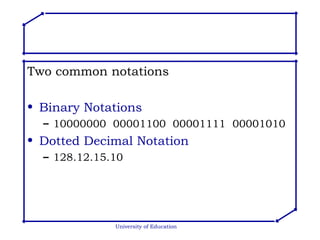
Two common notations Binary Notations 10000000  00001100  00001111  00001010 Dotted Decimal Notation 128.12.15.10 University of Education
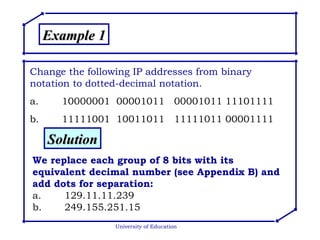
University of Education Example 1 Change the following IP addresses from binary notation to dotted-decimal notation. a. 10000001  00001011  00001011 11101111 b. 11111001  10011011  11111011 00001111 Solution We replace each group of 8 bits with its equivalent decimal number (see Appendix B) and add dots for separation: a. 129.11.11.239 b. 249.155.251.15
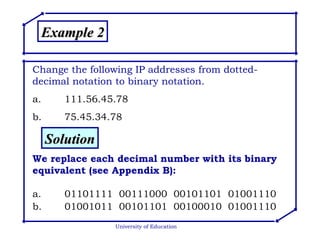
University of Education Example 2 Change the following IP addresses from dotted-decimal notation to binary notation. a. 111.56.45.78 b. 75.45.34.78 Solution We replace each decimal number with its binary equivalent (see Appendix B): a. 01101111  00111000  00101101  01001110 b. 01001011  00101101  00100010  01001110
University of Education In classful addressing, the address space is divided into five classes: A, B, C, D, and E. Note : Classful IP Addressing
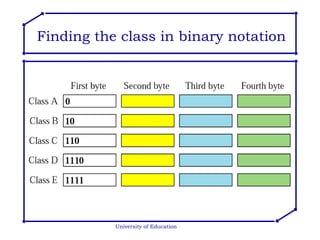
University of Education Finding the class in binary notation
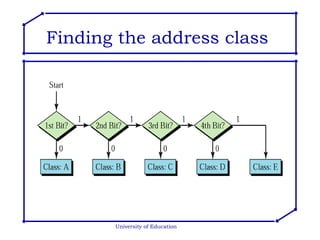
University of Education Finding the address class
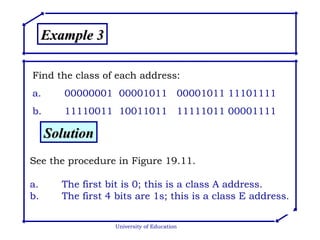
University of Education Example 3 Find the class of each address: a. 00000001  00001011  00001011 11101111 b. 11110011  10011011  11111011 00001111 Solution See the procedure in Figure 19.11.  a. The first bit is 0; this is a class A address. b. The first 4 bits are 1s; this is a class E address.
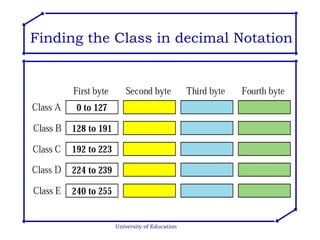
University of Education Finding the Class in decimal Notation
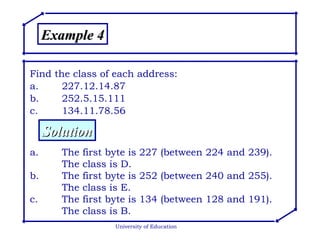
University of Education Example 4 Find the class of each address: a. 227.12.14.87 b. 252.5.15.111 c. 134.11.78.56 Solution a. The first byte is 227 (between 224 and 239). The class is D. b. The first byte is 252 (between 240 and 255).  The class is E. c. The first byte is 134 (between 128 and 191).  The class is B.
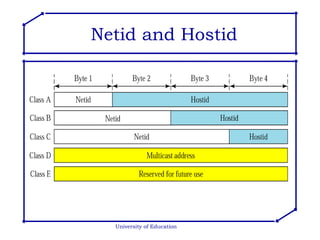
University of Education Netid and Hostid
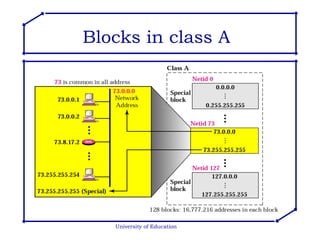
University of Education Blocks in class A
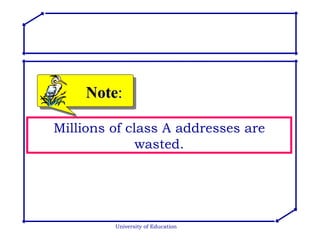
University of Education Millions of class A addresses are wasted. Note :
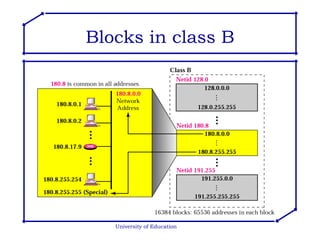
University of Education Blocks in class B
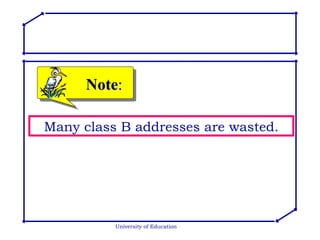
University of Education Many class B addresses are wasted. Note :
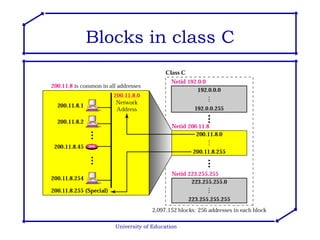
University of Education Blocks in class C
University of Education Note : The number of addresses in class C is smaller than the needs of most organizations.
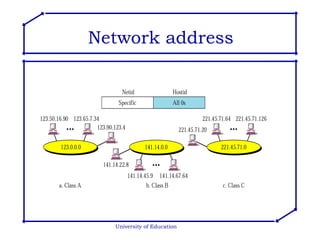
University of Education Network address
University of Education In classful addressing, the network address is the one that is assigned to the organization.   Note :
University of Education Example 5 Given the address 23.56.7.91, find the network address. Solution The class is A. Only the first byte defines the netid. We can find the network address by replacing the hostid bytes (56.7.91) with 0s. Therefore, the network address is 23.0.0.0.
University of Education Example 6 Given the address 132.6.17.85, find the network address. Solution The class is B. The first 2 bytes defines the netid. We can find the network address by replacing the hostid bytes (17.85) with 0s. Therefore, the network address is 132.6.0.0.
University of Education Example 7 Given the network address 17.0.0.0, find the class. Solution The class is A because the netid is only 1 byte.
University of Education A network address is different from a netid. A network address has both netid and hostid,  with 0s for the hostid. Note :
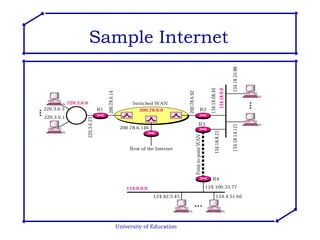
University of Education Sample Internet
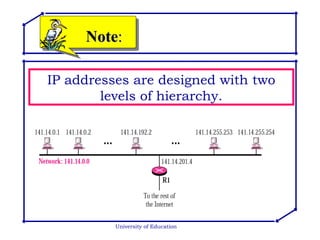
University of Education IP addresses are designed with two levels of hierarchy. Note :
Mask Default Mask Subnet Mask University of Education
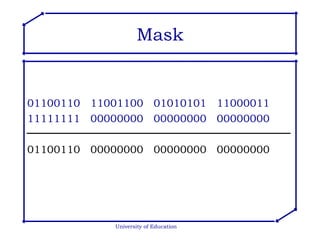
Mask 01100110  11001100  01010101  11000011 11111111  00000000  00000000  00000000 01100110  00000000  00000000  00000000 University of Education
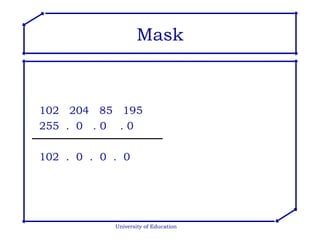
Mask 102  204  85  195 255  .  0  . 0  . 0 102  .  0  .  0  .  0 University of Education
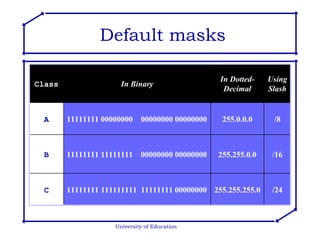
University of Education Default masks Class In Binary In Dotted-Decimal Using Slash A 11111111 00000000  00000000 00000000 255.0.0.0 /8 B 11111111 11111111  00000000 00000000 255.255.0.0 /16 C 11111111 111111111  11111111 00000000 255.255.255.0 /24

IP addressing

  • 1.
  • 2.
    University of EducationLecture Roadmap In the Following Lectures we Learn about the Internet Addressing Class full IP Addressing Classes and Blocks Masking
  • 3.
    University of EducationIP Addressing IANA (Internet Assigned Numbers Authority) is responsible for global coordination of the Internet Protocol addressing systems. Currently there are two types of Internet Protocol (IP) addresses in active use: IP version 4 (IPv4) and IP version 6 (IPv6) IPv4 was initially deployed on 1 January 1983 and is still the most commonly used version IPv4 addresses are 32-bit numbers often expressed as 4 octets in "dotted decimal" notation (for example, 192.0.2.53 )
  • 4.
    University of EducationIP Addressing v6 Deployment of the IPv6 protocol began in 1999. IPv6 addresses are 128-bit numbers and are conventionally expressed using hexadecimal strings (for example, 2001:0db8:582:ae33::29 ).
  • 5.
    University of EducationAn IPv4 address is a 32-bit address. Note : The IP addresses are unique and universal. Internet Address
  • 6.
    Two common notationsBinary Notations 10000000 00001100 00001111 00001010 Dotted Decimal Notation 128.12.15.10 University of Education
  • 7.
    University of EducationExample 1 Change the following IP addresses from binary notation to dotted-decimal notation. a. 10000001 00001011 00001011 11101111 b. 11111001 10011011 11111011 00001111 Solution We replace each group of 8 bits with its equivalent decimal number (see Appendix B) and add dots for separation: a. 129.11.11.239 b. 249.155.251.15
  • 8.
    University of EducationExample 2 Change the following IP addresses from dotted-decimal notation to binary notation. a. 111.56.45.78 b. 75.45.34.78 Solution We replace each decimal number with its binary equivalent (see Appendix B): a. 01101111 00111000 00101101 01001110 b. 01001011 00101101 00100010 01001110
  • 9.
    University of EducationIn classful addressing, the address space is divided into five classes: A, B, C, D, and E. Note : Classful IP Addressing
  • 10.
    University of EducationFinding the class in binary notation
  • 11.
    University of EducationFinding the address class
  • 12.
    University of EducationExample 3 Find the class of each address: a. 00000001 00001011 00001011 11101111 b. 11110011 10011011 11111011 00001111 Solution See the procedure in Figure 19.11. a. The first bit is 0; this is a class A address. b. The first 4 bits are 1s; this is a class E address.
  • 13.
    University of EducationFinding the Class in decimal Notation
  • 14.
    University of EducationExample 4 Find the class of each address: a. 227.12.14.87 b. 252.5.15.111 c. 134.11.78.56 Solution a. The first byte is 227 (between 224 and 239). The class is D. b. The first byte is 252 (between 240 and 255). The class is E. c. The first byte is 134 (between 128 and 191). The class is B.
  • 15.
    University of EducationNetid and Hostid
  • 16.
    University of EducationBlocks in class A
  • 17.
    University of EducationMillions of class A addresses are wasted. Note :
  • 18.
    University of EducationBlocks in class B
  • 19.
    University of EducationMany class B addresses are wasted. Note :
  • 20.
    University of EducationBlocks in class C
  • 21.
    University of EducationNote : The number of addresses in class C is smaller than the needs of most organizations.
  • 22.
    University of EducationNetwork address
  • 23.
    University of EducationIn classful addressing, the network address is the one that is assigned to the organization. Note :
  • 24.
    University of EducationExample 5 Given the address 23.56.7.91, find the network address. Solution The class is A. Only the first byte defines the netid. We can find the network address by replacing the hostid bytes (56.7.91) with 0s. Therefore, the network address is 23.0.0.0.
  • 25.
    University of EducationExample 6 Given the address 132.6.17.85, find the network address. Solution The class is B. The first 2 bytes defines the netid. We can find the network address by replacing the hostid bytes (17.85) with 0s. Therefore, the network address is 132.6.0.0.
  • 26.
    University of EducationExample 7 Given the network address 17.0.0.0, find the class. Solution The class is A because the netid is only 1 byte.
  • 27.
    University of EducationA network address is different from a netid. A network address has both netid and hostid, with 0s for the hostid. Note :
  • 28.
    University of EducationSample Internet
  • 29.
    University of EducationIP addresses are designed with two levels of hierarchy. Note :
  • 30.
    Mask Default MaskSubnet Mask University of Education
  • 31.
    Mask 01100110 11001100 01010101 11000011 11111111 00000000 00000000 00000000 01100110 00000000 00000000 00000000 University of Education
  • 32.
    Mask 102 204 85 195 255 . 0 . 0 . 0 102 . 0 . 0 . 0 University of Education
  • 33.
    University of EducationDefault masks Class In Binary In Dotted-Decimal Using Slash A 11111111 00000000 00000000 00000000 255.0.0.0 /8 B 11111111 11111111 00000000 00000000 255.255.0.0 /16 C 11111111 111111111 11111111 00000000 255.255.255.0 /24